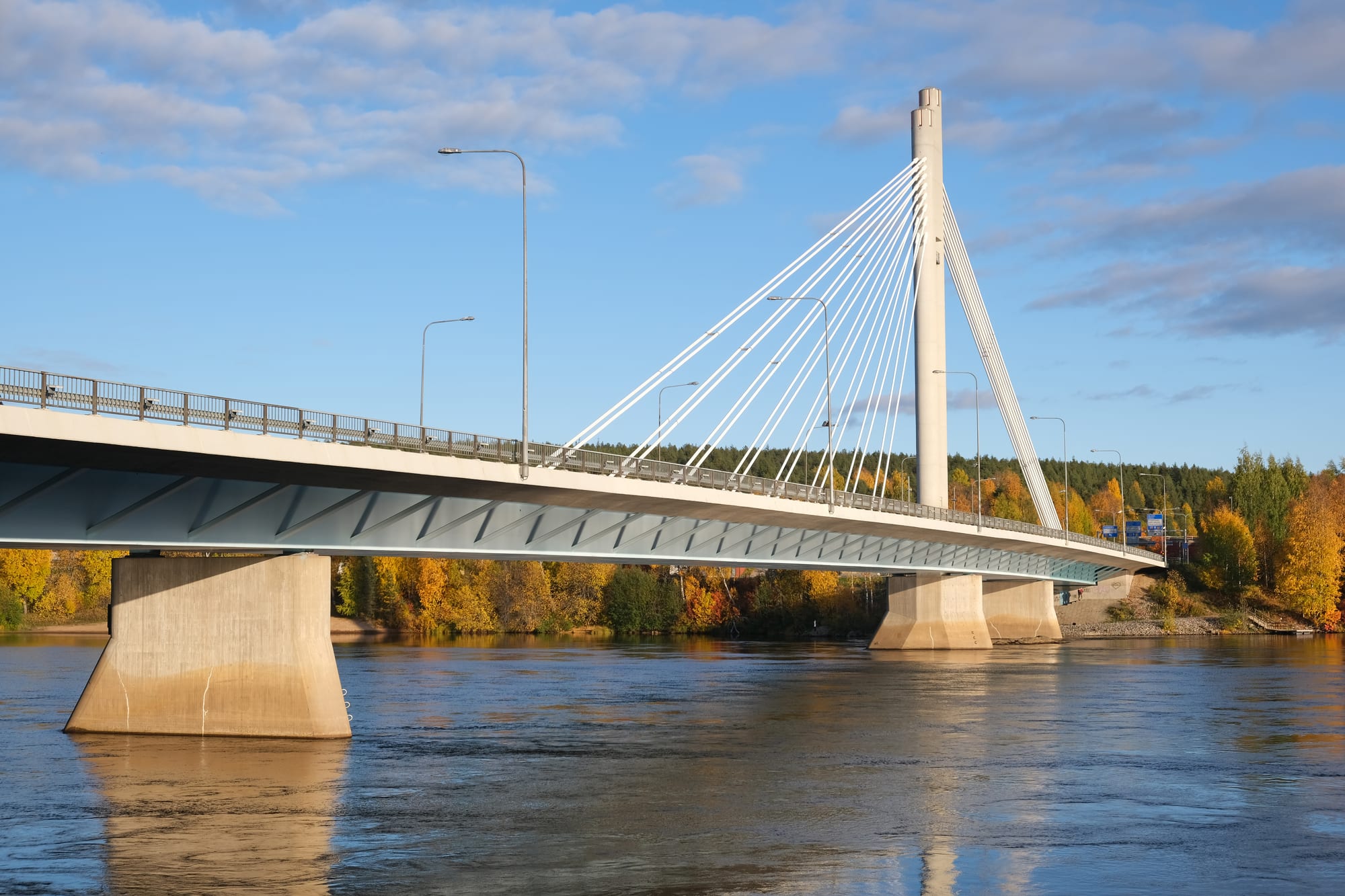
A bridge with a tall pylon crossing a wide river in Rovaniemi, with autumn forest behind

Lapland & the North, Finland

Rovaniemi

The Jätkänkynttilä bridge over the Kemijoki in Rovaniemi in autumn. (kallerna / Wikimedia Commons · CC BY-SA 4.0)

The capital of Finnish Lapland, where the Ounasjoki meets the Kemijoki just south of the Arctic Circle. A logging and trading centre almost wholly burned in the Lapland War of 1944, it was rebuilt to a plan by Alvar Aalto. Today it is a university and government city and one of Finland's busiest tourist destinations, home of Santa Claus Village and the Arktikum.

Neighbourhoods

  • City centre
    • First-time visitors
    • Close to public transport
    • Food and nightlife

    The compact centre rebuilt after 1944, between the hills of Ounasvaara and Korkalovaara at the meeting of two rivers. Koskikatu and the streets around Lordi's Square hold the shopping centres, restaurants and bars; Aalto's civic buildings, the Arktikum and the riverside paths are a short walk away.

    Open in Maps
  • Ounasvaara
    • Outdoor recreation
    • Skiing
    • Views

    The large forested hill directly across the Kemijoki from the centre, a hub for outdoor sport since the 1920s, with ski slopes, cross-country tracks, nature trails and a summer beach by the river. The Kiiruna district on its slope was built after the war with money from Sweden.

    Open in Maps
  • The Arctic Circle
    • Families
    • Christmas
    • Winter activities

    The area around Santa Claus Village, about 8 km north of the centre near the airport, where the Arctic Circle is marked. Souvenir shops, restaurants and the bases of many safari companies cluster here, and SantaPark lies a short walk away.

    Open in Maps
  • Saarenkylä
    • Quiet and residential
    • Local life

    A large suburb on the far side of the Kemijoki, linked to the centre by bridges, with hypermarkets and homes, between the city and the Arctic Circle.

    Open in Maps

Things to do

Landmarks and Aalto's Rovaniemi

  • Lappia Halllandmark

    Aalto's theatre, concert and conference building, finished in phases between 1961 and 1975, whose wavy roofline recalls the Lapland fells; it houses the Rovaniemi Theatre.

    Open in Maps
  • Rovaniemi Librarylandmark

    The Aalto-designed main library of 1965, part of the protected Aalto Centre with Lappia Hall and the city hall.

    Open in Maps
  • Rovaniemi city halllandmark

    Completed in 1986 after Aalto's death, fronted by Kain Tapper's 120-metre stone sculpture The Birth of Mountains, which symbolises the town's rebirth after the Lapland War.

    Open in Maps
  • Rovaniemi Churchlandmark

    The 850-seat church of 1950 that replaced the one burned in 1944, with a 14-metre altar fresco, The Source of Life, by Lennart Segerstråle that sets biblical scenes in a Lapland landscape.

    Open in Maps
  • Jätkänkynttilä bridgelandmark

    The 1989 bridge over the Kemijoki, whose tall pylon carries a light known as the eternal flame — one of the symbols of the city.

    Open in Maps
  • Lordi's Squarelandmark

    The central square renamed in 2006 after the hard-rock band Lordi won the Eurovision Song Contest, now a venue for summer events.

    Open in Maps

Museums and culture

  • Arktikummuseum

    A museum and science centre opened in 1992 on the bank of the Ounasjoki, combining the Arctic Centre's science exhibitions with the regional museum of Lapland, including Sámi culture and the city's history.

    Open in Maps
  • Arctic Arboretumpark

    A seven-hectare riverside garden of northern trees and plants behind the Arktikum, free to visit, lit by the midnight sun in summer.

    Open in Maps
  • Korundi House of Culturemuseum

    An old postal bus depot reopened in 2011 as an arts centre, with an art museum of mainly modern Finnish art and the home of the Chamber Orchestra of Lapland.

    Open in Maps

The Arctic Circle

  • Santa Claus Villageattraction

    The Christmas park opened in 1980, where a painted line marks the Arctic Circle and visitors meet Santa Claus and send mail from his post office.

    Open in Maps
  • SantaParkattraction

    An underground Christmas theme park opened in 1998, within walking distance of Santa Claus Village.

    Open in Maps

The outdoors

  • Ounasvaarapark

    The hill across the river, with downhill slopes, cross-country ski tracks, a winter walking trail and summer nature trails where reindeer are often seen.

    Open in Maps
  • Kirkkolampi Arboretumpark

    A park around a pond next to the Lutheran church, planted with more than 250 species of subarctic trees and perennials.

    Open in Maps
  • Lappi Areenaattraction

    The 2003 indoor arena, home of the RoKi ice hockey team, also used for concerts and trade fairs.

    Open in Maps

Short trips from the city

  • German Military Cemeterylandmark

    A stone memorial cemetery on Lake Norvajärvi, inaugurated in 1963, where 2,530 German soldiers who died in Lapland and Oulu during the Second World War are buried.

    Open in Maps
  • Ranua Wildlife Parkattraction

    Finland's northernmost zoo, opened in 1983, with about 50 Arctic species including brown bears, wolves, lynx and the country's only polar bears.

    Open in Maps

Seasonal events

  • Christmas seasonDecember

    The busiest time of the year, when charter 'Santa flights' fill the airport and visitors crowd Santa Claus Village in the short midwinter daylight.

  • Rovaniemi Old Market Fairmid-August

    A weekend old-style market on the Old Market Square near the Jätkänkynttilä bridge, selling local products and delicacies, continuing a market tradition dating from the 1880s.

Eat and drink

Long-standing places and food districts in Rovaniemi. Hours, ratings and directions come from your maps app, always current.

Lapland classics

  • Reindeer in the city centreneighborhood

    Restaurants around Koskikatu and Lordi's Square serve poronkäristys, thinly sliced sautéed reindeer with mashed potato and lingonberries.

    Open in Maps
  • Local delicacies at Rinteenkulmamarket

    The supermarket in the Rinteenkulma shopping centre stocks a wide range of local delicacies, including reindeer meat products.

    Open in Maps

Markets and cafés

  • Market Squaremarket

    The old market square, where berries are sold in summer and Christmas trees before Christmas.

    Open in Maps
  • Arktikum cafécafe

    The museum's café and lunch restaurant on the riverbank.

    Open in Maps

Experience Rovaniemi

History

People have lived around the river junction since the Stone Age, and the name is often traced to the Sámi word roavve, a forested ridge or the site of an old forest fire, joined to the Finnish niemi, cape. Rovaniemi is first named in documents in 1453, as a group of small villages living from farming and cattle, with fishing and hunting on the side. In the 19th century logging camps and a gold rush brought thousands of people to Lapland, and Rovaniemi became the business centre of the province; its market fairs began in the 1880s, and the railway from the south arrived in 1909. It became a market town in 1929.

The Second World War destroyed it. After Finland made peace with the Soviet Union in September 1944 it had to expel its former German allies, and in the Lapland War the retreating German army burned the town. In October 1944 an ammunition train exploded at the station and set the wooden houses alight, and about 90 per cent of the buildings were destroyed, including the church of 1817.

Alvar Aalto helped plan the rebuilding, laying out the main roads in the shape of a reindeer's head and antlers, with the sports stadium as its eye; he later designed the library, Lappia Hall and the city hall. Rovaniemi became a city in 1960 and merged with its surrounding rural municipality in 2006. Santa Claus Village opened in 1980, the Arktikum in 1992 and SantaPark in 1998, and tourism has grown into one of the city's main industries.

Culture & Customs

Rovaniemi presents itself as the official home town of Santa Claus, a slogan the city registered as a trademark in 2009, and Christmas tourism shapes its image abroad. Its everyday culture is that of a regional capital: the Rovaniemi Theatre in Aalto's Lappia Hall, the Chamber Orchestra of Lapland at the Korundi arts centre, the Arktikum's exhibitions on the Arctic and the Sámi, and two universities that give the city the feel of a student town.

Music has given the city an unusual landmark. After the masked hard-rock band Lordi won the Eurovision Song Contest in 2006, the central square was renamed Lordi's Square, and the band members were made honorary citizens. The 1951 musical comedy At the Rovaniemi Fair, with its gold-mining plot, has been described as a reformer of Finnish film entertainment.

Winter sport runs deep. Ounasvaara has hosted outdoor sport since 1927, and Rovaniemi has staged the 1984 Nordic World Ski Championships and, in 2021, the first World Rally Championship event inside the Arctic Circle. RoKi plays ice hockey at the Lappi Areena. Religious life includes an active Conservative Laestadian movement, part of the Lutheran church.

Daily Life

About 66,000 people live in the municipality, the 17th most populous in Finland, and about 53,000 in the urban area; since the 2006 merger the city covers a vast area of forest, rivers and villages, some almost a hundred kilometres from the centre. About 6 per cent of residents had a migrant background in 2024, below the national average.

As the capital of Lapland, Rovaniemi hosts many government offices, and the University of Lapland and Lapland University of Applied Sciences have about 10,000 students between them. The Finnish Air Force's Lapland Air Command is based at the airport. Tourism is an important industry: the city recorded more than 481,000 visitors in 2013, and the airport's busiest time is the Christmas season. The growth has also brought overtourism, which some locals resent.

Life follows the extreme seasons. In winter daylight is short and snow lies for months; around midsummer the sun does not set. Most households have a car, as buses are sparse outside the centre, and the local newspaper is Lapin Kansa. Ounasvaara's tracks and trails, across the river from the centre, are where residents ski, walk and run.

Food

The north eats from the forest, the fells and the rivers. The signature dish is poronkäristys, sautéed reindeer: thinly sliced reindeer meat, usually from the steak or the back, fried in fat and served with mashed potato and lingonberries. Lapland reindeer meat, Lapin poron liha, has protected designation of origin status in the EU, and smoked and dried reindeer are sliced thin as snacks.

Rivers and lakes supply Arctic char, whitefish, grayling and salmon, often salted, smoked or grilled. Cloudberries from the northern bogs are eaten with leipäjuusto, the baked squeaky bread cheese, or made into jam and liqueur, and the cheese may also be dropped into a cup of coffee. Lingonberries and bilberries are picked everywhere.

In the city, the market square sells berries in summer, the mid-August Old Market Fair brings local products and delicacies, and supermarkets in the centre stock reindeer products to take home. The centre's restaurants serve Lapland dishes, and coffee, drunk strong and often, keeps the long winter going.

Planning tools

Budget

Rovaniemi is expensive in winter. Hotels and cabins peak around Christmas and in February and March, and husky, reindeer and snowmobile safaris and aurora tours cost a great deal per person. Summer and autumn are much cheaper, and much of the outdoors — Ounasvaara's trails, the riverside arboretums — costs nothing.

Daily Budget Midrange
USD 210–460 (hotel or cabin, restaurant meals, one guided winter activity a day)
Daily Budget Shoestring
USD 80–140 (hostel or shared cabin, self-catering, local buses, free hiking)

Book Christmas and New Year months ahead, use only recommended taxi services in peak season, and compare self-guided skiing and walking with costly safari packages.

Best Time to Visit

December for the Christmas atmosphere and short midwinter days; late February to early April for snow, skiing and the aurora with longer days. The midnight sun shines from early June to early July, and late August and September bring hiking weather, autumn colour and the return of dark aurora nights.

Suggested Number of Days

Two or three days cover the centre, the museums and the Arctic Circle. Four or five allow for guided winter activities and trips into the surrounding forests. Short winter days and weather-dependent aurora watching are reasons to allow extra time.

First Visit
2–3 days
With Surroundings
4–5 days

Transportation

The centre is compact and best seen on foot. Local buses, with a white reindeer on their blue-green livery, run more often on school-year weekdays than at weekends or in summer; one line serves Santa Claus Village. Some sights lie well outside the centre and buses are sparse, so many visitors rent a car with winter tyres or use organised transfers.

In peak season use the city's recommended taxi services, and allow extra time for driving on dark, icy winter roads.

Airport & Station Connections

Rovaniemi Airport, about 10 km north of the centre, is the second-busiest airport in Finland, with flights from Helsinki, international routes and many winter charters; the Arctic Circle crosses its runway. Trains, including overnight sleepers that can carry cars, run from Helsinki, Tampere and Turku, taking 9–12 hours from Helsinki. The station is within walking distance of the centre, and long-distance coaches stop there.

Walkability

Good in the centre: the shopping streets, Aalto buildings, Arktikum and riverside paths are all close together, and a footpath runs along the river. Ounasvaara is reachable on foot across the bridges, but the Arctic Circle, about 8 km away, needs a bus or car. Pavements are snowy and icy for much of the year.

Safety

Finland is consistently rated one of the safest countries in the world, with very low crime. Around Rovaniemi the environment is the serious hazard: extreme cold, short daylight, thin river ice, reindeer on the roads and snowmobile accidents. Summer brings mosquitoes and fast rivers.

Dress in layers for the cold, follow guides on snowmobiles, keep off river ice and watch for reindeer on the road. Check current official travel advice before travelling.

Climate

Subarctic, with short, pleasant summers and long, cold, snowy winters; the average annual temperature is 0.9°C and snow lies for about 175 days a year. The midnight sun is above the horizon from 7 June to 6 July, while in December the city averages just under six minutes of sunshine a day.

Summer
short and pleasant, with the midnight sun from 7 June to 6 July; the record high is 32.2°C, set on 18 July 2018
Winter
long, cold and snowy, with snow on the ground about 175 days a year; the airport's record low is -38.1°C

Local Customs

Rovaniemi is Finnish-speaking, with a small Sámi-speaking community; English is widely used in tourism. Tipping is optional and never necessary. The Conservative Laestadian revival movement is active locally. Some residents feel the strain of mass tourism.

Bars and restaurants serve alcohol to over-18s; stronger drinks for home are sold only in the state Alko shops. Never walk on ski tracks, and ask before photographing people in traditional dress.

Common Payment Methods

The currency is the euro. Cards and phone payments are accepted almost everywhere, including at the airport and in shopping centres, and ATMs are easy to find. Small rural sellers may take only cash.