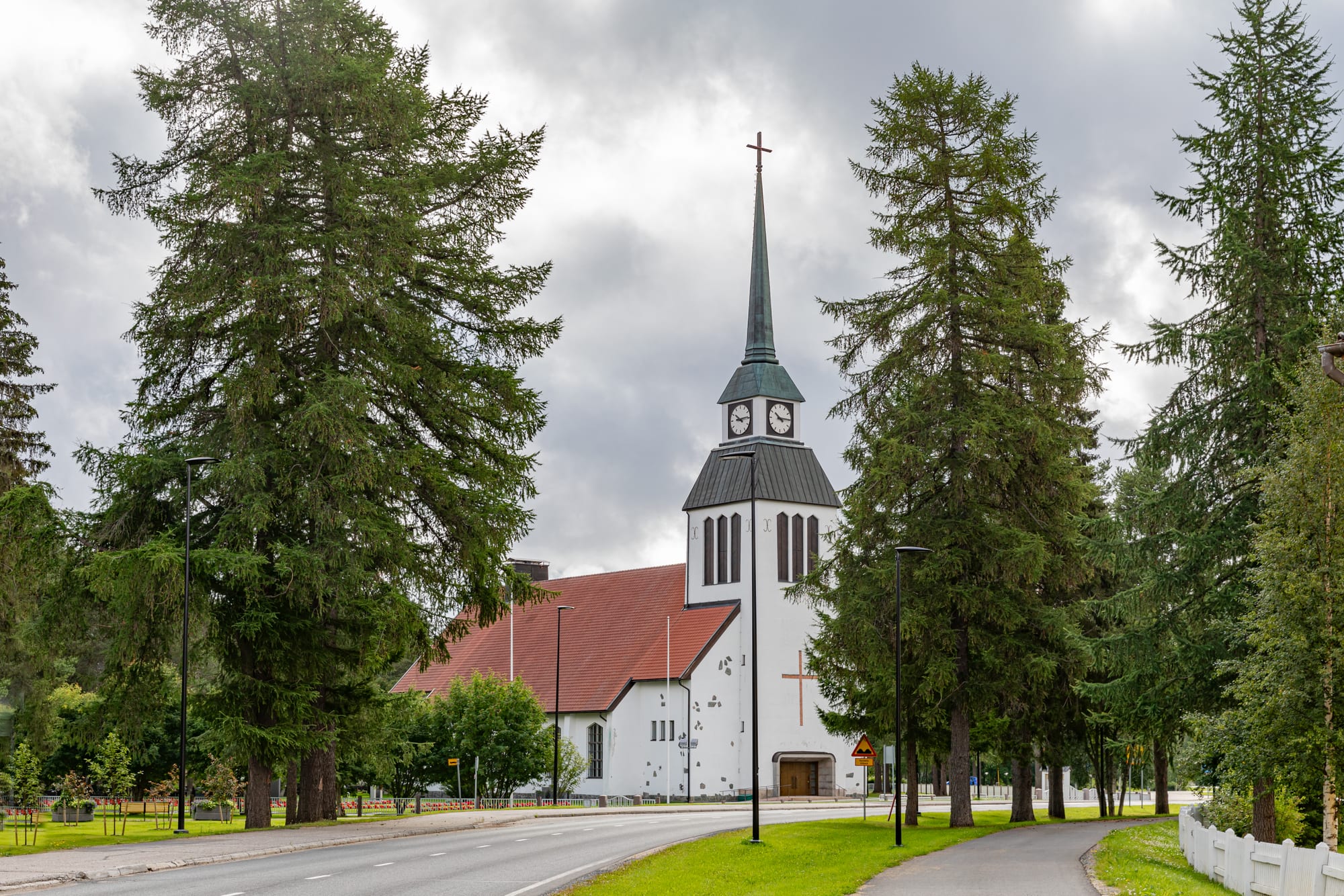
A white church with a tall green spire and red roof beside a road lined with tall spruces and larches in summer

Lapland & the North, Finland

Kuusamo

The Holy Cross Church in the centre of Kuusamo, rebuilt after the Second World War. (Ninara / Wikimedia Commons · CC BY 2.0)

A small town on the Koillismaa highlands of north-eastern Finland, near the Russian border, at the centre of a vast municipality of forests, hills and lakes. Settled by Finnish farmers in the late 17th century and rebuilt after it was burned in 1944, it is now the gateway to the Ruka ski resort and to Oulanka National Park and the Karhunkierros trail.

Neighbourhoods

  • Kuusamo town centre
    • Local life
    • Services
    • Easy on foot

    The compact centre, rebuilt quickly and plainly after 1944, where nearly two-thirds of the municipality's people live. The church, the Kuusamo Hall, shops, the coach station and the visitor centre with its nature photography exhibitions are all within walking distance.

    Open in Maps
  • Ruka
    • Skiers
    • Nightlife
    • Hiking base

    The ski village about 20 km north of town on the slopes of Rukatunturi, with around 12,000 beds, hotels, restaurants, ski jumps and a World Cup stadium. It is also the southern end of the Karhunkierros trail and the main base for summer hiking and biking.

    Open in Maps

Things to do

In and around the town

  • Holy Cross Churchlandmark

    The town church, built in 1951 on the site of the wooden church of 1802 burned in 1944; its two bells of 1698 and 1721, buried by German soldiers during the war, were recovered in 1959 and hang here again.

    Open in Maps
  • Kuusamo Local History Museummuseum

    An open-air museum set up on a historic farm, with old farmhouses showing rural life in the north-east.

    Open in Maps
  • Kuusamo Hallattraction

    The convention and cultural centre in the town centre, completed in 1996, with concerts, theatre and changing art exhibitions.

    Open in Maps
  • Lake Kuusamojärvipark

    The large lake beside the town, part of the Kem River basin that drains east into the White Sea.

    Open in Maps

Short trips from the town

  • Ruka ski resortattraction

    A 492-metre fell with 41 slopes, a gondola, over 500 km of cross-country tracks and one of the longest ski seasons in Europe, usually from October into June.

    Open in Maps
  • Oulanka National Parkpark

    A national park of pine forest, river rapids, sandbanks and mires along the Oulankajoki, established in 1956 and bordering Russia's Paanajärvi National Park.

    Open in Maps
  • Karhunkierrostrail

    The Bear's Round, Finland's most popular hiking trail, first marked in 1955 and about 80 km long, running mostly through Oulanka National Park; the main season is mid-July to late September.

    Open in Maps
  • Julma-Ölkkypark

    The largest of Finland's three canyon lakes, between cliffs up to 50 metres high on the border with Suomussalmi.

    Open in Maps

Seasonal events

  • Ruka Nordiclate November

    The opening World Cup weekend of the ski-jumping and Nordic combined season, with cross-country World Cup races, held at Ruka since 2002; it drew nearly 30,000 spectators in 2024.

  • Nature photography festivalmid-September

    A nature photography festival in the town, fitting for a place where nature photography has its own centre.

Eat and drink

Long-standing places and food districts in Kuusamo. Hours, ratings and directions come from your maps app, always current.

Kuusamo classics

  • Restaurants in Kuusamo town centreneighborhood

    Lunch restaurants and cafés in the town centre serve everyday Finnish food, with reindeer from local herds often on the menu.

    Open in Maps
  • Ruka village restaurantsneighborhood

    Around 28 restaurants in the ski village, busiest in the winter season.

    Open in Maps

Experience Kuusamo

History

Until the 17th century the Kuusamo area was home to semi-nomadic Sámi, who wintered in villages at Maanselkä and Kitka, moved to the rivers and lakes for fishing in spring and summer, and hunted reindeer, bears and beavers in autumn, trading furs with Finns on the Gulf of Bothnia and Karelians on the White Sea. Sweden's rule was limited to collecting taxes, and Russia taxed the same land. In 1673 the Swedish crown offered settlers in Lapland fifteen years free of tax, and farmers from Savo and Kainuu moved in, clearing forest by slash-and-burn. Within a few decades the Sámi had been assimilated or pushed out, and by 1718 only two Sámi families remained.

The parish grew through the 18th century on farming, cattle and reindeer, though famine in 1803 and smallpox the following year cut its numbers. Forestry brought workers from the late 19th century, but independence in 1917 closed the Russian border and cut off the timber routes to the White Sea. In the Moscow Peace of 1940 Finland lost about 1,650 square kilometres of eastern Kuusamo, and its 2,100 people were resettled elsewhere in the municipality.

In autumn 1944 German troops retreating north through Kuusamo destroyed most of its settlements, largely by burning, and Soviet troops then briefly occupied the area; accounts differ over who burned the village itself. Kuusamo was rebuilt between 1945 and 1952. The first ski run on Rukatunturi opened in 1954, and the growth of Ruka turned the farming parish into a tourist centre; Kuusamo became a town in 2000.

Culture & Customs

Kuusamo is visited for its nature rather than its buildings: because the centre was destroyed in the war and rebuilt quickly and economically, it has little old architecture, but its cultural life is lively for a place its size. The Kuusamo Hall, opened in 1996, hosts concerts, theatre and exhibitions, and the town has a centre devoted to nature photography and an annual nature photography festival in September.

Winter sport gives Kuusamo an international profile. Ruka hosted the 2005 Freestyle Skiing World Championships, and since 2002 the Ruka Nordic weekend in late November has opened the World Cup season in ski jumping and Nordic combined, with cross-country races alongside. The ski stadium has a large jumping hill, lit trails and a biathlon range.

The people of Kuusamo speak an eastern Finnish dialect, unlike the western dialects of Lapland, because their ancestors came up the lake routes from Savo and Kainuu. The church bells carry a wartime story: hidden in the cemetery by German soldiers in 1944, they were thought lost until the former regimental commander returned in 1959 and showed where they lay. Reindeer herding and the summer cottage remain part of local life.

Daily Life

The municipality had about 14,800 inhabitants at the end of 2025, nearly two-thirds of them in the town itself, spread over almost 5,800 square kilometres of forest, hills and 166 lakes. The population peaked at nearly 21,000 in the late 1960s and has fallen since, as young people leave for the cities, and the population is ageing.

Tourism is now the largest industry, bringing around a million visitors a year and providing about 17 per cent of full-time jobs in 2024. Forestry and wood processing employ over 1,000 people, and dairy farming, small industry and reindeer husbandry — some 10,000 semi-domesticated reindeer graze the municipality — continue. Kuusamo has around 7,500 summer cottages, more than any other Finnish municipality, and holidaymakers from the cities are an important source of income.

Life follows the snow, which can cover the ground for up to 200 days a year. Winter means skiing, snowmobiles and short, dim days; summer brings anglers, canoeists and hikers to the rivers and the national park, and a brief spell of near-midnight sun. Without the railway, the car and the coach to Oulu are the links to the rest of Finland.

Food

Kuusamo's food comes from its forests, lakes and herds. Reindeer from the local herds is the signature meat, most often as poronkäristys, sautéed reindeer: the meat is sliced thinly while still frozen, fried in fat, seasoned with black pepper and salt, and simmered with a little water, cream or beer until tender, then served with mashed potato. Milk and meat production remain important on the local farms.

Leipäjuusto, the fresh "bread cheese" with a squeaky texture traditionally made from cow's colostrum, comes originally from Southern Ostrobothnia, Northern Finland and Kainuu, and is often served with cloudberry jam and coffee. Lohikeitto, salmon soup with cream, is one of the most popular salmon dishes in Finland, and in summer Kuusamo is a popular destination for fishing.

Berries are gathered everywhere: bilberries and lingonberries grow in almost every part of Finland, while cloudberries, lakka, grow in more limited areas. Restaurants in the town and at Ruka serve these northern flavours alongside everyday Finnish lunches.

Planning tools

Budget

The town itself is priced like other small Finnish towns, but Ruka is expensive in winter, especially around Christmas and in the February and Easter holidays, when lift passes, rented cabins and safaris add up. Summer is quieter and cheaper, and hiking in the national park costs little: the trails and open wilderness huts are free.

Daily Budget Midrange
USD 200–430 (hotel or cabin at Ruka, restaurant meals, lift pass or a guided activity)
Daily Budget Shoestring
USD 80–135 (cabin or hostel bed, self-catering, coaches, free hiking)

Book Ruka well ahead for the winter holidays and the late-November World Cup weekend; a car makes the area far easier and cheaper to explore.

Best Time to Visit

For skiing, from late autumn to spring — Ruka's season usually runs from October into June. For hiking, mid-July to late September, with the ruska autumn colour at the end. Kuusamo lies just south of the Arctic Circle but has nearly midnight sun in the second half of June, and the aurora can be seen through the winter.

Suggested Number of Days

Two or three days give time for the town and a day or two outdoors. Most visitors stay longer, for a week of skiing or to walk a long trail in the national park, which takes several days on its own.

First Visit
2–3 days
With Surroundings
5–7 days

Transportation

The town centre and Ruka village are both compact enough to walk, but they are about 20 km apart and public transport is very limited: a few coaches and school buses, and a dial-a-ride service mainly between Kuusamo and Ruka. Most visitors use their own or a hired car. Hundreds of kilometres of snowmobile routes cross the area in winter.

Taxis cover the distances but are expensive; book transfers to Ruka and the trailheads in advance.

Airport & Station Connections

Kuusamo Airport is 6 km north-east of the town centre and 27 km from Ruka, with daily flights from Helsinki and seasonal flights from Central Europe. There is no railway: the nearest stations are Kemijärvi and Rovaniemi, and many travellers take the train to Oulu, about 215 km away, and a connecting coach of about three hours. Highway 5 (E63) and Highway 20 meet at the town. The border crossing to Russia is closed.

Walkability

The small town centre is easy to walk, as is Ruka village, but everything beyond — the lakes, the national park, the trailheads — needs a car, coach or bike. Pavements are snowy and icy for much of the year.

Safety

Finland is consistently rated one of the safest countries in the world, with very low crime. Around Kuusamo the real hazards are winter cold, deep snow, icy roads, reindeer on the highways, thin ice on lakes and rivers, and fast, cold water on the rapids in summer.

Drive carefully in the dark and watch for reindeer, keep to marked trails in the national park and stay off unknown ice. Check current official travel advice before travelling.

Climate

A cold climate that is almost continental, with long snowy winters — snowfall is among the highest in Finland and snow can lie for up to 200 days a year — and short, mild summers. At midwinter there are only about three hours of daylight.

Summer
mild — July averages about 15°C, and the highest temperature measured in the area is 32.5°C
Winter
cold and snowy — January averages about −11.5°C, and the area has recorded −48°C

Local Customs

Tipping is not expected in Finland. The local dialect belongs to the eastern group, a legacy of settlers who came up the lake routes from the south. Reindeer roaming the pastures and roads belong to herders, and summer cottages are central to local life — Kuusamo has more of them than any other Finnish municipality.

Strong alcohol is sold only in the state Alko shops. Leave reindeer undisturbed, and keep to marked trails and campsites in the national park.

Common Payment Methods

Finland uses the euro. Cards and mobile payment are accepted almost everywhere, including Ruka's lifts and restaurants, and many places no longer take cash.