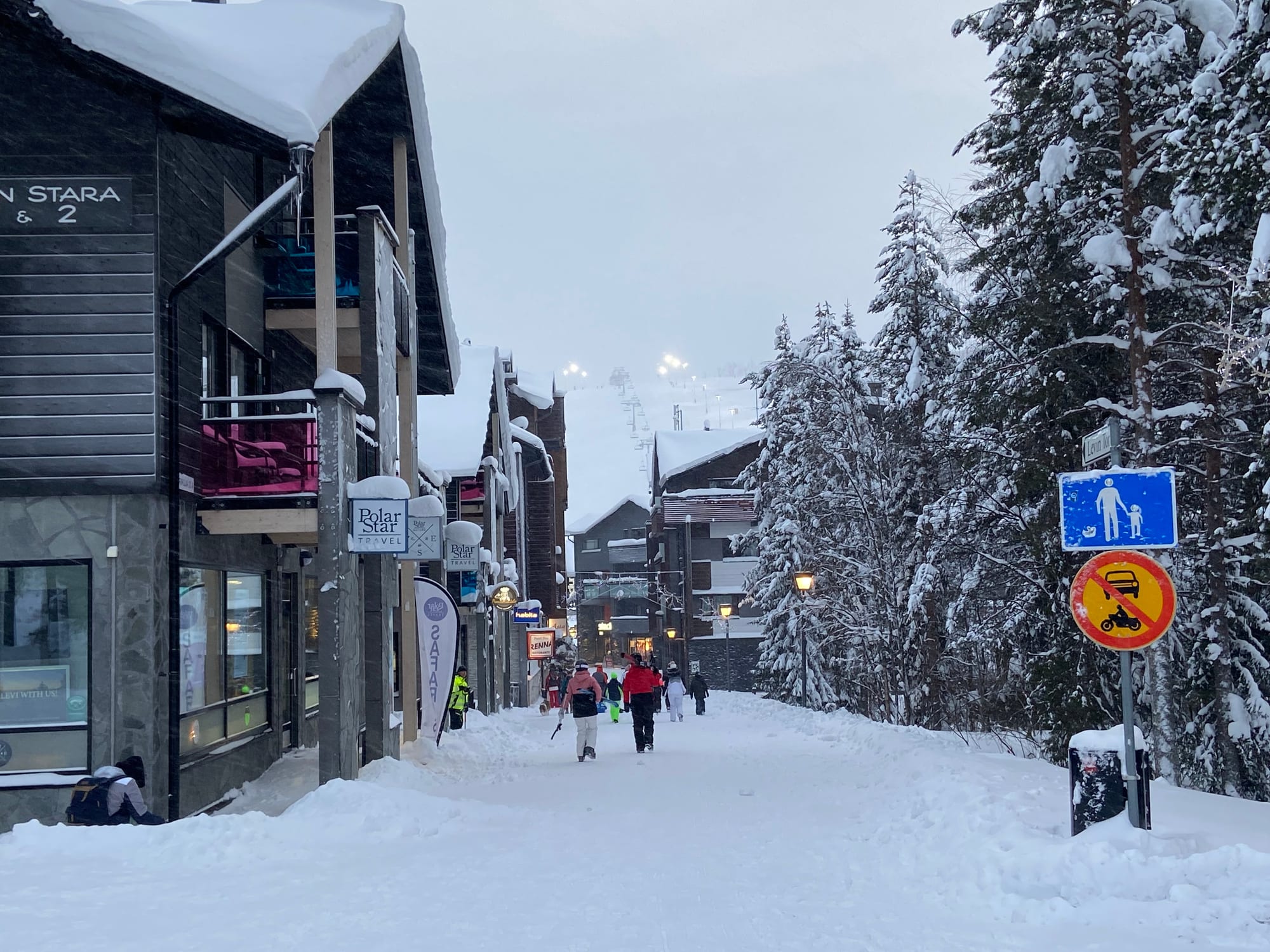
A snowy pedestrian street of dark timber buildings in Levi, with snow-laden spruces and a floodlit ski slope beyond

Lapland & the North, Finland

Levi

Torikuja, a street in the centre of Levi, looking towards the North ski slope on Levi fell. (DanielMichaelPerry / Wikimedia Commons · CC0)

A ski resort on Levi fell in Kittilä, Finnish Lapland, about 170 km north of the Arctic Circle, built around the small village of Sirkka. A single municipal ski slope of 1964 grew, after the airport opened in 1982, into a holiday town of tens of thousands of beds, gondolas, a World Cup slalom course and a busy winter nightlife.

Neighbourhoods

  • Levi centre and Sirkka
    • First-time visitors
    • Nightlife
    • Close to the slopes

    The compact, town-like core of the resort, built tightly around the village of Sirkka between Levi and Kätkä fells on the shore of Lake Immeljärvi. Shops, restaurants, bars, a spa and the main lift base are all within a short walk, and most hotels and apartment buildings are here.

    Open in Maps
  • Front slopes and Zero Point
    • Skiers
    • Families

    The oldest pistes on the northern side of the fell, right beside the centre, where the first ski lift was built in 1964. The Zero Point service building, the Express gondola and a children's play area with a kota for grilling are at their foot.

    Open in Maps
  • South slopes
    • Families
    • Quieter skiing

    A second ski area on the southern side of the fell, opened in late 2014 with a covered six-seat chairlift and the South Point service building. The Leevilandia snow play area for children is here, linked to the centre by the ski bus.

    Open in Maps
  • Kittilä village
    • Local life
    • History

    The municipal centre about 17 km south of Levi, past the airport, with the shops and services of an ordinary Lapland village. Its church of 1831 is one of the few buildings that survived the burning of the village in the Lapland War.

    Open in Maps

Things to do

On the fell

  • Levi Blackattraction

    The World Cup slalom course on Levi fell, first raced in February 2004; the World Cup slaloms moved to November in 2006, making Levi an early stop on the circuit.

    Open in Maps
  • Front pistes (Eturinteet)attraction

    The oldest pistes, right by the centre, on the slope where Kittilä municipality built the first piste and lift in 1964; many runs on the fell are floodlit for the dark months.

    Open in Maps
  • Gondola liftsattraction

    Levi opened Finland's first gondola lift at the start of 2000 and now has two, carrying skiers in winter and mountain bikers up the fell in summer.

    Open in Maps
  • Levi Bike Parktrail

    A mountain-bike park opened in 2006, with downhill and enduro trails on the fell served by the gondolas; the season usually runs from midsummer to early October.

    Open in Maps

Winter activities

  • Cross-country ski trackstrail

    About 230 km of cross-country ski tracks, some of them lit, run from the resort into the surrounding forests and fells.

    Open in Maps
  • Husky, reindeer and snowmobile safarisattraction

    Tour operators around Levi and the nearby village of Köngäs run husky and reindeer rides and snowmobile trips on a network of about 886 km of snowmobile tracks.

    Open in Maps

Short trips from the resort

  • Kittilä Churchlandmark

    A church of 1831 designed by C. L. Engel in Kittilä village, one of the few buildings spared when German troops burned the village in 1944–45.

    Open in Maps
  • Särestöniemi Museummuseum

    The home of the Lapland painter Reidar Särestöniemi in Kittilä municipality, opened as a museum in 1985 — his family's old farm buildings and the gallery and studio he had built in the 1970s.

    Open in Maps
  • Ylläsattraction

    A 719-metre fell in Kolari with two tourist villages, Äkäslompolo and Ylläsjärvi, Lapland's second-largest ski resort after Levi and Finland's highest fell with ski lifts.

    Open in Maps
  • Pallas-Yllästunturi National Parkpark

    Finland's most visited national park, following a chain of fells for about 100 km, with an extensive network of hiking and skiing trails.

    Open in Maps

Seasonal events

  • Levi World Cup slalomNovember

    Women's and men's slalom races of the FIS Alpine Ski World Cup on the Levi Black course; the winner of the women's race is awarded a reindeer, which stays on a nearby farm.

  • Levi Golf Weeklate July

    A week of golf on Levi's 18-hole course, with night games in the light summer evenings.

Eat and drink

Long-standing places and food districts in Levi. Hours, ratings and directions come from your maps app, always current.

Levi classics

  • Restaurants in Levi centreneighborhood

    Restaurants in the centre serve reindeer in many forms, willow grouse and fish such as salmon, Arctic char and whitefish, usually fried or smoked with mashed potato, alongside burgers, pizza and kebabs.

    Open in Maps
  • Slope restaurantsrestaurant

    Seven restaurants and cafés on the slopes of Levi fell, used by skiers for warm lunches and coffee between runs.

    Open in Maps

Bars and nights out

  • Crazy Reindeerrestaurant

    The oldest and best-known bar and nightclub in Levi, a centre of the resort's winter nightlife.

    Open in Maps

Experience Levi

History

The Levi fell was already known in the 19th century for its views, but the area had no roads and was hard to reach. Lake Immeljärvi, between Levi and the neighbouring Kätkä fell, had long been a sacred place for the Sámi. Small-scale tourism began in the 1930s once a road arrived from the south: fell skiers took the post bus to Kittilä and a horse and sleigh on to Sirkka, where they lodged in farmhouses. In the Lapland War of 1944–45 retreating German troops burned Kittilä village, and only a few buildings, among them the church, survived.

In 1964 Kittilä municipality bought land on the northern slope and built a piste and a ski lift there — today's front slopes. Growth followed the opening of Kittilä Airport in 1982 and the first international charter flights in 1993. The deep recession of the early 1990s helped rather than hurt: local entrepreneurs bought lift equipment cheaply from bankrupt resorts in the south, and Levi became one of Finland's two largest ski centres, rivalled only by Ruka.

The first gondola in Finland opened here at the start of 2000, and in February 2004 Levi held its first World Cup slalom. By 2012 about 27,500 beds had been built, enough for the resort to be described as a holiday town, and planning has caused disputes — a 15-storey tower hotel proposed in 1990 had to be halved in height after objections. A second ski area on the southern slopes opened in 2014.

Culture & Customs

Levi's culture is above all a winter-sport culture. The November slalom on the Levi Black course draws the world's best technical skiers to the start of the season, and it has given the resort one of the sport's odder traditions: the winner of the women's race receives a reindeer, which in practice stays on a local farm. Ski schools teach downhill, snowboarding, telemark and cross-country skiing, and the resort has snow parks, a superpipe and kilometres of floodlit trails for the dark months.

The resort is also known as a nightlife centre, not only for skiers from abroad but for young people from across rural Lapland, who come for the bars, clubs and concerts of the season. Away from the centre the rhythm is quieter and more traditional, built around reindeer herding, sauna and the outdoors. Herding families and tour operators run reindeer rides and safaris, and in summer visitors can join activities such as marking reindeer calves.

Kittilä has a strong place in Finnish art through Reidar Särestöniemi, born and died in the municipality, whose large, richly coloured paintings of Lapland's nature and people made him one of the best-known artists of the north. His home on the Ounasjoki river is now a museum.

Daily Life

Levi has no large permanent population of its own. Sirkka, the village at its heart, had about 540 people in its built-up area at the end of 2021, and the whole of Kittilä municipality had about 7,000 residents at the end of 2025. In season, though, the resort holds many times that number: by the mid-2010s around 200 companies were serving more than 600,000 visitors a year.

Tourism is the main business, and work follows the snow. Lift operators, ski schools, safari companies, restaurants and cleaning firms hire heavily for the season. Mining elsewhere in Kittilä adds year-round jobs. Summer was long a quiet time, but golf, mountain biking, hiking and fishing have slowly grown, and Levi is used as a base for exploring the fells nearby.

The year is shaped by the light. Kittilä has the midnight sun from late May to mid-July and around two weeks of polar night in late December, and the area holds Finland's record low temperature of −51.5°C. Life in winter means studded tyres, ski buses and snowmobiles, and reindeer are a constant presence on the roads.

Food

Levi's restaurants lean on the traditions of Lapland. Reindeer comes in many forms, most famously as poronkäristys, sautéed reindeer: steak or back meat is sliced thinly while still frozen, fried in fat, seasoned with black pepper and salt, then simmered with a little water, cream or beer until tender, and served with mashed potato. Willow grouse, known in Finnish as riekko, also appears on menus, as do fish from the rivers and lakes — salmon, Arctic char (nieriä) and whitefish (siika) — usually fried or smoked.

Lohikeitto, salmon soup with cream, is one of the most popular salmon dishes in Finland, and home-style dishes such as reindeer casserole and salmon soup are served in Lappish huts around the resort. Leipäjuusto, a fresh "bread cheese" with a squeaky texture traditionally made from cow's colostrum, is often served with cloudberry jam and coffee; cloudberries (lakka) grow in bogs and also flavour liqueurs such as lakkalikööri.

Coffee is drunk constantly, and outdoors it is often taken from a kuksa, a cup carved from birch burl in the Sámi tradition. Alongside the Lappish dishes, burgers, pizza and kebabs keep skiers fed late into the night.

Planning tools

Budget

Levi is among the most expensive places in Finland in winter. Rooms and cabins peak around Christmas and New Year and again in February and March, and lift passes, equipment hire and guided husky, reindeer and snowmobile safaris add a great deal per person. Summer and autumn are much cheaper, and walking the fell, cross-country skiing and self-catering cost little.

Daily Budget Midrange
USD 230–480 (hotel or apartment, lift pass or a guided activity, restaurant meals)
Daily Budget Shoestring
USD 90–150 (shared apartment or cabin, supermarket food, ski bus, free walking and skiing tracks)

Book the Christmas and February holiday weeks many months ahead, and compare self-catering apartments and day passes with full safari packages.

Best Time to Visit

The ski season often runs from October to mid-May. December brings the Christmas trade and the blue light of the short days; late February to April has deep snow, longer days and good chances of the northern lights. Summer is quiet, with the midnight sun, hiking, golf and mountain biking, and September brings the ruska autumn colour.

Suggested Number of Days

Most visitors come for a ski or winter-activity holiday of several days, often a week. Three or four days give a taste of the slopes and one or two guided outings; a week leaves room for the neighbouring fells and the national park. Short daylight in midwinter slows everything down.

First Visit
3–4 days
With Surroundings
6–7 days

Transportation

The centre is small enough to walk or ski around. From November to May a ski bus with two routes links the lift areas and the accommodation spread around the fell. Taxis are available, and for trips into the forest people use cross-country skis or snowmobiles. Cycling works well in summer.

Snowmobiles need a driving licence on official routes, may not be driven on roads, and frozen lakes and rivers must be treated with care — go with a guide if unsure.

Airport & Station Connections

Kittilä Airport, which serves both Levi and Ylläs, is about 14 km south of the resort and has flights from Helsinki and seasonal international flights; shuttle buses and taxis meet arrivals. The nearest railway station is Kolari, about 80 km away, reached by overnight train from Helsinki and linked to Levi by bus; others take the train to Rovaniemi, about 170 km away, and continue by bus. By car, Levi lies on national road 79.

Walkability

The core around the shops, bars and the front slopes is compact and pedestrian-friendly, with snow-covered streets in winter. The cabins and apartment areas around the fell are spread out, and the South slopes are a bus ride away. Streets can be icy and dark for much of the winter.

Safety

Finland is consistently rated one of the safest countries in the world, with very low crime. In Levi the real hazards are extreme cold, the long darkness of midwinter, skiing and snowmobile accidents, thin ice on lakes and rivers, and reindeer on the roads.

Dress in layers for the cold, follow guides on snowmobile and husky trips, keep off unknown ice and watch for reindeer when driving. Check current official travel advice before travelling.

Climate

A subarctic climate with long, snowy winters and short, mild summers. Snow cover and sub-freezing temperatures can usually be counted on all winter. The midnight sun lasts from late May to mid-July in Kittilä, and the sun does not rise for about two weeks in late December.

Summer
short and mild — in Sodankylä, to the east, the temperature usually stays below about 19°C, though Kittilä village has reached 32.4°C
Winter
long and very cold — in Sodankylä temperatures usually fall to about −20°C, and Finland's lowest recorded temperature, −51.5°C, was measured in Kittilä in January 1999

Local Customs

Service is included in Finnish prices and tipping is not expected. Finns are reserved and value quiet, though Levi's bars are lively in season. Sauna is taken seriously, often followed by a roll in the snow or a dip in an ice hole. Lake Immeljärvi, between Levi and Kätkä fells, has long been sacred to the Sámi.

Strong alcohol is sold only in the state Alko shop; bars apply age limits. Ask before photographing reindeer herders or people in Sámi dress.

Common Payment Methods

Finland uses the euro. Cards and mobile payment are accepted almost everywhere, including ski lifts, bars and taxis, and many places no longer accept cash. There are supermarkets and a pharmacy in the centre.