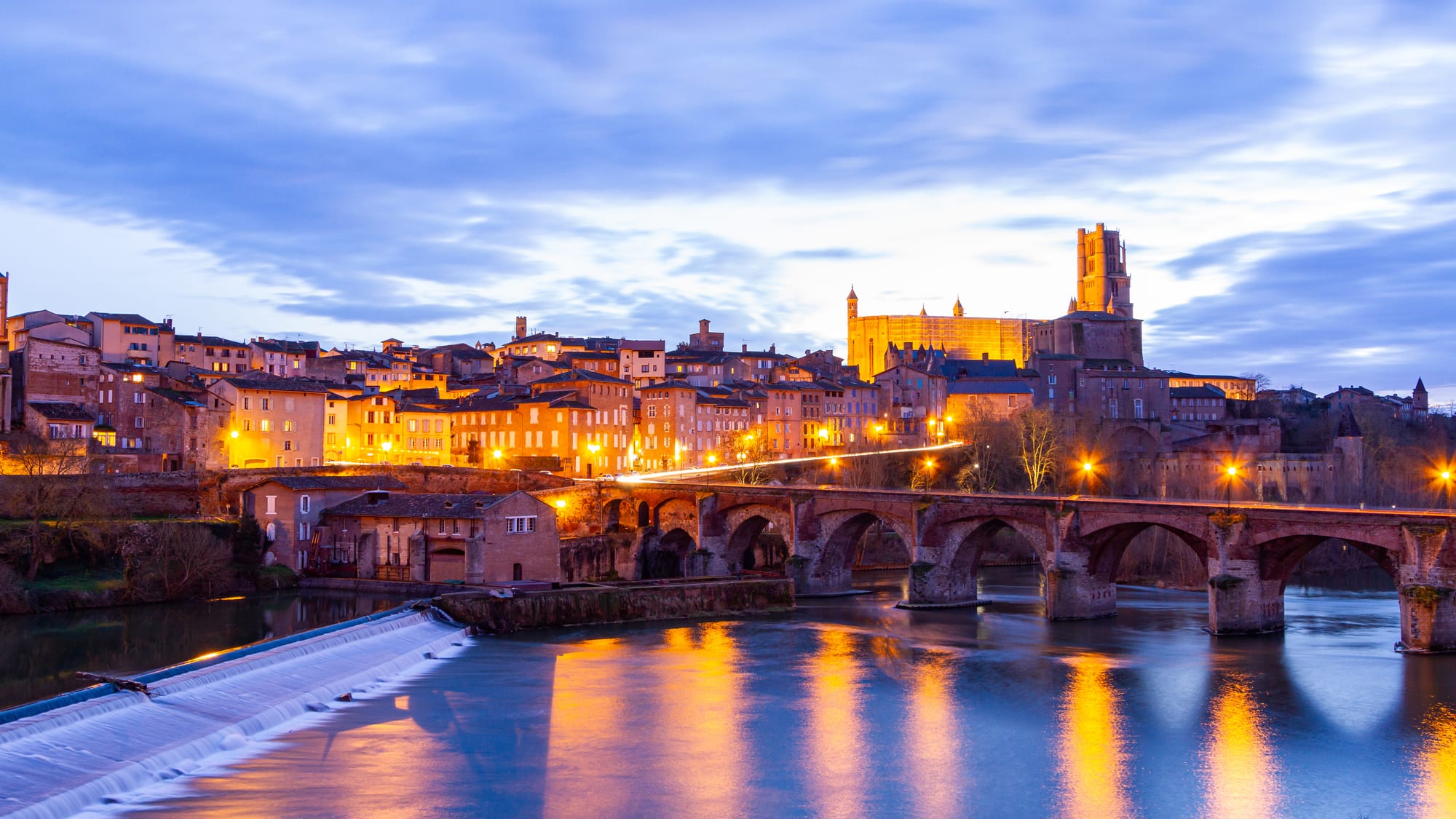
Old brick houses and a floodlit cathedral with a tall square tower above a many-arched bridge and a river at dusk

Occitanie, France

Albi

The cathedral of Sainte-Cécile, the old town and the Pont Vieux over the Tarn in Albi at dusk. (PierreSelim / Wikimedia Commons · CC BY 4.0)

The prefecture of the Tarn, on the river Tarn north-east of Toulouse, a red-brick town that gave its name to the Albigensian Crusade. After the Cathars were crushed its bishops built a fortress-like cathedral and palace, now a UNESCO World Heritage Site with the largest public collection of work by Toulouse-Lautrec, born here in 1864. About 51,000 people live in the commune.

Neighbourhoods

  • The Episcopal City
    • First-time visitors
    • Historic district

    The UNESCO-listed core of 63 hectares around the cathedral and the Palais de la Berbie, taking in the Castelviel, the Saint-Salvi quarter with its church and cloister, the riverbanks and the Pont Vieux — streets of red brick and tile above the Tarn.

    Open in Maps
  • Vigan and the Lices
    • Local life
    • Shopping
    • Close to public transport

    The heart of the town centre beside the old town, around the pedestrianised Place du Vigan and the boulevards known as the Lices, with cafés and shops.

    Open in Maps
  • La Madeleine
    • Quiet and residential
    • Views

    The faubourg across the river, reached by the Pont Vieux, with its own railway station and the classic views back across the Tarn to the cathedral and the bishops' palace.

    Open in Maps

Things to do

The Episcopal City

  • Albi Cathedrallandmark

    Sainte-Cécile, begun in 1282 and claimed to be the largest brick building in the world — a fortress-like Southern Gothic exterior with a 78-metre tower and a richly painted interior, a carved rood screen and a vast Last Judgement mural.

    Open in Maps
  • Musée Toulouse-Lautrecmuseum

    More than 1,000 works, including 31 posters, in the 13th-century Palais de la Berbie, the bishops' fortress — the largest public collection of the artist, who was born in Albi in 1864.

    Open in Maps
  • Palais de la Berbie gardenspark

    Renaissance-style terraced gardens around the bishops' palace, part of the Episcopal City.

    Open in Maps
  • Pont Vieuxlandmark

    A bridge of 1035–42, later clad in brick, still in use after almost a thousand years; its tolls made the medieval town rich, and in the 14th century it was fortified and built over with houses.

    Open in Maps
  • Saint-Salvi church and cloisterlandmark

    The collegiate church of the Saint-Salvi quarter, part of the World Heritage Site, with a quiet 12th-century cloister in the historic centre.

    Open in Maps

Museums and sport

  • Musée Lapérousemuseum

    A museum devoted to the 18th-century explorer Jean-François de Galaup, comte de Lapérouse, tracing knowledge of the world before, during and after his voyages.

    Open in Maps
  • Circuit d'Albiattraction

    A motor-racing circuit around the town's airfield, used for national racing.

    Open in Maps

Short trips from the town

  • Cordes-sur-Cielattraction

    A fortified hill town founded in 1222 by Count Raymond VII of Toulouse, a member of the Plus Beaux Villages de France.

    Open in Maps
  • Gaillacattraction

    The wine town down the Tarn whose appellation claims to be among the oldest wine regions of Gaul, with the rooster still used as its emblem.

    Open in Maps
  • Carmauxattraction

    The neighbouring mining town, where coal was dug from the 13th century until 2000 and glassworks once ran on it; the politician Jean Jaurès is among its famous residents.

    Open in Maps

Seasonal events

  • Carnaval d'AlbiFebruary

    About ten days of parades and street festivities each winter.

  • ActhéaApril

    An international theatre festival organised by students of the École des Mines d'Albi-Carmaux.

  • Pause Guitareearly July

    A summer music festival held in the town at the start of July.

Eat and drink

Long-standing places and food districts in Albi. Hours, ratings and directions come from your maps app, always current.

Albi classics

  • Gaillac winesneighborhood

    Reds, whites and sparkling wines from the Gaillac appellation just down the Tarn, a vineyard with roots in the Roman era whose wine was shipped down the river for centuries.

    Open in Maps
  • Lautrec pink garlicmarket

    Pink garlic from Lautrec in the west of the Tarn, protected by a Label Rouge since 1966 and a PGI since 1996.

    Open in Maps

Food districts and markets

  • Marché couvertmarket

    The town's covered market, renovated as a meeting place as well as a food market.

    Open in Maps
  • Place Sainte-Cécileneighborhood

    The square in front of the cathedral and the streets around it, with restaurant terraces in sight of the brick façade.

    Open in Maps
  • Rue Émile-Grand and the Viganneighborhood

    Everyday cafés, crêperies and inexpensive eateries in the streets between the Place du Vigan and the old town.

    Open in Maps

Experience Albi

History

People lived at Albi in the Bronze Age, and after the Roman conquest of Gaul it became the Civitas Albigensium, though digs suggest only a modest Roman town. In 1035–42 the Pont Vieux was built across the Tarn, and its tolls and the trade it carried made the medieval town rich, with new quarters rising around it.

The town gave its name to the Albigensian Crusade, launched in 1208 against the Cathars of the region. Repression was severe, many Cathars were burnt, and the region, until then almost independent, passed to the French crown. In its wake Bishop Bernard de Castanet completed the Palais de la Berbie as a fortress and in 1282 began the cathedral of Sainte-Cécile, a statement of Catholic power in brick; its tower was finished in 1492. A small Jewish community was destroyed during the Shepherds' Crusade of the 1320s.

From the 15th century the woad trade brought a new age of prosperity, and the fine Renaissance mansions of the dye merchants still stand in the old town. In the 19th century industry arrived — glassmaking, hatmaking and coal from nearby Carmaux — and in 1896 the workers' glassworks, the Verrerie ouvrière d'Albi, was founded as a self-managed cooperative with Jean Jaurès's support. In 2010 the Episcopal City was added to the UNESCO World Heritage List.

Culture & Customs

Albi's identity is written in its red brick. With Toulouse and Montauban it is one of the main brick-built towns of Languedoc, and the cathedral, the bishops' palace, the Pont Vieux and the mansions of the old town share the same warm colour. The contrast between the cathedral's severe, defensive outside and its painted interior, with a rood screen of more than 200 polychrome statues, is the town's great set piece.

Henri de Toulouse-Lautrec, born in Albi in 1864, is its most famous son, and the museum in the Berbie holds the world's largest public collection of his work. The explorer Lapérouse has his own museum, and the Lycée Lapérouse, where Jean Jaurès taught and Georges Pompidou studied, is a well-known school in an old monastery.

Rugby is the local sport in both codes: SC Albi plays union in Pro D2 and RC Albi league in the Elite One Championship. The Tour de France has held stages here, in 2007 and 2019. The calendar runs from the February carnival through the student theatre festival Acthéa in April to Pause Guitare in early July.

Daily Life

About 51,000 people lived in the commune in 2023, and about 75,000 in the urban area; the population has grown in recent years. As prefecture of the Tarn and seat of an archbishop, the town has the department's administration, a hospital and a growing higher-education sector, led by the École des Mines d'Albi-Carmaux, founded in 1992, and the Champollion university institute.

Industry has shrunk since the coal era, but the Verrerie ouvrière d'Albi still dominates the town's industry, and tourism to the Episcopal City and the museum is a mainstay. Residents live in the old centre and in districts on both sides of the river, from La Madeleine and Cantepau in the north to Le Lude and Bellevue in the south.

Life has the pace of a southern country town. The Place du Vigan, now pedestrianised, is the meeting point, the covered market anchors the morning shopping, and summer evenings are spent on the terraces and along the Tarn.

Food

Albi sits beside a vineyard with very old roots. The Gaillac appellation, just down the Tarn, claims to be among the earliest wine-growing areas of Gaul, with production established in the first century; Roman merchants shipped its wine to Bordeaux down the river, England was buying it by 1253, and François I gave Henry VIII fifty barrels at the Field of the Cloth of Gold in 1520. Its rooster emblem dates from a privilege of 1387.

The Tarn's best-known farm product is the pink garlic of Lautrec, in the west of the department, protected by a Label Rouge since 1966 and a geographical indication since 1996.

The covered market, renovated as a place to meet as well as shop, is the centre of food buying in the old town. Restaurants with terraces cluster around the Place Sainte-Cécile, facing the cathedral, while the streets around the Place du Vigan and Rue Émile-Grand have everyday cafés, crêperies and inexpensive eateries.

Planning tools

Budget

Albi is good value: a small provincial capital where rooms, meals and transport cost less than in Toulouse. Prices rise in summer, when most visitors come, and the main paid sight is the Toulouse-Lautrec museum.

Daily Budget Midrange
USD 130–240 (mid-range hotel, restaurant dinners, museum entry, a hire car for Cordes and the vineyards)
Daily Budget Shoestring
USD 60–100 (budget room or campsite, market food, free town shuttles and walking)

The Saint-Salvi cloister and the riverbanks cost nothing to visit, and the electric shuttles in the centre are free.

Best Time to Visit

Late spring and early autumn are the most comfortable seasons for walking the old town and visiting the vineyards. Summer is warm, with storms, and brings the Pause Guitare festival and the most visitors; February has the carnival. Winters are mild for the latitude but grey, and the town is very quiet.

Suggested Number of Days

The Episcopal City and the museum fill one full day, two at an easy pace. Allow three or four to add the hill towns, vineyards and valleys of the Tarn, which are easiest with a car.

First Visit
1–2 days
With Surroundings
3–4 days

Transportation

The historic centre is compact and walkable, and two free electric shuttle lines cover the area around it. The LibéA buses serve the rest of Albi and surrounding towns, and the short train ride between Albi-Ville and Albi-Madeleine stations is free. The A68 motorway links the town with Toulouse.

A car is the practical way to reach Cordes-sur-Ciel and the wine villages; park outside the old town and walk in.

Airport & Station Connections

The nearest airport is Toulouse–Blagnac, south-west of Albi; from Toulouse, trains on the line to Rodez run to Albi-Ville, the main station, and Albi-Madeleine. By road, the A68 motorway connects Albi and Toulouse.

Walkability

Very walkable: the cathedral, the palace, the Pont Vieux and the Place du Vigan are all within a few minutes of each other, and much of the centre is pedestrian. Some lanes are steep and cobbled near the river, and crossing the Pont Vieux to La Madeleine makes a pleasant short walk.

Safety

France is a safe country overall, with violent crime against visitors uncommon. Albi is a calm provincial town; ordinary care with bags in the busy summer streets around the cathedral is enough. Summer heat and thunderstorms are the main natural hazards.

Carry water on hot days, keep to the paths along the riverbanks and keep valuables out of sight in parked cars. Check current official travel advice before travelling.

Climate

Humid subtropical bordering on oceanic: summers warmer and winters milder than most places with a similar climate, with enough summer rain to rule out a true Mediterranean climate. The yearly average temperature near the town is 13.8°C.

Summer
warm to hot, with thunderstorms; 42.3°C was recorded nearby in August 2023
Winter
generally mild, with occasional severe cold — the record low is −20.4°C, set in January 1985

Local Customs

A 'bonjour' on entering shops and cafés is expected. Service is included in restaurant bills, and leaving small change is optional. Albi is proud of its brick heritage, its rugby clubs in both codes and Toulouse-Lautrec, and Occitan, the old language of the town, still appears in names.

Dress modestly and keep quiet in the cathedral, which remains a place of worship, and avoid visiting during services.

Common Payment Methods

The currency is the euro. Cards and contactless payment are widely accepted; cash is useful at the markets and for small purchases, and ATMs are easy to find around the Place du Vigan.