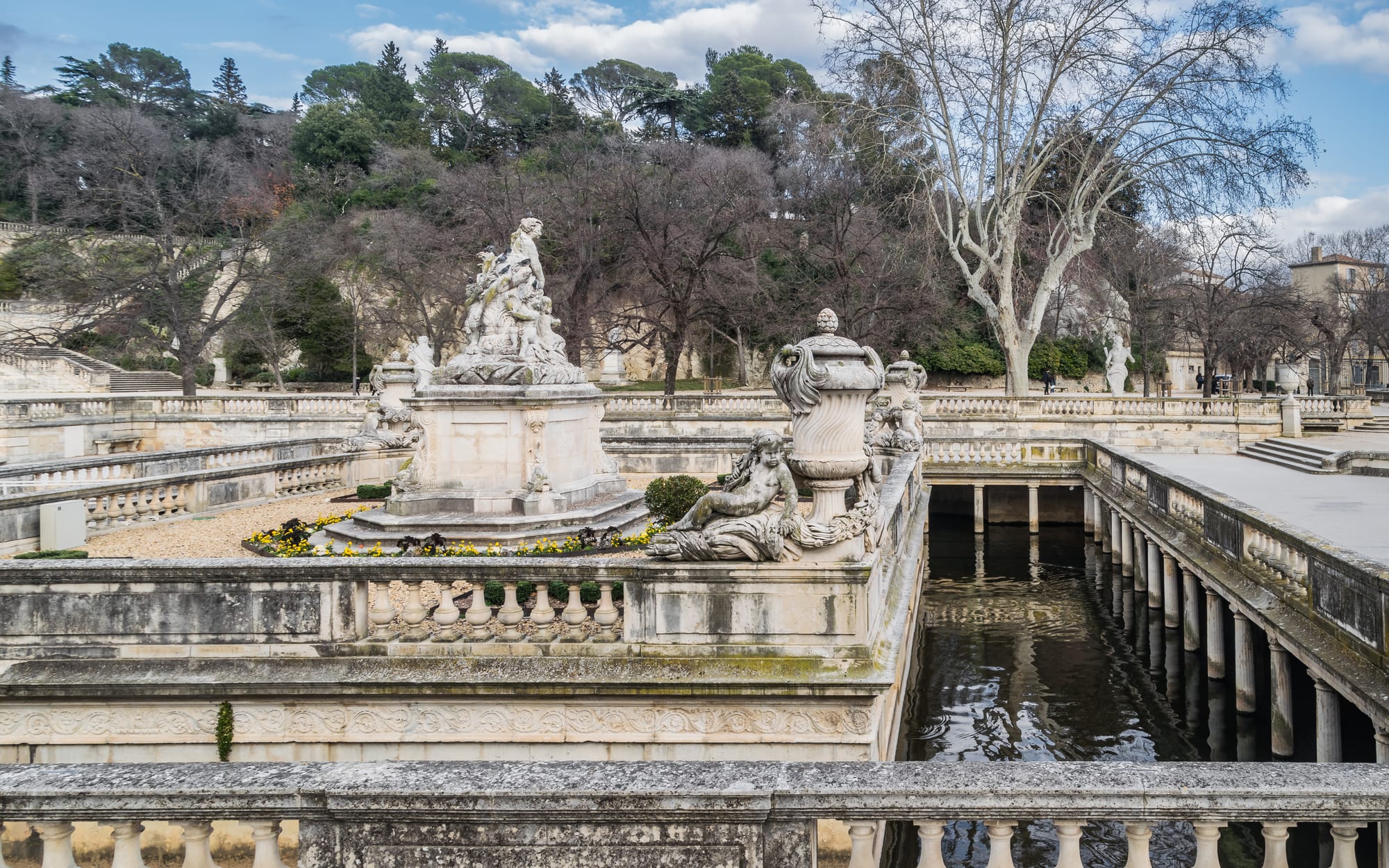
Stone balustrades, a sculpted fountain group and a canal of dark water among bare plane trees in a formal garden

Occitanie, France

Nîmes

The basins and statues of the 18th-century Jardins de la Fontaine in Nîmes. (Krzysztof Golik / Wikimedia Commons · CC BY-SA 4.0)

The prefecture of the Gard, between the Mediterranean and the Cévennes, a Celtic spring town that Rome rebuilt as Colonia Nemausus on the Via Domitia. Its amphitheatre and the Maison Carrée temple are among the best-preserved Roman buildings anywhere; today it is a city of about 152,000 known for its ferias, its gardens and the cloth that gave denim its name.

Neighbourhoods

  • The Écusson
    • First-time visitors
    • Historic district
    • Shopping

    The medieval old town inside a ring of broad boulevards laid out on the line of its walls — a protected maze of narrow, shaded shopping streets and small squares, with the Maison Carrée at its north-western corner and the arena at its southern tip.

    Open in Maps
  • Around the Arena
    • Nightlife
    • Close to public transport

    The boulevards and esplanade around the amphitheatre, a short walk from the railway and bus stations. Boulevard Victor-Hugo and the avenues nearby have late-night bars, and during the ferias this is the centre of the street party.

    Open in Maps
  • Jardins de la Fontaine and the Allées Jaurès
    • Parks
    • Quiet and residential

    The north-western quarter around the 18th-century gardens built over the city's sacred spring, with the Tour Magne on the hill above. The Avenue Jean-Jaurès, nearly two kilometres long and about 60 metres wide, runs south from the garden gates.

    Open in Maps

Things to do

Roman Nîmes

  • Arena of Nîmeslandmark

    An amphitheatre built around AD 100, 133 metres long, one of the best-preserved in the world; it was a walled town in the Middle Ages and is now used for bullfights during the ferias and for concerts.

    Open in Maps
  • Maison Carréelandmark

    A Roman temple of the imperial cult from the Augustan age, one of the best preserved anywhere, which inspired Thomas Jefferson's Virginia State Capitol and was inscribed on the UNESCO World Heritage List in 2023.

    Open in Maps
  • Temple of Dianalandmark

    A so-called temple of the Augustan era inside the Fontaine sanctuary, which may have been a library rather than a place of worship, and survived because it housed a medieval monastery.

    Open in Maps
  • Tour Magneviewpoint

    A ruined tower, 32 metres high, crowning Mont Cavalier above the Jardins de la Fontaine, later built into the Roman walls.

    Open in Maps
  • Porte d'Augustelandmark

    One of two surviving gates of the 6 km ring of Augustan walls, also called the Porte d'Arles and one of the city's main Roman gates.

    Open in Maps

Museums and gardens

  • Musée de la Romanitémuseum

    An archaeological museum opened in 2018 facing the arena, with mosaics and other finds from the Roman city.

    Open in Maps
  • Carré d'Artmuseum

    Norman Foster's glass, concrete and steel building facing the Maison Carrée, holding a contemporary art museum and the city library.

    Open in Maps
  • Musée des Beaux-Arts de Nîmesmuseum

    The city's fine arts museum, with Flemish, Italian and French paintings and a large Roman mosaic found when the old market halls were built in 1883.

    Open in Maps
  • Jardins de la Fontainepark

    The main public garden, laid out in the mid-18th century around the spring and Roman sanctuary of La Fontaine, with canals, balustrades and statues and paths climbing to the Tour Magne.

    Open in Maps

Churches and the old town

  • Nîmes Cathedrallandmark

    Notre-Dame-et-Saint-Castor, partly Romanesque and partly Gothic, believed to stand on the site of a temple of Augustus.

    Open in Maps

Short trips from the city

  • Pont du Gardlandmark

    The Roman aqueduct bridge over the Gardon, built in the first century AD to carry water more than 50 km to Nîmes, and a UNESCO World Heritage Site.

    Open in Maps
  • Uzèsattraction

    A small historic town of the Gard about 25 km north-north-east of Nîmes.

    Open in Maps
  • Aigues-Mortesattraction

    The walled medieval port town of the Camargue, built for Louis IX in the 13th century.

    Open in Maps
  • Arlesattraction

    The Roman and Romanesque city on the Rhône across the border in Provence, listed by UNESCO, where Van Gogh produced over 300 paintings and drawings.

    Open in Maps

Seasonal events

  • World Archery Indoor World CupJanuary

    A stage of the international indoor archery circuit held in the city each winter.

  • Feria de PentecôtePentecost, late May or early June

    The main feria since 1952, opening with the Pégoulade parade of floats and bands and running for a week of bullfights, course camarguaise and street parties that draw huge crowds.

  • Jeudis de Nîmessummer Thursdays

    Evening markets and street events that fill the old town every Thursday through the summer.

  • Feria des VendangesSeptember

    The three-day harvest feria, with bullfights in the arena and music in the streets.

Eat and drink

Long-standing places and food districts in Nîmes. Hours, ratings and directions come from your maps app, always current.

Nîmes classics

  • Brandade de Nîmesrestaurant

    The city's signature dish, salt cod worked with olive oil and milk, with potato added in some recipes; the recipe first appears in 1786.

    Open in Maps
  • Gardiane de taureaurestaurant

    A stew of Camargue bull meat with olives and red wine, a dish of the nearby Camargue.

    Open in Maps

Food districts and markets

  • Les Halles de Nîmesmarket

    The covered market in the Écusson, where local olives, charcuterie and pastries are sold.

    Open in Maps
  • Écusson squaresneighborhood

    The small squares of the old town, such as the Place du Marché with its crocodile fountain, are lined with café and restaurant terraces.

    Open in Maps
  • Boulevard Victor-Hugoneighborhood

    The avenue near the arena known for its late-night bars.

    Open in Maps

Experience Nîmes

History

Nîmes grew up around a spring at the foot of Mont Cavalier, where a Gallic oppidum became the capital of the Celtic Volcae Arecomici and took the name of the local water god, Nemausus. Rome conquered the region in the 120s BC and built the Via Domitia through the site, and Nîmes became Colonia Nemausus before 28 BC. Augustus gave it six kilometres of walls with 14 towers, the Maison Carrée was built as a temple of the imperial cult, an aqueduct carried water from the hills to the north across the Pont du Gard, and around AD 100 the amphitheatre rose. Its population is estimated at 50,000–60,000.

The Visigoths took the city in 472, Umayyad forces held it from about 725, and Charles Martel's expedition of 736–737 largely destroyed it before Pepin the Short captured it in 752. Through the Middle Ages the authorities lived inside the shell of the amphitheatre, which became a fortified quarter. In the 16th century Nîmes became a Protestant stronghold, suffering decades of religious violence, including the Michelade massacre.

Prosperity returned in the 17th and 18th centuries with silk and textiles — the twill called serge de Nîmes later gave denim its name — and the Jardins de la Fontaine were laid out. Since 1983 the Foreign Legion's 2nd Infantry Regiment has been garrisoned here, and in 2023 the Maison Carrée joined the UNESCO World Heritage List.

Culture & Customs

Nîmes calls itself the French Rome, and its monuments are part of daily life rather than set apart: the arena hosts concerts and bullfights, and the Maison Carrée faces Norman Foster's Carré d'Art across a public square. Concerts in the arena have been recorded for live albums by Rammstein and Metallica.

The ferias define the city's calendar and character. Held officially since 1952, the Pentecost feria opens with the Pégoulade parade of floats and brass bands and fills a week with corridas, course camarguaise and street parties; the harvest feria follows in September. Together they are among the most popular festivals in Europe, with more than a million visitors a year by some counts. Spanish-style bullfighting is defended locally as tradition and opposed by others; the course camarguaise, in which raseteurs try to snatch rosettes from a bull's horns, does not kill the animal.

Religious history runs deep: Nîmes was a Protestant stronghold through the Wars of Religion, and the Jewish community, present since at least the seventh century, built the synagogue that still serves the Gard in 1793. Football's Nîmes Olympique and the rugby club RC Nîmes have local followings, and the Tour de France often passes through.

Daily Life

About 152,000 people lived in the commune in 2023, up from about 128,000 in 1990. As prefecture of the Gard the city has a large public sector, and services, commerce and tourism dominate; the textile industry that made it famous has long gone. Nîmes also has two olive appellations, the Nîmes olive and Nîmes olive oil, and the Costières de Nîmes wine appellation lies between the city and the Rhône delta.

Residents live in the Écusson and the 19th-century districts around the boulevards, in suburbs spreading across the plain and in large housing estates on the western hills. Some of those estates face real difficulties; in 2023 city buses stopped serving Pissevin after a shooting and attacks on buses.

Summer shapes the rhythm of the year. Heat drives life into the evenings, with Thursday night markets in the old town, open-air concerts and films in the Jardins de la Fontaine, and terraces full late. The ferias transform the city for days at a time, and in autumn people watch for the heavy Mediterranean rainstorms that can flood the Gard.

Food

Brandade de Nîmes is the dish the city is known for: salt cod worked with olive oil and milk, with potato added in some recipes; the recipe first appears in 1786, when a Nîmes fish lover crushed salt cod with garlic, olive oil and a touch of milk. Olives matter here too — Nîmes olives have their own appellation — and tapenade, puréed or finely chopped olives with capers and sometimes anchovies, is eaten as an hors d'œuvre spread on bread.

From the Camargue to the south comes gardiane de taureau, a stew of Camargue bull meat with olives and red wine. The croquant Villaret, a crunchy biscuit, has been made to a family recipe kept secret since 1775, and pélardon, a goat's cheese from the Cévennes, turns up in local dishes and on cheese boards.

Les Halles de Nîmes, the covered market in the Écusson, is the place for olives, charcuterie and local specialities, and the squares of the old town are lined with café terraces. Costières de Nîmes reds and rosés are the local wines, grown on the stony slopes between the city and the Camargue.

Planning tools

Budget

Nîmes is good value for a city with such famous monuments, and cheaper than the coast or nearby Provence. Rooms are scarce and expensive during the Pentecost feria and in high summer. A combined ticket covers the arena, the Maison Carrée and the Tour Magne.

Daily Budget Midrange
USD 140–260 (mid-range hotel, restaurant dinners, the combined Roman monuments ticket, a hire car or bus to the Pont du Gard)
Daily Budget Shoestring
USD 65–105 (hostel or budget room, market food, buses and walking)

The cathedral and the Temple of Diana are free; book well ahead for feria weekends.

Best Time to Visit

April to June and September to October are the most comfortable months, and both main ferias fall in them — Pentecost in late May or early June and the harvest feria in September. July and August are very hot, though summer Thursdays bring evening markets to the old town. Autumn can bring heavy storms and flash floods in the Gard; winter is cool and quiet.

Suggested Number of Days

The Roman monuments and the old town fit into a day or two. Allow three to five days to add the aqueduct, the small towns of the Gard and the Camargue, and more if the stay coincides with a feria, when the city slows to the rhythm of the festival.

First Visit
1–2 days
With Surroundings
3–5 days

Transportation

The centre is small and best covered on foot. The Tango network runs city buses, including a bus rapid transit line, the T1 or 'Tram'Bus', from the A54 motorway to the arena, extended around the Écusson. Regional liO buses leave from the bus station beside the railway station for the Pont du Gard, Arles and other towns.

A car makes it easier to combine the Pont du Gard, Uzès and the Camargue in one trip; park outside the Écusson, which is largely pedestrian.

Airport & Station Connections

Nîmes–Alès–Camargue–Cévennes Airport is 9 km south-south-east of the city, with a few Ryanair flights and a shuttle bus timed to them; Montpellier's larger airport is the alternative. The central station, a short walk from the arena, has TGV services to Paris and trains to Montpellier, Marseille, Toulouse and Barcelona, and some high-speed trains use Nîmes-Pont-du-Gard station, opened in 2019 about 12 km outside the city. The A9 and A54 motorways meet here.

Walkability

Very walkable: the arena, the Maison Carrée, the cathedral and the Jardins de la Fontaine are all within comfortable walking distance of each other and of the station. The Écusson's lanes are narrow and mostly traffic-free, and the paths up to the Tour Magne are steep. Summer heat is the main obstacle.

Safety

France is a safe country overall, with violent crime against visitors uncommon. The tourist centre of Nîmes is calm by day; petty theft is the usual risk in crowds, above all during the ferias. Some outlying estates have serious problems — city buses stopped serving the Pissevin district in 2023 after a shooting and attacks on buses — but they lie well away from the sights. Autumn rainstorms can cause sudden flooding.

Keep valuables close in feria crowds, drink plenty of water in summer heat and never drive through flooded roads. Check current official travel advice before travelling.

Climate

One of the warmest cities in France, with hot summers and cool winters; its slightly inland position traps heat in July and August.

Summer
hot — temperatures above 34°C are common in July and August
Winter
cool but not cold — January, the coldest month, averages 6.9°C, and the cold north wind, the mistral, makes the mild winters feel colder

Local Customs

A 'bonjour' on entering any shop comes first. Service is included in restaurant bills and small change is an optional extra. Bullfighting and the course camarguaise, in which the bull is not killed, are part of local culture and divide opinion; during ferias the city stays up very late. The Protestant tradition remains part of the city's identity.

Dress respectfully and keep voices low in the cathedral, and avoid visiting during services.

Common Payment Methods

The currency is the euro. Cards and contactless payment are widely accepted, including at the monuments; cash is useful at markets and feria bars, and ATMs are easy to find in the Écusson and near the station.