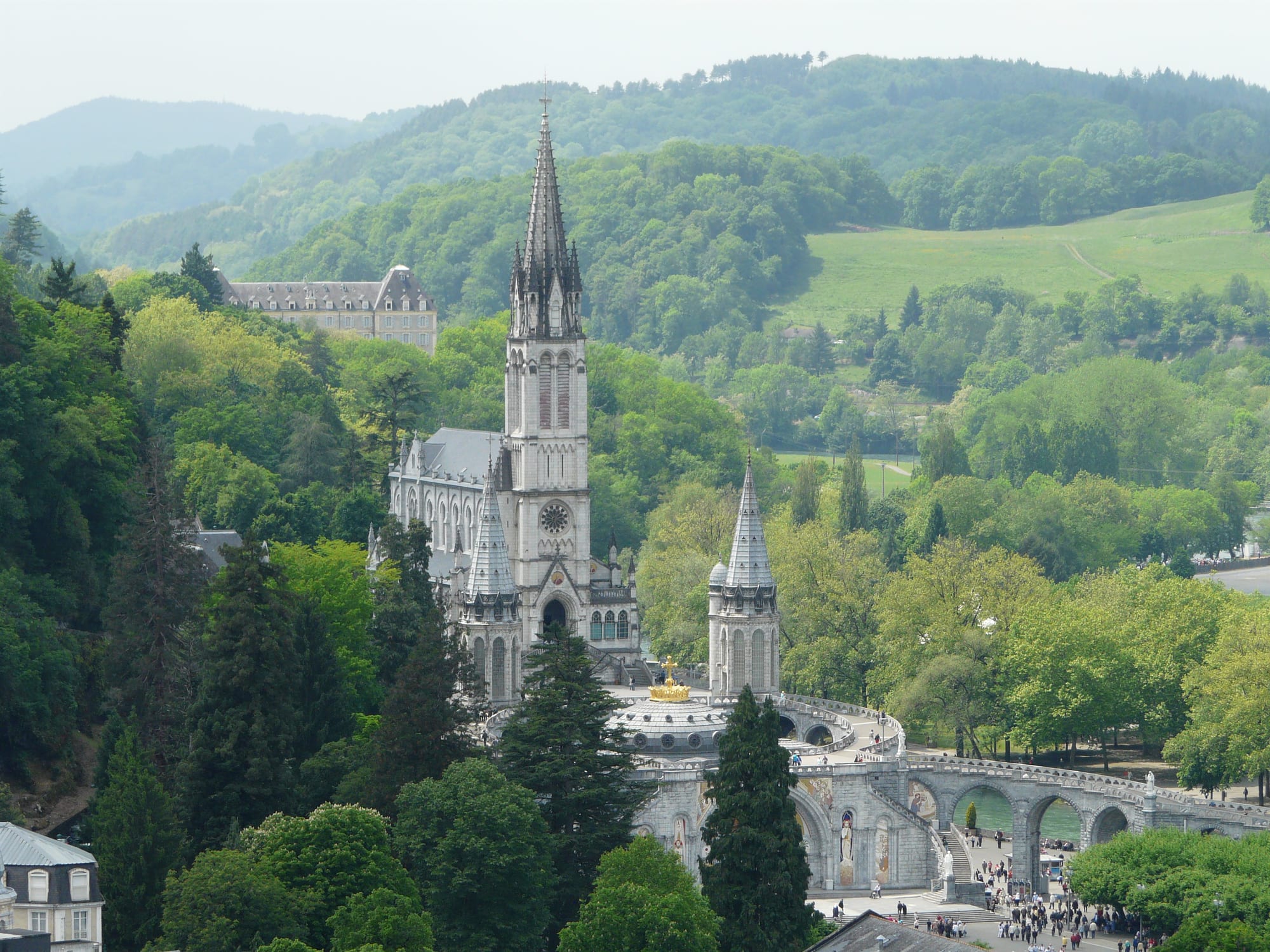
A tall Gothic spire above a domed basilica and curving ramps, among wooded green hills, with crowds on the esplanade below

Occitanie, France

Lourdes

The Upper Basilica and the Rosary Basilica of the Lourdes sanctuary, seen from the château fort. (Père Igor / Wikimedia Commons · CC BY-SA 3.0)

A market town in the foothills of the Hautes-Pyrénées on the Gave de Pau, long known only for its castle on a rock, transformed after a local girl, Bernadette Soubirous, reported visions of the Virgin Mary at the grotto of Massabielle in 1858. Its sanctuary now draws millions of visitors a year to a town of about 13,000.

Neighbourhoods

  • The Sanctuary and the lower town
    • First-time visitors
    • Pilgrims

    The grotto, the basilicas and the esplanade on the west side of town beside the Gave de Pau, with the streets that lead to them lined with hotels and devotional shops. Rue de la Grotte is the busiest street in town, crowded from Easter to October and much quieter in winter.

    Open in Maps
  • The upper town
    • Local life
    • Markets

    The everyday town on the higher ground, around the Place du Champ-Commun with its 19th-century iron-and-glass market hall, the Marcadal and the Place Peyramale. The station is a short walk away.

    Open in Maps
  • Old Lourdes and the château
    • Historic district
    • Viewpoints

    The streets below the château fort on its rocky outcrop, where the houses connected with Bernadette Soubirous's family, including the Boly mill, owned by the family until 1854, have been turned into museums.

    Open in Maps

Things to do

The Sanctuary

  • Grotto of Massabiellelandmark

    The shallow cave beside the Gave de Pau where Bernadette reported 18 apparitions in 1858; pilgrims drink and wash at fountains along the Massabielle rock and fill containers at taps away from the grotto.

    Open in Maps
  • Basilica of the Immaculate Conceptionlandmark

    The 'Upper Church' built directly above the grotto, a Gothic Revival basilica whose spire, about 70 metres high, dominates the sanctuary.

    Open in Maps
  • Rosary Basilicalandmark

    The Byzantine-style lower basilica finished in 1899, its domed nave ringed by fifteen side chapels, each with a large mosaic of one of the Mysteries of the Rosary.

    Open in Maps
  • Basilica of St. Pius Xlandmark

    The largest of the sanctuary's churches, built almost entirely underground, able to hold up to 25,000 worshippers.

    Open in Maps

The town and its viewpoints

  • Château fort de Lourdeslandmark

    The castle on its rock at the entrance to the seven valleys of the Lavedan, once a state prison, now home to the Pyrenean Museum and views over the town and sanctuary.

    Open in Maps
  • Pic du Jerviewpoint

    A 951-metre summit above the town, crowned by a large cross lit at night, reached by a funicular, with a cave to explore and a walking or mountain-bike descent.

    Open in Maps
  • St Mary's Ukrainian Catholic Churchlandmark

    A tall, narrow church consecrated in 1982 near the station, with Byzantine interior paintings by Jerzy Nowosielski.

    Open in Maps

Short trips into the Pyrenees

  • Cirque de Gavarniepark

    A vast glacial amphitheatre of cliffs up to 1,500 metres high in the Pyrénées National Park, with Gavarnie Falls, the highest waterfall in mainland France; part of a UNESCO World Heritage Site.

    Open in Maps
  • Pont d'Espagnepark

    A stone bridge where the Gave de Marcadau meets the Gave de Gaube, near Cauterets, with a ski lift up to the Lac de Gaube.

    Open in Maps
  • Pic du Midi de Bigorreviewpoint

    A 2,877-metre peak topped by the Pic du Midi Observatory, with wide views along the chain of the Pyrenees.

    Open in Maps
  • Grottes de Bétharramattraction

    A cave system explored on foot, by boat and by small train, on the border of the Hautes-Pyrénées and the Pyrénées-Atlantiques.

    Open in Maps
  • Hautacamattraction

    A ski resort in the Pyrenees whose difficult climb is used occasionally by the Tour de France.

    Open in Maps

Seasonal events

  • Feast of Our Lady of Lourdes11 February

    The anniversary of the first apparition, marked in the sanctuary in the quiet of winter; the 150th jubilee in 2008 drew some 45,000 pilgrims to an outdoor Mass.

  • Torchlight processionsEaster to October

    Each evening of the pilgrimage season thousands of pilgrims walk the esplanade with candles behind a statue of Mary, praying the Rosary and singing the Ave Maria in many languages.

Eat and drink

Long-standing places and food districts in Lourdes. Hours, ratings and directions come from your maps app, always current.

Pyrenean classics

  • Garburerestaurant

    The hearty one-pot soup-stew of the Béarn and the Pyrenees, mainly root vegetables slowly cooked with meat in an earthenware pot.

    Open in Maps
  • Tarbais beansrestaurant

    A local bean grown mainly in the Hautes-Pyrénées, protected by a Label Rouge and a PGI.

    Open in Maps

Food districts and markets

  • Les Halles de Lourdesmarket

    The covered market in the 19th-century market hall on the Place du Champ-Commun, at the centre of the upper town.

    Open in Maps
  • Rue de la Grotteneighborhood

    The street between the town and the sanctuary, where most of the restaurants and cafés serving pilgrims are found, many with menus in several languages.

    Open in Maps

Experience Lourdes

History

The rock in the middle of Lourdes was an oppidum in Roman times, and remains of walls and a temple to water gods have been found on the site of the present fortress. Legend says the Muslim leader Mirat, besieged by Charlemagne, gave in after an eagle dropped a trout at his feet, and took the baptismal name Lorus, which became the town's name. In the Middle Ages the castle belonged to the counts of Bigorre, and a market made the town prosperous; the English held it from 1360 to 1407, until Charles VI took it after an 18-month siege. Lourdes became part of the kingdom of France in 1607, and its castle served as a state prison.

Until 1858 it was a quiet town of about 4,000, with a garrison and travellers passing through to the spas of Barèges and Cauterets. On 11 February that year Bernadette Soubirous, the 14-year-old daughter of a miller whose family had fallen into poverty, said a lady had appeared to her in the grotto of Massabielle; the lady appeared 18 times and called herself the Immaculate Conception. A spring rose where Bernadette dug, and by 1859 thousands of pilgrims were arriving.

The basilicas followed, and Lourdes became one of the world's leading Marian shrines. Pope John Paul II visited twice, in 1983 and 2004. The town has been declared a natural disaster zone for floods and mudslides many times, most recently in 2021 and 2022.

Culture & Customs

Pilgrimage is the town's culture. From Easter to All Saints' Day the sanctuary runs Masses in many languages, the daily Blessed Sacrament procession led by sick pilgrims, and the evening torchlight procession with candles and the Lourdes Ave Maria. The Catholic Church has recognised 72 healings as miraculous as of April 2025, examined through the Lourdes Medical Bureau, and volunteers from many countries come to help sick and disabled pilgrims.

The story has been retold many times: Émile Zola's novel Lourdes, the 1943 film The Song of Bernadette, which won four Academy Awards, and more recent documentaries and films such as The Miracle Club. Bernadette spoke Occitan, the old language of the region, and her family's houses in town are now museums.

Beyond the shrine, Lourdes is a Pyrenean town with its own loyalties. FC Lourdes was one of the great French rugby clubs of the mid-20th century, winning the national championship eight times, and its most famous player, Jean Prat, played 51 times for France. Since 2015 the town's mountain-bike course has hosted a round of the UCI Downhill World Cup.

Daily Life

About 13,000 people lived in the commune in 2023, yet Lourdes has around 144 hotels and some 22,000 beds — the second-largest hotel stock in France after Paris. The sanctuary receives around four million visitors a year, and pilgrimage tourism shapes nearly every job, from hotels and restaurants to the shops selling candles, rosaries and containers for Lourdes water.

The town is divided in two. The lower town around the sanctuary is busy, international and seasonal, with hotels that close in winter; the upper town, around the Place du Champ-Commun and its market hall, keeps the rhythm of an ordinary French country town, with schools, the médiathèque and everyday shops.

The year follows the pilgrimage calendar. In season, trains and coaches bring large organised groups, including the sick and their helpers, and the streets fill with many languages; in winter the crowds thin and life slows. The river and the mountains bring risks too, with repeated floods along the Gave de Pau.

Food

Lourdes eats the food of the Pyrenean foothills. Garbure, the hearty soup-stew of the Béarn and the Pyrenees, is a one-pot dish of mainly root vegetables slowly cooked with meat in an earthenware pot, the cooking liquid sometimes served first as a soup. The Tarbais bean, grown mainly in the Hautes-Pyrénées, is a protected local variety with a Label Rouge and a PGI.

Most restaurants are geared to pilgrims, particularly along Rue de la Grotte and the streets near the sanctuary, offering set menus, pizzerias and simple French cooking, often with menus in several languages. Shops close for a long lunch, and on Sundays only a few stay open.

For everyday food, residents shop at the covered market in the Halles on the Place du Champ-Commun, under the 19th-century iron-and-glass roof, and in the bakeries and grocers of the upper town. A local market also sells fresh produce and French snacks, a useful alternative to the set menus of the pilgrim streets.

Planning tools

Budget

Lourdes has more hotel rooms than any French town but Paris, so beds are plentiful and prices for food and rooms are generally modest, though the most central hotels and big pilgrimage dates cost more. Visiting the sanctuary, attending Mass and joining the processions are free.

Daily Budget Midrange
USD 130–240 (comfortable hotel near the sanctuary, restaurant dinners, the Pic du Jer funicular and château entry)
Daily Budget Shoestring
USD 60–100 (budget hotel or pilgrim hostel, set menus and bakery food, walking)

Containers for Lourdes water are sold everywhere, but the taps at the sanctuary are free; a hire car opens up the Pyrenean valleys.

Best Time to Visit

The sanctuary is fully active from Easter to All Saints' Day, with daily processions, Masses in many languages and the busiest crowds in summer and around major feasts. Winter is quiet, with fewer services and no processions, which some visitors prefer. Late spring and early autumn suit trips into the mountains; December to March brings snow to nearby resorts.

Suggested Number of Days

One or two days are enough for the sanctuary and the town; many pilgrims on organised trips stay several days for the full round of services. Allow three to five days to add the high Pyrenean valleys, which need a car or a tour.

First Visit
1–2 days
With Surroundings
3–5 days

Transportation

The town is small and most places are reached on foot, with several pedestrian streets; it is used to sick and disabled visitors, and help is readily available. A handful of local bus lines link the centre, the sanctuary and the suburbs. Driving in the centre is slow because of one-way streets and pedestrian zones, so most drivers park on the outskirts and walk in.

Hire a car for Gavarnie, Cauterets and the Tourmalet, and note that the mountain roads can close in winter.

Airport & Station Connections

Tarbes–Lourdes–Pyrénées Airport is about 10 km from the town, with scheduled and charter flights from across Europe; Pau and Toulouse have larger airports. Lourdes station, a few hundred metres from the centre on the Toulouse–Bayonne line, has TGV trains from Paris in about four and a half hours, as well as night trains and regional services. Many pilgrims arrive by coach from France and Spain.

Walkability

Very walkable: the station, the upper town and the sanctuary are all within a short walk, and the sanctuary itself is flat and step-free in large parts, with ramps up to the Upper Basilica. The château and the old streets around it are on a steep rock.

Safety

France is a safe country overall, with violent crime against visitors uncommon. Lourdes is calm; the main risk is pickpocketing in the crowds at the grotto, in the processions and on Rue de la Grotte in high season. The Gave de Pau floods from time to time, and mountain weather changes fast in the valleys above the town.

Keep bags closed in crowds, respect the barriers along the river and check the forecast before heading into the mountains. Check current official travel advice before travelling.

Climate

Oceanic, thanks to the nearness of the Atlantic: mild for most of the year, with about 120 rainy days and more than 1,000 mm of rain a year, highest in winter. Being close to the mountains, the town can be hit by sharp frosts.

Summer
warm, with moderate rain; 39°C was recorded nearby in August 2003
Winter
cool and wet, with occasional severe cold — the record is around −27°C, set in January 1985

Local Customs

The sanctuary is a place of prayer: modest dress, quiet voices and restraint with cameras are expected, especially at the grotto and during services and processions, and the sick and disabled pilgrims take priority. In town, a 'bonjour' on entering a shop is expected, and many shops close for a long lunch.

Silence is asked for at the grotto; ask before photographing pilgrims, especially the sick. Service is included in restaurant bills.

Common Payment Methods

The currency is the euro. Cards and contactless payment are widely accepted in hotels, restaurants and most shops; cash is handy for candles, small souvenirs and market stalls, and ATMs are easy to find in the centre.