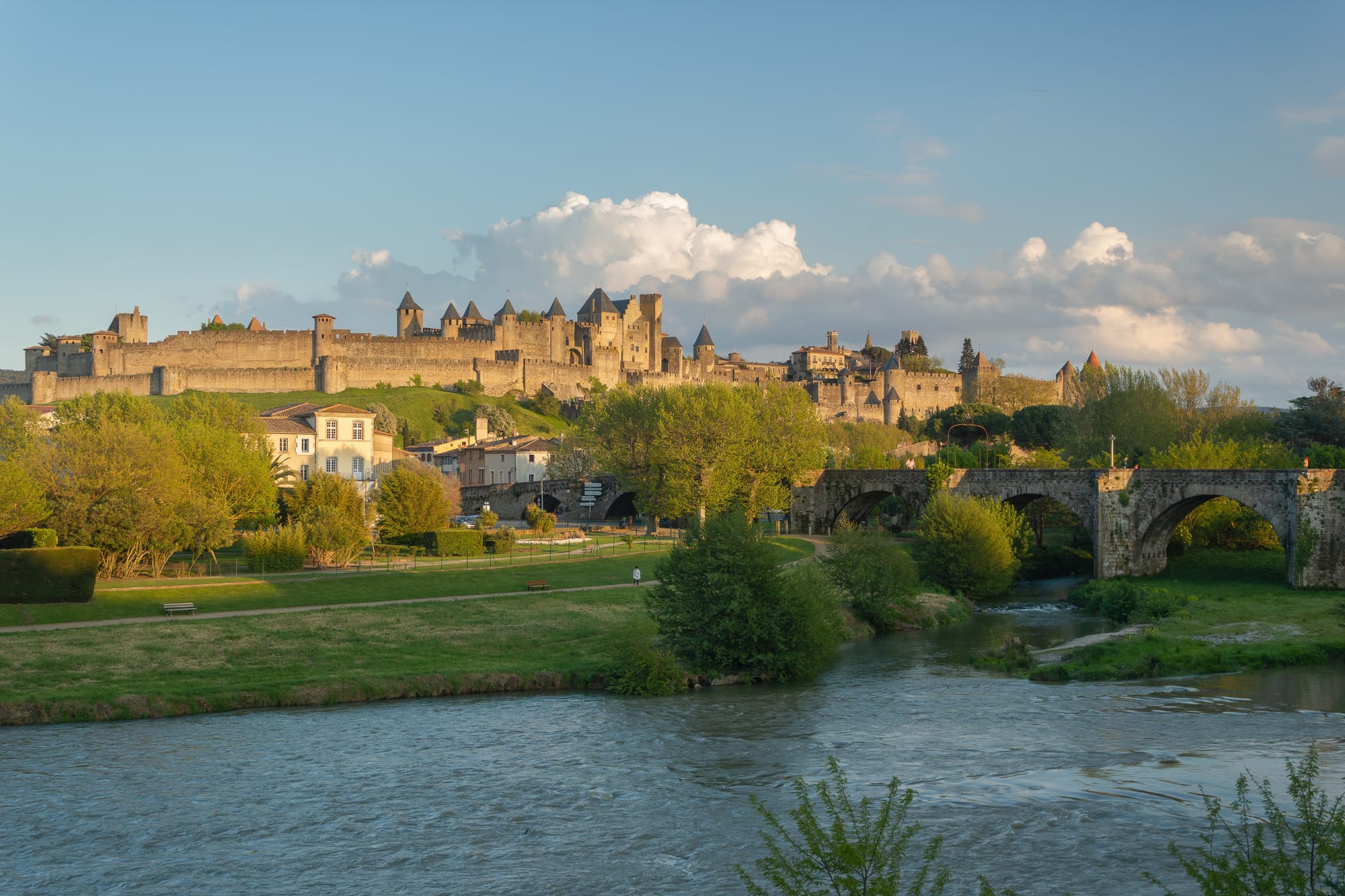
The walls and pointed towers of a hilltop citadel above trees, with an old arched stone bridge over a river in front

Occitanie, France

Carcassonne

The Cité de Carcassonne and the Pont Vieux over the Aude, seen from the Pont Neuf. (Lynx1211 / Wikimedia Commons · CC BY-SA 4.0)

The prefecture of the Aude, on a plain between the Atlantic and Mediterranean trade routes, where a double-walled hilltop citadel taken in the Albigensian Crusade and restored by Viollet-le-Duc in the 19th century faces a grid-planned lower town across the river. Today it is a working town of about 46,000 that lives largely from some three million visitors a year.

Neighbourhoods

  • La Cité
    • First-time visitors
    • Historic district

    The walled upper town on a hill on the right bank of the Aude, ringed by about 3 km of double walls and 52 towers. Inside are the Château Comtal, the basilica and narrow streets of shops and restaurants around a main square, busy by day in summer and much quieter once the day visitors leave.

    Open in Maps
  • Bastide Saint-Louis
    • Local life
    • Best for food
    • Close to public transport

    The lower town founded in 1247 across the river, laid out on a regular grid inside a boulevard that follows its demolished walls. Several streets are pedestrianised, Place Carnot is the centre, and the cathedral, the station and the Canal du Midi are all close by.

    Open in Maps
  • La Trivalle and La Barbacane
    • Quiet and residential
    • Restaurants

    The old faubourgs at the foot of the Cité, linked to the Bastide by the pedestrian Pont Vieux. Rue Trivalle climbs towards the walls with restaurants along the way, and the Barbacane quarter has the church of Saint-Gimer, designed by Viollet-le-Duc.

    Open in Maps

Things to do

The Cité

  • Ramparts of the Citélandmark

    A Gallo-Roman and medieval citadel whose double walls, 3 km long with 52 towers, were restored from 1853 and listed by UNESCO in 1997; the outer ring was added under Louis IX and Philip III.

    Open in Maps
  • Château Comtallandmark

    The castle of the viscounts of Carcassonne inside the Cité, with its own moat and barbican, a lapidary museum and an exhibition on the 19th-century restoration; the ticket includes a walk along part of the ramparts.

    Open in Maps
  • Basilica of Saints Nazarius and Celsuslandmark

    The former cathedral inside the walls, a Romanesque and Gothic church whose oldest part is the Romanesque nave, demoted when the cathedral moved to the lower town in 1803.

    Open in Maps

The lower town and the river

  • Carcassonne Cathedrallandmark

    Saint-Michel, built in the 13th century as the parish church of the new Bastide and rebuilt as a fortified church after damage in the Hundred Years' War, a cathedral since 1803.

    Open in Maps
  • Église Saint-Vincentlandmark

    A church of 1269 with one of the widest single naves in France and a 54-metre bell tower that holds a carillon of 54 bells and looks over the whole Bastide.

    Open in Maps
  • Place Carnotlandmark

    The central square of the Bastide, around which its grid of streets is laid out.

    Open in Maps
  • Pont Vieuxlandmark

    The old stone bridge over the Aude between the Bastide and the Trivalle, now open only to pedestrians; the nearby Pont Neuf gives the best-known view of the Cité.

    Open in Maps
  • Canal du Midiattraction

    The 17th-century UNESCO-listed canal from Toulouse to the Mediterranean passes between the station and the Bastide, and boat trips leave from the quay by the station lock.

    Open in Maps

Parks, lakes and sport

  • Lac de la Cavayèrepark

    An artificial lake made in 1988 after forest fires, known as Carcassonne Plage, with gently sloping beaches, supervised bathing, boats and picnic areas a short drive from the centre.

    Open in Maps
  • Stade Albert Domecattraction

    The 10,000-capacity municipal stadium shared by the rugby union club USC and the rugby league club AS Carcassonne, with a bronze statue of the league player Puig Aubert outside.

    Open in Maps

Short trips from the town

  • Châteaux de Lastourslandmark

    Four so-called Cathar castles strung along a rocky spur above the village of Lastours, between the deep valleys of the Orbeil and the Grésilhou.

    Open in Maps
  • Montolieuattraction

    A village given over to books and the arts, with bookshops, artists' workshops and galleries, and a museum of book arts and crafts.

    Open in Maps
  • Limouxattraction

    A town on the Aude south of Carcassonne, home of Blanquette de Limoux sparkling wine and of the Fecos winter festival.

    Open in Maps
  • Castelnaudaryattraction

    The town on the Canal du Midi where, by tradition, cassoulet was invented during an English siege in 1355.

    Open in Maps
  • Lagrasseattraction

    A village of the Corbières listed among the Plus Beaux Villages de France.

    Open in Maps
  • Minerveattraction

    A village in the Hérault above the gorge of the Cesse that gave its name to the Minervois wine region.

    Open in Maps

Seasonal events

  • Festival international du film politiqueJanuary

    A festival of political cinema held each January.

  • Festival de CarcassonneJuly and August

    Since 2006, around a hundred concerts, plays and dance shows each summer, drawing some 200,000 spectators.

  • Embrasement de la Cité14 July

    A Bastille Day fireworks display over the walls of the Cité.

  • Medieval tournamentsJuly and August

    Jousting and horsemanship displays held between the two rings of walls during the summer season.

  • Féria de Carcassonnelate August

    The town's late-summer feria.

Eat and drink

Long-standing places and food districts in Carcassonne. Hours, ratings and directions come from your maps app, always current.

Carcassonne classics

  • Cassoulet in the Citéneighborhood

    Restaurants with outdoor tables around the main square inside the walls serve cassoulet, the haricot bean and meat stew of the Aude; the Carcassonne version traditionally uses leg of mutton and, in season, partridge.

    Open in Maps
  • Aude winesneighborhood

    Bars and restaurants pour the local appellations — Minervois, Corbières, Malepère and Cabardès among them — along with Blanquette de Limoux from just to the south.

    Open in Maps

Food districts

  • Rue Trivalleneighborhood

    The street linking the lower town with the Cité, with a handful of restaurants serving regional dishes along the climb.

    Open in Maps
  • Bastide Saint-Louisneighborhood

    The lower town's squares and pedestrian streets around Place Carnot, where locals eat and drink away from the busiest part of the Cité.

    Open in Maps

Experience Carcassonne

History

In the sixth century BC the hilltop of Carsac was a trading place, fortified by the Volcae Tectosages as an oppidum. The Romans fortified the hill around 100 BC, and the lower courses of the northern ramparts still date from Gallo-Roman times. The Visigoths held the town from AD 453, and a medieval county of Carcassonne later ruled the city and its surroundings. In 1067 it passed by marriage to Raimond-Bernard Trencavel, whose family began building the Château Comtal in 1130.

Carcassonne was a Cathar stronghold when the crusading army of the papal legate Arnaud Amalric besieged it in August 1209. Viscount Raymond-Roger Trencavel was imprisoned while negotiating a surrender and died in his dungeon three months later, and the inhabitants were expelled. Simon de Montfort took the viscounty, and the city submitted to the French crown in 1247. Louis IX founded a new town across the river for the expelled population — the Bastide Saint-Louis — and he and Philip III built the outer walls, making Carcassonne a border fortress facing Aragon.

The Treaty of the Pyrenees moved the border south in 1659, and Carcassonne became a centre of the woollen cloth trade until the Ottoman market collapsed late in the 18th century. The abandoned citadel fell into such ruin that a decree of 1849 ordered its demolition; the antiquary Jean-Pierre Cros-Mayrevieille and the writer Prosper Mérimée campaigned to save it, and Eugène Viollet-le-Duc restored it from 1853. His slate roofs were criticised as northern rather than local, but the Cité was listed by UNESCO in 1997.

Culture & Customs

The town's identity is bound up with the Cité, which has been a romantic symbol since the 19th century. Gustave Nadaud's poem about a man who dreamed all his life of seeing Carcassonne and died without doing so was translated into English several times and set to music by Georges Brassens; Lord Dunsany and William Faulkner each wrote a story called "Carcassonne", and the walls inspired the board game of the same name, released in 2000. Films have used the ramparts as a backdrop, including Robin Hood: Prince of Thieves.

Occitan was the language of Carcassonne and Languedoc before French, and the town's Occitan name, Carcassona, is close to the Latin. Summer is the season of spectacle: the Festival de Carcassonne fills July and August with concerts, theatre and dance, the 14 July fireworks light up the walls, and jousting displays take place between the ramparts. In 2018, for the 20th anniversary of the UNESCO listing, the artist Felice Varini mounted giant yellow concentric circles of painted aluminium on the walls from May to September.

Rugby is the local sport. AS Carcassonne, founded in 1938, is the town's rugby league club, while Union Sportive Carcassonnaise plays rugby union in Pro D2; both share the Stade Albert Domec. The Tour de France regularly finishes stages here, and it was in Carcassonne in 2021 that Mark Cavendish equalled Eddy Merckx's record of 34 stage wins.

Daily Life

The commune had about 46,000 inhabitants in 2023, and Carcassonne Agglo, the wider grouping of communes, about 114,000. The population has grown almost continuously since 1800, peaked in 2009 and has since dipped slightly. As prefecture of the Aude, the town has the department's offices, courts and services alongside the tourist trade.

Tourism drives the economy: about three million visitors come each year, most of them to the Cité, and boat trips on the Canal du Midi add to the trade. The lower town has manufactured shoes, rubber and textiles, and Carcassonne is the centre of a large wine-growing area. Most residents live in the Bastide and the districts beyond it rather than in the Cité, which is overwhelmingly given over to visitors; social housing is concentrated in the Viguier and La Conte neighbourhoods, which have large immigrant communities.

Life in the Bastide follows the southern pattern of morning shopping, a long lunch and evenings in the squares. In summer the town is crowded and lively; in winter the Cité empties and the lower town carries on at its own pace. The river and the climate bring risks as well as pleasures — the Aude flooded the area in October 2018, and summer heat has passed 43°C.

Food

Cassoulet is the dish most associated with Carcassonne: a slow-cooked stew of haricot beans with meat, named after its traditional cooking pot. Tradition places its invention in nearby Castelnaudary during a siege of 1355, and Prosper Montagné, editor of the original Larousse Gastronomique, called the cassoulets of Castelnaudary, Carcassonne and Toulouse "the Trinity", with Carcassonne's version made with leg of mutton and, in season, partridge. It is on the menus of most restaurants in the Cité and the lower town.

The restaurants clustered around the Cité's main square cater largely to visitors and are busiest on summer evenings; rue Trivalle, between the Cité and the river, and the squares and pedestrian streets of the Bastide offer more everyday places to eat.

Wine is the other pillar. The vineyards around the town use the appellations Minervois, Minervois La Livinière, Corbières, Malepère, Cabardès and Languedoc, along with the Cité de Carcassonne local wine label. To the south, Limoux is known for Blanquette de Limoux, and wine historians believe the world's first sparkling wine was made at the abbey of Saint-Hilaire nearby in 1531.

Planning tools

Budget

Carcassonne is moderately priced for France. Eating and staying inside the Cité costs the most and gets crowded in summer; the Bastide and the area around the station are cheaper and a short walk or bus ride away. Rooms are in demand in July and August, when the summer festival and the 14 July fireworks fill the town.

Daily Budget Midrange
USD 140–260 (mid-range hotel, restaurant dinners, Château Comtal entry, a canal boat trip)
Daily Budget Shoestring
USD 70–110 (hostel bed, bakery and market food, town buses and walking)

The Château Comtal and its rampart walk are run by the Centre des monuments nationaux, while the lists between the two walls and the rest of the Cité belong to the town.

Best Time to Visit

April to June and September to October are the easiest months, warm without the summer crowds. July and August bring the Festival de Carcassonne, the medieval tournaments and the 14 July fireworks, but also heat and the heaviest visitor numbers in the Cité. Late summer and early autumn can bring violent thunderstorms. Winter is quiet and many visitors come only for the day.

Suggested Number of Days

Many people visit for a single day, but staying a night allows the walled town to be seen in the evening and early morning when it is calm. Allow three or four days to add the castles, villages and wine country of the Aude, which are far easier with a car.

First Visit
1–2 days
With Surroundings
3–4 days

Transportation

The Cité, the Pont Vieux and the Bastide are all within walking distance of one another. Eight town bus lines run by RTCA serve the town and nearby villages, several of them calling at the Cité, and in summer free small electric shuttles circulate in the Bastide while a tourist train links the centre with the Cité. Visitors to the Cité who come by car use the paid car parks below the walls.

Hire a car for the Cathar castles and the villages of the Corbières, Minervois and Montagne Noire, which buses serve poorly.

Airport & Station Connections

Carcassonne Airport, also called Salvaza, is 3 km west of the town and handles budget flights; a shuttle bus runs to the railway station and some services stop at the Cité. Toulouse–Blagnac is the nearest major airport. Carcassonne station, on the line from Toulouse to Narbonne and Sète, has TGV, Intercités and TER trains; Toulouse is about an hour to an hour and a quarter away. The A61 motorway links the town with Toulouse and Narbonne.

Walkability

Very walkable. The Cité is around 20 minutes on foot from the station, through the Bastide and over the Pont Vieux, and the Bastide's grid has several pedestrian streets. The Cité itself is cobbled and climbs steeply to its gates, and the lanes between the walls are uneven underfoot.

Safety

France is a safe country overall, with violent crime against visitors uncommon. In Carcassonne the main risks are pickpocketing in the crowded lanes of the Cité in summer and the natural hazards of the region: intense thunderstorms and torrential rain in late summer and early autumn can flood the town, as they did in October 2018, and summer heat can be severe.

Keep bags closed in the crowds of the Cité, carry water in summer and heed orange and red weather warnings in autumn. Check current official travel advice before travelling.

Climate

A humid subtropical climate with a strong Mediterranean influence: moderately wet, mild winters and hot summers. Intense thunderstorms and torrential rain can strike in late summer and early autumn.

Summer
hot and fairly dry — daytime temperatures average above 28°C, and 43.2°C was recorded in August 2023
Winter
moderately wet and mild, though cold snaps happen — the record low is −15.2°C, set in February 1963

Local Customs

A 'bonjour' on entering a shop or café is expected before anything else. Service is included in restaurant bills, and leaving small change is a courtesy rather than an obligation. Lunch is a fixed point in the day and many smaller shops close for it. Occitan is the historic language of the town and appears on some signs, and rugby, in both codes, is followed closely.

Dress modestly and keep voices low in the basilica and the cathedral, which remain places of worship, and avoid visiting during services.

Common Payment Methods

The currency is the euro. Cards and contactless payment are widely accepted in shops, restaurants and at the Château Comtal; cash is useful for markets, bakeries and small purchases, and ATMs are easy to find in the Bastide and near the station.