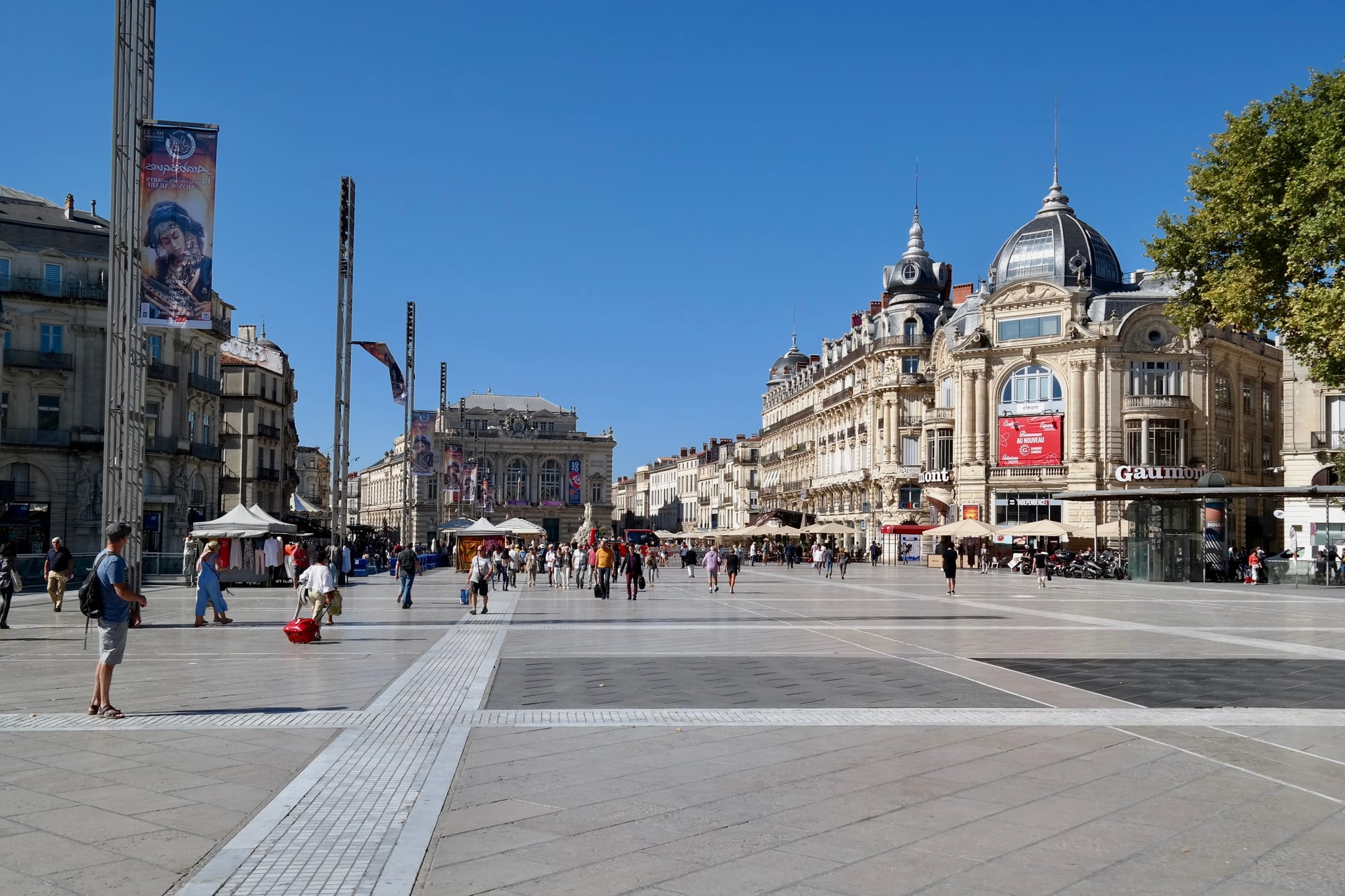
A wide paved square with people walking, ornate domed 19th-century buildings on the right and an opera house in the distance

Occitanie, France

Montpellier

The Place de la Comédie in Montpellier, with the Opéra Comédie at the far end. (Choinowski / Wikimedia Commons · CC BY-SA 4.0)

The prefecture of the Hérault, on hilly ground about 10 km inland from the Mediterranean, first mentioned in 985 and made famous by a medical school that has taught since the Middle Ages. One of France's fastest-growing cities, it pairs a compact old centre, the Écusson, with new districts stretching towards the sea and some 70,000 students.

Neighbourhoods

  • The Écusson
    • First-time visitors
    • Historic district
    • Nightlife

    The old centre, named for its shield-like outline, a largely traffic-free web of narrow streets under stone arches, mansions with hidden courtyards and small squares. Place Saint-Roch, Place Jean-Jaurès and the Marché-aux-Fleurs square are packed with bars and restaurants, and this is the city's main district for going out.

    Open in Maps
  • Comédie and the Esplanade
    • Close to public transport
    • Shopping

    The great square at the south-east corner of the centre, on the line of the old fortifications, with the 1888 opera house and the tree-lined Esplanade Charles-de-Gaulle. Trams meet here, the Saint-Roch station is a short walk south, and the main shopping streets start from its edges.

    Open in Maps
  • Antigone
    • Architecture
    • Quiet and residential

    A neighbourhood east of the centre designed by Ricardo Bofill on the site of former barracks, a long axis of grand neoclassical blocks running from the old centre to the river Lez.

    Open in Maps
  • Port Marianne
    • Modern architecture
    • Riverside

    One of the new districts built towards the sea, beside the Lez, with contemporary housing, the city hall completed in 2011 and the Odysseum leisure area with an aquarium-planetarium and ice rink on tram line 1.

    Open in Maps
  • Les Arceaux and Boutonnet
    • Local life
    • Students

    Old faubourgs just outside the Écusson. Les Arceaux takes its name from the arches of the 18th-century aqueduct that runs through it, while Boutonnet, a student quarter, gave its name to the Boutographies photography festival, which began there.

    Open in Maps

Things to do

Squares and landmarks

  • Place de la Comédielandmark

    The city's main square since the railway arrived in the mid-19th century, with the Three Graces fountain and cafés along its sides.

    Open in Maps
  • Opéra Comédielandmark

    The Italian-style opera house of 1888 on the Comédie, designed by a pupil of Charles Garnier and home to the national opera company founded in 1755.

    Open in Maps
  • Promenade du Peyrouviewpoint

    A terraced esplanade of 1689 at the highest point of the old town, with a triumphal arch, an equestrian statue of Louis XIV and a water tower fed by the Saint-Clément aqueduct.

    Open in Maps
  • Montpellier Cathedrallandmark

    Saint-Pierre, a Gothic former monastery chapel that became a cathedral in 1536, with a massive porch carried on two cylindrical pillars.

    Open in Maps
  • University of Montpellierlandmark

    The historic Faculty of Medicine beside the cathedral belongs to a university established in 1220 whose medical school is the oldest still in operation; Rabelais took his medical degrees here.

    Open in Maps
  • Citadel of Montpellierlandmark

    The fortress Louis XIII built in 1624–27 to watch over the city after its Protestant rebellion, later the Joffre barracks and now a school.

    Open in Maps

Museums and gardens

  • Musée Fabremuseum

    The city's art museum, founded by the painter François-Xavier Fabre in 1825 and reopened after a long renovation in 2007, close to the Comédie.

    Open in Maps
  • Jardin des plantes de Montpellierpark

    France's oldest botanical garden, founded in 1593 for the medical school, with an arboretum and glasshouses.

    Open in Maps
  • Château de Flaugerguesattraction

    A folie, or country house, built in 1696 and a model for the other follies of the local gentry around the city, with gardens and a vineyard.

    Open in Maps

Modern Montpellier

  • Hôtel de Villelandmark

    The city hall in Port Marianne, a modern building by Jean Nouvel and François Fontès opened in 2011.

    Open in Maps

Beaches and short trips

  • Palavas-les-Flotsbeach

    A fishing village and seaside resort 9 km south of the city, whose beach tourism took off when a local train from Montpellier opened in 1872.

    Open in Maps
  • Sèteattraction

    A port and seaside town built around Mont Saint-Clair at the end of the Étang de Thau, with its own traditions and cuisine and a museum devoted to Georges Brassens.

    Open in Maps
  • Saint-Guilhem-le-Désertattraction

    A medieval village on the pilgrim road to Santiago, where the narrow Gellone valley meets the gorge of the Hérault, built around an abbey founded in 804.

    Open in Maps
  • Pic Saint-Loupviewpoint

    The 658-metre limestone peak about 20 km north of the city, visible from much of the Hérault, which gives its name to a wine appellation.

    Open in Maps
  • Aigues-Mortesattraction

    A walled medieval town among marshes and ponds, built as a royal Mediterranean port in the 13th century.

    Open in Maps

Seasonal events

  • Festival international des sports extrêmes (FISE)May

    Five days of extreme sports on the banks of the Lez.

  • Comédie du Livrelate May or early June

    A large book fair held on the Place de la Comédie.

  • Festival des fanfaresmid-June

    A brass-band festival in the Beaux-Arts and Boutonnet neighbourhoods.

  • Festival Radio France Occitanie Montpelliermid to late July

    A festival of classical music, opera and jazz founded in 1985, with about a hundred events, most of them free, in historic courtyards and the Corum.

  • Cinemedautumn

    The International Mediterranean Film Festival, held since 1979, showing films from around the Mediterranean, the Black Sea, Portugal and Armenia.

Eat and drink

Long-standing places and food districts in Montpellier. Hours, ratings and directions come from your maps app, always current.

Montpellier classics

  • Seafood and Picpoulneighborhood

    Oysters and mussels from the Étang de Thau, near Sète, are a staple of local menus, often paired with Picpoul de Pinet, the regional white.

    Open in Maps
  • Pic Saint-Loup and Languedoc winesneighborhood

    The wine bars of the old town pour the wines of the Pic Saint-Loup appellation just north of the city and the wider Languedoc.

    Open in Maps

Food districts and markets

  • Halles Castellanemarket

    A covered food market on rue de la Loge in the Écusson, a 19th-century iron market hall of the Baltard type first opened in 1855.

    Open in Maps
  • Place Saint-Roch and Place Jean-Jaurèsneighborhood

    Squares in the Écusson lined with bars, cafés and restaurants, busy from early evening into the night.

    Open in Maps
  • Mosson Sunday marketmarket

    A sprawling Sunday-morning flea market at the western end of tram line 1, particularly known as a place to buy bicycles.

    Open in Maps

Experience Montpellier

History

Montpellier is young by southern French standards. In the early Middle Ages the episcopal town of Maguelone was the main settlement, but pirate raids pushed people inland, and Montpellier is first mentioned in a document of 985. The Guilhem lords joined two hamlets, built a castle and walls, and the town grew into a Mediterranean trading centre with a rich Jewish cultural life. William VIII allowed anyone to teach medicine in 1180, and in 1220 a papal legate established the faculties of law and medicine.

In 1204 the city passed to the kings of Aragon through the marriage of Peter II and Marie of Montpellier, and under them it became the main centre of the spice trade in the kingdom of France, with some 40,000 inhabitants before the Black Death. James III of Majorca sold it to Philip VI of France in 1349. A bishop moved from Maguelone in 1536, and in the Reformation the city became a Protestant stronghold until Louis XIII besieged it in 1622 and built the citadel to hold it. Louis XIV made it capital of Lower Languedoc, and the Peyrou and the Esplanade date from that era.

Wine made the city rich in the 19th century until phylloxera ruined the vineyards in the 1890s, and in June 1907 a huge wine growers' demonstration in Montpellier marked the peak of the protests that shook the Midi. After Algerian independence in 1962 repatriates from North Africa swelled the population, and from the 1980s ambitious building programmes — Antigone, Port Marianne, Odysseum — pushed the city towards the sea.

Culture & Customs

The university shapes the city's character. Petrarch studied law here and Rabelais took his medical degrees, and the medical school gave its name to Montpellier vitalism. Today about 70,000 students make up nearly a quarter of the population, which keeps the Écusson's squares crowded late into the evening and supports theatres, bookshops and concert venues, from the Opéra Comédie and the Corum to the Zénith Sud concert hall.

Festivals fill the calendar: the Comédie du Livre book fair, the extreme-sports FISE on the Lez, the Radio France summer festival with its free concerts in historic courtyards, the contemporary dance festival Montpellier Danse, and in autumn Cinemed, the Mediterranean film festival held since 1979. Contemporary architecture is part of the city's identity too, from Bofill's Antigone to the new districts along the Lez.

Sport is followed closely. Montpellier HSC won the French football championship in 2012 and now plays in Ligue 2, Montpellier Hérault Rugby competes in the Top 14, and the handball club has been French champion fourteen times and won the European Cup twice. The city has long had a large Spanish community, and Moroccan, Algerian and Italian communities as well.

Daily Life

About 310,000 people lived in the city in 2023 and about 843,000 in the metropolitan area. Montpellier has grown faster than any other large French city in recent years, and its urban area has had the highest population growth in France since 2000 — growth that has brought new districts, five tram lines and rent controls, in force since July 2022.

The economy rests on the universities, hospitals, research and services rather than heavy industry, and the city is the prefecture of the Hérault. Many residents live outside the old centre — in the faubourgs such as Figuerolles, Boutonnet and Les Arceaux, in Antigone and Port Marianne, or in the Mosson district, including La Paillade, on the north-western edge. Public transport became free for residents at the end of 2023, and the tram is how much of the city gets around.

Days follow a southern rhythm: markets in the morning, a long lunch, terraces in the evening. The Mediterranean is close enough for an after-work swim in summer, and the Peyrou fills on fine evenings. Heat is a growing concern — the city's record of 43.5°C in June 2019 broke the previous one by almost 6°C.

Food

Montpellier eats from the sea and the vineyard. Oysters and mussels come from the Étang de Thau near Sète, and the region's Picpoul de Pinet is the white drunk with them; local wines include those of the Pic Saint-Loup appellation, named after the peak north of the city. Languedoc as a whole is one of the largest wine-growing areas in the world.

The clapassade, made with lamb neck, is counted as a Montpellier speciality. The medieval spice trade gave Montpellier a long familiarity with spices, which fed a tradition of confectionery that flourished in the 19th century.

Everyday eating is cosmopolitan and student-priced: sandwich shops, kebab counters and North African, Asian and other kitchens are everywhere in the centre. The Halles Castellane on rue de la Loge, an iron market hall first opened in 1855, sells produce in the heart of the Écusson, and the squares of Saint-Roch, Jean-Jaurès and the Marché-aux-Fleurs are lined with restaurants and bars. Bistros around the Comédie serve the classic French café menu.

Planning tools

Budget

Montpellier is moderately priced for a French city of its size, with plenty of cheap student cafés, sandwich shops and kebab counters in the centre alongside more formal restaurants. Rooms cost more in summer and during the big festivals, and the beaches add little expense because trams and buses reach them.

Daily Budget Midrange
USD 140–260 (mid-range hotel, restaurant dinners, museum entries, tram day passes)
Daily Budget Shoestring
USD 70–110 (hostel or budget room, market food and sandwich shops, tram and bike share)

The squares, the Peyrou, the Jardin des plantes and walking Antigone cost nothing; a tram day pass covers trips out to the beach connections.

Best Time to Visit

April to June and September to October are the most comfortable months. July and August are hot and bring the Radio France festival and the beach season, while May and June have the extreme sports and book festivals. Autumn can bring heavy Mediterranean storms. Winters are mild and the student city stays lively all year.

Suggested Number of Days

Two or three days cover the old centre, the museums and the newer districts. Allow four to six days to add beach time and the towns and villages of the Hérault coast and hills; the number also rises in summer, when the heat slows the pace.

First Visit
2–3 days
With Surroundings
4–6 days

Transportation

The TaM network runs five tram lines over about 56 km, the fifth completed in 2025, plus buses; public transport has been free for residents since December 2023, while visitors need tickets. Vélomagg' bike share has stations across the centre, and a cycle path runs to the beaches at Palavas and Carnon. The Écusson is closed to most traffic, so driving into the centre is not worthwhile.

Park at a tram station with parking, such as Sabines, rather than driving into the centre, and keep the ticket on hand for inspections.

Airport & Station Connections

Montpellier–Méditerranée Airport is 7 km east-south-east of the city at Mauguio, linked by a shuttle bus to the tram at Place de l'Europe. High-speed trains reach Paris in about three and a half hours; most use the central Saint-Roch station, while some call at Montpellier Sud de France, opened in 2018 south-east of the centre. The A9 motorway passes the city.

Walkability

The centre is compact and largely pedestrian, and crossing the Écusson takes little time, though it is built on hilly ground and some streets are steep or even stepped. From the Comédie it is an easy walk through Antigone to the Lez. Port Marianne, Odysseum and the beaches are tram or bike distances.

Safety

France is a safe country overall, with violent crime against visitors uncommon. Petty theft occurs in Montpellier's city centre, especially around the station, the Comédie and on crowded trams, and in beach car parks. Autumn storms can bring flash flooding, and summer heat can be extreme.

Keep phones and bags secure on trams and café terraces, leave nothing in parked cars at the beach and heed weather warnings in autumn. Check current official travel advice before travelling.

Climate

Mediterranean, with cool, damp winters and hot, rather dry summers. Rain is heaviest in autumn and winter, sometimes falling in violent storms.

Summer
hot and dry — July averages 24.1°C, and the record is 43.5°C, set in June 2019
Winter
cool and damp — January averages 7.2°C; frost is occasional and the record low is −17.8°C, set in February 1963

Local Customs

A 'bonjour' on entering a shop or café comes before anything else. Service is included in restaurant bills, and leaving small change is optional. Montpellier is a young, student-heavy city with a late, outdoor evening life in the squares; football, rugby and handball are followed keenly.

Cover shoulders and keep voices low in the cathedral and churches, and avoid visiting during services.

Common Payment Methods

The currency is the euro. Cards and contactless payment are accepted almost everywhere, including the tram ticket machines; cash is handy for markets and small bakeries, and ATMs are plentiful in the centre.