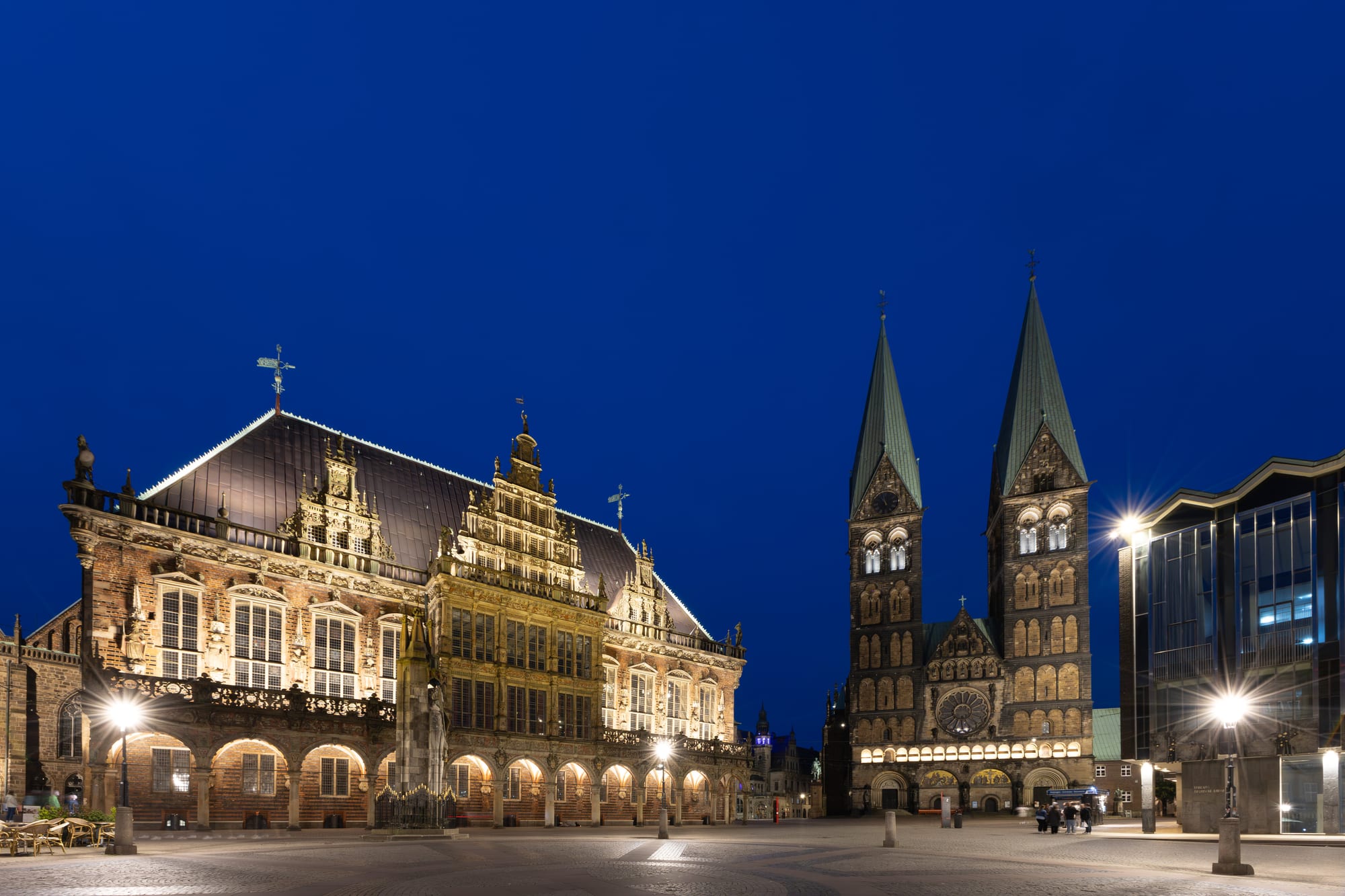
Bremen's floodlit town hall and the twin green spires of the cathedral across an empty market square at dusk

Hamburg & Northern Germany, Germany

Bremen

The town hall, the Roland statue and St Peter's Cathedral on Bremen's market square at blue hour. (Matthias Süßen / Wikimedia Commons · CC BY-SA 4.0)

A Hanseatic port city on the River Weser, some 60 km upstream from the North Sea, and with Bremerhaven a city-state of its own. Its market square of guild houses, the Gothic town hall and the Roland statue form a UNESCO World Heritage Site; today Bremen builds aircraft parts and cars, roasts coffee and follows Werder Bremen.

Neighbourhoods

  • Altstadt and the Marktplatz
    • First-time visitors
    • Historic district
    • Close to public transport

    The old town between the Weser and the old moat, the Wallgraben. The market square holds the town hall, the Roland, the cathedral and the guild houses, and Böttcherstraße leads off it towards the river.

    Open in Maps
  • Schnoor
    • Historic district
    • Shopping

    The only part of the medieval centre to keep a medieval character: crooked lanes of 17th- and 18th-century fishermen's and shippers' houses between the cathedral and the river, now lined with small shops.

    Open in Maps
  • The Schlachte
    • Nightlife
    • Riverside
    • Best for food

    The old harbour along the east bank of the Weser, now a riverside promenade with pubs, beer gardens and restaurants on one side and moored boats on the other.

    Open in Maps
  • Das Viertel
    • Nightlife
    • Arts and culture
    • Best for food

    The quarter east of the old town, between Ostertor and Steintor, with rows of 19th-century Bremen houses, the Kunsthalle and theatres along the Kulturmeile, and a young crowd in its cafés, bars and boutiques.

    Open in Maps

Things to do

Famous landmarks

  • Bremen City Halllandmark

    The seat of the city-state's mayor, one of the major examples of Brick Gothic and Weser Renaissance architecture in Europe, listed by UNESCO with the Roland in 2004.

    Open in Maps
  • Bremen Rolandlandmark

    The stone statue of 1404 on the market square, facing the cathedral, showing Charlemagne's paladin Roland as an emblem of the city's liberties.

    Open in Maps
  • Town Musicians statuelandmark

    Gerhard Marcks' bronze of 1953 beside the town hall, showing the donkey, dog, cat and rooster of the Grimm brothers' fairy tale.

    Open in Maps
  • Bremen Cathedrallandmark

    St Peter's, the twin-spired former cathedral of the prince-archbishops on the market square, now a Protestant church.

    Open in Maps
  • Böttcherstraßelandmark

    A street only about 100 m long, rebuilt between 1922 and 1931 for the coffee merchant Ludwig Roselius in a mix of Gothic and Art Nouveau styles.

    Open in Maps
  • St. Martin's Churchlandmark

    A late-Gothic brick church near the Weser, founded in 1229, severely damaged in 1944 and rebuilt after the war.

    Open in Maps

Museums

  • Kunsthalle Bremenmuseum

    An art museum of 1849 on the Kulturmeile, run by the citizens' art society, with paintings of the 19th and 20th centuries.

    Open in Maps
  • Paula Modersohn-Becker Museummuseum

    On Böttcherstraße, the first museum in the world devoted to a woman artist, showing work from every period of the early Expressionist painter.

    Open in Maps
  • Weserburgmuseum

    A museum of modern art opened in 1991 in an old factory on the Teerhof peninsula in the Weser, Europe's first museum built around private collections.

    Open in Maps
  • Overseas Museummuseum

    A natural history and ethnographic museum presenting nature, culture and trade in overseas regions, with permanent exhibitions on Asia, the South Pacific and beyond.

    Open in Maps
  • Universum Bremenmuseum

    A hands-on science museum with around 250 interactive exhibits.

    Open in Maps

Parks and the river

  • Bürgerpark and Stadtwaldpark

    A 19th-century public park near the main station, with lakes, coffee houses and lawns, joined to a city forest to the north — more than 200 hectares in all.

    Open in Maps
  • Rhododendron-Parkpark

    The world's largest collection of rhododendrons and azaleas, with a botanical garden; entry to the park is free.

    Open in Maps
  • Weserstadionattraction

    Werder Bremen's football stadium on the north bank of the Weser, about a kilometre from the centre, almost completely clad in solar panels.

    Open in Maps

Short trips from the city

  • Worpswedeattraction

    A village on the Teufelsmoor north-east of Bremen, home to an artists' colony since the end of the 19th century.

    Open in Maps
  • German Emigration Centermuseum

    In Bremerhaven, Europe's largest museum about emigration, telling the story of the Germans who sailed from the port, above all to the United States.

    Open in Maps

Seasonal events

  • BreminaleJune

    A music and arts festival on the banks of the Weser.

  • La Stradasummer

    An international street-circus festival in the city's squares and streets.

  • Freimarktsecond half of October

    One of Germany's oldest fairs, first held in 1035, a 17-day funfair with more than four million visitors a year.

  • Christmas marketDecember

    Christmas markets around the town hall and along the Schlachte on the Weser.

Eat and drink

Long-standing places and food districts in Bremen. Hours, ratings and directions come from your maps app, always current.

Bremen classics

  • Bremen Ratskellerrestaurant

    The council wine cellar under the town hall, storing and selling German wine since 1405 and holding some of the oldest wines in Germany.

    Open in Maps

Food districts

  • The Schlachteneighborhood

    Cafés, restaurants and beer gardens in a row along the Weser promenade, busiest on summer evenings.

    Open in Maps
  • Das Viertelneighborhood

    The young, lively quarter east of the Kunsthalle, with the city's densest mix of cafés, bars and small restaurants.

    Open in Maps
  • Around the Marktplatzneighborhood

    Cafés and chocolate shops around the market square and the Schnoor, where Kluten, the traditional Bremen sweet, are sold.

    Open in Maps

Experience Bremen

History

Bremen grew from an early medieval settlement on a dune beside the Weser and became the seat of a bishopric in 787. In the High Middle Ages it flourished as a trading town and joined the Hanseatic League in the 13th century, its merchants and guilds trading across the North Sea and the Baltic. To win and keep its independence the city had to contend first with the power of its archbishops and, after the Thirty Years' War, with Sweden, which ruled the surrounding duchy of Bremen-Verden. Its standing as a free city was recognised in 1720 by George I, Elector of Hanover and King of Great Britain.

In 1827 Bremen founded Bremerhaven as its seaport at the river mouth, and through its new docks it became the main port of embarkation for German and central European emigrants to the Americas. The Norddeutscher Lloyd, founded in the city in 1857, grew into one of the world's leading shipping lines, and the port became an entrepôt for Germany's late colonial trade. In the late 19th century Prussia drew Bremen into the German Empire.

After the First World War this liberal, social-democratic city was briefly a soviet republic, and under the Nazi regime it lost its autonomy. Bombing in the Second World War destroyed almost two-thirds of the city. Afterwards the old city-state was restored, together with Bremerhaven. In 2004 the town hall and the Roland were listed together as a UNESCO World Heritage Site.

Culture & Customs

The Grimm brothers' tale of the Town Musicians of Bremen — the donkey, dog, cat and rooster who set off for the city and never arrive — has made Bremen known to children around the world, and Gerhard Marcks' bronze of the four animals stands beside the town hall. The Roland on the market square, erected in 1404, is the older emblem: a symbol of the civic freedom the city defended for centuries, and still a source of pride in a place that remains a city-state of its own.

The arts are concentrated along the Kulturmeile in the Viertel, with the Kunsthalle and the theatres of Theater Bremen, and on Böttcherstraße, where the museum of Paula Modersohn-Becker recalls the artists' colony at nearby Worpswede. In 2023 Bremen was named a UNESCO City of Literature. Each year the city also hosts young musicians from around the world in the International Youth Symphony Orchestra.

Football is followed closely: Werder Bremen, which won the league and cup double in 2004, plays at the Weserstadion on the river. The Freimarkt each October, held since the 11th century, is one of the oldest fairs in Germany and the biggest funfair in the north, and in summer the Breminale and the La Strada street-circus festival fill the riverbanks and squares.

Daily Life

About 580,000 people live in Bremen, one of Germany's ten or so largest cities and the second-largest in the north after Hamburg, and it is the centre of a metropolitan region of around 2.8 million that also includes Oldenburg and Bremerhaven. Migrant workers, drawn largely from Turkey and southern Europe, settled here permanently in the post-war decades, and more recent arrivals have slowed the ageing of the population.

The ports of Bremen and Bremerhaven together are the second-largest in Germany after Hamburg's. Airbus runs its second-largest German site here, equipping the wings of its widebody aircraft, and a Mercedes-Benz plant builds cars. Food and drink companies are a Bremen speciality: Beck's beer is brewed in the city, and coffee firms such as Jacobs, Melitta and Eduscho, along with the chocolatier Hachez, are based here. The University of Bremen and its marine research institutes add students and scientists.

The city is spread out — larger by area than Munich — and its rows of 19th-century Bremen houses, the town houses typical of the city, line inner districts such as the Viertel; trams and bicycles carry much of the daily traffic. Evenings out centre on the Schlachte and the Viertel, and in winter many groups set off on a Kohl-und-Pinkel walk, a hike followed by a meal of kale and sausage.

Food

Bremen's best-known winter dish is Grünkohl mit Pinkel: kale stewed with pork belly and sausages, above all Pinkel, a smoked sausage of meat and grain eaten mainly around Bremen, Oldenburg and Osnabrück and in East Frisia. The tradition of the Kohl-und-Pinkel-Tour, or Grünkohlfahrt, joins a winter hike to a meal of kale and Pinkel with Schnaps. Knipp is another local sausage dish, made from oat groats, pork head, pork belly, rind, liver and broth, seasoned with salt, allspice and pepper.

Labskaus is the northern German port-city dish shared with Hamburg and Lübeck — salted meat or corned beef, potatoes and onion, sometimes with beetroot, pickled gherkin or herring mixed in or served alongside. Fish, from smoked eel to herring, appears on many menus, and the sweet to take home is Kluten, a traditional Bremen confection sold by the chocolatier Hachez near the town hall and in shops throughout the centre.

Several of Germany's coffee roasters are based in the city, and Beck's beer is brewed here. The Ratskeller beneath the town hall, a council wine cellar since 1405, keeps a famous collection of German wines, including some of the oldest in the country. For a casual meal, the cafés and beer gardens of the Schlachte and the small restaurants of the Viertel are where most people head.

Planning tools

Budget

Bremen is cheaper than Hamburg for rooms and meals. The old town sights — the market square, the Schnoor, Böttcherstraße and the Weser promenade — cost nothing to see, and the trams make it easy to stay a little outside the centre. Prices rise during the Freimarkt and big trade events.

Daily Budget Midrange
USD 140–260 (mid-range hotel, restaurant dinners, museum tickets, a river boat trip)
Daily Budget Shoestring
USD 65–100 (hostel bed, bakery food and Imbiss meals, tram day tickets)

Day passes and four-ride tickets cost less than single fares on the trams and buses.

Best Time to Visit

May to September, when the Schlachte's beer gardens are open and the summer festivals run on the river. The second half of October brings the Freimarkt; December the Christmas markets. Winter is the season for Grünkohl, grey and damp but rarely very cold.

Suggested Number of Days

The old town is compact and a first visit takes one or two days. Three or four allow time for the museums, the parks and the trips north to the coast and the artists' village on the moor.

First Visit
1–2 days
With Surroundings
3–4 days

Transportation

An extensive network of trams and buses fans out from the main station, which lies just north-east of the old town; night trams and buses run through most of the night at weekends. The Bremen S-Bahn reaches Bremerhaven, Oldenburg and the surrounding towns. The city is flat and cycling is a common way to get around.

Tickets can be bought on board, but day passes and multi-ride tickets are cheaper.

Airport & Station Connections

Bremen Airport is 3.5 km south of the city, with mostly European flights; tram line 6 runs from outside the terminal to the centre every 6 to 10 minutes. Bremen Hauptbahnhof is served by ICE and Intercity trains, and Hamburg Airport is the larger alternative for long-haul arrivals.

Walkability

Very good in the centre: the station, the market square, the Schnoor, the Schlachte and the Viertel all lie within a short walk of each other, on flat ground. Cobbles are uneven in the Schnoor. Trams cover the longer distances to the parks and the stadium.

Safety

Germany is a safe country with low levels of violent crime. Bremen's centre is busy and generally safe; the districts to the west and north-west of the old town are best reached by tram late at night.

Take a tram or bus rather than walking from the old town to the districts west or north-west of it late at night, and keep bags secure in festival crowds. Check current official travel advice before travelling.

Climate

Moderate oceanic, shaped by the nearby North Sea and westerly Atlantic winds: extremes are rare, rain falls in every month, and the weather changes quickly.

Summer
mild — June to August average highs of about 20–23°C
Winter
cool and damp — December to February average lows of around −1 to 0°C

Local Customs

German manners apply: punctuality matters, people shake hands with eye contact, and Herr or Frau with the surname is used until first names are offered. When paying in a restaurant, tell the server the total including any tip rather than leaving money on the table. Keep noise down late at night and on Sundays and public holidays.

Wait for 'Guten Appetit' before eating and look each person in the eye when saying 'Prost'; ask before photographing anyone.

Common Payment Methods

The currency is the euro. Cards are widely accepted in shops, hotels and larger restaurants, but some bakeries, bars and smaller places still prefer or require cash, so carry some. ATMs are easy to find in the centre and at the station.