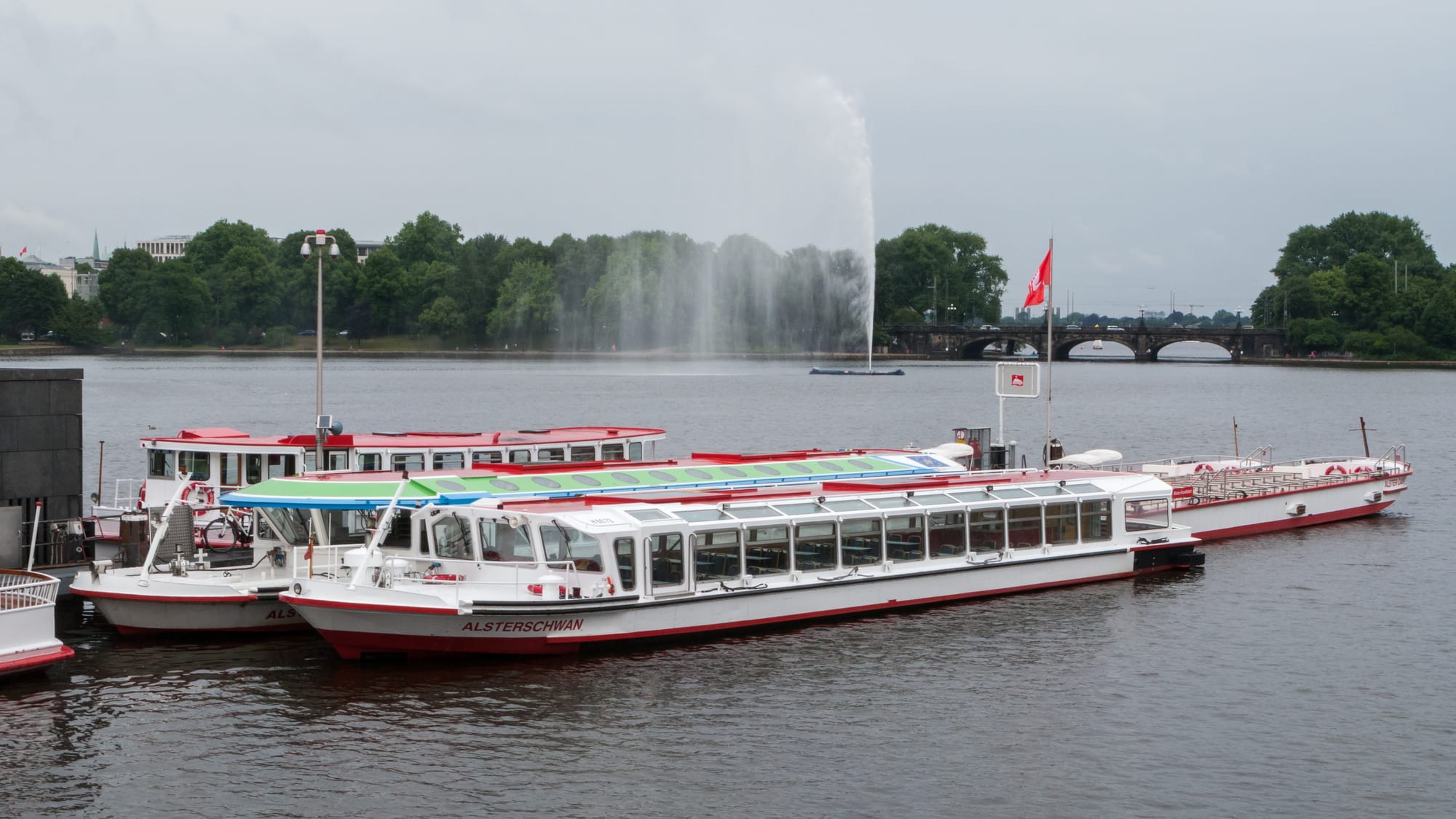
White Alster pleasure boats moored on the Binnenalster in Hamburg, with the tall Alster fountain and an arched bridge behind

Hamburg & Northern Germany, Germany

Hamburg

Alster boats moored on the Binnenalster in central Hamburg, with the Alster fountain behind. (Dietmar Rabich / Wikimedia Commons · CC BY-SA 4.0)

Germany's second-largest city and a city-state of its own, on the Elbe where the Alster and Bille meet it — a Hanseatic merchant republic whose port, still Germany's largest, made it rich. Rebuilt after the fire of 1842 and the bombing of 1943, it is a city of canals, brick warehouses and lakes, with the Elbphilharmonie on the waterfront and St. Pauli's Reeperbahn at night.

Neighbourhoods

  • Altstadt and Neustadt
    • First-time visitors
    • Shopping
    • Close to public transport

    The city centre between the Hauptbahnhof and the harbour, rebuilt after the fire of 1842, with the City Hall, the Binnenalster and the Jungfernstieg, the main churches and the brick Kontorhaus district. The Neustadt to the west holds St. Michael's and the Portuguese quarter.

    Open in Maps
  • HafenCity and the Speicherstadt
    • Architecture
    • Museums
    • Waterfront

    The warehouse district of red-brick blocks on timber piles along narrow canals, and beside it HafenCity, one of Europe's largest urban redevelopment projects, built on former port land since the 2000s. The Elbphilharmonie stands at its western tip.

    Open in Maps
  • St. Pauli
    • Nightlife
    • Music
    • Harbour views

    The harbourside quarter of the Reeperbahn, Hamburg's entertainment and red-light mile, the clubs where the Beatles played in the early 1960s, music theatres and the home ground of FC St. Pauli. The Landungsbrücken piers are on its waterfront.

    Open in Maps
  • Sternschanze
    • Cafés
    • Bars
    • Alternative culture

    The city's best-known entertainment and nightlife district after the Reeperbahn, with many bars and clubs and the Rote Flora, a squatted former theatre around which the city's alternative and punk scene gathers.

    Open in Maps
  • Ottensen
    • Local life
    • Best for food

    A former town in the Altona borough on the north bank of the Elbe, with small shops, cafés and restaurants in its old streets, close to the Elbe shore.

    Open in Maps
  • Blankenese
    • Quiet and residential
    • Riverside walks

    A former fishing village on the steep north bank of the Elbe in the west of the city, a suburban quarter on the river, independent until 1938 and today one of Hamburg's most affluent neighbourhoods.

    Open in Maps

Things to do

Famous landmarks

  • Elbphilharmonielandmark

    The concert hall opened in January 2017, a glass structure shaped like a hoisted sail or a wave set on top of an old brick warehouse, with a public plaza looking over the port.

    Open in Maps
  • Speicherstadtlandmark

    The largest warehouse district in the world standing on timber-pile foundations, built as a customs-free zone, and a UNESCO World Heritage Site together with the Kontorhaus district since 2015.

    Open in Maps
  • Chilehauslandmark

    A ten-storey office building of the 1920s in the Kontorhaus district, a landmark of Brick Expressionism whose sharp-angled corner is reminiscent of a ship's prow.

    Open in Maps
  • Hamburg City Halllandmark

    The Neo-Renaissance town hall on the Rathausmarkt, seat of the city-state's government and parliament since 1897.

    Open in Maps
  • St. Michael's Churchviewpoint

    The Michel, one of Hamburg's five Lutheran main churches, whose 132-metre copper-covered Baroque spire has long been a landmark for ships sailing up the Elbe.

    Open in Maps
  • Old Elbe Tunnellandmark

    A tunnel opened in 1911, 24 metres below the river, reached by large lifts at either end and open around the clock to pedestrians and cyclists.

    Open in Maps

Museums

  • Miniatur Wunderlandmuseum

    The largest model railway system in the world in a Speicherstadt warehouse, with more than 16 kilometres of track and one of the most visited sights in Germany.

    Open in Maps
  • Hamburger Kunsthallemuseum

    The city's main art museum beside the Hauptbahnhof, showing classical and contemporary art, with its own gallery of contemporary art, the Galerie der Gegenwart.

    Open in Maps
  • Museum für Kunst und Gewerbemuseum

    The Museum of Art and Design, a museum of fine, applied and decorative arts near the Hauptbahnhof.

    Open in Maps
  • International Maritime Museummuseum

    A museum of seafaring and naval history in an old warehouse in HafenCity, opened in 2008.

    Open in Maps

The harbour and the Elbe

  • Landungsbrückentransit hub

    The floating piers and domed terminal building at St. Pauli, starting point for harbour tours and for the HADAG ferries that are part of the public transport network.

    Open in Maps
  • Reeperbahnneighborhood

    St. Pauli's main street of bars, clubs, theatres and sex shops, the city's major red-light district, where the Beatles played in several clubs in the early 1960s.

    Open in Maps

Lakes and parks

  • Binnenalsterpark

    The smaller of the two lakes formed by damming the Alster, in the middle of the city centre, framed by the Jungfernstieg and crossed by Alster pleasure boats.

    Open in Maps
  • Außenalsterpark

    The larger of the two Alster lakes, north of the centre and separated from the Binnenalster by the Lombard and Kennedy bridges, its water and shores used for sailing, rowing and recreation.

    Open in Maps
  • Planten un Blomenpark

    A 47-hectare park in the inner city, its Low German name meaning 'plants and flowers', with water-light concerts, theatre and music performances.

    Open in Maps
  • Stadtparkpark

    A large urban park in Winterhude whose best-known landmark, a former water tower, has housed Germany's largest planetarium since 1930.

    Open in Maps
  • Ohlsdorf Cemeterypark

    The world's biggest rural cemetery, in the north of the city, opened in 1877 as the first American-style park cemetery in Germany.

    Open in Maps

Short trips from the city

  • Altes Landpark

    The reclaimed marshland on the south-west bank of the Elbe downstream from the city, the biggest contiguous fruit-producing region in northern Europe, mostly apples and cherries.

    Open in Maps
  • Lübeckneighborhood

    The Hanseatic city on its island to the north-east, entered through the Holstentor, with the brick Gothic Marienkirche and its marzipan makers.

    Open in Maps

Seasonal events

  • Hafengeburtstagearly May

    The port's birthday, celebrated with a funfair and with tall ships, naval vessels and cruise ships moored along the waterfront.

  • Hamburger DOMthree times a year — spring, summer and late autumn

    The biggest and longest-running fair in Germany, held on the Heiligengeistfeld in St. Pauli.

Eat and drink

Long-standing places and food districts in Hamburg. Hours, ratings and directions come from your maps app, always current.

Hamburg classics

  • Fischbrötchen at the Landungsbrückenneighborhood

    Kiosks along the harbour piers sell the fish roll — herring, rollmops, smoked mackerel or fried fish in a bread roll with onions and pickles.

    Open in Maps
  • Franzbrötchencafe

    Hamburg's own pastry, made like a croissant with a cinnamon and sugar filling, sold in bakeries across the city.

    Open in Maps

Food districts and markets

  • Altona Fischmarktmarket

    The early-morning Sunday market on the Elbe at Altona, Hamburg's oldest open-air market, dating back to 1703, where traders loudly praise wares of every kind.

    Open in Maps
  • Portuguese quarterneighborhood

    Streets near the harbour in the Neustadt, settled by Portuguese immigrants since the 1970s, with Portuguese restaurants, cafés and shops.

    Open in Maps
  • Sternschanzeneighborhood

    The Schanze's streets are lined with street cafés, bars and small international restaurants.

    Open in Maps

Experience Hamburg

History

Hamburg takes its name from the Hammaburg, a fortress built on a patch of high ground in the marsh between the Alster and the Elbe. In 845 a Viking fleet sailed up the Elbe and destroyed the town, which then had about 500 inhabitants. Tradition dates its rise to 1189, when Frederick Barbarossa granted its trading privileges, and its alliance with Lübeck in 1241 is regarded as the founding moment of the Hanseatic League. The Black Death of 1350 killed at least 60 per cent of the population.

As the Hansa faded, Hamburg turned to Atlantic trade. After the end of the Holy Roman Empire in 1806 it became a sovereign city-state, the Free and Hanseatic City of Hamburg. The Great Fire of 1842 destroyed about a quarter of the inner city, but in the second half of the 19th century the population more than quadrupled to 800,000 and the port became the second-largest in Europe; it was also the port from which millions of Germans and Eastern Europeans emigrated to America. The Greater Hamburg Act of 1937 added Altona, Harburg and Wandsbek to the city.

The Second World War brought deportations of the city's Jews from October 1941 and, in July 1943, the Allied firebombing codenamed Operation Gomorrah, which created a firestorm and killed at least 42,600 civilians. In February 1962 the North Sea flood flooded a fifth of the city and killed more than 300 people. Since 1990 the port has regained trade to the east, HafenCity has risen on former harbour land, the Speicherstadt and Kontorhaus district became a World Heritage Site in 2015, and the Elbphilharmonie opened in 2017.

Culture & Customs

The city's formal name, the Free and Hanseatic City of Hamburg, reflects its history as a member of the medieval Hanseatic League and a free imperial city. Low German, Hamborger Platt, was the city's original language, and 'Moin' remains the everyday greeting. Hamburg also has a reputation as the most anglophile of German cities — a local saying claims that when it starts raining in London, Hamburgers open their umbrellas.

Music is central. The Beatles lived and played in St. Pauli's clubs, among them the Star-Club, from 1960 to 1962; the Hamburger Schule movement of German-language indie rock gathered at the Golden Pudel Club near the Fischmarkt, and the Rote Flora in the Sternschanze is the hub of a large punk and alternative scene. The Elbphilharmonie and the older Laeiszhalle host classical concerts, the Reeperbahn's theatres stage long-running musicals, and the city has one of the highest densities of music venues in Germany.

Football divides the city between Hamburger SV, six times German champion and winner of the European Cup in 1983, who play at the Volksparkstadion, and FC St. Pauli, the left-leaning club of the Millerntor-Stadion. The calendar includes the Hafengeburtstag and the DOM funfair three times a year, voters have twice rejected Olympic bids, in 2015 and again in May 2026, and the city has the largest Portuguese community in Germany, about 30,000 people.

Daily Life

About 1.87 million people lived in Hamburg at the end of 2025, making it the second-largest city in Germany, and more than 5.1 million in its metropolitan region. The city-state is divided into seven boroughs and 104 quarters. About a third of residents have a migrant background, and around two-thirds belonged to no church or to other faiths in 2018. Many live in the 19th-century apartment blocks of the inner quarters, in the villas of the Elbe and Alster shores, or in the large post-war estates on the edges.

The port, Germany's largest and Europe's third-largest after Rotterdam and Antwerp, remains the core of the economy, together with logistics and shipping. Airbus builds aircraft at Finkenwerder, and Blohm + Voss, Aurubis, Beiersdorf and Unilever have major sites here, alongside Lufthansa's maintenance base at the airport and a large media industry. Hamburg is one of Europe's richest regions per head, yet unemployment has been above the German average, and the cost of housing is a constant issue.

Water shapes the daily rhythm: commuters ride ferries across the harbour, boats crowd the Alster in summer, and on warm evenings people barbecue on the Elbe beaches or sit in the street cafés of the Schanze. Some 2,500 bridges cross the city's rivers and canals, more than in any other city in Europe.

Food

Hamburg's food comes from the port, the river and the marshes. The Fischbrötchen — a bread roll filled with Bismarck or soused herring, rollmops, smoked mackerel or fried fish, with onions, pickles or remoulade — is eaten standing up at the harbour. Old Hamburg dishes include Birnen, Bohnen und Speck, green beans cooked with pears and bacon; Finkenwerder Scholle, pan-fried plaice; Pannfisch, pan-fried fish in mustard sauce; and Labskaus, a northern German dish of corned beef, potato and beetroot. Hamburg's Aalsuppe is often taken to mean eel soup, but its name probably comes from a Low German word for 'all' — a soup of everything in the kitchen.

For dessert there is Rote Grütze, a red-berry pudding related to the Danish rødgrød, and in the city's bakeries the Franzbrötchen, a croissant-like pastry rolled with cinnamon and sugar. Hamburg's cooking has much in common with that of Denmark and Copenhagen.

The city's long trading history shows in its restaurants. Portuguese sailors and merchants have come since the 15th century, and the Portuguese quarter near the harbour, settled since the 1970s, is full of Portuguese restaurants and cafés. The Sunday-morning Fischmarkt at Altona, the street cafés of the Schanze and the restaurants of Ottensen are the other places where the city eats out.

Planning tools

Budget

Hamburg is not a cheap city, above all for hotels, which rise further during trade fairs and big events such as the Hafengeburtstag. Fish rolls, bakeries and the ferries, which run on ordinary public transport tickets, keep some costs down.

Daily Budget Midrange
USD 170–300 (mid-range hotel, restaurant dinners, a harbour tour, museum tickets)
Daily Budget Shoestring
USD 70–115 (hostel bed, fish rolls and bakery food, a public transport day ticket including the harbour ferries)

The HADAG harbour ferries from the Landungsbrücken are part of the public transport network, so an ordinary ticket gives a cheap tour of the port; hotel prices often fall at weekends when the trade fairs are over.

Best Time to Visit

May to September, when the Alster fills with boats, the Elbe beaches are busy and the evenings are long; the Hafengeburtstag opens the season in early May. Autumn and winter are grey, damp and windy, but the concert halls, theatres, museums and Advent markets keep the city lively.

Suggested Number of Days

Two or three days covers a first visit to the city centre, the port and the main quarters. Four or five allows time for the Elbe shore, the countryside south of the river and a trip along the coast. Concerts and nightlife add to the number.

First Visit
2–3 days
With Surroundings
4–5 days

Transportation

The HVV network ties together six S-Bahn lines, four U-Bahn lines, buses and eight HADAG ferry lines on the Elbe, all on the same tickets. Much of the U-Bahn runs above ground on viaducts and embankments, giving views of the harbour. Cycling is common, and the Alster lakes can be crossed by boat in summer.

Buy a day ticket for sightseeing — it covers the harbour ferries as well as trains and buses.

Airport & Station Connections

Hamburg Airport is in Fuhlsbüttel, about 8.5 kilometres north of the city centre, and the S-Bahn S1 runs from the terminal to the Hauptbahnhof every ten minutes. The Hauptbahnhof is one of the main rail hubs of the north, with ICE trains to Berlin and regional trains to Lübeck in about 45 minutes.

Walkability

The city centre, the Speicherstadt, HafenCity and St. Pauli lie close together along the water and are pleasant to walk, especially on the promenades by the harbour and the Alster. Hamburg is large, though, and outer quarters such as Blankenese need the S-Bahn or a ferry. Wind and rain are frequent companions.

Safety

Germany is a safe country with low levels of violent crime. In Hamburg, pickpocketing around the Hauptbahnhof and on the Reeperbahn late at night is the main risk, and drunken crowds are the chief nuisance in St. Pauli at weekends. Storm surges can flood low-lying parts of the waterfront such as HafenCity.

Keep bags close at the Hauptbahnhof and on the Reeperbahn, and heed flood warnings on the waterfront during storms. Check current official travel advice before travelling.

Climate

Oceanic, mild and changeable, with rain in every month and frequent wind from the Atlantic. The record high, 40.1°C, was measured in July 2022.

Summer
mild, with average highs of about 20–23°C in June, July and August
Winter
cool and damp, with average lows of about −0.3 to 1°C from December to February

Local Customs

'Moin' is the greeting at any time of day. Service is included in restaurant prices, and tips are modest, usually a matter of rounding up. Dress is smart-casual.

Keep out of the cycle lanes, and avoid photographing people in the Reeperbahn's red-light streets, where it is unwelcome.

Common Payment Methods

The currency is the euro. Cards and contactless payment are widely accepted, but some bakeries, kiosks, bars and market stalls still prefer cash, so it is worth carrying some. ATMs are easy to find.