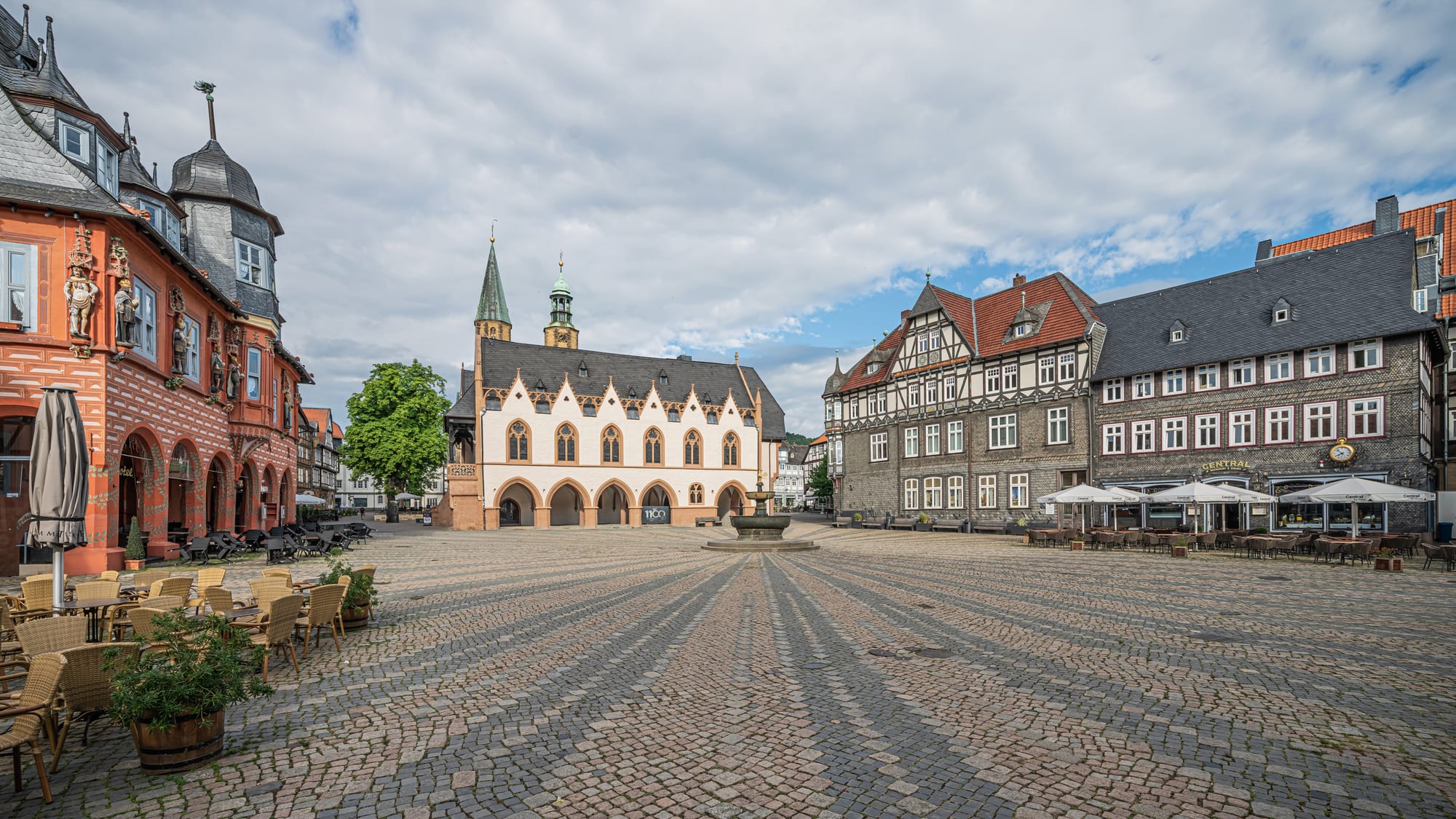
Goslar's cobbled market square with the arcaded town hall, a fountain, café chairs and timber-framed houses

Hamburg & Northern Germany, Germany

Goslar

The market square in Goslar, with the town hall and the cloth merchants' guildhall. (A.Savin / Wikimedia Commons · FAL)

A town on the north-western edge of the Harz mountains in Lower Saxony, made rich by the silver of the Rammelsberg mine and favoured by medieval emperors, who built an imperial palace here. Its old town of more than 1,500 timber-framed houses and the mine, worked for over a thousand years until 1988, are a UNESCO World Heritage Site.

Neighbourhoods

  • The Old Town
    • First-time visitors
    • Historic district
    • Best for food

    The walled medieval town around the market square, with more than 1,500 timber-framed houses, Romanesque churches, guildhalls and the Imperial Palace at its southern edge. The little River Gose runs through it.

    Open in Maps
  • Frankenberg quarter
    • Historic district
    • Quiet and residential

    The quarter where the miners of the Rammelsberg lived, close to the mines, around their parish church, the Frankenberg Church.

    Open in Maps
  • Hahnenklee
    • Nature
    • Skiing
    • Walking

    A borough of about 1,200 people up in the Harz between Goslar and Osterode, with walking and winter sports and a Norwegian-style wooden stave church.

    Open in Maps

Things to do

The imperial and mining town

  • Imperial Palacelandmark

    The palace complex at the foot of the Rammelsberg, built from the 11th century and a favourite residence of the Salian emperors; the Kaiserhaus was extensively restored in the late 19th century, with historical murals inside.

    Open in Maps
  • Rammelsberg minemuseum

    A silver, copper and lead mine that had worked continuously for more than 1,000 years when it closed in 1988, now a museum and visitor mine with tours above and below ground and a ride on the miners' train.

    Open in Maps
  • Cathedral porchlandmark

    The north porch is all that survives of the imperial collegiate church of St Simon and St Jude, built between 1040 and 1050 and largely demolished by 1822.

    Open in Maps
  • Market Churchlandmark

    The twin-spired town church of Saints Cosmas and Damian, first mentioned in 1151; its north tower can be climbed for a view over the roofs.

    Open in Maps
  • Town hall and Hall of Homagelandmark

    The town hall on the market square, whose Hall of Homage can be seen on guided tours of the old town.

    Open in Maps
  • Zwingerlandmark

    A massive battery tower of the town's fortifications, built on the side of town overlooked by the Rammelsberg hill; it now houses a small museum of medieval weapons and armour.

    Open in Maps
  • Mönchehaus Museummuseum

    A renowned museum of modern art, which each year shows the work of the winner of the town's Kaiserring art prize.

    Open in Maps

Short trips into the Harz

  • Gustav Adolf Stave Churchlandmark

    A wooden church in the style of a Norwegian stave church, begun in 1907 in Hahnenklee.

    Open in Maps
  • Upper Harz Water Regaleattraction

    A system of dams, reservoirs and ditches built mostly from the 16th to the 19th centuries to power the mines of the Upper Harz.

    Open in Maps
  • Bad Harzburgattraction

    A spa town on the northern edge of the Harz, in the Goslar district.

    Open in Maps
  • Brockenviewpoint

    At 1,141 m the highest peak of the Harz, also known as the Blocksberg, near Schierke in Saxony-Anhalt.

    Open in Maps
  • Wernigerodeattraction

    A town in Saxony-Anhalt in the Harz district, with a population of about 32,000.

    Open in Maps

Seasonal events

  • Hanseatic Daysspring, usually during the Easter holidays

    A spring festival in the old town recalling Goslar's membership of the Hanseatic League.

  • Artisans' marketusually early August

    An annual craft market in the streets of the old town.

  • Christmas marketAdvent

    An Advent market around the market square, with a lit Christmas forest of spruces on the Schuhhof; in 2025 it was named one of the 12 best Christmas markets in Europe.

Eat and drink

Long-standing places and food districts in Goslar. Hours, ratings and directions come from your maps app, always current.

Food and drink in the old town

  • Around the market squareneighborhood

    Cafés and restaurants with outdoor tables around the market square and the Market Church, at the centre of the old town.

    Open in Maps
  • Along the Goseneighborhood

    Restaurants beside the little River Gose, among them one in an old mill and another in the former chefs' guildhall.

    Open in Maps
  • Weekly marketmarket

    Once a week farmers come into town to sell their local produce.

    Open in Maps

Experience Goslar

History

Ore has been mined in the Harz since Roman times, and the settlement on the Gose creek is first recorded in a deed of Emperor Otto II in 979, probably beside an existing royal palace. Its importance grew with the discovery of rich silver deposits at the nearby Rammelsberg. From 1009 Henry II held imperial synods here, and Conrad II laid the foundations of a new imperial palace in 1025. His son Henry III made Goslar his favourite residence, staying about twenty times; his son, the future Henry IV, was born here in 1050, and in 1051 the collegiate church known as the cathedral was consecrated. Henry III's heart was buried in Goslar.

Control of the silver brought conflict. Henry IV's hold on the mines helped provoke the Saxon revolt of 1073–1075, and in 1180 Henry the Lion had the mines devastated. The town received market rights in 1025, had a council by 1219 and joined the Hanseatic League in 1267, trading in Gose beer and later slate and vitriol. From 1527 the dukes of Brunswick-Wolfenbüttel seized the mines and edged out the council, though Goslar kept its status as a free imperial city. Swedish troops occupied it from 1632 to 1635.

In 1802 Prussia annexed the town, which passed through the Kingdom of Westphalia to the Kingdom of Hanover; the cathedral was sold and demolished in 1820–1822. Back under Prussia after 1866, Goslar became a garrison town and a favoured place to retire, and the Hohenzollern emperors restored the palace. In the Cold War it was a garrison town near the inner German border. The Rammelsberg closed in 1988 after more than a thousand years, and in 1992 the mine and the old town became a UNESCO World Heritage Site.

Culture & Customs

Goslar's identity rests on silver and empire. The old town's timber-framed houses, its guildhalls and its Romanesque churches reflect a medieval prosperity built on the mine, and the restored Kaiserhaus, with its 19th-century murals by Hermann Wislicenus, recalls the emperors who held court here. The Rammelsberg is now a museum of mining history and part of the European Route of Industrial Heritage.

Since 1975 the town has awarded the Goslarer Kaiserring, a prize for modern art whose winners include Henry Moore, Joseph Beuys and Christo; the winner's work is shown at the Mönchehaus Museum. The alternative theatre Kulturkraftwerk Harz occupies a disused power station.

The year's festivals include the Hanseatic Days in spring and the artisans' market in August, and the Advent market fills the old town at the end of the year. A legend tells that the Rammelsberg takes its name from Ramm, a knight of Otto the Great, who tied his horse to a tree while out hunting. Outdoor life matters too: the Harz offers walking, climbing, mountain biking and skiing, and the town's oldest sports club, MTV Goslar, dates from 1849.

Daily Life

Goslar had 50,184 inhabitants at the end of 2020, including Vienenburg — about 50,000 — and is the administrative centre of the district of Goslar. Tourism, services and the town's role as the shopping centre of the northern Harz carry the economy. Department stores, supermarkets, boutiques and restaurants fill the old town, and farmers sell local produce at the weekly market.

The palace and a large hotel serve as conference venues, most notably for the annual German road traffic law conference, the Deutscher Verkehrsgerichtstag, and a private hospital serves the wider Harz region. A park-and-ride system serves commuters to Braunschweig and Hanover.

The boroughs stretch from Oker on the river to Jürgenohl and up to Hahnenklee in the mountains. Life follows the seasons of the Harz: walkers and cyclists in summer, foliage in autumn, the Advent market at the end of the year and skiing in the higher Harz in winter.

Food

Goslar gave its name to Gose, a beer first brewed in the town at some point between 1181 and 1470 and named after the River Gose. It is a warm-fermented beer made with at least half malted wheat, flavoured with coriander and salt, with lactic acid as its main flavour, so it tastes tart, light and strongly carbonated, with little hop bitterness and 4 to 5 per cent alcohol. Because of the coriander and salt it falls outside the German beer purity law, and is allowed as a regional speciality. Gose was later popular for centuries in Leipzig, but its home is here, and trade in it was once important to Goslar.

The other taste of the region is Harzer cheese, a sour-milk cheese from the Harz made from low-fat curd, usually flavoured with caraway. It comes small and round, as Handkäse or Taler, or in cylinders, as Stangenkäse, and the round cheeses are often sold stacked in a roll. Some varieties ripen with a white mould, others with a red one, which generally gives a stronger flavour; Harzer has a distinctive strong smell.

Restaurants cluster around the market square and along the Gose, where one occupies an old mill and another the former guildhall of the cooks, and the weekly market brings in produce from the surrounding farms.

Planning tools

Budget

Goslar and the Harz are among the best-value corners of western Germany. Rooms and meals cost less than in the big northern cities, though prices rise in the Advent season and on summer weekends. The old town itself is free to wander; the mine and the palace charge admission.

Daily Budget Midrange
USD 130–230 (mid-range hotel or guesthouse, restaurant dinners, mine tour and palace tickets)
Daily Budget Shoestring
USD 65–100 (youth hostel or guesthouse, bakery and Imbiss food, regional buses)

The mine offers several different tours above and below ground at different prices; choosing one or two is enough for most visitors.

Best Time to Visit

May to October for walking in the Harz and the old town's outdoor cafés, with the artisans' market in August. Autumn is good for the forests, and Advent brings the Christmas market around the market square; the higher Harz has snow and skiing for much of the winter.

Suggested Number of Days

One or two days cover the old town, the palace and the mine. Three to five days allow time for the Harz mountains, the neighbouring towns and walking or skiing, depending on the season.

First Visit
1–2 days
With Surroundings
3–5 days

Transportation

The old town is walked, not driven. Town buses link the centre with the boroughs of Oker, Jürgenohl and Hahnenklee, and regional buses from the central bus station at the railway station run to Bad Harzburg, Clausthal-Zellerfeld and other places in the Harz. A car makes the mountains easier to explore.

A single ticket covers connected journeys by regional train and bus, so there is no need to buy a new one at each change.

Airport & Station Connections

Goslar lies about 70 km south-east of Hanover and about 40 km south of Braunschweig. Regional trains run from Hanover, Braunschweig, Göttingen, Halle and Magdeburg; travellers from further afield change from the ICE at Hanover, Göttingen or Halle. Hannover Airport is the nearest large airport, connected to Hanover's S-Bahn network.

Walkability

Excellent: the old town is compact, and the station, the market square and the Imperial Palace are within easy walking distance. Streets are cobbled and the climb to the Rammelsberg mine at the edge of town is uphill. The Harz trails begin close to town.

Safety

Germany is a safe country with low levels of violent crime. Goslar is a quiet town; the main things to watch are icy cobbles in winter and the weather on Harz walks, which can change quickly.

Take warm, waterproof clothing into the mountains, keep to marked trails, and keep bags secure in the Christmas market crowds. Check current official travel advice before travelling.

Climate

Temperate and changeable, cooler and snowier in the Harz above the town than on the plain to the north.

Summer
mild — in Braunschweig, about 40 km north, July averages around 18.7°C
Winter
cold and grey — in Braunschweig, January averages around 1.8°C, with snow in the Harz

Local Customs

German manners apply: punctuality matters, people shake hands with eye contact, and Herr or Frau with the surname is used until first names are offered. When paying in a restaurant, tell the server the total including any tip rather than leaving money on the table. Keep noise down late at night and on Sundays and public holidays.

Wait for 'Guten Appetit' before eating and look each person in the eye when saying 'Prost'; ask before photographing anyone, and respect services in the churches.

Common Payment Methods

The currency is the euro. Cards are accepted in most hotels, shops and larger restaurants, but bakeries, cafés and market stalls may prefer cash, so carry some. ATMs are found in the old town and at the station.