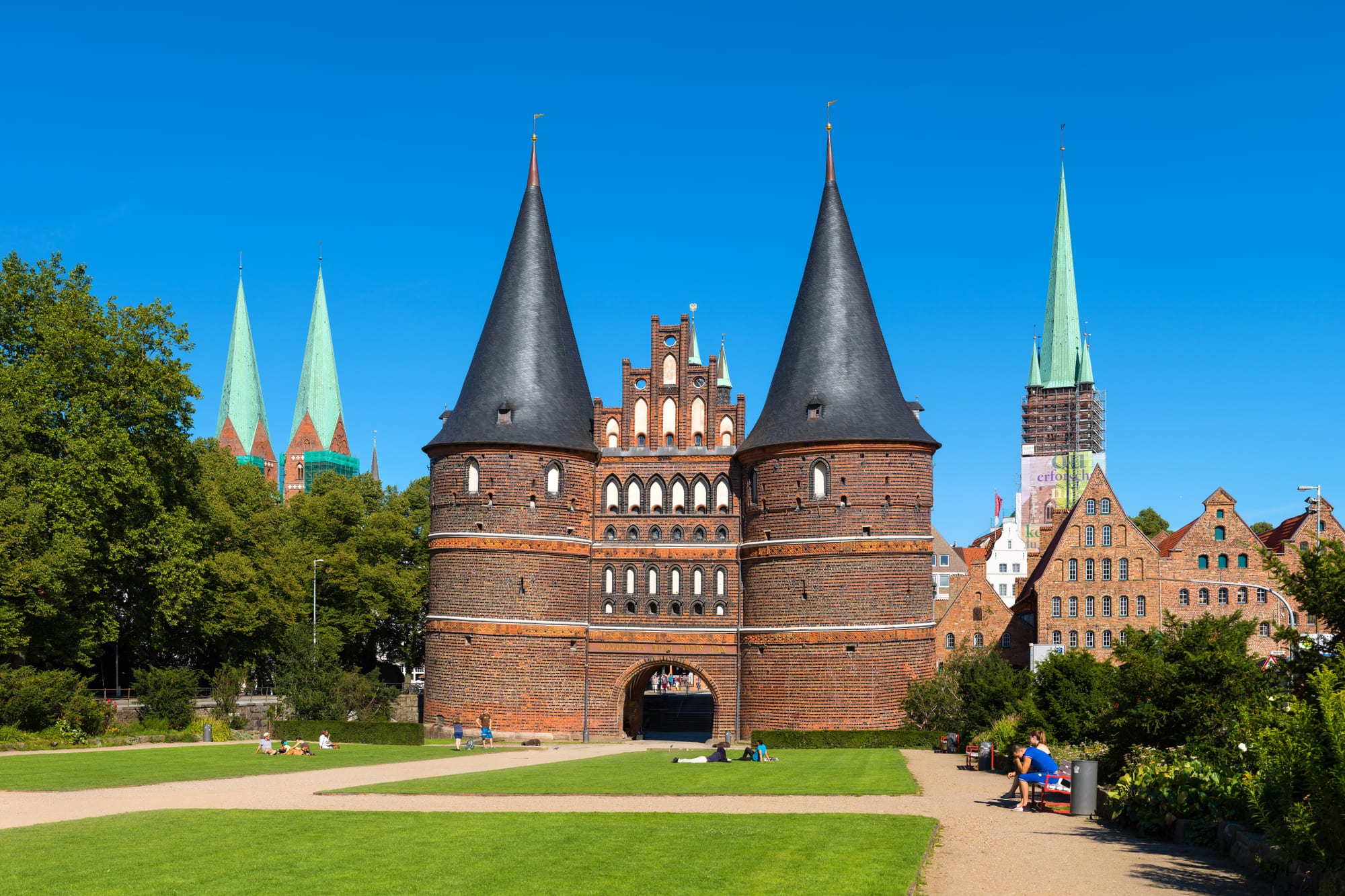
The brick Holstentor with its two conical towers on a lawn, with green church spires and gabled salt warehouses

Hamburg & Northern Germany, Germany

Lübeck

The Holstentor seen from Holstenplatz, with the spires of St Mary's and St Peter's behind and the historic Salzspeicher in front. (Christian Wolf (www.c-w-design.de) / Wikimedia Commons · CC BY-SA 3.0 de)

The old capital of the Hanseatic League, on the River Trave near the Baltic coast of Schleswig-Holstein. Its brick Gothic old town fills an island ringed by water, entered through the Holstentor and marked by seven church towers, and is a UNESCO World Heritage Site. Today it is a port, university and marzipan city with a seaside borough at Travemünde.

Neighbourhoods

  • The old town island
    • First-time visitors
    • Historic district
    • Museums

    The densely built island between the Trave and the Wakenitz holds the town hall, the market, St Mary's, the cathedral and most of the museums. Off the main streets run the Gänge, narrow passages leading to tiny houses in the back courtyards.

    Open in Maps
  • Koberg and the northern old town
    • Historic district
    • Best for food

    A particularly well-preserved 13th-century quarter at the island's northern end, around the Koberg square, the Hospital of the Holy Spirit, St James' and the Burgtor gate. The guildhall of the ship captains, now a restaurant, faces St James'.

    Open in Maps
  • St. Gertrud and the Wakenitz
    • Quiet and residential
    • Parks

    The borough north-east of the old town, along the Wakenitz river, with the city park and the old fishing village of Gothmund, a group of thatched fishermen's cottages on the bank of the Trave.

    Open in Maps
  • Travemünde
    • Beaches
    • Seaside resort
    • Ferries

    Lübeck's seaside borough at the mouth of the Trave, a resort with a long beach and also the city's main port, where ferries leave the Skandinavienkai for Scandinavia and the Baltic states. The four-masted barque Passat lies moored at the mouth of the Trave.

    Open in Maps

Things to do

Famous landmarks

  • Holstentorlandmark

    The Brick Gothic western gate of the old town, begun in 1464, with its two round towers and arched entrance — the symbol of the city and one of only two medieval gates to survive.

    Open in Maps
  • St Mary's Churchlandmark

    The merchants' and council's church on the highest point of the island, built between 1265 and the 1350s, the model for Brick Gothic churches around the Baltic, with the tallest brick vault in the world.

    Open in Maps
  • Lübeck Cathedrallandmark

    The brick cathedral begun by Henry the Lion in 1173, the first large brick church in the Baltic region, damaged in the 1942 raid and rebuilt, with works by Bernt Notke inside.

    Open in Maps
  • St Peter's Churchlandmark

    A church first mentioned in 1170, severely damaged in the Second World War and restored by 1987; with its furnishings lost, it is used for special services rather than as a parish church.

    Open in Maps
  • Burgtorlandmark

    The northern city gate, built in 1444 in late Gothic style, with a Baroque helmet roof added in 1685.

    Open in Maps
  • Salzspeicherlandmark

    Six brick storehouses of the 16th to 18th centuries beside the Holstentor, where salt from Lüneburg waited for shipment to Baltic ports.

    Open in Maps
  • Hospital of the Holy Spiritlandmark

    A medieval hospital at the northern end of Königstraße, whose halls hold a handicrafts market during the Christmas season.

    Open in Maps

Museums and the stage

  • European Hansemuseummuseum

    Opened in 2015, the largest museum in the world devoted to the Hanseatic League, on the Untertrave at the northern edge of the old town.

    Open in Maps
  • St. Anne's Museum Quartermuseum

    A former Augustinian convent holding one of Germany's largest collections of medieval sculpture and altarpieces, including the altar by Hans Memling once in the cathedral.

    Open in Maps
  • Behnhausmuseum

    An art museum in a neoclassical house, known for its Nazarene paintings and its works by Edvard Munch.

    Open in Maps
  • Buddenbrookhausmuseum

    The house in Mengstraße near St Mary's, dedicated to Thomas Mann and his family and to the novel Buddenbrooks.

    Open in Maps
  • Willy-Brandt-Hausmuseum

    A museum and memorial to the chancellor and Nobel Peace Prize winner Willy Brandt.

    Open in Maps
  • Theater Lübeckattraction

    One of the largest theatres in Schleswig-Holstein, staging opera, drama and concerts on the Beckergrube.

    Open in Maps

The water and the coast

  • Lisa von Lübeckattraction

    A reconstruction of a 15th-century Hanseatic caravel, berthed with other historic vessels in the museum harbour on the Trave.

    Open in Maps
  • Travemünde beachbeach

    The long beach of the resort at the river mouth, which makes Travemünde the city's most popular destination after the old town, reached by bus, boat or train from the city centre.

    Open in Maps
  • Passatattraction

    One of the last surviving windjammers, a four-masted steel barque bought by Lübeck in 1959 and moored at Travemünde as a museum ship and landmark.

    Open in Maps
  • Ratzeburgattraction

    A small town to the south set on an island in a ring of four lakes, reached from Lübeck by water along the Wakenitz or by road.

    Open in Maps

Seasonal events

  • Travemünde WeekJuly

    Germany's second-largest sailing regatta week, held off Travemünde since 1889, with tens of thousands of visitors.

  • Nordic Film Daysearly November

    A festival of films from the Nordic and Baltic countries, held since 1956 over five days at the beginning of November.

  • Christmas marketlate November to December

    Markets on the market square and around the old town, with the craft market in the halls of the Hospital of the Holy Spirit and an artisans' market on the Koberg.

Eat and drink

Long-standing places and food districts in Lübeck. Hours, ratings and directions come from your maps app, always current.

Lübeck classics

  • Café Niedereggercafe

    The café and shop of the marzipan maker founded in 1806, on Breite Straße opposite the town hall, with a marzipan museum on its upper floor.

    Open in Maps
  • Schiffergesellschaftrestaurant

    The ship captains' guildhall of 1535 at the Koberg, its original interior intact and ship models hanging from the ceiling, now the city's best-known restaurant.

    Open in Maps

Cafés and pubs

  • Old town cafés and Kneipenneighborhood

    The old town has a high density of cafés and Kneipen (pubs), many of them in the side streets away from Breite Straße and Königstraße.

    Open in Maps

Experience Lübeck

History

A Slavic settlement called Liubice stood at the meeting of the Schwartau and the Trave before 819, and by the 10th century it was one of the main places of the Obotrites. In 1143 Adolf II, Count of Holstein, founded a new town on the river island of Bucu; after a fire in 1157 Henry the Lion took over the site in 1159 and rebuilt it, and in 1160 it received town rights. In 1226 Emperor Frederick II made it a Free Imperial City, subject to no one but the emperor.

From the middle of the 12th century Lübeck grew into the cradle of the Hanseatic League, the trading network of German merchant towns, and became its leading city and de facto capital: the league's assemblies met here regularly from the middle of the 14th century. Salt from Lüneburg, stored in the Salzspeicher, went out to the Baltic ports, and the merchants' wealth paid for St Mary's and the brick churches whose seven towers still mark the skyline. Decline came slowly as European trade turned to the Atlantic and the Thirty Years' War broke the league's cooperation, though the city remained an important Baltic port in the 19th century.

Lübeck stayed an independent state until 1 April 1937, when the Greater Hamburg Act merged it into Prussian Schleswig-Holstein. On 28 March 1942 an RAF raid caused a firestorm in the old town. After the war refugees from the east swelled the population, and during the Cold War it was the only large West German city directly on the inner German border, which cut it off from its eastern hinterland. In 1987 UNESCO listed the old town as a World Heritage Site; reunification in 1990 brought new residents from the former East.

Culture & Customs

Lübeck calls itself the City of the Seven Towers, after the spires of its five main Protestant churches, and its identity rests on the Hanseatic past — the city still uses the title Hansestadt. Music has deep roots here: the organist Franz Tunder began the tradition of evening concerts in St Mary's, and Dieterich Buxtehude, who succeeded him in 1668, made those Abendmusiken famous. The Lübeck Academy of Music keeps the tradition of serious music alive in the old town.

The city is also a literary one. Thomas Mann came from a family of Lübeck merchants, and his 1901 novel Buddenbrooks made the manners of its 19th-century merchant class familiar to readers around the world; the Buddenbrookhaus is devoted to him and his family. Günter Grass lived just outside the city from 1995 until his death, and Willy Brandt is remembered at the Willy-Brandt-Haus. One of the Salzspeicher served as the vampire's house in Murnau's film Nosferatu.

The local speech belongs to the Holsatian dialect of Low German. Each November the Nordic Film Days, held since 1956, bring films from the Nordic and Baltic countries, and in July the sailing crowds gather for Travemünde Week. December is the city's other great season, when Christmas markets fill the market square, the Koberg and the halls of the Hospital of the Holy Spirit and visitors arrive for marzipan.

Daily Life

About 223,000 people lived in Lübeck at the end of 2025, making it the second-largest city in Schleswig-Holstein after Kiel, and it belongs to the wider metropolitan region of Hamburg. Most of them live in the boroughs that spread around the old town island, from St. Jürgen and St. Lorenz to Kücknitz and Travemünde on the coast.

The port is the second-largest German port on the Baltic after Rostock, and the Skandinavienkai at Travemünde is Germany's most important ferry port, with sailings to Scandinavia and the Baltic countries. The University of Lübeck with its medical centre, the Technical University of Applied Sciences and the Academy of Music bring students and researchers, and tourism — to the old town and to the resorts along Lübeck Bay — is an important part of the economy. Marzipan making continues on an industrial scale.

Summer weekends pull residents to the beach at Travemünde and the resorts beyond it, and to boats on the Wakenitz; in winter life turns inward to cafés, Kneipen and, in December, the markets.

Food

Lübeck is best known for marzipan. A local legend says it was invented here when a siege or famine left nothing but stored almonds and sugar, though others place its origin in Persia centuries earlier. What is certain is that Lübeck, as the Hanseatic trading hub, had a steady supply of imported almonds, and by the 18th century its marzipan was known for a high almond content. Lübeck Marzipan has been a protected geographical indication since 1996 and may contain no more than 30 per cent sugar; the fine grade, no more than 10 per cent.

Niederegger, founded in 1806, is the best-known maker. Its café and shop on Breite Straße draw visitors all year, especially at Christmas, and a small museum upstairs shows historical wooden moulds and figures sculpted from marzipan. Carstens and other makers also produce it in the city.

The other local speciality is Rotspon, a red wine whose grapes are processed and fermented in France and then shipped in wooden barrels to Lübeck, where it is aged and bottled — a trade dating back to Hanseatic times, and the wine is sold in nearly every shop. For a meal with history, the Schiffergesellschaft at the Koberg serves dinner under ship models hanging from the ceiling of the captains' guildhall of 1535. Fish rolls are the cheap meal of the northern coast, and the old town is dense with cafés and Kneipen.

Planning tools

Budget

Hamburg is the dearer city of the north; in Lübeck prices rise in Travemünde in the summer beach season and across the old town during the Christmas markets. Most of the pleasure of the place — walking the island, the churches, the riverbanks — costs nothing.

Daily Budget Midrange
USD 150–280 (mid-range hotel, restaurant meals, museum tickets, a harbour boat trip)
Daily Budget Shoestring
USD 70–110 (hostel bed, bakery food and fish rolls, buses and regional trains)

The LübeckCard from the tourist office gives discounts on museums and tours; book Travemünde rooms well ahead for July and August.

Best Time to Visit

May to September for long light evenings, river boats and the Travemünde beach, with the sailing week in July. December is the other high season, when the Christmas markets fill the old town. Early November brings the Nordic Film Days; winter otherwise is grey, damp and quiet.

Suggested Number of Days

The old town island is compact, and one or two days cover a first visit. Three or four days allow time for the Baltic coast and the lakes to the south as well, and for the museums at a slower pace.

First Visit
1–2 days
With Surroundings
3–4 days

Transportation

The old town is walkable, and an extensive bus network centred on the ZOB bus station beside the main railway station covers the rest of the city, with night buses at weekends. Buses, trains and boats run to Travemünde. The Deutschlandticket is valid on all local buses, and tourist boats circle the old town on the river.

Heavy lorry traffic to the Travemünde port slows the A1 motorway from Hamburg; the train is usually the easier choice.

Airport & Station Connections

Hamburg Airport is the main air gateway: the S-Bahn reaches Hamburg Hauptbahnhof in about 25 minutes, and Regional Express trains to Lübeck, running every 30 minutes, take about 45 more. The small Lübeck Airport, 8 km south of the city, has a few international and charter flights. Long-distance buses stop at the ZOB, and ferries from Scandinavia and the Baltic states dock at Travemünde.

Walkability

Excellent on the island, where nearly everything is within a short walk and the station is just across the river from the Holstentor. Streets are cobbled in places and the island rises gently to St Mary's. Travemünde and the outer boroughs need a bus.

Safety

Germany is a safe country with low levels of violent crime. Lübeck is a calm city; the main things to watch are pickpockets in the Christmas market crowds and, on the coast, the Baltic weather.

Keep bags secure in crowded markets and swim at lifeguarded beaches in Travemünde. Check current official travel advice before travelling.

Climate

Oceanic, mild and changeable, with rain in every season and the sea softening both summer and winter.

Summer
mild — average temperatures around 18°C, with a handful of days above 30°C most years
Winter
cool and grey — average temperatures around 2°C

Local Customs

German manners apply: punctuality matters, people shake hands with eye contact, and Herr or Frau with the surname is used until first names are offered. When paying in a restaurant, tell the server the total including any tip rather than leaving money on the table. Keep noise down late at night and on Sundays and public holidays.

Wait for 'Guten Appetit' before eating and look each person in the eye when saying 'Prost'; ask before photographing anyone, and the churches are working places of worship.

Common Payment Methods

The currency is the euro. Cards are widely accepted in shops, hotels and larger restaurants, but some bakeries, bars and smaller places still prefer or require cash, so carry some. ATMs are easy to find in the old town and at the station.