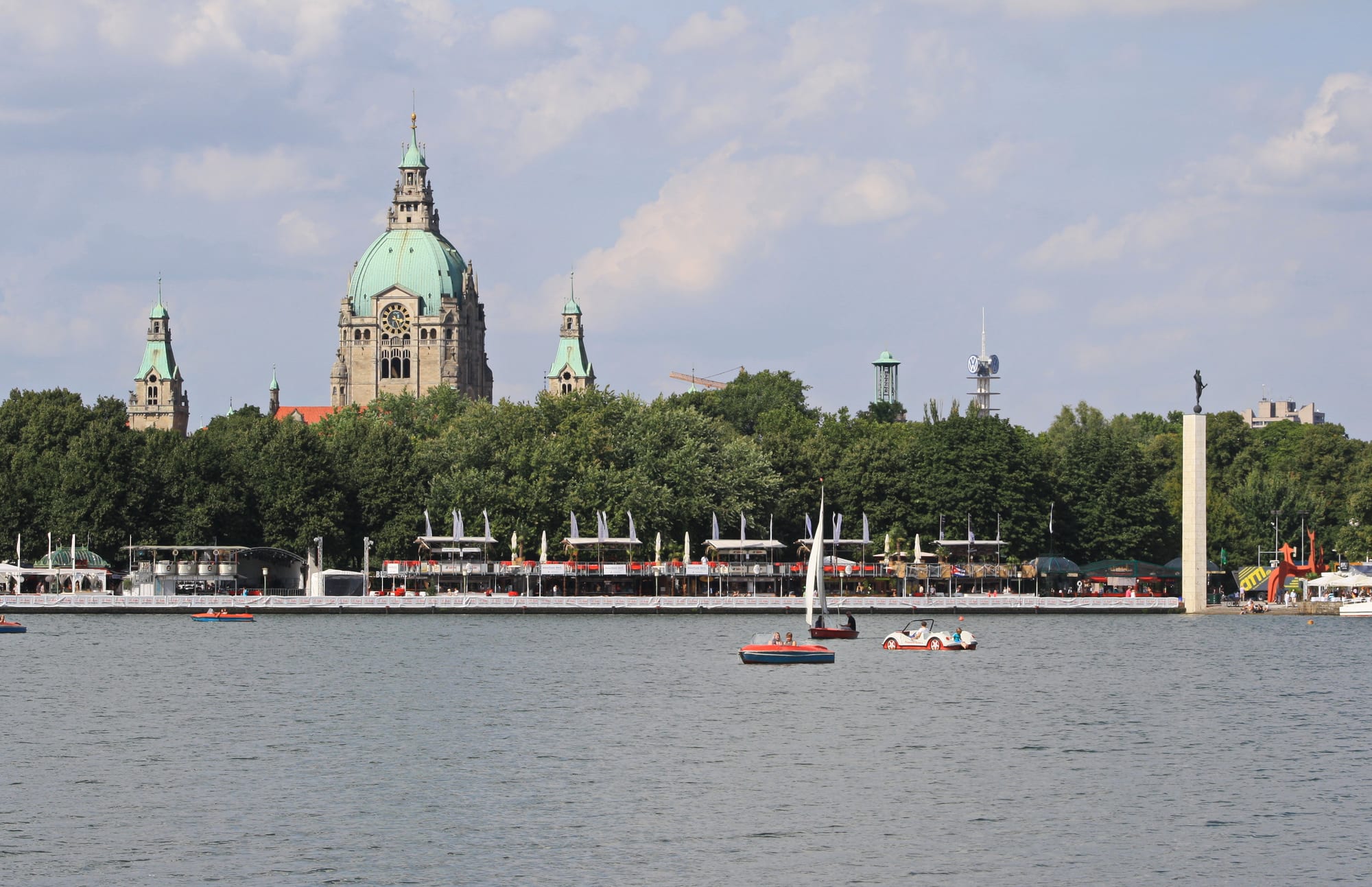
Pedal boats and a small sailing boat on the Maschsee, with trees and the green dome of the New Town Hall beyond

Hamburg & Northern Germany, Germany

Hanover

The Maschsee lake in Hanover, with the dome and towers of the New Town Hall rising behind the trees. (Kora27 / Wikimedia Commons · CC BY-SA 4.0)

The capital of Lower Saxony, on the River Leine, and the seat of the electors and kings whose dynasty ruled Great Britain from 1714 to 1837. Heavily bombed in the Second World War and largely rebuilt, it is now a city of trade fairs and insurers, with the baroque Herrenhausen Gardens, a vast city forest and the Maschsee lake.

Neighbourhoods

  • Mitte and the Old Town
    • First-time visitors
    • Shopping
    • Close to public transport

    The centre between the main station and the Leine. A car-free shopping zone runs from the station to the Kröpcke square and the opera house, and beyond it lie the rebuilt Old Town around the Marktkirche, the Leine Palace and the New Town Hall.

    Open in Maps
  • Linden
    • Nightlife
    • Best for food
    • Local life

    A borough west of the Leine that joined the city in 1920, with late-19th-century housing and the busy Limmerstraße, lined with small restaurants, cafés and bars.

    Open in Maps
  • List
    • Quiet and residential
    • Shopping

    A residential district north-east of the station, with late-19th-century and Art Nouveau houses and the Lister Meile, a long pedestrian street of small shops that holds its own festival and Christmas market.

    Open in Maps
  • Herrenhausen
    • Gardens
    • Quiet and residential

    The north-western district of the royal summer palace and its gardens, reached by Stadtbahn from Kröpcke, with the university's main building nearby on the Welfengarten.

    Open in Maps

Things to do

Famous landmarks

  • New Town Halllandmark

    A castle-like town hall in eclectic Wilhelmine style, opened in 1913 after 12 years of building, at the southern edge of the inner city beside the Maschpark.

    Open in Maps
  • Old Town Halllandmark

    The city's first town hall, begun in 1410 and restored after heavy bomb damage, the oldest secular building in Hanover.

    Open in Maps
  • Marktkirchelandmark

    The main Lutheran church of Hanover, a 14th-century brick church of Saints James and George at the heart of the Old Town.

    Open in Maps
  • Leine Palacelandmark

    The former residence of Hanover's dukes, electors and kings on the Leine, now the seat of the Lower Saxony state parliament.

    Open in Maps
  • Aegidienkirchelandmark

    The ruin of a 14th-century church, left unrebuilt after the war as a memorial to the victims of war and violence.

    Open in Maps
  • Nanasattraction

    Three large, brightly coloured female figures by Niki de Saint Phalle, set up in 1974 on the banks of the Leine at the start of the city's Sculpture Mile.

    Open in Maps

Gardens, parks and the lake

  • Herrenhausen Gardenspark

    The gardens of the electors' summer palace; the Great Garden, enlarged for Sophia of Hanover from 1683, is one of the most distinguished baroque gardens in Europe.

    Open in Maps
  • Berggartenpark

    A vegetable garden of 1666 turned botanical garden, known for its orchids, and the site of the mausoleum of Sophia, Ernest Augustus and George I.

    Open in Maps
  • Herrenhausen Palacelandmark

    The royal summer residence at the head of the Great Garden, destroyed by bombing and rebuilt to reopen in 2013.

    Open in Maps
  • Maschseepark

    A 78-hectare artificial lake just south of the centre, the largest body of water in the city, used for sailing, rowing and dragon-boat racing and ringed by a lakeside path.

    Open in Maps
  • Eilenriedepark

    A 640-hectare municipal forest, the largest urban forest in Germany and nearly twice the size of New York's Central Park.

    Open in Maps
  • Hanover Zooattraction

    A zoo founded in 1865 in the Mitte borough, with thousands of animals in six themed zoo worlds and a winter Christmas market.

    Open in Maps

Museums

  • Sprengel Museummuseum

    One of Germany's most significant collections of modern art, opened in 1979 beside the Maschsee, with works by Niki de Saint Phalle.

    Open in Maps
  • Landesmuseum Hannovermuseum

    The state museum of Lower Saxony beside the New Town Hall, the largest museum in the city, including the state art gallery.

    Open in Maps
  • Museum August Kestnermuseum

    A museum founded in 1889 around the collections of August Kestner, covering ancient cultures, ancient Egypt, applied art and historic coins.

    Open in Maps

Fairs and short trips

  • Hanover Fairgroundattraction

    The largest exhibition centre in the world, site of Expo 2000 and of the Hanover Fair, with the wooden Expo Roof and the Hermes Tower.

    Open in Maps
  • Hildesheimattraction

    A cathedral city south-east of Hanover, founded as a bishopric in 815, with buildings on the UNESCO World Heritage list.

    Open in Maps

Seasonal events

  • Schützenfest Hannoverlate June to early July

    The largest marksmen's festival in the world, founded in 1529, with rides, beer tents and a 12 km parade of more than 12,000 participants, among them marksmen, bands and floats.

  • International Fireworks Competitionbetween May and September

    Teams from around the world compete with fireworks displays over the Great Garden at Herrenhausen.

  • Kleines Fest im Großen Gartensummer

    A festival of clowns, acrobats, comedy and street theatre performed by artists from around the world across the Great Garden.

  • Maschseefestsummer

    A festival around the Maschsee, with fireworks over the lake through its weekends.

  • Christmas marketslate November to just before Christmas

    Markets in front of the main station, at the Kröpcke, in the Old Town and on the Lister Meile.

Eat and drink

Long-standing places and food districts in Hanover. Hours, ratings and directions come from your maps app, always current.

Food districts and markets

  • Markthallemarket

    The covered market hall on the edge of the Old Town, with some 73 stalls.

    Open in Maps
  • Limmerstraße, Lindenneighborhood

    Linden's main street of small restaurants, cafés and bars, from Vietnamese kitchens to traditional Lower Saxon cooking, with outdoor tables in summer.

    Open in Maps
  • Lister Meileneighborhood

    A pedestrian street in List with cafés and small restaurants among its shops.

    Open in Maps

Experience Hanover

History

Hanover began as a small village of ferrymen and fishermen on the east bank of the Leine. Its position at a natural crossroads made it a sizeable town by the 13th century, and it received town privileges in 1241. In 1636 George, Duke of Brunswick-Lüneburg, moved the residence of his principality of Calenberg here, and in 1692 the duchy was raised to an electorate, known after its capital as the Electorate of Hanover.

In 1714 the elector George Louis succeeded to the British throne as George I, and for more than a century, until 1837, the electors and later kings of Hanover were also kings of Great Britain. They rarely visited — between 1760 and 1837 there was only one short royal visit, by George IV in 1821 — but the link left its mark in the Herrenhausen Gardens and in the King's German Legion, formed in Britain by soldiers from Hanover during the Napoleonic Wars. The electorate became the Kingdom of Hanover in 1814, and the personal union ended in 1837, when the British crown passed to Queen Victoria and Hanover to her uncle Ernest Augustus. The kingdom lasted until 1866, when Prussia defeated and annexed it, making the city a provincial capital.

As a major railway junction and industrial centre, Hanover was a prime target in the Second World War: 88 air raids destroyed more than 90 per cent of the city centre and killed more than 6,000 civilians. The ruin of the Aegidienkirche was left as a memorial. In 1946 Hanover became the capital of the new state of Lower Saxony, grew rapidly during the post-war economic boom, and in 2000 hosted the world exhibition, Expo 2000.

Culture & Customs

The city's courtly past is best seen at Herrenhausen, where the Great Garden, shaped by Sophia of Hanover from 1683, remains one of the most distinguished baroque gardens in Europe and hosts festivals all summer, from the International Fireworks Competition to the Kleines Fest of street performers. The letters of the philosopher Gottfried Wilhelm Leibniz, kept in the library named after him, have been on UNESCO's Memory of the World Register since 2007.

Modern art has a strong presence. Niki de Saint Phalle gave the city her Nanas on the Leine and a decorated grotto in the Great Garden, and the Sprengel Museum holds one of the country's most important modern collections; the Kestnergesellschaft, with more than 4,000 members, is the largest art society in Germany. Cabaret has its own festivals, among them the Calenberg Cabaret Weeks and the Hanover Cabaret Festival.

The great popular event is the Schützenfest, the world's largest marksmen's festival, founded in 1529, whose parade of more than 12,000 participants winds 12 km through the city, and its funfair draws large crowds every year. Hanover also lays claim to Germany's first rugby team, founded in 1878, and the Maschsee is busy with rowing, sailing and dragon-boat racing. The city lies in the Low German dialect area, of which it is the fifth-largest city.

Daily Life

Hanover had 535,932 people in 2021 — about 536,000 — making it the 13th-largest city in Germany, and the surrounding Hanover Region has about 1.16 million. The population has grown since the city became the state capital in 1946, and the boom years of the 1950s and 1960s brought a large migrant population, drawn largely from Turkey, Greece and Italy.

The biggest employer in the region is the Volkswagen Commercial Vehicles factory at Stöcken, on the Mittelland Canal. Continental, founded in Hanover in 1871, is one of the city's major companies, the travel group TUI and the audio maker Sennheiser are based here, and insurers such as Talanx make the city a centre of the industry. Trade fairs such as the Hanover Fair, Domotex, Ligna and Agritechnica fill the world's largest exhibition grounds, and Hanover Medical School, one of Germany's leading medical schools, and Leibniz University are major employers and centres of study.

Districts such as List, Oststadt and Linden keep streets of late-19th-century houses with historicist and Art Nouveau decoration. Weekends are spent in the Eilenriede and around the Maschsee, and the Christmas markets mark the end of the year.

Food

Hanover's best-known contribution to the table is a drinking custom rather than a dish. The Lüttje Lage grew out of the old habit of drinking the local Broyhan beer together with spirits: beer and Korn, a grain schnapps, are drunk at the same moment from two separate glasses.

The local dessert is Welfenspeise, or Welf pudding, created by a Hanoverian chef and named after the colours of the House of Welf, the dynasty that ruled the land. Its white bottom layer is a cooked milk and vanilla sauce folded into stiffly whipped egg white; once chilled, it is covered with a yellow layer of wine sauce made from beaten egg yolk and white wine. It is said to have become the favourite of Ernest Augustus, Elector of Hanover. Around Hanover the grain sausage known elsewhere as Knipp goes by the name Calenberger Pfannenschlag, made from oat groats, pork and broth and seasoned with allspice and pepper.

For everyday eating, the Markthalle on the edge of the Old Town is the place for a lunchtime meal at the counters, while Linden's Limmerstraße has the city's liveliest mix of small restaurants, from Vietnamese to traditional Lower Saxon cooking, and the cafés of the Lister Meile fill on fine afternoons.

Planning tools

Budget

Hanover is cheaper than Hamburg for food and rooms, except during the big trade fairs, when hotel prices climb steeply and rooms fill across the whole region. Much of what draws visitors — the Red Thread walk, the Eilenriede, the lake and the Old Town — costs nothing.

Daily Budget Midrange
USD 140–260 (mid-range hotel, restaurant meals, garden and museum tickets)
Daily Budget Shoestring
USD 65–100 (hostel bed, bakery and Imbiss food, Stadtbahn day tickets)

Check the trade-fair calendar before booking: during the Hanover Fair and other large fairs, rooms are scarce and expensive.

Best Time to Visit

May to September, when the Herrenhausen Gardens are at their best, the fireworks competition and garden festivals run, and the Maschsee is busy with boats; the Schützenfest falls in late June and early July. Late November and December bring the Christmas markets. Fair weeks are best avoided by anyone not attending them.

Suggested Number of Days

One or two days cover the centre and the gardens. Three or four leave time for the museums, the forest and the lake, and for the older towns within easy reach by train.

First Visit
1–2 days
With Surroundings
3–4 days

Transportation

The Stadtbahn light-rail network and the city buses operated by üstra reach every district, and the Hanover S-Bahn serves the wider region from the main station. The city is flat and cycling is easy, with paths through the Eilenriede and around the Maschsee.

The Red Thread, a red line painted on the pavement, links 36 sights of the centre on a 4.2 km walk starting at the tourist office by the station.

Airport & Station Connections

Hannover Airport is in Langenhagen, about 11 km north of the centre, with flights mainly to European cities and holiday destinations. Hannover Hauptbahnhof is a hub of the ICE high-speed network, with trains to Hamburg in about 75 minutes and to Berlin in under two hours.

Walkability

The centre is compact and flat: the station, the Kröpcke, the Old Town, the New Town Hall and the Maschsee are close together, linked by pedestrian streets and the Red Thread. Herrenhausen, the zoo and the fairground are better reached by Stadtbahn.

Safety

Germany is a safe country with low levels of violent crime. Hanover is a calm city for visitors; the main things to watch are pickpockets in the crowds of the station, the Christmas markets and the Schützenfest.

Keep bags secure in festival and fair crowds, and stay out of marked cycle lanes on foot. Check current official travel advice before travelling.

Climate

Oceanic and changeable, with rain in every season and an average annual temperature of about 10.6°C.

Summer
mild — in Bremen, to the north-west, June to August highs average about 20–23°C
Winter
cool and damp — in Bremen, December to February lows average around −1 to 0°C

Local Customs

German manners apply: punctuality matters, people shake hands with eye contact, and Herr or Frau with the surname is used until first names are offered. When paying in a restaurant, tell the server the total including any tip rather than leaving money on the table. Keep noise down late at night and on Sundays and public holidays.

Wait for 'Guten Appetit' before eating and look each person in the eye when saying 'Prost'; ask before photographing anyone.

Common Payment Methods

The currency is the euro. Cards are widely accepted in shops, hotels and larger restaurants, but some bakeries, bars and smaller places still prefer or require cash, so carry some. ATMs are easy to find in the centre and at the station.