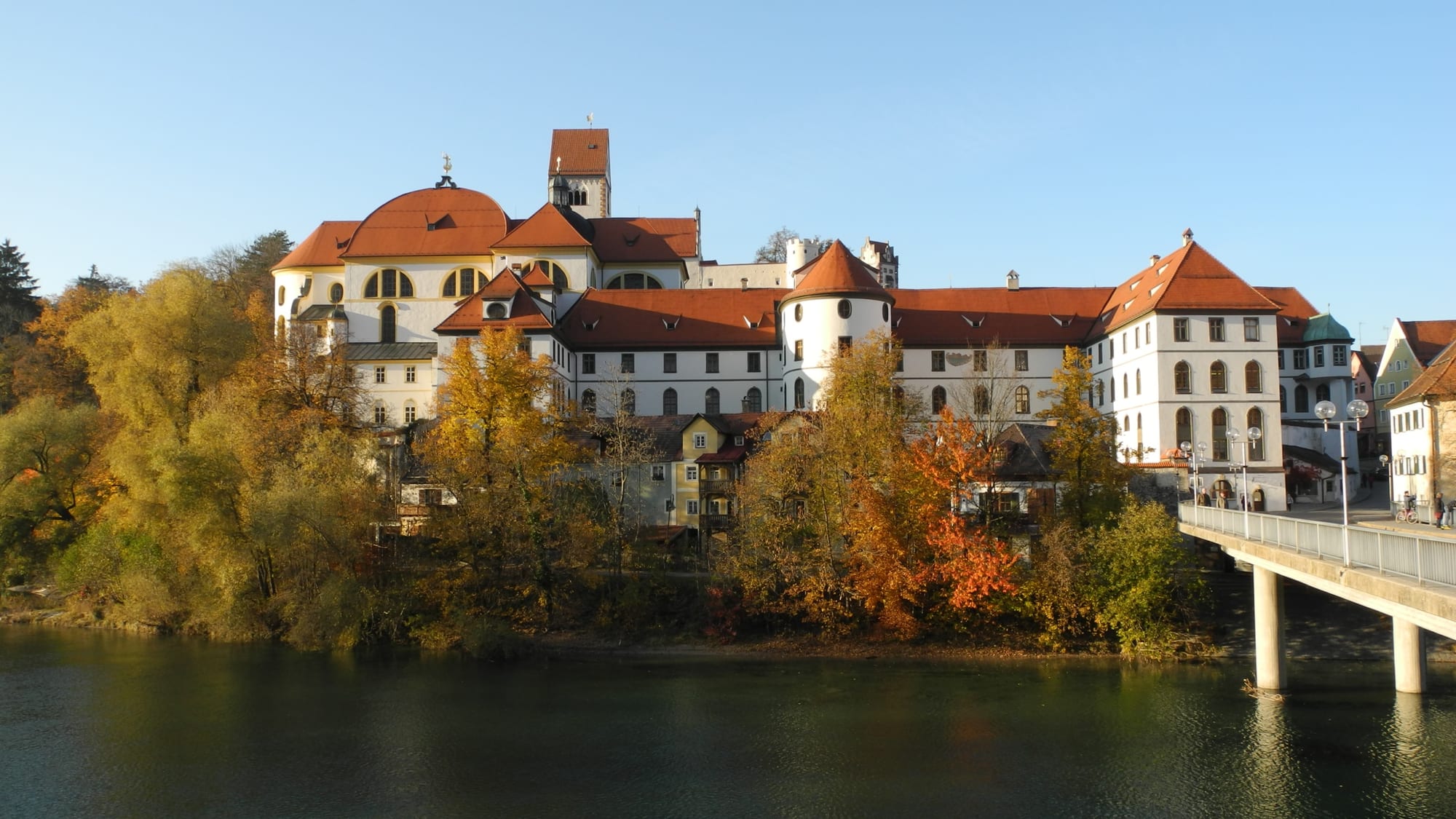
The white, red-roofed buildings of St. Mang's Abbey above the green Lech, framed by autumn trees, with a footbridge on the right

Bavaria, Germany

Füssen

The former abbey of St. Mang and the High Castle above the River Lech in Füssen. (Franzfoto / Wikimedia Commons · CC BY-SA 3.0)

A small walled town on the Lech in the Bavarian Allgäu, a kilometre from the Austrian border, that grew from a Roman post on the Via Claudia Augusta and a ninth-century abbey into the cradle of European lute-making. Today it is the end of the Romantic Road and the base for Neuschwanstein and Hohenschwangau, with lakes and the Ammergau Alps all around.

Neighbourhoods

  • Altstadt (Old Town)
    • First-time visitors
    • Historic district
    • Close to public transport

    The compact, pedestrianised old town on the left bank of the Lech, still partly enclosed by its medieval wall, with fountains and shops along Reichenstraße. The High Castle and the abbey of St. Mang rise over its southern end, and the railway station is a short walk away.

    Open in Maps
  • Hopfen am See
    • Lakes
    • Quiet and residential

    A former village, now part of Füssen, on the north-east shore of the Hopfensee, a few kilometres north of the old town. It is a small lakeside resort with swimming and boating in summer and views south to the Allgäu Alps.

    Open in Maps
  • Hohenschwangau
    • Castles
    • Walks

    The village at the foot of Neuschwanstein and Hohenschwangau Castle, in the neighbouring municipality of Schwangau. It is mostly ticket offices, car parks, cafés and souvenir shops, busy all day in summer and quiet once the castles close.

    Open in Maps

Things to do

The old town and the abbey

  • Hohes Schloss (High Castle)landmark

    The former summer residence of the prince-bishops of Augsburg above the old town, now holding a branch gallery of the Bavarian State Painting Collections devoted to late Gothic and Renaissance art.

    Open in Maps
  • St. Mang's Abbeylandmark

    A Benedictine monastery founded in the ninth century and rebuilt in Baroque style between 1697 and 1726; the crypt of its church holds a fresco of about 980, the oldest in Germany.

    Open in Maps
  • Museum der Stadt Füssenmuseum

    The town museum in the former abbey, covering Füssen's history, the monastery and the town's lute- and violin-making, with the Baroque state rooms and St. Anne's Chapel.

    Open in Maps
  • Lechfallviewpoint

    A waterfall on the southern edge of town, close to the Tyrol border, where the Lech pours over a weir almost 8 metres high into a short gorge.

    Open in Maps

The royal castles

  • Neuschwanstein Castlelandmark

    Ludwig II's palace on a crag above Hohenschwangau, built between 1869 and 1892 in honour of Richard Wagner and part of the UNESCO World Heritage Site of Ludwig's palaces since 2025.

    Open in Maps
  • Hohenschwangau Castlelandmark

    The 19th-century palace that King Maximilian II made from the dilapidated old castle of Schwanstein, bought in 1832, where his son Ludwig II spent his childhood.

    Open in Maps
  • Tegelbergviewpoint

    A mountain of the Ammergau Alps beside the castles, reached by cable car or on foot, and a hang-gliding and paragliding site since the 1970s.

    Open in Maps

Lakes

  • Forggenseepark

    The reservoir just north of town on the Lech, the largest in Germany by area, used for sailing and boat trips in summer and drained after the middle of October.

    Open in Maps
  • Hopfenseepark

    A glacial lake north of Füssen, where swimming is possible from the end of May and the north shore looks across the water to the Allgäu Alps.

    Open in Maps

Short trips from the town

  • Wieskirchelandmark

    The oval Rococo pilgrimage church of the Zimmermann brothers in a meadow near Steingaden, completed in 1754 and a UNESCO World Heritage Site since 1983.

    Open in Maps
  • Linderhof Palacelandmark

    The smallest of Ludwig II's three palaces and the only one he completed, where he lived much of the time from 1876, set in formal gardens in a remote valley.

    Open in Maps
  • Falkenstein Castlelandmark

    A castle ruin above Pfronten at 1,277 metres, the highest in Germany, which Ludwig II bought in 1883 to rebuild as a fairy-tale castle — a plan abandoned at his death.

    Open in Maps

Seasonal events

  • St. Mang's Feastearly September

    The town's patron saint is honoured with a Mass and a torchlight procession through the old town, and a small run of 'Magnus wine' is sold during the feast week.

  • Advent market at St. Mangtwo weekends in Advent

    A Christmas market held in the Baroque courtyard of the former abbey.

Eat and drink

Long-standing places and food districts in Füssen. Hours, ratings and directions come from your maps app, always current.

Füssen classics

  • Old-town Bavarian innsrestaurant

    Traditional dining rooms in and around the old town serve Spätzle, liver-dumpling soup, venison and wild boar, and Kaiserschmarrn for dessert, with Bavarian draught beer.

    Open in Maps

Food streets

  • Reichenstraßeneighborhood

    The old town's main pedestrian street and the lanes off it, with snack bars, schnitzel houses, pizzerias, Asian kitchens and cafés side by side.

    Open in Maps

Experience Füssen

History

Füssen began as a Roman post on the Via Claudia Augusta, the road that ran from northern Italy over the Alps to Augusta Vindelicum, today's Augsburg. Its early name, Foetes, probably comes from the Latin fauces, "gorge", after the narrow gorge of the Lech, and in Late Antiquity part of the Legio III Italica was stationed here to guard the route. In the eighth century monks gathered around Saint Magnus, a missionary from the Abbey of Saint Gall, and the Benedictine abbey of St. Mang grew up on the spot.

The town prospered as a trans-shipment point: the Lech becomes navigable below the Lechfall, and goods carried over the Alps by pack horses on the Via Claudia were loaded onto boats here. A duke of Bavaria built the High Castle above the abbey to secure his claims, and the prince-bishops of Augsburg later used it as their summer residence. Füssen became a centre of lute- and violin-making, and in 1562 the first lute-makers' guild in Europe was founded here. In 1745 the Treaty of Füssen ended Bavaria's part in the War of the Austrian Succession.

The abbey was dissolved in the secularisation of Bavaria in the early nineteenth century. When Ludwig II built Neuschwanstein just to the east, Richard Wagner travelled to Füssen by railway to visit him. Since the 1950s the town has been known as the southern end of the Romantic Road, and it hosted the World Junior Curling Championships in 1988.

Culture & Customs

Füssen's cultural identity rests on its monastery and its instrument makers. The town regards itself as the cradle of commercial lute-making in Europe, and the museum in the former abbey tells the story of its lute and violin workshops; in 2018 Füssen was twinned with Cremona, the Italian violin-making city, on the strength of that shared craft. Concerts are held in the Kaisersaal of the former abbey, and the main organ of the abbey church goes back to an instrument of 1753. Beside the Forggensee, the Festspielhaus Neuschwanstein is an event venue looking across to the castle.

Religious tradition is strong. Saint Magnus is the patron saint, and on his feast day in September a Mass is followed by a torchlight procession through the old town; during that week a special Magnus wine, limited to 500 bottles, goes on sale. The Rococo interior of the Franciscan church, built in the 1760s, and the Stations of the Cross on the Kalvarienberg above town reflect the same Catholic culture.

Winter sport matters too. The ice hockey club EV Füssen is known well beyond the town, the town's notable residents include Olympic hockey players, a biathlete and curlers, and the annual Königsschlösser marathon starts and finishes in the old town. People here are Allgäuer as much as Bavarians, and greet visitors with "Grüß Gott".

Daily Life

About 15,300 people lived in Füssen at the end of 2024, and the population has grown steadily since 2011. The town includes the old centre, the newer districts of Füssen-West, Ziegelwies and Weidach, and former villages such as Hopfen am See on its lake. In the 2022 census about 38 per cent of residents were Catholic and about 13 per cent Protestant, while half belonged to no church or gave no answer.

Tourism dominates the economy. More than 1.3 million people a year visit Neuschwanstein, and many of them pass through Füssen's station and streets, filling hotels, restaurants and souvenir shops from spring to autumn. Alongside tourism, the Allgäu economy rests on dairy farming and the building of machinery and industrial equipment.

Local news comes from the Allgäuer Zeitung, whose Füssener Blatt section covers the town and its neighbouring villages. The rhythm is that of a small southern German town: early starts, quiet Sundays, and evenings and weekends spent on the lakes, the bike paths and the mountains in summer, and at the ice rink in winter.

Food

Füssen eats the food of the Allgäu, a region known across Germany for its dairy produce, especially Hirtenkäse, "herdsman's cheese", and Bergkäse, "mountain cheese". Spätzle, a rough egg pasta served with meat and sauce or tossed with cheese and onion as a main dish, is a staple, and the pre-Alpine Allgäu has its own simpler, rounder form called Knöpfle. Old-town inns also serve liver-dumpling soup and game such as venison and wild boar.

Bavarian dishes appear on the same menus: Schweinsbraten, roast pork, and Schweinshaxe, roast knuckle, with bread or potato dumplings and red cabbage or sauerkraut. For something sweet, Kaiserschmarrn — a lightly sweetened, shredded pancake named after the Austrian emperor Franz Joseph I — is served as a dessert or a light lunch, often in portions large enough to share.

Beer is the everyday drink, from pale Helles to Weissbier made with wheat. Wine has a small place in local tradition through the Magnus wine sold in limited numbers for the feast of the patron saint each September. Bakeries and snack bars along Reichenstraße and the lanes around it supply quick meals for the many visitors passing through on their way to the castles.

Planning tools

Budget

Füssen is cheaper to eat in than to sleep in: rooms in town and in Schwangau fill and rise in price in summer, when the castles draw their biggest crowds, while bakeries and snack bars keep lunch affordable. Castle tickets, the cable car and lake boats add up, and the lakes, walks and the old town are free.

Daily Budget Midrange
USD 170–300 (mid-range hotel, restaurant meals, castle tickets, the Tegelberg cable car)
Daily Budget Shoestring
USD 75–130 (youth hostel bed, bakery and snack-bar meals, local buses)

Neuschwanstein is seen only on a guided tour; buy timed tickets online well in advance, especially for June to August.

Best Time to Visit

June to September for the lakes, mountain walks and the longest days, but this is also when Neuschwanstein takes up to 6,000 visitors a day. May and September are quieter. The Forggensee is drained after mid-October, and winter brings snow, short days and the Advent market at St. Mang.

Suggested Number of Days

The town itself and the two castles below it fill one or two days. Three or four allow time for the lakes, a mountain and the other royal palaces and churches within reach. Ticket times at the castles decide much of the pace, so a longer stay is more relaxed in peak season.

First Visit
1–2 days
With Surroundings
3–4 days

Transportation

Füssen is small enough that a car is not needed: the old town is easily walked, and buses run from the station to Hohenschwangau and the castles. The town has built up a network of cycle routes, and bicycles can be hired. A car helps for the remoter castles, churches and lakes, though roads and car parks near the castles are crowded in summer.

On the castle buses and in the castle grounds, expect queues in summer; arriving early in the day makes the visit calmer.

Airport & Station Connections

Füssen station, a terminus in the centre of town, has direct regional trains from Munich roughly every two hours, taking about two hours, and connections from Augsburg. The nearest airports are Munich and Memmingen. By road the town is the end of the Romantic Road, the B 17 runs north to Augsburg, and the A 7 motorway reaches the Austrian border close by. From Innsbruck the trip takes about three hours by train and bus via Reutte.

Walkability

The pedestrianised old town is compact, with cobbles and a few short climbs up to the High Castle. The station, the abbey and the river are all within a few minutes of each other. Marked roads and paths lead out to the castles at Hohenschwangau, a few kilometres east, and the Forggensee shore and the Lechfall are an easy walk from the centre.

Safety

Germany is a safe country with low levels of violent crime. In Füssen the practical concerns are crowds at the castle bus stops and viewpoints in summer, and mountain hazards — sudden storms, exposed paths and, in winter, avalanches — for anyone walking above the town.

Keep bags secure in castle crowds, check weather and avalanche reports before mountain walks, and carry winter kit when driving in snow. Check current official travel advice before travelling.

Climate

At about 800 metres, surrounded by mountains, Füssen is cooler than lowland Germany. Summers are mild and wet, with much of the year's rain; winters are cold, with snow, and relatively dry.

Summer
mild and often rainy — July averages about 16 °C
Winter
cold — January averages about −1.5 °C, with daytime highs around 1 °C

Local Customs

This is Catholic, Swabian Bavaria: the usual greeting is 'Grüß Gott', the abbey church and the Franciscan church are places of worship as well as sights, and traditional dress appears at church holidays and festivals. Most shops close on Sundays. Photography is not allowed inside Neuschwanstein.

Tipping is a matter of politeness, usually done by stating a rounded-up total when paying. Dress modestly in churches and keep quiet during services.

Common Payment Methods

The currency is the euro. German debit cards are accepted almost everywhere, but foreign credit and debit cards are less widely taken than in many countries, and some bakeries, bars and small shops prefer cash, so carrying euros is sensible.