💰 Budget
Würzburg costs well below Munich. Wine taverns, bratwurst stands and the student cafés keep eating good value. Rooms fill during the Africa Festival, the Mozart Festival and the summer wine fairs.
- Daily Budget Midrange
- USD 160–280 (mid-range hotel, wine-tavern dinners, palace and museum tickets, a regional train trip)
- Daily Budget Shoestring
- USD 75–125 (hostel or budget hotel, bakery and bratwurst lunches, trams)
The old town is compact and flat, so trams are needed mainly for the station and outer districts; walking the Old Main Bridge, the Ringpark and the riverbanks costs nothing.
📅 Best Time to Visit
May to September, when the Africa Festival, the Weindorf, the Mozart Festival and the Kiliani fair follow one another and evenings are spent outdoors with a glass of wine. Autumn brings the grape harvest in the surrounding vineyards, and Advent the Christmas market. Winters are cold but quiet.
⏳ Suggested Number of Days
Two days cover a first visit to the city. Allow three or four to add the wine villages and Romantic Road towns of the surrounding countryside; the extra time depends on trains and buses, or on having a car.
- First Visit
- 2 days
- With Surroundings
- 3–4 days
🚆 Transportation
Five tram lines, about 20 kilometres in all, run through the centre between the main station and the Sanderring and out to the districts, backed by city and regional buses, some of which run all night. Bicycle paths cross the city, and the Main-Radweg follows the river through the old town.
Buy tram and bus tickets from the machines at the stops or from bus drivers before riding.
🛬 Airport & Station Connections
Würzburg Hauptbahnhof, on the northern edge of the old town, is one of Bavaria's major stations, at the southern end of the Hanover–Würzburg high-speed line, with frequent ICE and Intercity trains to Frankfurt, Cologne, Hamburg, Munich, Nuremberg and Vienna. The city has no airport of its own: Frankfurt Airport, with its own long-distance station, is about 90 minutes away by ICE, and Nuremberg is the other nearby airport. Autobahns A3 and A7 meet at the city.
🚶 Walkability
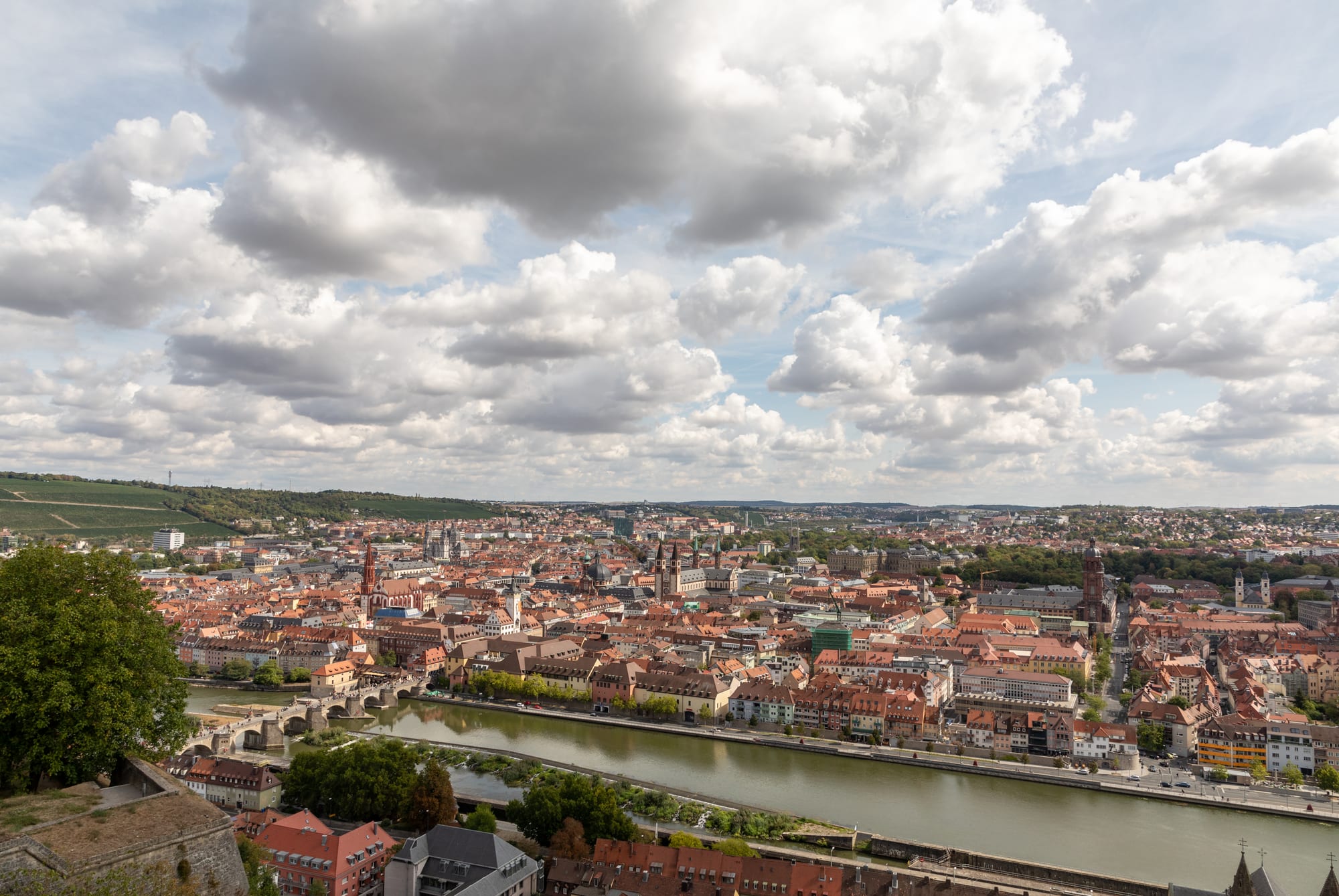
Most sights lie inside the Ringpark, on flat ground; a walk from the main station to the southern end of the Ringpark takes about half an hour. The exceptions are the steep climbs across the river to the Marienberg fortress and the Käppele, which take a good half-hour on foot from the centre.
🛡️ Safety
Germany is a safe country with low levels of violent crime. Würzburg is a lively but orderly university city; the things to watch are bags in the crowds of the festivals and the Christmas market, trams and cyclists in the old town's streets, and the steep paths up to the fortress in wet weather.
Keep bags secure in festival crowds, look out for trams and stay out of marked cycle lanes on foot. Check current official travel advice before travelling.
🌦️ Climate
A temperate climate, drier and warm enough in the Main valley for vineyards, with cold winters and mild to warm summers.
- Summer
- mild to warm — July averages about 18.4°C
- Winter
- cold — January averages about −0.6°C
🤝 Local Customs
Würzburg is Franconian, and many Franconians do not like being lumped together with Bavarians. The city is the seat of a Catholic diocese, and its many churches are working places of worship. Tipping in restaurants and bars is usual but modest, rarely more than 10 per cent, and often a rounding up of the bill, stated as the total when paying.
Dress modestly and keep quiet in churches during services; tell the server the total including the tip when paying.
💳 Common Payment Methods
Germany uses the euro. Many places still prefer cash — some bakeries, bars and smaller restaurants do not take cards at all — so carry some euros alongside a card for larger purchases. Cash machines are easy to find in the centre.