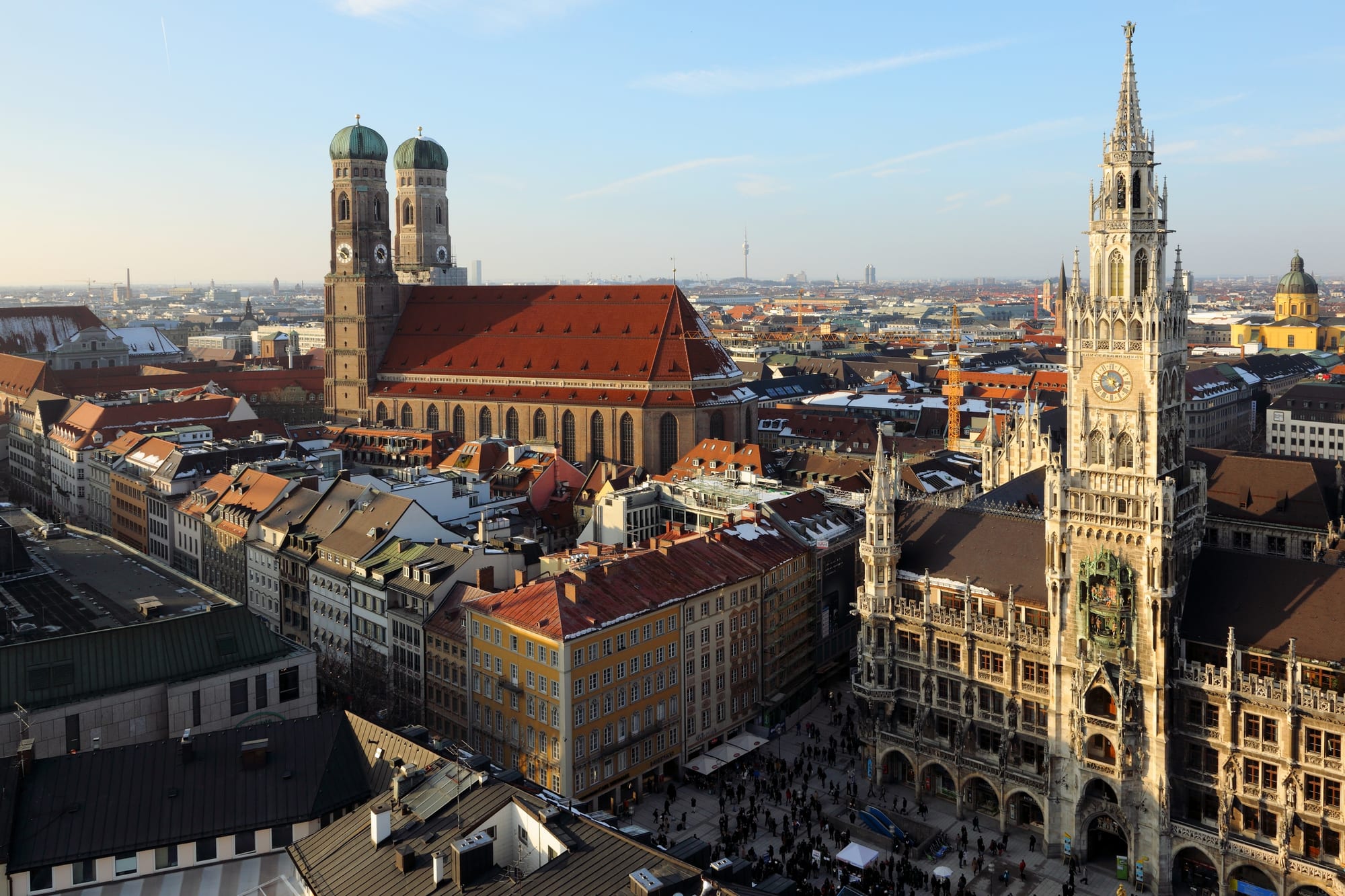
Red roofs of central Munich with the twin domed towers of the Frauenkirche and the Gothic spire of the New Town Hall

Bavaria, Germany

Munich

The Frauenkirche and the New Town Hall above Marienplatz in central Munich. (Martin Falbisoner / Wikimedia Commons · CC BY-SA 3.0)

The capital of Bavaria, on the Isar about 50 km north of the Alps. Founded in 1158 to control the salt trade, it grew as the seat of the Wittelsbach dukes, electors and kings, was heavily bombed in the Second World War and rebuilt on its old street plan, and is now Germany's third-largest city, rich in palaces, art collections, beer halls and high-technology industry.

Neighbourhoods

  • Altstadt-Lehel
    • First-time visitors
    • Historic district
    • Close to public transport

    The old town and its neighbour Lehel, around Marienplatz, the Frauenkirche, the Viktualienmarkt and the Residenz, with three surviving medieval gates and a pedestrian spine running from Karlsplatz to Marienplatz. Lehel, between the old town and the Isar, has quieter residential streets.

    Open in Maps
  • Maxvorstadt
    • Museums
    • Students and nightlife

    The district north-west of the old town where the Kunstareal's galleries — the Alte Pinakothek, the Pinakothek der Moderne, the Lenbachhaus and the classical collections around the Königsplatz — sit beside the main buildings of the city's universities.

    Open in Maps
  • Schwabing
    • Cafés and shopping
    • Parks

    The bohemian quarter of artists and writers around 1900, where Lenin lived for some years, now one of the city's most expensive residential districts. It borders the Englischer Garten and has the daily Elisabethmarkt.

    Open in Maps
  • Ludwigsvorstadt-Isarvorstadt
    • Nightlife
    • Best for food
    • LGBTQ+ scene

    The districts south and west of the old town, from the Theresienwiese to the Isar, including the Glockenbachviertel and Gärtnerplatz, the centre of the city's gay scene since the 1960s, and one of the main areas for bars and nights out.

    Open in Maps
  • Haidhausen
    • Local life
    • Bars

    A district on the east bank of the Isar near the Ostbahnhof, with old streets of bars and restaurants and a lively nightlife.

    Open in Maps
  • Neuhausen-Nymphenburg
    • Palaces and gardens
    • Quiet and residential

    The western district built up around Nymphenburg Palace and its park, with the botanical garden and the Hirschgarten, the city's largest beer garden.

    Open in Maps

Things to do

Famous landmarks

  • Marienplatz and the New Town Halllandmark

    The central square of the old town, framed by the Old and New Town Halls; the tower of the Gothic Revival New Town Hall holds the Rathaus-Glockenspiel.

    Open in Maps
  • Frauenkirchelandmark

    The late Gothic brick cathedral of the Archdiocese of Munich and Freising, built in only 20 years in the 15th century, whose twin domed towers mark the skyline.

    Open in Maps
  • St. Peter's Churchviewpoint

    The oldest recorded parish church in Munich, beside Marienplatz, on a site where a church stood before the city's founding in 1158.

    Open in Maps
  • Munich Residenzlandmark

    The former royal palace of the Wittelsbachs, now one of Europe's most important museums of interior decoration, with a treasury and the Rococo Cuvilliés Theatre.

    Open in Maps
  • Nymphenburg Palacelandmark

    The Baroque summer residence of the Bavarian rulers, begun in 1664, whose 632-metre front is wider than Versailles, set in a large park.

    Open in Maps

Museums

  • Alte Pinakothekmuseum

    European painting up to the 18th century, including Dürer's Self-Portrait and Four Apostles and Rubens's large Last Judgement.

    Open in Maps
  • Pinakothek der Modernemuseum

    Modern art, architecture, design and works on paper in a building of 2002 in the Kunstareal.

    Open in Maps
  • Lenbachhausmuseum

    The city gallery known for its works of Der Blaue Reiter, the expressionist group founded in Munich in 1911.

    Open in Maps
  • Deutsches Museummuseum

    The world's largest museum of science and technology, founded in 1903 and opened in 1925 on an island in the Isar.

    Open in Maps
  • BMW Museummuseum

    The carmaker's museum, opened in 1973 in a bowl-shaped building by the architect of its headquarters, telling the history of the company that made its first aircraft engine in Munich in 1916.

    Open in Maps
  • Munich Documentation Centre for the History of National Socialismmuseum

    A museum opened in 2015 on the site of the Nazi party's former headquarters, explaining the city's role as 'Capital of the Movement'.

    Open in Maps

Parks and markets

  • Englischer Gartenpark

    One of the world's largest urban parks, begun in 1789 and covering 3.7 square kilometres from the city centre to the north-eastern city limits, laid out in the informal English landscape style, with large beer gardens.

    Open in Maps
  • Olympiaparkpark

    The park built for the 1972 Summer Olympics, with its Olympic stadium and swimming hall, now one of the city's large green spaces.

    Open in Maps
  • Viktualienmarktmarket

    A food market held daily except Sundays and holidays since 1807, with about 140 stalls of flowers, fruit, game, cheese, fish and spices just off Marienplatz.

    Open in Maps

Beer halls and sport

  • Hofbräuhaus am Platzlattraction

    The beer hall founded in 1589 as part of the court brewery and opened to the public in 1828.

    Open in Maps
  • Allianz Arenaattraction

    The football stadium in the north of the city, home of FC Bayern Munich, Germany's most successful club, and a venue of the 2006 World Cup.

    Open in Maps

Short trips from the city

  • Dachau Concentration Camp Memorial Sitemuseum

    The memorial at the first concentration camp set up by the Nazis in 1933, about 16 km north-west of the city.

    Open in Maps
  • Schleissheim Palacelandmark

    A complex of Baroque palaces and gardens built as a summer residence just outside the city limits.

    Open in Maps
  • Lake Starnbergpark

    A large lake about 25 km south-west of the city and a popular recreation area for Munich.

    Open in Maps

Seasonal events

  • Strong Beer FestivalLent, usually March

    The Starkbierfest on the Nockherberg, known for its opening night of political satire, a speech and a musical play mocking politicians.

  • Frühlingsfestlate April to early May

    A two-week spring fair on the Theresienwiese, held since 1965.

  • Auer DultMay, late July to early August, and mid-October

    A nine-day market and funfair held three times a year on the Mariahilfplatz in Au, with around 300 traders — far more local and less touristy than Oktoberfest.

  • Tollwood FestivalJune to July, and winter

    An arts and music festival with lanes of craft stalls and organic food, held in summer at the Olympic Park and in winter on the Theresienwiese.

  • Oktoberfestlate September to early October

    The world's largest beer festival and Volksfest, 16–18 days on the Theresienwiese with beer from the six big Munich breweries, descended from the celebration of a royal wedding in 1810.

Eat and drink

Long-standing places and food districts in Munich. Hours, ratings and directions come from your maps app, always current.

Munich classics

  • Hofbräuhaus am Platzlrestaurant

    The most famous beer hall in the city, serving beer from the state-owned Hofbräu brewery with Bavarian food under the vaulted Schwemme, the one historic hall that survived the war.

    Open in Maps
  • Hirschgartenrestaurant

    The former royal deer park founded in 1780, now the site of the largest beer garden in the city.

    Open in Maps

Markets

  • Viktualienmarktmarket

    The central food market of the old town, grown from a farmers' market into a gourmet market of game, cheese, fish, spices and fruit.

    Open in Maps
  • Elisabethmarktmarket

    A daily food market in Schwabing for more than a century, named after Empress Sisi, with meat, vegetables, delicatessen and snacks.

    Open in Maps

Beer gardens and nights out

  • Englischer Garten beer gardensneighborhood

    Large beer gardens in the city's great park, where people of every background share long tables under the trees.

    Open in Maps
  • Glockenbachviertel and Gärtnerplatzneighborhood

    The streets around Gärtnerplatz, Müllerstraße and Hans-Sachs-Straße, the heart of the city's gay scene and among its busiest areas for bars and restaurants.

    Open in Maps

Experience Munich

History

Henry the Lion, Duke of Saxony and Bavaria, founded Munich around 1158 to control the salt trade, burning the bridge at Föhring and building his own toll bridge over the Isar; 14 June 1158 is counted as the founding day, and the name comes from a small monastic settlement, zu den Munchen, "to the monks". It received city status in 1175 and passed to the Wittelsbachs, who ruled it until 1918; Duke Louis IV, born in Munich, became Holy Roman Emperor in 1328. The Frauenkirche rose in the 15th century, and in 1506 Munich became capital of a reunited Bavaria.

The city became a stronghold of the Counter-Reformation — the "German Rome" — and the Hofbräuhaus was founded in 1589. It became an electoral residence in 1623 and, in 1806, capital of the Kingdom of Bavaria. In October 1810 a festival for the crown prince's wedding grew into the Oktoberfest, and Ludwig I's neoclassical museums and avenues earned the city the name "Athens on the Isar". Der Blaue Reiter was founded here in 1911.

After the 1918 revolution and the short-lived Bavarian Soviet Republic, Munich became the birthplace of the Nazi movement: Hitler's Beer Hall Putsch failed in 1923, and the city was later called the "Capital of the Movement". The first concentration camp opened at nearby Dachau in 1933, the Munich Agreement was signed here in 1938, and the White Rose student resistance was based at the university. Around half the city was heavily damaged in 71 air raids, and US troops entered on 30 April 1945. Rebuilt on its pre-war street plan, Munich passed a million people in 1957. It hosted the 1972 Olympics, overshadowed by the murder of 11 Israeli athletes taken hostage in the Olympic village, and the 1974 World Cup final.

Culture & Customs

Few German cities have such a weight of art and music. The Pinakotheken, the Glyptothek and the Lenbachhaus fill the Kunstareal; the National Theatre is home to the Bavarian State Opera, where Wagner's Die Meistersinger had its premiere under Ludwig II's patronage; and the city has three orchestras of international standing. Orlando di Lasso, Mozart, Wagner and Richard Strauss all worked here. Schwabing was the bohemian heart of German letters around 1900, from Thomas Mann to the satirical magazine Simplicissimus, and the city later became a centre of the New German Cinema and of the 1970s disco and rock recorded at Musicland Studios.

Beer culture is part of the city's identity. Six big breweries supply the Oktoberfest; beer gardens are places where people of every class share a table; and the calendar runs from the Strong Beer Festival in Lent through the spring fair and the Auer Dult to Oktoberfest itself. The coopers' Schäfflertanz, a guild dance that began in Munich, is meant to be held every seven years.

FC Bayern Munich, the most successful club in Germany, and 1860 Munich divide football loyalties. The city is Catholic by tradition, though about 45 per cent of residents now belong to no religion, and since the 1960s the Glockenbachviertel has been the heart of a gay scene that by the 1980s was counted among the best known in the world. The Bavarian dialect lives on alongside Standard German.

Daily Life

Munich had about 1.6 million inhabitants in November 2024, with around 3 million in the metropolitan area. It is the most densely populated municipality in Germany, and about 30 per cent of residents are foreign nationals, the largest groups Turkish and Croatian. Housing is the city's greatest worry: rents and property prices are among the highest in Germany, and a long-term plan adopted in 2011 aims to build denser housing and new estates on the edges.

The economy is the strongest of any German city. BMW, Siemens, Allianz and Munich Re have their headquarters here, alongside more DAX companies than any other German city, Europe's largest publishing industry, and research bodies such as the Max Planck and Fraunhofer societies and two elite universities, LMU and TUM. Unemployment, at 5.4 per cent in July 2026, was the lowest of any German city with more than a million people.

Daily life mixes tradition and wealth. Commuters ride the S-Bahn and U-Bahn in from the suburbs, cyclists fill the paths all year, and summer evenings are spent in beer gardens or by the Isar. In October 2025 two-thirds of voters backed a bid for a future Olympic Games, and in 2026 the city elected Dominik Krause of the Greens as mayor.

Food

Munich's cooking is Bavarian. The city's own speciality is the Weißwurst, invented here in 1857: a white sausage of minced veal and pork back fat flavoured with parsley, lemon, mace, onion, ginger and cardamom, heated in water rather than boiled, eaten without its skin and traditionally only before noon, with sweet mustard and a fresh pretzel. Schweinshaxe is a roasted pork knuckle, served in Bavaria with potato dumplings and red cabbage or with sauerkraut and potatoes. Leberkäse, a finely ground loaf of beef, pork and bacon baked in a bread tin, is the classic snack in a roll, and Obatzda, a spread of aged soft cheese such as Camembert mashed with butter, paprika and a little beer, belongs on every beer-garden table.

Beer is the city's drink. Helles, a pale lager, and Dunkel, the older dark style coloured by Munich malts, are the traditional Munich lagers; lighter beers became common only in the later 19th century. Weissbier, wheat beer, is a local favourite, and Starkbier, the strongest Munich beer at 6–9 per cent, belongs to Lent. The six big breweries are Augustiner, Hacker-Pschorr, Hofbräu, Löwenbräu, Paulaner and Spaten-Franziskaner, joined by a growing number of small brewers.

The Viktualienmarkt has sold food in the heart of the old town since 1807, and Schwabing's Elisabethmarkt serves its own district. The city also has a strong fine-dining tradition: Eckart Witzigmann opened the Tantris restaurant in Schwabing in 1971 and is credited with starting Germany's culinary revival, the Küchenwunder.

Planning tools

Budget

Munich is among the most expensive German cities for property and rents, and room prices rise steeply during Oktoberfest and big trade fairs. Food and drink are better value: beer gardens, market stalls and butchers' snack counters keep lunch cheap, and the parks, churches and squares are free.

Daily Budget Midrange
USD 180–320 (mid-range hotel, beer-hall and restaurant meals, palace and museum tickets)
Daily Budget Shoestring
USD 80–130 (hostel bed, bakery and beer-garden food, public transport day tickets)

Book rooms months ahead for Oktoberfest, or stay in a smaller town on the S-Bahn network and travel in.

Best Time to Visit

May to September for the beer gardens, the parks and day trips to the lakes and the Alps; late September and early October for Oktoberfest, when the city is at its busiest and dearest. December brings Christmas markets and the winter Tollwood festival. The museums make Munich a year-round city, and spring has the strong-beer and spring festivals.

Suggested Number of Days

Three days cover the old town, the palaces and the main museums. Five or six allow for the lakes, the memorial at Dachau and the Alpine foothills, all within reach by S-Bahn or regional train. Oktoberfest or a passion for art adds to the number.

First Visit
3 days
With Surroundings
5–6 days

Transportation

The U-Bahn, S-Bahn, trams — running since 1876 — and buses form a comprehensive network in which one ticket is valid across all modes. In 2015 public transport carried 38 per cent of trips, walking 23 per cent and cycling 15 per cent; cycle paths line most streets and a bike-hire scheme covers the area inside the Mittlerer Ring. Driving is slowed by heavy traffic, and vehicles need a green sticker for the environmental zone.

Buy one ticket for the whole network; the same tickets cover U-Bahn, S-Bahn, trams and buses.

Airport & Station Connections

Munich Airport, the second-largest in Germany, is about 30 km north-east of the centre, 40–50 minutes from the city centre by S-Bahn. The Hauptbahnhof is a terminus with high-speed ICE trains to Nuremberg, Berlin and other German cities and international services such as the trains to Zurich. Motorways from Stuttgart, Nuremberg, Salzburg, Garmisch and Lindau end at the city.

Walkability

The centre is flat and largely pedestrianised: the 700-metre Kaufinger Straße runs from near the main station almost across the old town, and Marienplatz, the Residenz and the Viktualienmarkt are a few minutes apart. The Englischer Garten and the Isar banks make long walks easy. Outer sights such as Nymphenburg, the Olympic Park and the BMW Museum are best reached by tram or U-Bahn.

Safety

Germany is a safe country with low levels of violent crime. Munich has one of the lowest crime rates of any major European city; the risks are pickpockets and drunkenness at Oktoberfest and in crowded central streets and stations, and cyclists on shared paths.

Pace the beer at Oktoberfest, keep bags secure in crowds, and stay out of marked cycle lanes on foot. Check current official travel advice before travelling.

Climate

Oceanic bordering on continental, at about 520 metres above sea level: warm summers with thunderstorms, and cold, overcast winters without permanent snow cover. The Föhn wind off the Alps can raise temperatures sharply within hours, even in winter, and brings clear views of the mountains.

Summer
pleasantly warm — daytime temperatures average about 25°C; July is the warmest and wettest month, and the city recorded 37.6°C in June 2026
Winter
cold and grey — January is the coldest month, and Alpine inversions can push temperatures below −15°C

Local Customs

Munich is Catholic by tradition and proud of its Bavarian identity: the Bavarian dialect is still spoken alongside Standard German, and Weißwurst is eaten before noon. In beer gardens it is customary to share long tables. Shops close on Sundays.

Tips are usual in restaurants, bars and taxis but rarely exceed 10 per cent; most people round up, stating the total while paying. Bottles and cans carry a deposit (Pfand) that is refunded at shops.

Common Payment Methods

The currency is the euro. Cards are accepted in most hotels, shops and restaurants, but many places still prefer cash — some bakeries, bars and smaller restaurants do not take cards at all — so it is worth carrying some, especially at beer gardens, market stalls and festival tents.