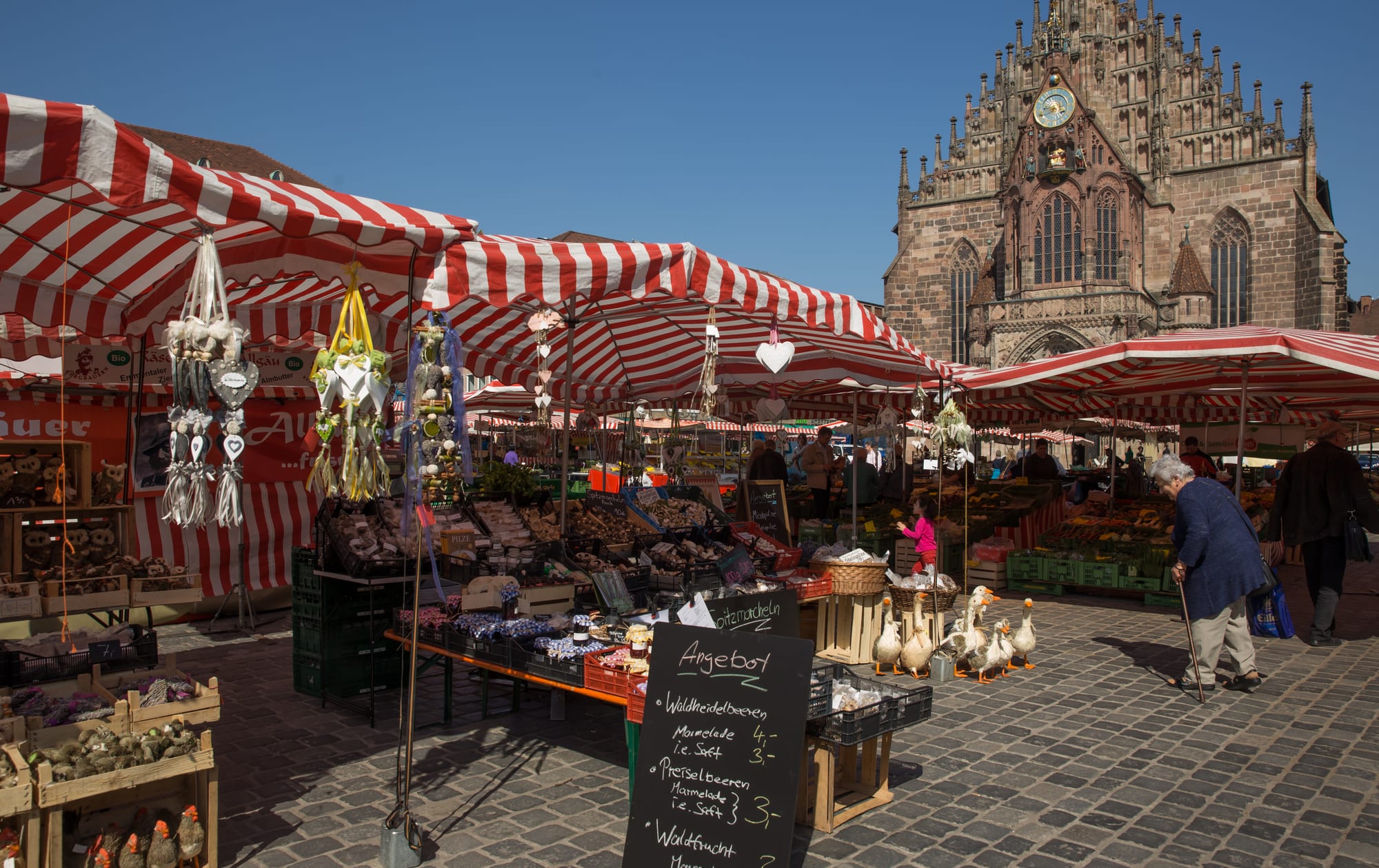
Red-and-white striped market stalls selling fruit and crafts on a cobbled square, with the Gothic front of the Frauenkirche behind

Bavaria, Germany

Nuremberg

Market stalls on the Hauptmarkt in front of the Frauenkirche in Nuremberg's old town. (Hubertl / Wikimedia Commons · CC BY-SA 4.0)

Bavaria's second city and the largest city of Franconia, on the Pegnitz, which grew around an imperial castle into one of the great Free Imperial Cities and the home of Dürer and the German Renaissance. Its name was later bound to the Nazi rallies and the post-war trials; the walled old town, largely destroyed in 1945, was rebuilt and is again a centre of trade, industry and Christmas markets.

Neighbourhoods

  • Sebalder Altstadt
    • First-time visitors
    • Historic district
    • Bars

    The northern half of the walled old town, rising from the Pegnitz to the Imperial Castle around St. Sebaldus and the town hall. Dürer's house, the Hauptmarkt and the half-timbered Weißgerbergasse, lined with bars, restaurants and galleries, are all here.

    Open in Maps
  • Lorenzer Altstadt
    • Shopping
    • Museums
    • Close to public transport

    The southern half of the old town, around St. Lorenz, and the main shopping district, with department stores on Breite Gasse, Karolinenstraße and Kaiserstraße. The Germanisches Nationalmuseum and the Neues Museum are here, and the main station stands just outside the walls at its south-eastern corner.

    Open in Maps
  • Gostenhof
    • Local life
    • Best for food
    • Nightlife

    A district west of the old town beyond the Plärrer transport hub, nicknamed GoHo after New York's SoHo, and 'Gostanbul' for its many residents of Turkish origin. It has its own Christmas market and the old St. Rochus cemetery.

    Open in Maps
  • St. Johannis
    • Quiet and residential
    • Historic sites

    A residential district just north-west of the walls. Its Johannisfriedhof, known as the rose cemetery, holds five centuries of bronze epitaphs and the graves of Albrecht Dürer and Willibald Pirckheimer.

    Open in Maps

Things to do

Famous landmarks

  • Nuremberg Castlelandmark

    The group of medieval buildings on a sandstone ridge above the old town — the Imperial Castle, the burgraves' castle and the city's buildings — with a Romanesque double chapel and views over the roofs.

    Open in Maps
  • City wallslandmark

    The medieval fortifications begun in the 12th century, about four kilometres of which still stand around the old town, with gates and towers, the towers named since 1540 by a code of colours and letters.

    Open in Maps
  • Schöner Brunnenlandmark

    The 'beautiful fountain' on the Hauptmarkt, about 19 metres high, a replica of the 14th-century original; spinning the brass ring set in its railing is said to bring luck.

    Open in Maps
  • Frauenkirchelandmark

    The Gothic Church of Our Lady on the east side of the Hauptmarkt, built between 1352 and 1362 on the initiative of Emperor Charles IV.

    Open in Maps
  • St. Lorenzlandmark

    The great Gothic church of the southern old town, badly damaged in the Second World War and restored.

    Open in Maps
  • St. Sebaldus Churchlandmark

    One of the city's oldest churches, the northern counterpart of St. Lorenz, where Johann Pachelbel was organist.

    Open in Maps
  • Fleisch Bridgelandmark

    A late-Renaissance bridge over the Pegnitz, whose 27-metre arch was the largest masonry arch in Germany when built; it survived the war almost unscathed.

    Open in Maps
  • Chain Bridgelandmark

    A pedestrian bridge of 1824 by the western walls, the oldest surviving chain bridge on the European continent.

    Open in Maps

Museums

  • Germanisches Nationalmuseummuseum

    Germany's largest museum of cultural history, founded in 1852, with works by Dürer, Rembrandt and Kirchner and the original stone figures of the Schöner Brunnen.

    Open in Maps
  • Albrecht Dürer's Housemuseum

    The timber-framed house below the castle where Dürer lived from 1509 until his death in 1528, with a re-created workshop and demonstrations of printmaking.

    Open in Maps
  • Nuremberg Toy Museummuseum

    A municipal museum founded in 1971 and among the best-known toy museums in the world, in a city long famous for its toymakers.

    Open in Maps
  • Nuremberg Transport Museummuseum

    Deutsche Bahn's railway museum and a museum of communications, just outside the walls, with a replica of the first locomotive to run on German rails.

    Open in Maps
  • Neues Museum Nürnbergmuseum

    The museum of modern and contemporary art and design in the Lorenzer Altstadt.

    Open in Maps

The Nazi era and the trials

  • Nazi party rally groundslandmark

    About 11 square kilometres south-east of the centre, largely designed by Albert Speer for the party rallies; they include the Zeppelin Field and the unfinished Congress Hall.

    Open in Maps
  • Documentation Center Nazi Party Rally Groundsmuseum

    A museum in the north wing of the unfinished Congress Hall, pierced by Günther Domenig's diagonal glass and steel passage, explaining the rallies and the regime.

    Open in Maps
  • Memorium Nuremberg Trialsmuseum

    The exhibition on the top floor of the Palace of Justice, beside Courtroom 600, where the leaders of Nazi Germany were tried in 1945–46.

    Open in Maps

Parks, sport and the outskirts

  • Nuremberg Zoopark

    A zoo of about 67 hectares in the Reichswald forest on the city's south-eastern edge, keeping around 300 species.

    Open in Maps
  • Johannisfriedhoflandmark

    The historic cemetery of St. Johannis, with bronze epitaphs and the graves of Dürer and Willibald Pirckheimer, known for its many rose bushes.

    Open in Maps
  • Max-Morlock-Stadionattraction

    The stadium of 1. FC Nürnberg, opened in 1928 beside the Zeppelin Field and a venue of the 2006 World Cup.

    Open in Maps

Short trips from the city

  • Fürthattraction

    The neighbouring city, now contiguous with Nuremberg, which celebrated its thousandth anniversary in 2007 and was the other end of Germany's first railway in 1835.

    Open in Maps
  • Erlangenattraction

    A university city to the north, shaped by the Huguenots who settled there after 1685 and today dominated by the Friedrich-Alexander University.

    Open in Maps

Seasonal events

  • ChristkindlesmarktAdvent, from the Friday before the first Sunday of Advent to Christmas Eve

    One of Germany's largest Christmas markets, with about two million visitors a year to its stalls of Christmas decorations, Lebkuchen and mulled wine on the Hauptmarkt.

  • Blue NightMay

    A night when museums, churches and other cultural institutions stay open until dawn, with blue lighting, music and performances in the old town streets.

  • Rock im ParkJune

    A large rock festival at the Zeppelin Field, held at the same time as its twin, Rock am Ring.

  • Norisring DTM racesummer

    Touring cars of the DTM series race on a street circuit around the former rally grounds.

  • Bardentreffenlate July or early August

    A free open-air world and folk music festival on stages across the old town, first held in 1976 for the 400th anniversary of Hans Sachs's death.

  • Altstadtfestmid-September

    A two-week old-town festival with music, processions and a food and drink market.

Eat and drink

Long-standing places and food districts in Nuremberg. Hours, ratings and directions come from your maps app, always current.

Nuremberg classics

  • Bratwurst-Rösleinrestaurant

    A traditional restaurant founded in 1431 beside the Christmas market square, which claims to be the largest sausage restaurant in the world.

    Open in Maps
  • Bratwurstglöckleinrestaurant

    A sausage kitchen in the Handwerkerhof that carries the name of a historic bratwurst house destroyed in the Second World War.

    Open in Maps
  • Lebkuchen bakersmarket

    Shops across the old town sell the city's gingerbread, with Elisenlebkuchen regarded as the finest quality.

    Open in Maps

Food districts

  • Handwerkerhofneighborhood

    A courtyard laid out in 1971 inside the Frauentor fortifications, styled as a medieval village of craft workshops, with traditional restaurants and beer gardens.

    Open in Maps
  • Weißgerbergasseneighborhood

    One of the few largely preserved old streets of the Sebalder Altstadt, its timber-framed houses now lined with bars and restaurants.

    Open in Maps

Experience Nuremberg

History

Nuremberg first appears in records in 1050, as the site of an imperial castle on the border between Franconia and Bavaria's Nordgau. It grew quickly on the trade routes between Italy and northern Europe: in 1219 Frederick II granted it the Great Charter of Freedom, and it became a Free Imperial City answerable only to the emperor. Imperial diets met here so often that it became an unofficial capital of the Holy Roman Empire; the Golden Bull of 1356 required each new king to hold his first diet here, and from 1424 to 1796 the Imperial Regalia were kept in the city. The prosperity had a dark side — Jews were massacred in 1298, and after the pogrom of 1349 a market square was laid out over the Jewish quarter.

In the fifteenth and sixteenth centuries Nuremberg was the centre of the German Renaissance. Albrecht Dürer worked here, Anton Koberger printed the Nuremberg Chronicle in 1493, and Martin Behaim made the oldest surviving globe. The city accepted the Reformation in 1525. The Thirty Years' War nearly halved its population, and in 1806 it passed to Bavaria. Industry revived it: Germany's first railway ran from here to Fürth in 1835, and Siemens and MAN made it Bavaria's industrial heart.

The Nazis staged their party rallies here and passed the Nuremberg Laws at the 1935 rally. Bombing on 2 January 1945 destroyed about 80 per cent of the medieval centre in an hour, and the city was taken by US troops in April after street fighting. In 1945–46 the leading Nazis were tried in the Palace of Justice. The old town was rebuilt, and since 1995 the city has awarded an international human rights prize.

Culture & Customs

Nuremberg's golden age still defines its image. Dürer, born here, is everywhere, from his house below the castle to his grave in the Johannisfriedhof. The city's prosperous craftsmen formed guilds of Meistersinger, and Wagner made the most famous of them, Hans Sachs, the hero of Die Meistersinger von Nürnberg. Johann Pachelbel was born here and played the organ at St. Sebaldus, and the city's academy of fine arts is the oldest in central Europe. Today the State Theatre, founded in 1906, stages opera, ballet and drama, and the Bardentreffen fills the old town with free world music every summer.

Remembrance is part of civic life. The city that hosted the rallies now runs a documentation centre in the unfinished Congress Hall, set up the Memorium in the Palace of Justice, and laid out the Way of Human Rights by Dani Karavan beside the Germanisches Nationalmuseum. Stolpersteine in the pavements recall the Jewish residents persecuted by the Nazi regime.

Sport is followed closely. 1. FC Nürnberg, known simply as Der Club, won nine German championships and held the record for most titles until 1986; the Ice Tigers play in the top ice hockey league, and touring cars race at the Norisring each summer. Franconian identity is strong, and since 1945 the city has mainly elected Social Democrat mayors in a conservative state, though the mayor elected in 2020 is from the CSU.

Daily Life

About 546,000 people lived in Nuremberg in 2024, making it the second-largest city in Bavaria. It forms a continuous built-up area of about 1.4 million people with Fürth, Erlangen and Schwabach, and the wider metropolitan region has about 3.6 million. About a fifth of residents have an immigrant background, and districts such as Gostenhof have large Turkish-origin communities.

Siemens remains the largest industrial employer, and the city builds electrical and mechanical equipment, vehicles and writing and drawing materials and stationery, and about a third of Germany's market-research agencies are based here. The Messe is one of the country's largest trade-fair organisers, and its International Toy Fair is the biggest of its kind in the world. The University of Erlangen-Nuremberg, the Technische Hochschule and the new University of Technology Nuremberg bring a large student population.

Life runs on an efficient network of U-Bahn, trams and S-Bahn, with driverless trains on two lines. Weekdays start early; Sundays are quiet, with most shops closed. In summer the beer gardens, the Pegnitz meadows and the festivals at the Dutzendteich draw crowds, and in Advent the whole old town turns towards the Christkindlesmarkt.

Food

The Nürnberger Rostbratwurst is the city's emblem: a small, thin pork sausage, seven to nine centimetres long and flavoured with marjoram, which under EU protection may only be made in Nuremberg. Grilled and served three in a bread roll with mustard — "Drei im Weggla" — it is sold from kiosks across town; as a main meal it comes with sauerkraut, potato salad or horseradish. Saure Zipfel, or Blaue Zipfel, are bratwurst simmered in a broth of vinegar, onions and spices.

Franconian cooking also gives the Schäufele, roast pork shoulder with a crackling crust, and Presssack, a firm sausage sliced and eaten with mustard. Bratwurst-Röslein, founded in 1431, is among the old sausage kitchens, and the Bratwurstglöcklein in the Handwerkerhof carries the name of another, destroyed in the war.

Lebkuchen, honey-sweetened spiced cakes similar to gingerbread, are part of Germany's Christmas traditions; Elisenlebkuchen are considered the finest. Local beer is drunk in beer gardens and old-town taverns, and Franconian white wine, mostly Silvaner and Müller-Thurgau, comes in the round, flat Bocksbeutel bottle.

Planning tools

Budget

Nuremberg is cheaper than Munich, and Franconian inns and sausage kiosks keep eating out affordable. Hotel prices rise during the Christmas market and the big trade fairs at the Messe, such as the toy fair. The Nürnberg Card covers public transport and museum entry for two days.

Daily Budget Midrange
USD 170–280 (mid-range hotel, Franconian restaurant meals, museum and castle tickets)
Daily Budget Shoestring
USD 75–130 (hostel bed, bratwurst rolls and bakery food, a day ticket for local transport)

Book rooms early for Advent weekends and trade-fair weeks; many of the best sights — the walls, the bridges, the churches and the rally grounds — cost nothing to see from outside.

Best Time to Visit

May to September brings beer gardens, open-air festivals and long evenings by the Pegnitz. Late November and December are the season of the Christkindlesmarkt, crowded and cold but the city's best-known event. Winter outside Advent is quiet and grey, and good for museums.

Suggested Number of Days

Two or three days are enough for a first visit to the city itself, including the sites outside the walls. Four or five allow for the neighbouring cities and other Franconian towns by train. Trade fairs and the Christmas market make rooms scarcer, so dates matter more than length.

First Visit
2–3 days
With Surroundings
4–5 days

Transportation

Public transport is run by the VGN network: U-Bahn lines, trams, buses, the S-Bahn and regional trains, all on one ticket within the network (not on IC or ICE trains). The first U-Bahn line opened in 1972, and since 2008 two lines have run without drivers. The Plärrer and the main station are the main hubs.

Most public transport stops at night outside weekends and holidays, so plan late arrivals and departures with that in mind.

Airport & Station Connections

Nuremberg Airport is about 5 km north of the centre and is the end of U-Bahn line U2, which runs to the main station. ICE trains reach Munich in about an hour, Frankfurt and Leipzig in about two and Berlin in under three; from Frankfurt Airport the direct ICE takes about two and a half hours. The A3, A6 and A9 motorways meet around the city.

Walkability

The walled old town, about five kilometres around, is compact and mostly pedestrianised, with cobbles and a steep climb to the castle. The station is just outside the walls at the south-east corner. The rally grounds, the zoo and the stadium lie several kilometres south-east and are reached by public transport.

Safety

Germany is a safe country with low levels of violent crime. In Nuremberg the main concern for visitors is pickpocketing in the crowds of the Christkindlesmarkt and around the main station; the area around the station is patrolled by state and federal police.

Keep bags closed and valuables out of reach at the Christmas market and on crowded trams, and validate tickets where required. Check current official travel advice before travelling.

Climate

An oceanic climate with a continental touch, shaped by the city's inland position and altitude. Winters swing between mild and cold spells; summers are generally warm. Rain is spread through the year, with July a little wetter and February and April a little drier.

Summer
warm — July averages about 19.8 °C, and some summer days pass 35 °C
Winter
changeable — January averages about 1.7 °C

Local Customs

Nuremberg is the largest city of Franconia, a region with its own culture and dialect. The city became Protestant in 1525, and its two great parish churches, St. Lorenz and St. Sebaldus, are Lutheran. Sunday is a strict day of rest: most shops close, though restaurants and museums usually open. Brass Stolpersteine set in the pavements mark the homes of people persecuted by the Nazis.

Tipping is a matter of politeness, usually done by stating a rounded-up total when paying. Behave quietly at the rally grounds and the trials memorial, which are places of remembrance.

Common Payment Methods

The currency is the euro. German debit cards are accepted almost everywhere, but foreign credit and debit cards are less widely taken than in many countries, and some bakeries, bars, sausage kiosks and Christmas-market stalls prefer cash, so carrying euros is sensible.