History
Celtic settlers called the place Radasbona, and the Romans built a fort here around AD 90. In 179, under Marcus Aurelius, they founded Castra Regina, "the fortress by the River Regen", for the Legio III Italica at the Danube's northernmost point; its walls still shape the core of the old town. From about 530 the Agilolfing dukes made it the capital of Bavaria, which it remained until the thirteenth century. Saint Boniface re-established its bishopric in 739; after 843 it was the seat of Louis the German, and in 845 fourteen Bohemian princes were baptised here, beginning the Christianisation of the Czechs.
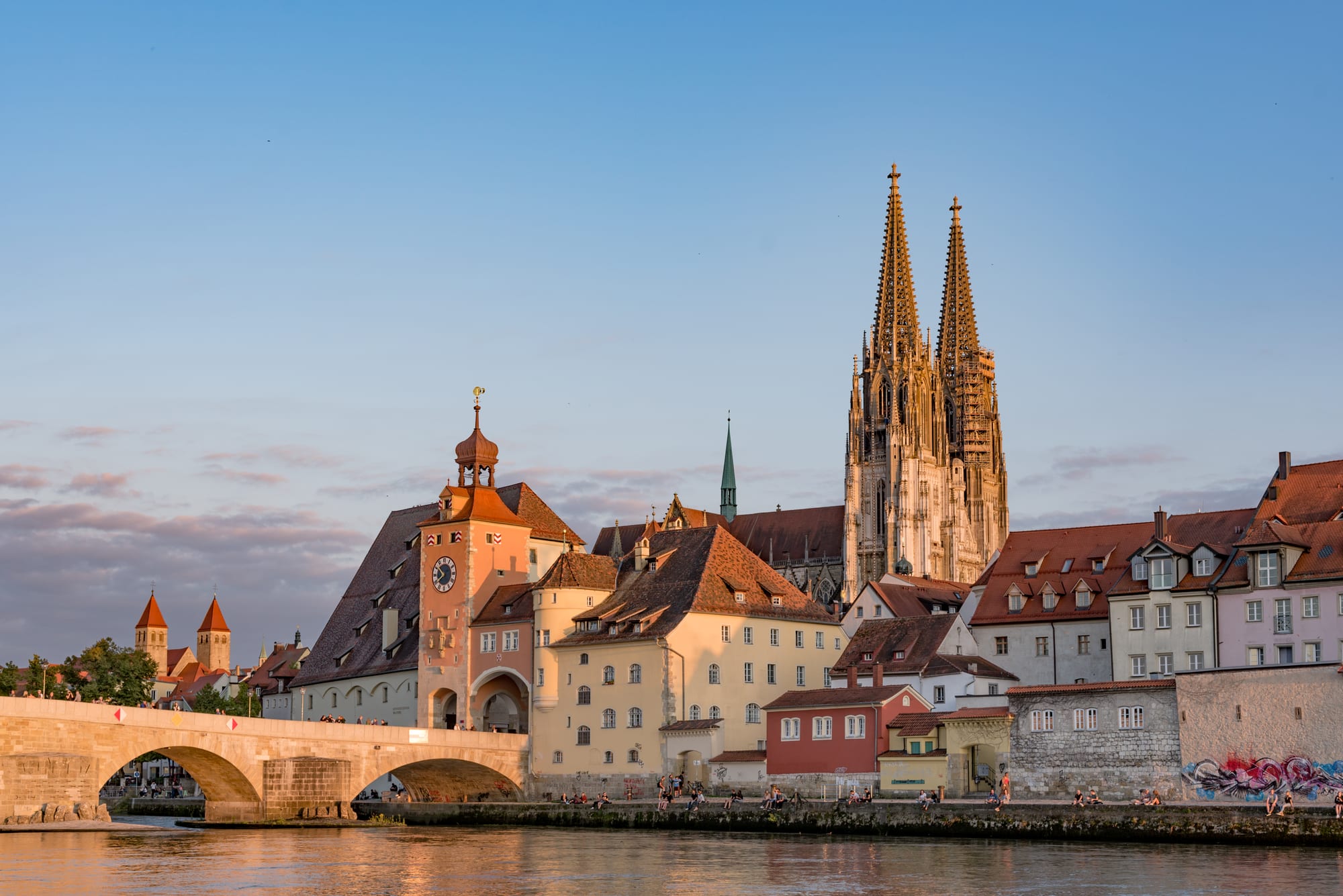
The Stone Bridge, built between 1135 and 1146, opened trade routes between northern Europe and Venice and began a golden age of wealthy merchant families. Regensburg became a Free Imperial City in 1245, adopted the Reformation in 1542, and from 1663 to 1806 hosted the Perpetual Diet of the Holy Roman Empire. The city itself, its Catholic bishop and three abbeys were five separate states of the Empire within one town. Its Jewish community, one of the largest in southern Germany, was expelled in 1519 and its synagogue destroyed. In 1803 the city passed to Carl von Dalberg's Principality of Regensburg, was fought over by Napoleon in 1809, and became part of Bavaria in 1810.
Under the Nazis the synagogue was destroyed on Kristallnacht and more than 200 Jews deported in 1942. Allied bombers struck the Messerschmitt aircraft works in 1943 and the oil refinery in 1945, but the medieval centre suffered little, and slow post-war recovery spared it from redevelopment. From 1945 to 1949 the city held Germany's largest displaced persons camp. Siemens, a new university and, from 1986, BMW transformed the economy, and in 2006 the old town and Stadtamhof became a UNESCO World Heritage Site.