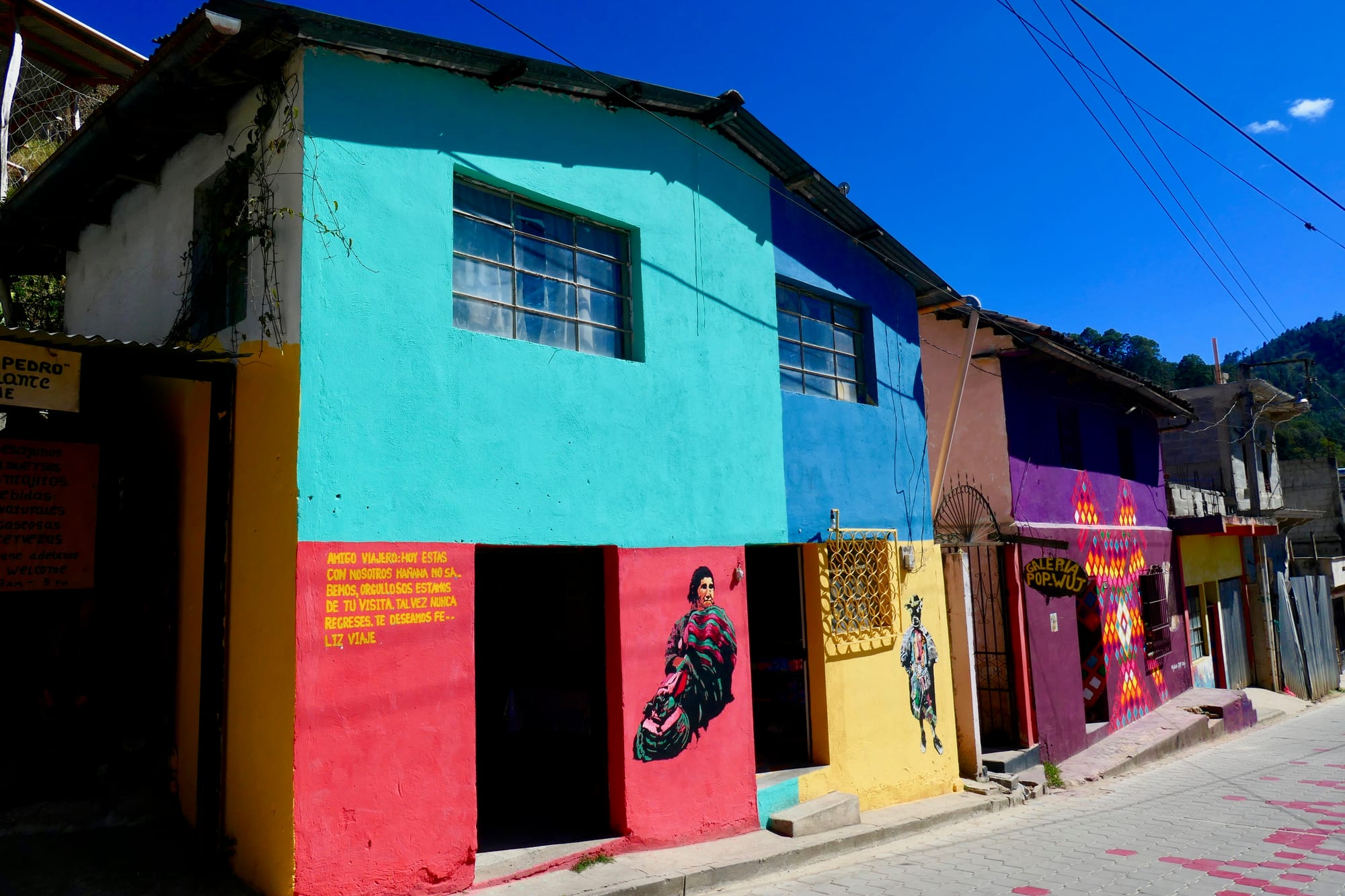
Turquoise, blue, red, yellow and purple houses with painted murals along a sunlit paved street below wooded hills

Lake Atitlán & the Western Highlands, Guatemala

Chichicastenango

Brightly painted houses and murals on a street in Chichicastenango. (Bruno Rijsman / Wikimedia Commons · CC BY-SA 2.0)

A K'iche' Maya town on a highland plateau in El Quiché, almost 2,000 metres up, where the Popol Vuh manuscript was preserved and copied by a Dominican friar in the early 18th century. Its Thursday and Sunday market fills the streets around the church of Santo Tomás, whose steps and hillside shrine are still used for Maya ritual.

Neighbourhoods

  • Plaza Central and the market streets
    • First-time visitors
    • Markets
    • Historic district

    The heart of the town, where the church of Santo Tomás faces the central square. On market days the stalls spread from the plaza into the surrounding streets, with traders selling the same kinds of goods setting up beside one another, and most visitors' lodgings and restaurants lie within a few blocks.

    Open in Maps
  • The outer streets
    • Local life
    • Quiet and residential

    Away from the plaza the town becomes residential, with painted houses and steep streets climbing towards the surrounding hills. Market stalls thin out here, and prices tend to fall the further they are from the centre.

    Open in Maps
  • Cerro Turkaj
    • Sacred places
    • Walks

    The wooded hill outside the town where the stone image of Pascual Abaj stands. Prayer-makers perform ceremonies at the shrine, and the ridge overlooks the Chichicastenango valley.

    Open in Maps

Things to do

Church, shrine and museum

  • Church of Santo Tomáslandmark

    A church first built in the mid-16th century on a pre-Columbian temple platform; its steps are still venerated, and K'iche' Maya priests burn incense and candles there and inside.

    Open in Maps
  • Pascual Abajlandmark

    A pre-Columbian Maya stone image on a hill near the town that survived the Spanish conquest and is still venerated, although it was badly damaged in the 1950s.

    Open in Maps
  • Chichicastenango Regional Museummuseum

    A small archaeological museum at the church of Santo Tomás, holding Maya objects, some more than 3,000 years old, many donated by a priest who served in the town for half a century.

    Open in Maps

Markets

  • Chichicastenango marketmarket

    Held on Thursdays and Sundays around the plaza, with textiles, masks for traditional dances, pottery, wooden boxes, medicinal plants, candles, copal incense, grindstones, tools and livestock.

    Open in Maps

Short trips from the town

  • Qʼumarkajlandmark

    The ruins of the late K'iche' capital beside Santa Cruz del Quiché, one of the most powerful Maya cities when the Spanish arrived, with a ballcourt, temples and palaces around a plaza.

    Open in Maps
  • Panajachel and Lake Atitlánattraction

    The main town on the north-east shore of Lake Atitlán, a transport hub and the centre of the lake's tourism, beneath the Atitlán, Tolimán and San Pedro volcanoes.

    Open in Maps

Seasonal events

  • Fiesta of Santo Tomás13–22 December, with the main day on 21 December

    The town's patron-saint festival, combining traditional dances such as the palo volador, cofradía processions carrying the saints to the church, fireworks in the main square and the regular market.

  • Convite of 8 DecemberDecember

    A convite, a festive procession, held for more than 125 years and recognised as part of Guatemala's intangible heritage.

Eat and drink

Long-standing places and food districts in Chichicastenango. Hours, ratings and directions come from your maps app, always current.

Chichicastenango classics

  • Market comedoresmarket

    Simple food stalls inside and around the market, serving tortillas, black beans, eggs, stews and hot atol to traders and shoppers.

    Open in Maps
  • Restaurants around the plazaneighborhood

    Restaurants near the church and on the side streets of the plaza, one in an old colonial building, serving Guatemalan dishes and grilled meats.

    Open in Maps

Experience Chichicastenango

History

Before the Spanish conquest the town was a K'iche' Maya ceremonial and regional centre, known by its K'iche' name, Chaviar. The Spanish renamed it Tzitzicaztenanco, "place of nettles", using the Nahuatl language of the Tlaxcalan soldiers who came with Pedro de Alvarado's army in the 1520s, and Dominican friars made it one of their doctrinas, settlements where the K'iche' were taught the Catholic faith. The church of Santo Tomás was raised on a pre-Columbian temple platform, and the town took the apostle as its patron.

The town's most famous moment came between 1701 and 1703, when the friar Francisco Ximénez served as its parish priest. In the convent he found a K'iche' manuscript of the Popol Vuh, the sacred narrative of the K'iche' people, written down around 1550, and he transcribed and translated it into Spanish, preserving the Maya creation story and the tale of the Hero Twins.

After independence Chichicastenango passed between several administrative divisions, and on 13 September 1948 it was raised to the rank of villa and confirmed as a municipality of El Quiché. In the 1950s members of Catholic Action badly damaged the stone image of Pascual Abaj, but it is still venerated. From the 1930s the town drew film-makers: The New Adventures of Tarzan was partly filmed here in 1935, and a colour travelogue, Sacred City of the Mayans, followed in 1936. Today its market is one of the best known in the Guatemalan highlands.

Culture & Customs

Chichicastenango is a K'iche' Maya cultural centre. According to the 2012 census, 98.5 per cent of the municipality's people are K'iche'; about a fifth speak only K'iche', most speak both K'iche' and Spanish, and a small minority speak only Spanish. Women's huipil blouses, woven on the backstrap loom, carry patterns tied to lineage and to the Maya view of the cosmos.

Religion joins two traditions. K'iche' priests use the church of Santo Tomás for their own rituals, burning incense and candles, and each of the steps leading up to it is said to stand for one month of the Maya calendar year. Ceremonies are also held on the hill of Turkaj, where Pascual Abaj stands. The town has fourteen cofradías, religious brotherhoods, each of which keeps the image of a saint on an altar in the home of its senior mayordomo and carries it to the church at festival time.

The fiesta of Santo Tomás, with its main day on 21 December, is one of the largest celebrations in Guatemala. Each dance group holds its own ceremonies and rehearsals with marimba music, and the groups perform the dances of the bulls, the deer, the conquest, the Moors, the snake and the palo volador, in which men swing from a tall pole, while the cofradías process with the saints and fireworks fill the evenings. The masks worn in these dances are made in the town and sold in the market.

Daily Life

The municipality takes in the town and dozens of rural communities around it. Farming is one mainstay: the main crops are maize, beans, wheat and fruit, especially apples and peaches. The municipality covers about 400 square kilometres of hills, with woods of pine, oak and cypress alongside orchards of apples, pears and peaches.

Crafts are the other mainstay. Families weave textiles on the backstrap loom and make bags, hammocks, clothing, wooden masks and furniture, musical instruments, palm baskets and hats, leather goods, candles and fireworks, and these are sold at the market, which also draws traders from neighbouring towns and regions.

The week turns on Thursday and Sunday. Traders arrive early with produce, flowers, livestock and goods for the stalls, which spread through the streets around the plaza until the late afternoon, while tour groups arrive later by bus. On other days the town is quieter, and life follows the fields, the church and the cofradías.

Food

Food here is highland Maya cooking at its simplest: hand-patted maize tortillas with every meal, black beans, eggs, fresh cheese and chillies, with tamales and chuchitos, small tamales steamed in maize husks or leaves, for weekends and celebrations. Pepián, a stew thickened with toasted seeds and chillies, is the dish of fiestas.

The market is the place to eat as well as to shop. Comedores serve simple set meals, and stalls sell atol, a warm and often sweetened maize drink, and pan dulce, sweet bread. Besides the cooked food, the market sells cal, the lime used to prepare maize for tortillas, along with grindstones, condiments and the season's fruit from the hills around the town.

During the fiesta, dance groups pay their own expenses by selling chicha, a fermented drink, and cheap cane spirit, aguardiente, is widely drunk in the highlands. Around the plaza, restaurants, one of them in an old colonial building, add grilled meats and fuller Guatemalan menus for visitors.

Planning tools

Budget

Chichicastenango is inexpensive. Simple guesthouses, comedor meals and chicken buses cost little; the main extras are a better hotel near the plaza, a shuttle from Antigua or Panajachel and shopping at the market, where bargaining is normal.

Daily Budget Midrange
USD 60–120 (hotel near the plaza, restaurants, a tourist shuttle)
Daily Budget Shoestring
USD 25–40 (guesthouse, comedor meals, chicken buses)

Carry small notes in quetzales for the market, and expect busier streets and higher demand for rooms on market days and during the December fiesta.

Best Time to Visit

The dry season, from November to April, brings clear days and cold nights. The town is busiest on Thursday and Sunday market days, and the Santo Tomás fiesta in mid-December is its great event. The wet season, from May to October, has afternoon rain.

Suggested Number of Days

Many visitors come for a single market day from Lake Atitlán or Antigua. Staying the night before a market day gives a quieter start, and two or three days allow time for the surrounding highlands and Santa Cruz del Quiché.

First Visit
1 day
With Surroundings
2–3 days

Transportation

The town is small and covered on foot. Chicken buses and shuttles link it with the Pan-American Highway at the Los Encuentros junction, 17 km away along a road of many switchbacks, and with Santa Cruz del Quiché to the north. Tuk-tuks and taxis cover short hops.

Direct buses run on market days; otherwise most connections are made at Los Encuentros.

Airport & Station Connections

Most visitors arrive by tourist shuttle from Antigua, Guatemala City or Panajachel, a few hours from the capital, or by chicken bus with a change at Los Encuentros. The nearest international airport is La Aurora in Guatemala City.

Walkability

The centre is compact, with the church, the plaza and the market within a few minutes of each other, though some streets are steep and the market crowds are dense. The shrine of Pascual Abaj stands on a wooded hill outside the town.

Safety

Guatemala has significant crime, including gang activity and armed robbery, concentrated in parts of Guatemala City and on some highways and rural routes. The tourist circuit around Lake Atitlán, Chichicastenango and Xela is generally calm, but bag-snatching occurs, and mountain roads are steep and driven fast.

Keep valuables out of sight in the market, avoid travelling at night on rural roads, and ask before photographing people and especially children. Check current official travel advice before travelling.

Climate

At almost 2,000 metres the town has a temperate highland climate with a dry season and a wet season. Temperatures range from about 10 to 22°C, falling as low as 4°C in November, December and January.

Summer
wet season, May to October: mild days within the town's range of about 10–22°C, with afternoon rain
Winter
dry season, November to April: sunny days and cold nights, down to about 4°C from November to January

Local Customs

Chichicastenango is a K'iche' Maya town: most people speak K'iche', many also speak Spanish, and Maya and Catholic practice meet in the church of Santo Tomás and at the shrine of Pascual Abaj, where prayer-makers burn incense, copal and candles. Bargaining in the market is expected and should stay friendly.

Behave quietly around ceremonies in the church and at the shrine, do not walk through offerings, and ask before photographing people and especially children.

Common Payment Methods

The currency is the Guatemalan quetzal. Cash is needed in the market and in most small shops and comedores; cards are accepted mainly at larger hotels. The town has banks and cash machines.