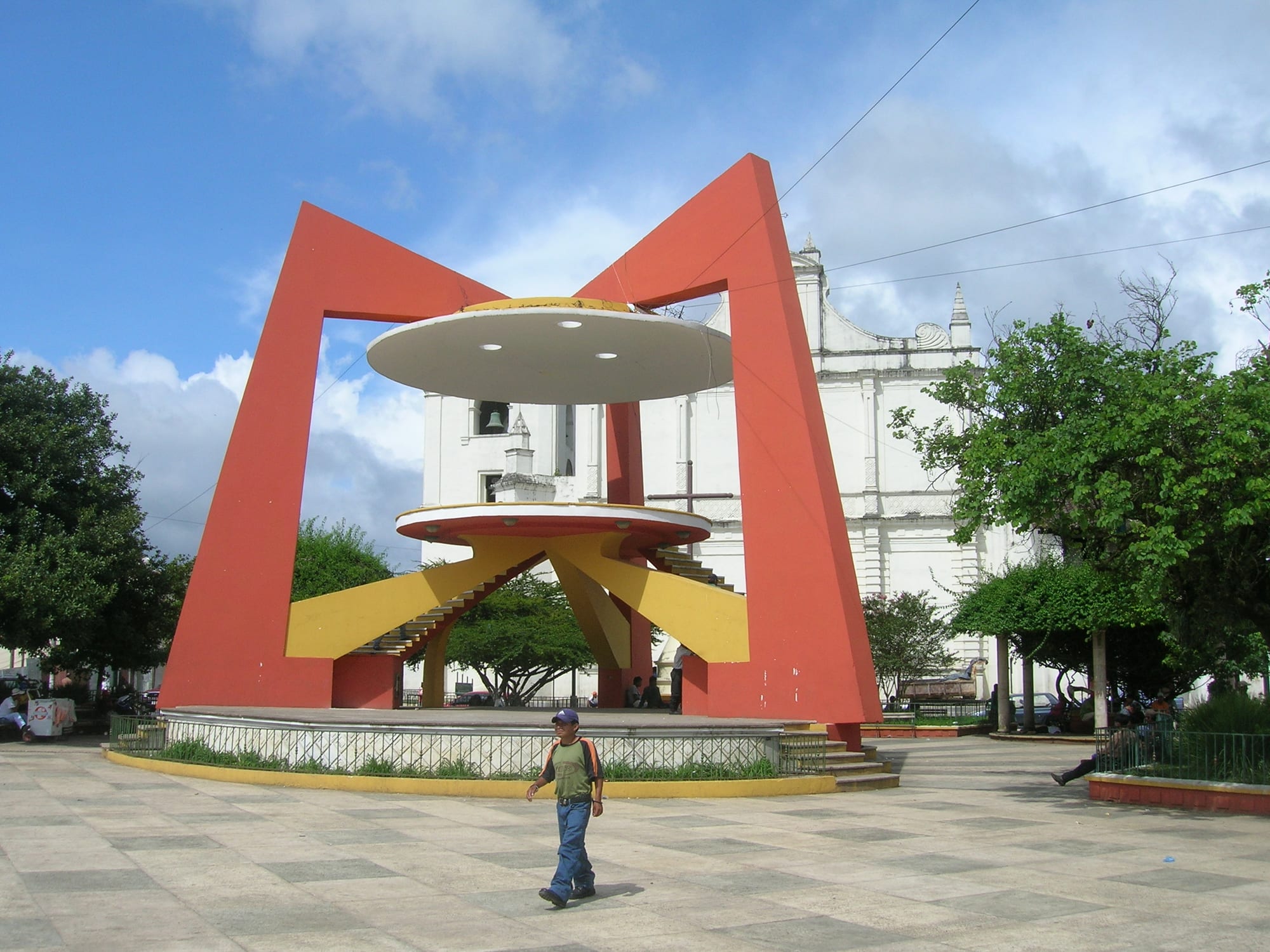
A tall red and yellow modern bandstand on a paved plaza, with the white front of the cathedral behind it

Tikal, the Verapaces & the Caribbean, Guatemala

Cobán

The central plaza of Cobán, with its modern bandstand and the cathedral of Santo Domingo. (Micah MacAllen / Wikimedia Commons · CC BY-SA 2.0)

The capital of Alta Verapaz, a cool, often drizzly highland city at about 1,320 m in the hills of central Guatemala. Founded by Dominican friars in the 1540s and shaped by German coffee planters in the late 19th century, it is now a busy Q'eqchi' Maya market town at the centre of a coffee and cardamom region, and the gateway to the Verapaz cloud forests.

Neighbourhoods

  • The centre around the plaza
    • First-time visitors
    • Historic district
    • Markets

    The hilltop heart of the city, around the central plaza with its modern bandstand and the cathedral of Santo Domingo. The market behind the cathedral, the Sunday crafts market, banks, restaurants and most of the hotels are within a few blocks.

    Open in Maps
  • El Calvario
    • Viewpoints
    • Quiet and residential

    The residential streets around El Calvario church, close to the forest of Las Victorias National Park on the north-western outskirts of the city.

    Open in Maps
  • Plaza Magdalena and the bus terminals
    • Close to public transport
    • Shopping

    The busier, newer side of town around the Plaza Magdalena shopping centre, where minibuses leave for the surrounding villages and Lanquín; the Talpetate terminal, used by most buses, is a short ride from the centre.

    Open in Maps

Things to do

The centre

  • Cobán Cathedrallandmark

    The cathedral of Santo Domingo de Guzmán, one of the oldest buildings in the region, begun in 1543 and rebuilt in 1741 and 1799 beside a convent of 1551; it is the mother church of the Diocese of Verapaz.

    Open in Maps
  • Central plazalandmark

    The city's main square in front of the cathedral, with its striking modern bandstand, the place where Cobán meets and where crafts are sold on Sundays.

    Open in Maps
  • El Calvario churchlandmark

    A church in the city, one of Cobán's popular sights.

    Open in Maps

Parks and coffee

  • Las Victorias National Parkpark

    A forested former coffee estate on the north-western edge of the city, once owned by the French coffee grower Jules Rossignon, with walking trails, picnic and camping areas and a small lake.

    Open in Maps
  • Dieseldorff coffee plantationattraction

    A coffee farm linked to Erwin Paul Dieseldorff, the German planter who built a coffee empire in Alta Verapaz at the end of the 19th century; it is one of the city's popular sights.

    Open in Maps

Markets and sport

  • Market behind the cathedralmarket

    The city's busy market, where farmers from the surrounding hills sell their produce and Q'eqchi' is widely spoken.

    Open in Maps
  • Estadio Verapazattraction

    The 15,000-seat football stadium opened in 1936, home of Cobán Imperial, one of Guatemala's traditional clubs and league champions for the first time in 2004.

    Open in Maps

Short trips from the city

  • San Juan Chamelcoattraction

    A neighbouring Q'eqchi' town at about 1,350 m in the hills just south-east of Cobán, whose annual festival falls on 24 June.

    Open in Maps
  • San Pedro Carcháattraction

    The neighbouring town to the east, centre of a large municipality of 1,310 km².

    Open in Maps
  • Biotopo del Quetzalpark

    The Mario Dary Rivera Protected Biotope, a mountain forest reserve in Baja Verapaz managed by the San Carlos University, created to protect the quetzal, Guatemala's national bird, which can sometimes be seen there.

    Open in Maps
  • Grutas de Lanquínpark

    A large limestone cave system just outside the village of Lanquín, a national park whose bats stream out at dusk.

    Open in Maps
  • Semuc Champeypark

    Stepped turquoise pools on a natural limestone bridge over the Cahabón River, which plunges underground beneath them; a natural monument since 2005.

    Open in Maps

Seasonal events

  • International Half Marathon of CobánMay

    A half marathon that draws about 4,000 runners and has become the region's landmark sporting event.

  • Rabin Ajawlate July

    Considered the largest and most important Maya festival in the country, with fireworks, processions in traditional dress and the crowning of the Rabin Ajaw, 'daughter of the king' in Q'eqchi', chosen from among Indigenous women.

  • Departmental fairlate July to early August

    The fair of Alta Verapaz, which begins on the last Sunday of July and runs for a week.

  • Fiesta of Santo Domingo de Guzmánearly August

    The city's patron saint's day, 4 August, the religious feast of the town named after Saint Dominic.

  • International Orchid ExhibitionNovember

    A show of the orchids of the Verapaces, among them the monja blanca, the white nun orchid that is the symbol of Alta Verapaz.

Eat and drink

Long-standing places and food districts in Cobán. Hours, ratings and directions come from your maps app, always current.

Cobán classics

  • Kak'ik in the comedoresrestaurant

    The spicy red turkey soup made to the Verapaz recipe, coloured with annatto and flavoured with mint, coriander and culantro, usually served with rice and white tamales.

    Open in Maps
  • Coffee from Alta Verapazcafe

    Cafés around the centre pour the coffee of the surrounding hills, which built the city's fortunes in the 19th century.

    Open in Maps

Food districts and markets

  • Market behind the cathedralmarket

    Stalls of produce brought in by farmers from the surrounding hills.

    Open in Maps
  • Restaurants around the central plazaneighborhood

    Restaurants in the centre range from simple comedores to grills and places serving traditional dishes.

    Open in Maps

Experience Cobán

History

In the early colonial period the hills of what became the Verapaz were known to the Spanish as Tezulutlán, the "land of war". In 1537 Bartolomé de las Casas won an agreement that its peoples, once brought into the empire, would not be handed out to settlers as forced labour, and Dominican friars set out to convert them peacefully. The church at Cobán, begun in 1543, became the centre of their mission; the town took its name from a local ruler, and in 1547 the region's name was officially changed to Vera Paz, "true peace". The emperor Charles V granted Cobán the title of imperial city, and in 1599 it became the seat of a bishop.

By 1850 Cobán had about 12,000 people. In the late 19th century liberal governments offered generous concessions to German settlers, who built a coffee economy around the city and ran it as an almost separate world, with a German club founded in 1888, a German school from 1935 and about 2,000 Germans by 1930. They built the Verapaz railway, which linked the coffee region with Lake Izabal from 1895 until 1963, and in 1898 Cobán was reported to be the third-largest city in Guatemala.

In 1941, under pressure from the United States, the government of Jorge Ubico expelled the Germans; many were interned in camps in Texas. A sizeable population of German descent remains, largely absorbed through intermarriage, and German touches survive in the city's architecture. In 1970 Cobán was included in the Franja Transversal del Norte, the zone opened up for agricultural development, and the expansion of oil palm in the 21st century has reached the municipality.

Culture & Customs

Q'eqchi' Maya people are the majority, and the language is widely heard in the streets, above all in the markets where farmers from the surrounding hills sell their produce. The Rabin Ajaw, held at the end of July, is considered the largest and most important Maya festival in Guatemala: Indigenous women from across the country compete for the title of Rabin Ajaw, "daughter of the king" in Q'eqchi', amid fireworks and processions in traditional dress. The departmental fair begins on the last Sunday of July, and the city's patron, Saint Dominic, is honoured on 4 August.

The city's German past is still visible in its buildings and families, and its coffee is part of its identity. Orchids are another: the hills around Cobán are rich in them, the rare white monja blanca is the symbol of Alta Verapaz, and an international orchid exhibition is held each November.

Sport has a loyal following. Cobán Imperial, nicknamed the Blue Princes, is one of Guatemala's traditional football clubs and won its first league title in 2004, playing at the Estadio Verapaz, and the city is also known for basketball, with strong youth leagues. Each May, about 4,000 runners come for the international half marathon.

Daily Life

The 2018 census counted about 212,000 people in the municipality of Cobán, which covers almost 2,000 km² of hills and forest. The city is the capital of Alta Verapaz and a central city of northern Guatemala, the place where goods from Quetzaltenango and the capital are distributed across the department, and it sits at the heart of a major coffee-growing area that also produces cardamom.

The day starts with the arrival of workers and traders from the surrounding villages, who come into town in the morning and leave in the afternoon. The markets, the minibuses around Plaza Magdalena and the bus terminals are busiest early, and the centre quietens in the evening under the drizzle. Shopping centres such as Plaza Magdalena sit alongside the traditional markets.

In the countryside coffee and cardamom are the crops that provide the most work, many Q'eqchi' families still depend on their maize fields for food, and oil palm plantations have spread into the municipality in the 21st century.

Food

Kak'ik, typical of Guatemalan cuisine, is a spicy red turkey soup whose name comes from the Q'eqchi' words for "red" and "hot". The Verapaz recipe uses turkey with garlic, onion, mint, coriander and culantro, coloured with ground annatto, and it is usually served with rice, white tamales wrapped in leaves, chilli and a cocoa drink. It was declared part of Guatemala's intangible cultural heritage in 2007.

Coffee built Cobán, and the coffee of the Verapaz hills, grown since the German planters' time, is poured in cafés around the centre. The Cobán region is also one of the cardamom-growing areas of Guatemala, the world's largest producer, and most of the crop is exported; the markets sell spices, tamales steamed in leaves, fruit and vegetables brought in from the surrounding villages.

Everyday eating follows the rest of Guatemala and is built on maize, with comedores near the market and grills and family restaurants in the centre. Cantinas serve cheap beer and spirits, and restaurants offer wine, beer and a few locally known cocktails.

Planning tools

Budget

Cobán is inexpensive, with hotels, comedores and buses at local prices. The main extra costs are tours into the countryside — Semuc Champey, the caves and the cloud forests — and private shuttles.

Daily Budget Midrange
USD 65–130 (comfortable hotel, restaurant meals, a guided day tour, taxis)
Daily Budget Shoestring
USD 25–45 (guesthouse room, comedor meals and market food, minibuses)

Use the numbered taxis rather than unmarked cars.

Best Time to Visit

Cobán is mild all year. Late July and early August bring the Rabin Ajaw and the fair, the liveliest time; November has the orchid exhibition. The persistent fine drizzle called chipi-chipi is most common from November to March, and the wet season keeps the cloud forests at their greenest.

Suggested Number of Days

A day or two is enough for the city itself. Four or five days allow for the countryside around it as well, as the roads through the hills are slow and most outings take a full day.

First Visit
1–2 days
With Surroundings
4–5 days

Transportation

The centre is small enough to walk, though pavements are in poor shape and cars take the right of way. Numbered taxis cover the city at modest fares, and minibuses and colectivos leave from near Plaza Magdalena for Lanquín and nearby towns such as Tactic.

Only take taxis with a number marked on the door; unmarked cars are not licensed.

Airport & Station Connections

Cobán is about 219 km from Guatemala City, roughly four hours by the regular bus services from the capital, with shuttles as a more expensive option. Microbuses and shuttles run north to Flores in five to seven hours and east to Lanquín, and most buses use the Talpetate terminal, about 1.5 km from the centre. The country's main airport is in Guatemala City.

Walkability

The compact centre is walkable, but it is hilly, the pavements are uneven and drivers rarely give way. The plaza, cathedral, market and El Calvario are within easy reach of each other; Las Victorias is on the edge of town.

Safety

Guatemala has significant crime, including gang activity and armed robbery, concentrated in parts of Guatemala City and on some highways and rural routes. The region's tourist circuit of Flores, Tikal, Lanquín and the Río Dulce is generally calm. In Cobán, the city's many cantinas are associated with trouble, and there have been reports of drinks being spiked in nightclubs.

Use numbered taxis at night, keep an eye on drinks, avoid the cantinas, and travel between towns by day. Check current official travel advice before travelling.

Climate

A subtropical highland climate, cool for Guatemala because of the city's altitude. Rain is plentiful, though not constant, and the light drizzle called chipi-chipi can last for hours or days, especially from November to March.

Summer
Wet season: 18–25°C and misty, the wider region's figure for Cobán.
Winter
Dry season: mild and damp, with frequent chipi-chipi drizzle; the region's figure of 18–25°C for Cobán is for the wet season.

Local Customs

Cobán is a Q'eqchi' Maya city, and Q'eqchi' is widely spoken, above all around the markets; Spanish is used in business and with visitors. Traditional woven huipiles are sold in the market. Bargaining is normal at the Sunday crafts market and the market behind the cathedral.

Ask before photographing people, especially in the market and at the Rabin Ajaw; dress modestly in the cathedral and churches.

Common Payment Methods

The currency is the quetzal (GTQ). Markets, comedores, taxis and buses run on cash.