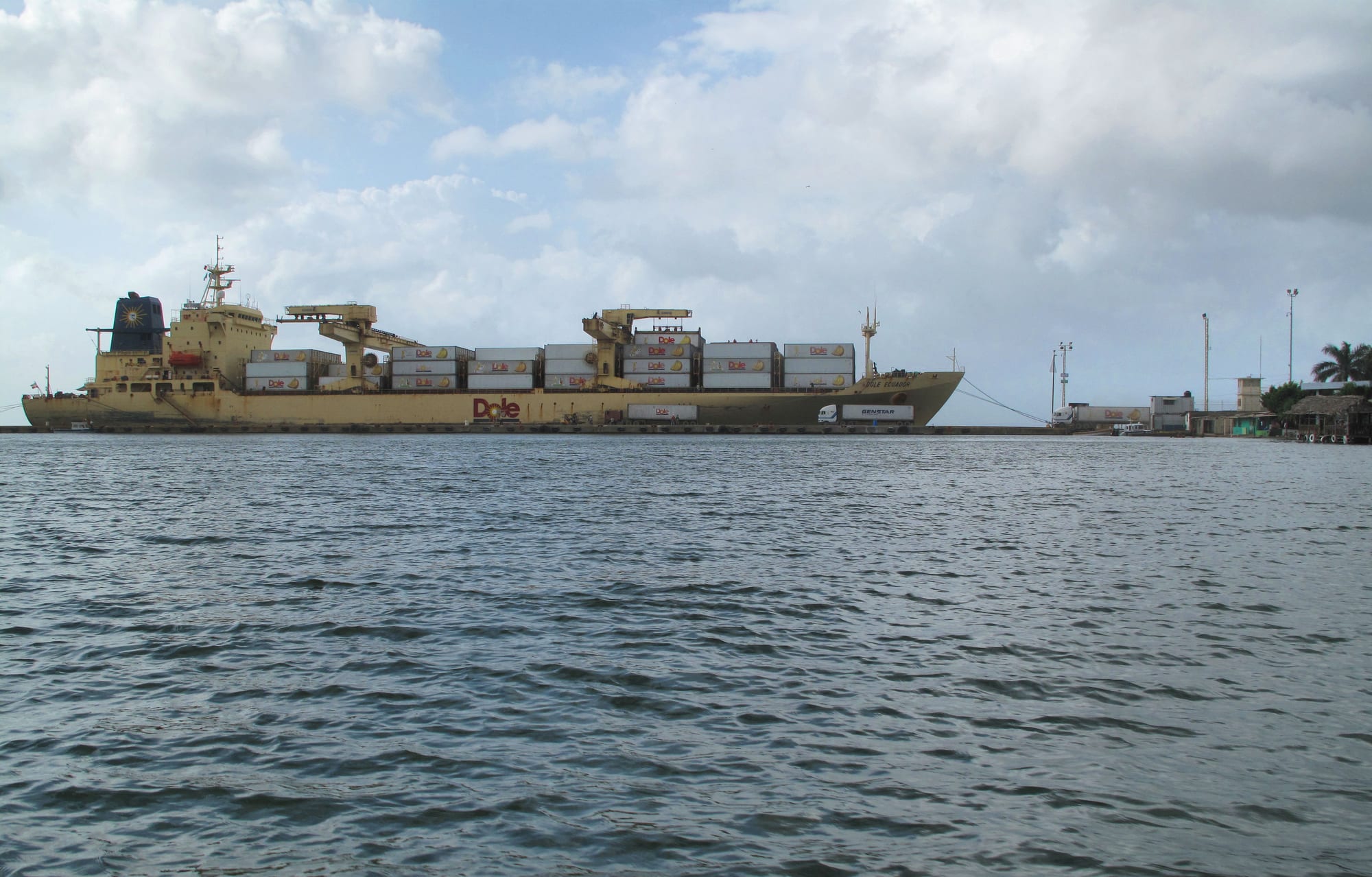
A cream-coloured cargo ship loaded with refrigerated containers moored at a long quay, seen across grey bay water

Tikal, the Verapaces & the Caribbean, Guatemala

Puerto Barrios

A banana cargo ship at the quay in Puerto Barrios, on Amatique Bay. (Francisco Anzola / Wikimedia Commons · CC BY 2.0)

The capital of Izabal and, with its twin port of Santo Tomás de Castilla, Guatemala's main Caribbean port, on a sheltered inner bay of Amatique Bay. Founded in the 1890s as the terminus of the railway from the capital, it grew as the banana port of the United Fruit Company; today it is a hot, working port town and the place to catch boats to Livingston and Belize.

Neighbourhoods

  • The town centre and Central Market
    • Local life
    • Markets
    • Close to public transport

    The grid of numbered streets and avenues around the Central Market, where local buses start and most shops, banks and simple restaurants are found. The old part of town runs down to the Tecún Umán park and the seafront terrace of El Malecón.

    Open in Maps
  • El Rastro and the dock
    • First-time visitors
    • Best for food
    • Boats

    The neighbourhood beside the municipal boat dock, where lanchas leave for Livingston, Punta de Palma and Belize. Seafood restaurants sit by the water, and the immigration office is just up the street from the dock.

    Open in Maps
  • Santo Tomás de Castilla
    • Port and cruise ships
    • Quiet and residential

    The modern twin port a short ride south-west, officially named Matías de Gálvez but known by its old name, where cargo ships and cruise ships dock. A single bus route links it with the Central Market.

    Open in Maps

Things to do

The town and the waterfront

  • El Malecónviewpoint

    A paved terrace above the sea in the old part of town, beside the Tecún Umán park, looking out over the bay.

    Open in Maps
  • Parque Reina Barrios and La Concha Acústicapark

    The town's other park, Reina Barrios, with a large shell-shaped open-air stage, La Concha Acústica.

    Open in Maps
  • Municipal docktransit hub

    El Muelle, the boat terminal near El Rastro, starting point for lanchas across the bay to Livingston, the beaches and Punta Gorda in Belize.

    Open in Maps

The bay and the hills

  • Amatique Baypark

    The large bay of the Gulf of Honduras on which the town stands, stretching from Santo Tomás de Castilla to Punta Gorda in Belize and fed by the Río Dulce, the Sarstoon and the Moho.

    Open in Maps
  • Punta de Manabiquepark

    The peninsula that shelters the bay, about 24 km north of the town, a wildlife reserve since 1999 with rainforest, mangroves and beaches.

    Open in Maps
  • Punta de Palmabeach

    A beach across the bay reached by daily boats from the dock, though litter can wash up after holidays.

    Open in Maps
  • Las Escobas rivertrail

    A cold, clear river with natural pools in the forest of Cerro San Gil outside the town, with a hiking trail and swimming spots; after heavy rain the water turns muddy.

    Open in Maps

Short trips from the town

  • Livingstonattraction

    The Garifuna town at the mouth of the Río Dulce across the bay, with no road link, reached by lancha from the dock.

    Open in Maps
  • Quiriguálandmark

    A Classic Maya site on the lower Motagua River with the tallest stele erected in the Maya world, carved from local red sandstone, set in a park among banana plantations; a UNESCO World Heritage Site since 1981.

    Open in Maps
  • Castillo de San Felipelandmark

    A Spanish colonial fort guarding the entrance to Lake Izabal, built to protect a Spanish port on the lake from pirate attacks and now on UNESCO's World Heritage Tentative List.

    Open in Maps

Eat and drink

Long-standing places and food districts in Puerto Barrios. Hours, ratings and directions come from your maps app, always current.

Puerto Barrios classics

  • Seafood restaurants in El Rastroneighborhood

    Restaurants near the dock and by the beach serving the town's typical seafood, such as tapado, grilled prawns and ceviche.

    Open in Maps
  • Rice and beansrestaurant

    The Garifuna plate of rice and beans cooked with coconut cream and served with meat, found in small restaurants across the town.

    Open in Maps

Food districts and markets

  • Central Marketmarket

    The town's market, the place for fresh tropical fruit — papaya, mango, melon and pineapple.

    Open in Maps

Experience Puerto Barrios

History

Puerto Barrios was born of a railway. In 1883 President Justo Rufino Barrios planned a line from Guatemala City to the Atlantic coast to carry the coffee of his and his allies' estates, but the plan stalled after his death in 1885. President José María Reina Barrios revived it in the 1890s, decreeing that a city be founded between the Escondido and Estrecho rivers, declaring it a major port of the republic and ordering the customs house moved there from Livingston. A collapse in coffee and silver prices left the railway unfinished.

His successor, Manuel Estrada Cabrera, contracted an American company in 1900 to complete the railway, giving it possession and operation of the finished section, including the dock at Puerto Barrios. In 1904 the International Railways of Central America was formed, and in time the United Fruit Company controlled Puerto Barrios entirely: the docks, the railway, the banana plantations of Izabal and the ships of its Great White Fleet. In 1910 it also bought the land around the Maya ruins of Quiriguá for banana production, leaving the ceremonial centre as a park.

Jacobo Árbenz's government (1951–1954) set out to break that hold by building a highway to the Atlantic and a new port at Santo Tomás de Castilla; the highway was finished after the 1954 coup. The earthquake of 4 February 1976, one of the worst in Guatemala's history, destroyed most of the port facilities, and modern cargo traffic moved to Santo Tomás. Puerto Barrios remains an important hub for the banana trade, and cruise ships now call at its twin port.

Culture & Customs

Puerto Barrios is a Caribbean town in a Spanish-speaking country. Its people are a mix of Garifuna, Maya, Afro-Caribbean people such as Afro-Jamaicans, and other West Indian groups. Garifuna culture can be experienced across the bay in Livingston, with its punta and yankunu dances, but its food and its people are part of life here too.

The town's character is that of a working port. Many of its visitors are seamen, and bars, discos and karaoke places serve them through the night. The town's two parks, Tecún Umán with the seafront terrace of El Malecón and Reina Barrios with its shell-shaped open-air stage, are its main public spaces.

The town is divided into many barrios with their own names, such as El Rastro, Las Champas, Los Tanques and El Estrecho, and local identity is attached to them. The local football club, Izabal J.C., plays at the Estadio Roy Fearon, and the town has produced numerous footballers.

Daily Life

The 2018 census gave Puerto Barrios a population of 100,593 people. It is the capital of Izabal and the administrative seat of its municipality, which stretches from sea level at Punta de Manabique to 1,276 m on Cerro San Gil. Together with Santo Tomás de Castilla, the town is the commercial heart of the region and the country's main Caribbean port, and Santo Tomás is Guatemala's largest port.

The banana trade still shapes the economy: it is an important hub for Chiquita, United Fruit's successor, and for Dole and Fresh Del Monte Produce. As the departmental capital and the region's commercial centre, the town lives from its ports, trade and administration, and cruise passengers arriving at Santo Tomás bring tourism to the region's sights.

Daily life centres on the Central Market, the dock and the bus stops; a single bus route links the market with Santo Tomás, and taxis fill the gaps. Boats to Livingston run several times a day, and boats to Punta Gorda in Belize leave from the same municipal dock.

Food

The food of Puerto Barrios is Caribbean, and seafood is typical of the city. Tapado, the Garifuna seafood soup made with coconut milk and plantain, is the dish to try, alongside camarones a la plancha (grilled prawns) and ceviche of raw fish or seafood cured in lime juice. Rice and beans, cooked with coconut cream and served with meat, is the everyday Garifuna plate.

The town's restaurants range from beachside seafood places in El Rastro to grills serving churrasco, grilled beef, and places making flour tortillas. Guatemala's fried-chicken chain Pollo Campero has a branch by the Central Market.

The market is the place for tropical fruit — papaya, mango, melon and pineapple — and licuados, fruit juices and milkshakes, are a refreshment in the tropical heat. Much of the town's cooking is marked by Garifuna influence, seen in tapado, rice and beans and breads such as pan de coco, and the local flour tortilla is eaten with almost any meal.

Planning tools

Budget

Puerto Barrios is inexpensive and prices are local: cheap buses and taxis, market food and plain hotels. Boat trips to Livingston are cheap on shared lanchas; private boats, the international crossing to Belize and the larger hotels outside town cost more.

Daily Budget Midrange
USD 65–130 (hotel with air conditioning, seafood dinners, taxis, private boats to the beaches)
Daily Budget Shoestring
USD 25–45 (simple hotel, market food and seafood comedores, buses and shared lanchas)

Use taxis with a number on both doors and agree the fare first; ask for a receipt for any fee charged at immigration.

Best Time to Visit

The town has no dry season: rain falls in every month, and it is hot all year. Visits are best timed for the boats and beaches rather than the weather, and the beaches can be littered after holidays.

Suggested Number of Days

Most travellers spend a single night here while changing between bus and boat. Three or four days allow time for the surrounding coast and countryside as well.

First Visit
1 day
With Surroundings
3–4 days

Transportation

Local buses and taxis are cheap. A single bus route runs from the Central Market to Santo Tomás de Castilla, with few marked stops; taxis, which should carry an identification number on both doors, are best for other trips. Lanchas from the municipal dock serve Livingston, the beaches and Belize.

At night take taxis from well-lit places and ask the driver not to pick up anyone else.

Airport & Station Connections

Puerto Barrios is 297 km north-east of Guatemala City at the end of Highway CA9, about five to six hours by bus. It has a small airport, which has been of particular use to charter flights for cruise passengers. Boats cross to Livingston and run to Punta Gorda in Belize, and the road continues to the Honduran border at Corinto.

Walkability

The centre is flat and laid out on a grid, so it is easy to walk by day, though the heat is tiring. The dock, the market and the seafront parks are within walking distance of one another; Santo Tomás de Castilla needs a bus or taxi.

Safety

Guatemala has significant crime, including gang activity and armed robbery, concentrated in parts of Guatemala City and on some highways and rural routes. The region's tourist circuit, including the Río Dulce, is generally calm, though robberies of boats and yachts on the Río Dulce have occurred. Puerto Barrios is considered relatively safe, though taxis at night call for care. As a port, it has a night scene aimed at ship workers.

Use numbered taxis, especially after dark, keep valuables secure on boats, and stay in busy, well-lit areas at night. Check current official travel advice before travelling.

Climate

A hot tropical rainforest climate with significant rain all year and no dry season. The average annual temperature is about 27°C, and about 2,750 mm of rain falls in a year.

Summer
Hot and humid, with an annual average of about 27°C and heavy rain.
Winter
Little cooler: the year-round average is about 27°C, and rain continues in every month.

Local Customs

The town's people are a mix of Garifuna, Maya, Afro-Caribbean and other West Indian groups. Spanish is the main language, and English is not widely spoken. Dress is casual in the heat, but swimwear is kept for the beach.

Speak some Spanish, ask before photographing people, and agree prices with boatmen and taxi drivers before setting off.

Common Payment Methods

The currency is the quetzal (GTQ). As the departmental capital, the town has banks and cash machines, and larger hotels take cards, but buses, taxis, boats and the market run on cash.