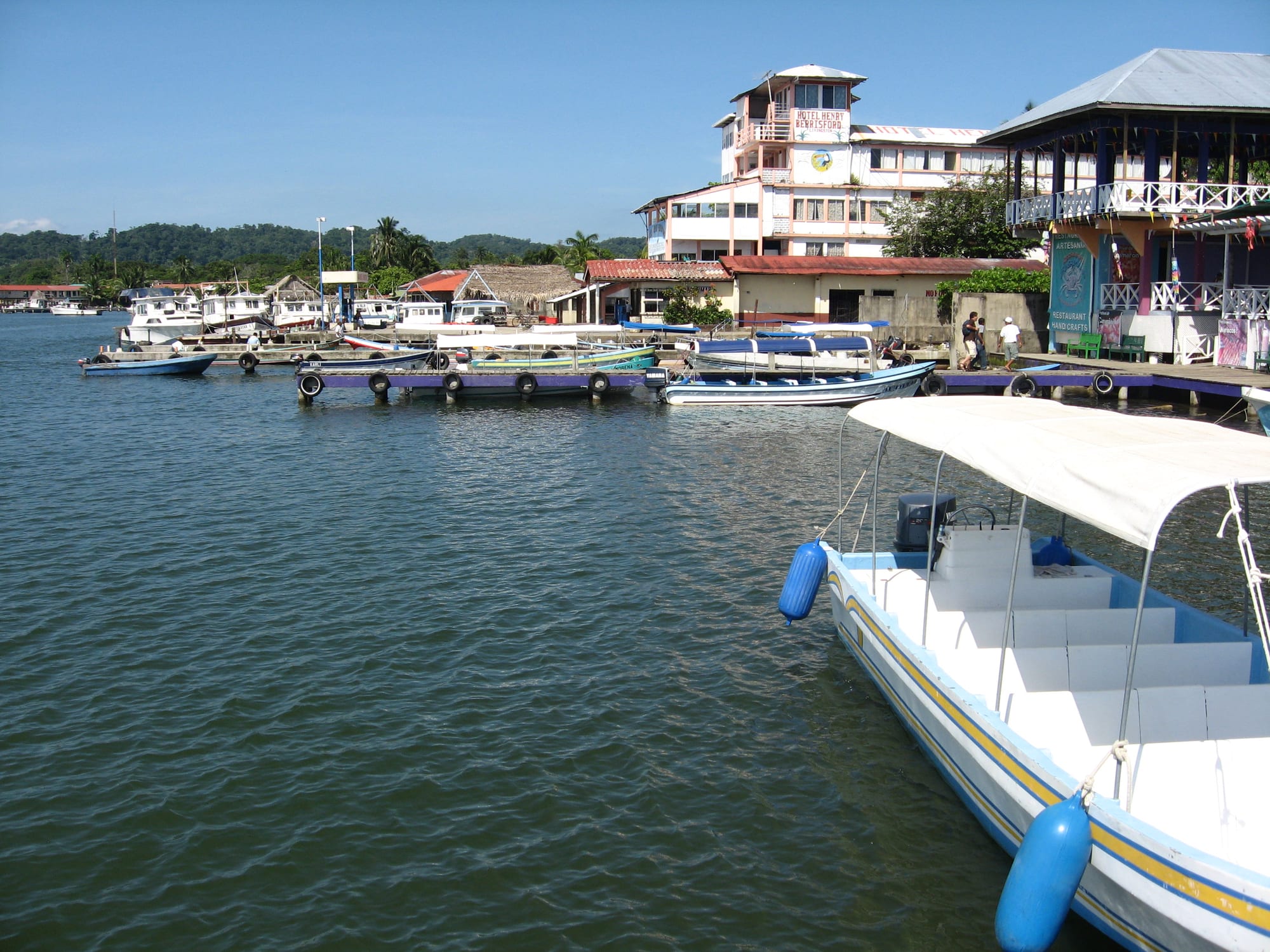
Small passenger boats moored at wooden jetties in front of waterfront buildings, with forested hills behind

Tikal, the Verapaces & the Caribbean, Guatemala

Livingston

The harbour at Livingston, where the boats from Puerto Barrios and the Río Dulce tie up. (Padraic / Wikimedia Commons · CC BY-SA 2.0)

A small Caribbean town at the mouth of the Río Dulce on Amatique Bay, with no road link to the rest of Guatemala, so that everyone arrives by boat. Once the country's main Atlantic port, it is now a mainly Garifuna town, known for its mix of Garifuna, Maya and Ladino cultures, its drumming and its coconut-milk seafood.

Neighbourhoods

  • Calle Principal and the dock
    • First-time visitors
    • Best for food
    • Nightlife

    The main street climbs from the municipal dock, where every boat arrives, through the heart of the town. Most of the shops, restaurants and bars are on it or just off it, and live Garifuna drumming is heard in its bars most nights.

    Open in Maps
  • The beaches north of town
    • Beaches
    • Quiet and rural

    A strip of shore running north from the town towards Siete Altares and Playa Blanca, with the central beach where local families swim and children fly kites in the evenings, and quieter stretches further along reached on foot or by boat.

    Open in Maps

Things to do

The town and the coast

  • Municipal docktransit hub

    The Muelle Municipal at the foot of Calle Principal, the town's front door, where boats arrive from Puerto Barrios, Río Dulce and Belize and leave for the beaches and the river.

    Open in Maps
  • Siete Altaresattraction

    A set of seven freshwater pools and waterfalls stepping down to the Caribbean about 5 km north of the town, reached by a short boat ride or a long walk along the beach.

    Open in Maps
  • Playa Blancabeach

    A beach about 12 km up the northern coast, usually visited by boat, often combined with Siete Altares.

    Open in Maps

The Río Dulce

  • Río Dulce gorgepark

    Upstream of the town the river winds for about 10 km through a gorge whose walls rise up to about 90 m, covered in forest, before opening into the lake of El Golfete; the boat trip between Livingston and the town of Río Dulce runs through it.

    Open in Maps

Short trips from the town

  • Castillo de San Felipelandmark

    A Spanish colonial fort at the entrance to Lake Izabal, at the narrowest point of the waterway, built to keep pirates out of the lake; it is on UNESCO's World Heritage Tentative List.

    Open in Maps

Eat and drink

Long-standing places and food districts in Livingston. Hours, ratings and directions come from your maps app, always current.

Livingston classics

  • Restaurants along Calle Principalneighborhood

    The town's many restaurants are spread along the main street and the lanes leading off it, serving tapado, grilled shrimp, fish and Caribbean rice and beans.

    Open in Maps
  • Tapadorestaurant

    Livingston's defining dish, a Garifuna soup of fish, prawns and shellfish cooked in coconut milk with plantain, garnished with coriander.

    Open in Maps

Cafés and bars

  • Bars by the dock and on the main streetneighborhood

    Places to sit with a coco loco — rum poured into a freshly opened coconut — or a glass of guifiti, while Garifuna musicians with drums, turtle shell and conch make the rounds.

    Open in Maps

Experience Livingston

History

Livingston stands where the Río Dulce, having cut its gorge through the hills, meets Amatique Bay on the Gulf of Honduras. Its Garifuna founders were part of a people descended from West Africans and the Carib and Arawak islanders of St Vincent, whom the British deported to the island of Roatán, off Honduras, in 1797; from there they spread along the Caribbean coast of Central America and north into Guatemala and Belize, settling fishing villages such as this one.

The town takes its name from Edward Livingston, the American jurist whose legal codes, translated into Spanish by José Francisco Barrundia, were used as the basis for the laws of the liberal government of the United Provinces of Central America in the early 19th century; in Guatemala the plan was cut short by Rafael Carrera's conservative revolt of 1838. When the Jesuits returned to Guatemala under Carrera around 1851, they settled first in Livingston, and the town's border with British Honduras was fixed by the Wyke-Aycinena treaty of 1859.

Before Puerto Barrios was built at the end of the 19th century, Livingston was Guatemala's main port on the Caribbean and the capital of Izabal. A description of 1902 found its people building canoes, raising pigs, fishing and farming maize, bananas and cassava. The port moved away, but the town kept its Garifuna character, and from 1970 it was included with the rest of Izabal in the Franja Transversal del Norte development zone. In recent decades it has built a large tourist industry around its culture and the river.

Culture & Customs

Livingston is a mainly Garifuna town, known for its mix of Garifuna, Afro-Caribbean, Maya and Ladino people and cultures. Garifuna, an Arawakan language that survives from the Island Carib speech of the Lesser Antilles, is spoken in the streets beside Spanish, Q'eqchi' and English, and the town's music and dance carry Garifuna identity more than anything else. UNESCO has recognised the Garifuna language, dance and music as part of the intangible heritage of humanity.

Punta, the best-known Garifuna dance, with its African and Arawak roots, is danced on beaches, in parks and at funerals, and drumming fills the town's bars most nights. Groups of local musicians go from restaurant to restaurant with large drums, a turtle shell, a conch and maracas, chanting traditional songs over the beat. Spiritual practices such as the dugu ceremony remain widespread among the Garifuna.

Q'eqchi' Maya and Ladino people make up much of the rest of the town, and their traditions sit alongside those of the Garifuna. Shops along Calle Principal sell jewellery made from shells and coconut, embroidery, and small bottles of guifiti.

Daily Life

Livingston was traditionally a fishing town, and the sea and river still feed it, but in recent decades it has developed a large tourist industry, with guesthouses, restaurants, boatmen and guides along the main street and the waterfront. The wider municipality, which reaches inland across forest and farmland, lives from cattle and oil palm, and has also seen oil exploration.

Life revolves around the dock. Boats bring in supplies, visitors and people from Puerto Barrios and the river villages, and Calle Principal climbs from the water past shops, restaurants and bars to the town's houses. In the evenings families and children gather at the central beach, where children fly kites and local people swim.

Isolation shapes everything. With no road, goods arrive by water, and travel to the rest of the country means a boat ride before any bus. Heavy rain falls in almost every month, and after storms the beaches can be littered with plastic washed in from the sea, which workers are sent to clear.

Food

Livingston's cooking is Garifuna and Caribbean, built on fish, coconut, plantain and cassava. The defining dish is tapado, a rich soup of fish, prawns and shellfish cooked in coconut milk with plantain and garnished with coriander, served with bread. Hudut, fish in coconut milk with mashed plantain, is another Garifuna dish, and cassava bread and coconut bread are staples.

Rice and beans, the Caribbean dish of rice cooked with beans in coconut milk, is the everyday plate, often served with stewed chicken, and grilled shrimp is cheap and widely sold. As a traditional fishing town, Livingston has seafood in almost every restaurant along Calle Principal and the streets running off it. After dark a few stalls also sell pupusas, the stuffed maize cakes from neighbouring El Salvador.

The local drinks are as distinctive. Coco loco is a fresh coconut with its top cut off and a generous measure of rum poured in, and guifiti is a Garifuna rum infused with herbs and roots, sold in small bottles and said to have medicinal properties. Both are drunk to the sound of Garifuna drums in the bars by the water.

Planning tools

Budget

Livingston is inexpensive once there, with cheap seafood and simple guesthouses. The boat is the main cost: shared lanchas from Puerto Barrios are cheap, while the longer trip down the Río Dulce and any private boat or tour cost much more. Most things are paid for in cash, so it is wise to bring enough.

Daily Budget Midrange
USD 65–130 (waterfront hotel, seafood dinners, a river boat trip, private boats to the beaches)
Daily Budget Shoestring
USD 25–45 (guesthouse room, rice and beans and street food, shared boats)

Agree boat prices before setting off, and bring enough cash from Puerto Barrios or Río Dulce.

Best Time to Visit

Livingston is wet all year, and July is the wettest month. Rain falls in every month, so boat trips and beach visits always depend on the weather.

Suggested Number of Days

One or two nights is enough for the town itself. Three or four allow time for the coast to the north and a slow trip on the river, rather than passing through on the boat between Río Dulce and Puerto Barrios.

First Visit
1–2 days
With Surroundings
3–4 days

Transportation

Livingston is small and walkable, built along one main street; taxis charge a set fare, which should be agreed first. Everything beyond the town goes by boat: lanchas leave the municipal dock for the beaches, Siete Altares, the Río Dulce, Puerto Barrios and Belize, either as shared colectivos or hired privately.

Keep bags close and dry on open boats, which can be wet and bumpy in rough weather.

Airport & Station Connections

There is no road to Livingston, and all access is by water. Lanchas cross Amatique Bay from Puerto Barrios several times a day in about 40 minutes, and boats come down the Río Dulce from the town of Río Dulce in one to two and a half hours, depending on stops along the gorge. Boats also run to and from Punta Gorda in Belize; travellers arriving from abroad must get their entry stamp at the immigration office uphill from the dock.

Walkability

The town is compact and easily walked, with the dock, Calle Principal and the central beach within a few minutes of each other. Side streets are steep in places and muddy after rain. Siete Altares can be reached on foot along the beach, a walk of one and a half to two hours.

Safety

Guatemala has significant crime, including gang activity and armed robbery, concentrated in parts of Guatemala City and on some highways and rural routes. In Livingston the everyday nuisance is touts at the dock, who can be persistent in steering new arrivals to hotels that pay them commission. The beach north of the town has had incidents in the past and is patrolled by police, and robberies of boats and yachts on the Río Dulce have occurred.

Walk to a hotel independently rather than with a tout, keep valuables secure on boats and in town at night, and go to Siete Altares in company. Check current official travel advice before travelling.

Climate

A hot tropical rainforest climate at sea level. With more than 3,600 mm of rain a year, falling in every month and above 600 mm in July, Livingston is the wettest municipality in Guatemala. The temperatures below are for the wider region.

Summer
In the wet season the region's lowlands of Petén and Izabal see 28–35°C and high humidity; July is the town's wettest month.
Winter
The region's lowlands of Petén and Izabal are hot and humid all year, with wet-season temperatures of 28–35°C, and the Caribbean coast is wet in most months.

Local Customs

Spanish, Garifuna, Q'eqchi' and English are all spoken, and English is widely understood. Garifuna identity — language, drumming, punta dancing and food — is central to the town, alongside Maya and Ladino communities. Coral, starfish and turtle shell are sold as souvenirs but come from the barrier reef.

Ask before photographing people or musicians, tip the roving Garifuna bands if listening to them, dress modestly away from the beach, and do not buy coral or turtle shell.

Common Payment Methods

The currency is the quetzal (GTQ). Livingston is largely a cash town: boats, small restaurants and street stalls expect quetzales.