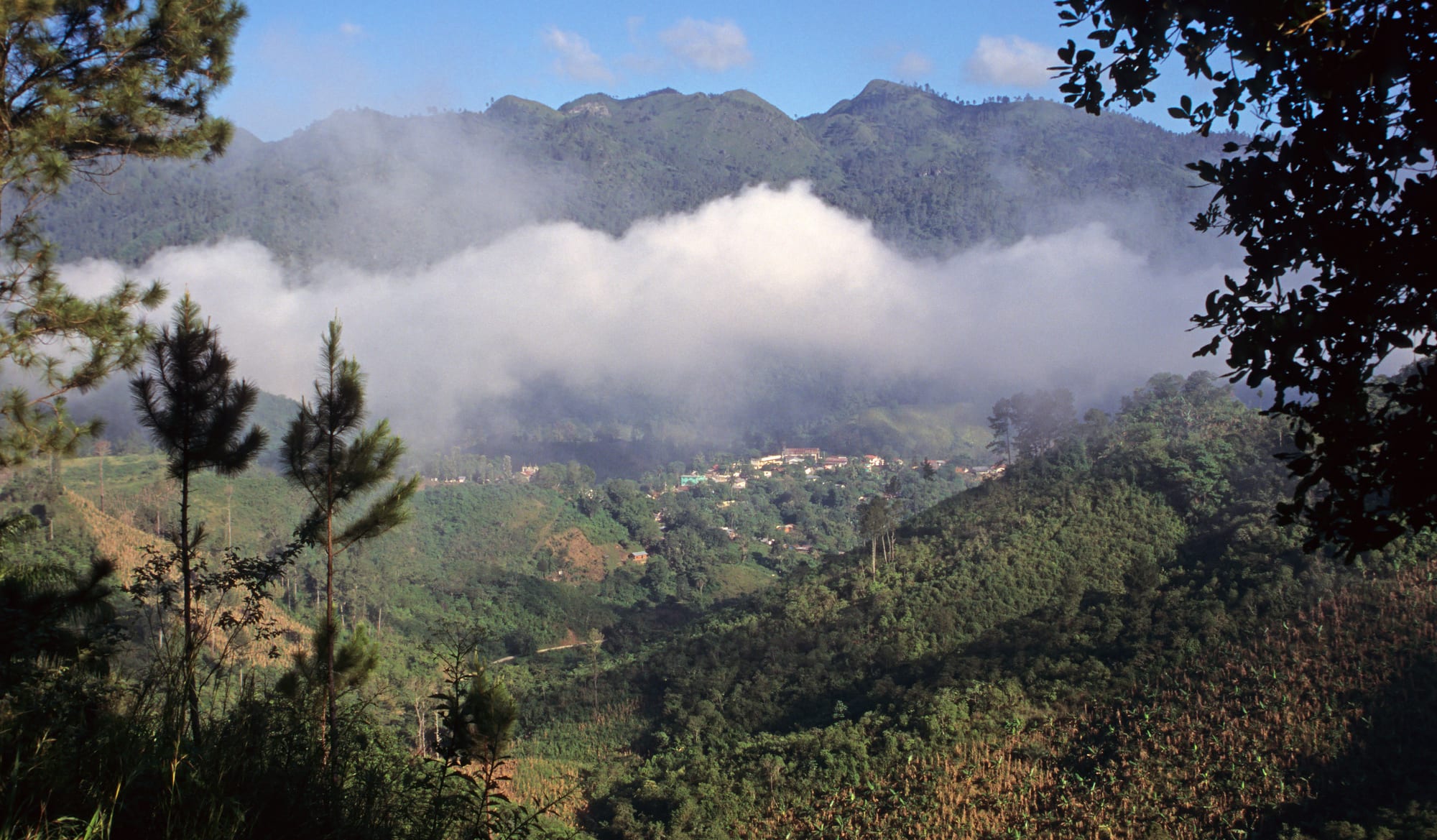
A small town of pale houses in a green valley, with a bank of low cloud below forested mountains

Tikal, the Verapaces & the Caribbean, Guatemala

Lanquín

Lanquín in its valley in Alta Verapaz, under low cloud and forested hills. (Salix Oculus / Wikimedia Commons · CC BY-SA 4.0)

A small Q'eqchi' Maya town in a deep, hot valley of Alta Verapaz, founded by Dominican friars in 1540 beside the river that pours out of the Lanquín caves. It is the usual base for Semuc Champey, the stepped turquoise pools on a limestone bridge over the Cahabón River, and for caving and tubing on the rivers around it.

Neighbourhoods

  • Lanquín town
    • Local life
    • Close to shuttles

    The small town centre, with its church, market, bank and comedores, where minibuses from Cobán arrive and pickups leave for Semuc Champey. Most places are within a twenty-minute walk, and tuk-tuks fill the gaps.

    Open in Maps
  • The river valley towards Semuc Champey
    • Nature
    • Quiet and rural
    • Rivers

    Simple lodges and guesthouses spread along the river outside town and on the road towards Semuc Champey, in forested country where tubing and cave trips start from the riverbank.

    Open in Maps

Things to do

Semuc Champey

  • Semuc Champeypark

    A natural limestone bridge about 300 m long over the Cahabón River, which plunges underground beneath a staircase of turquoise pools; the name is Q'eqchi' for 'where the river hides under the earth', and it was made a natural monument in 2005.

    Open in Maps
  • El Mirador at Semuc Champeyviewpoint

    The viewpoint above the pools, reached by a hot, steep jungle climb of about 45 minutes from the parking area, with the classic view down the valley.

    Open in Maps

Caves and the river

  • Grutas de Lanquínpark

    A large limestone cave system about 1 km west of the town, a national park, lit for its first stretch and long held sacred, from whose mouth clouds of bats stream out at dusk.

    Open in Maps
  • Grutas de las Maríasattraction

    A cave with an underground river near Semuc Champey, explored by candlelight on guided tours that involve swimming, wading and climbing.

    Open in Maps
  • Tubing on the Lanquín riverattraction

    Floating downstream on an inner tube on the pale blue river that rises inside the caves, a favourite way to spend a hot afternoon.

    Open in Maps

Seasonal events

  • Fiesta of San Agustínlate August

    The town's annual fair in honour of its patron, Saint Augustine, with fireworks, parades, traditional food stands, games, music and popular dances, building to the saint's day on 28 August.

Eat and drink

Long-standing places and food districts in Lanquín. Hours, ratings and directions come from your maps app, always current.

Lanquín classics

  • Comedores in the town centrerestaurant

    Small eating houses in the town serving standard Guatemalan fare at low prices.

    Open in Maps
  • Lanquín marketmarket

    A small town market selling everyday goods.

    Open in Maps

Experience Lanquín

History

The name Lanquín comes from the Ch'olti' word lakin, "east", so that it means "the eastern town". It was one of the communities of the Verapaz brought under Spanish rule without conquest by Dominican friars, among them Pedro de Angulo and Luis de Cáncer, and the settlement was established in 1540. Its first Catholic chapel, dedicated to San Agustín, was built in the same decade, and Saint Augustine has been the town's patron ever since. Under independent Guatemala it was counted part of the Cahabón judicial circuit in the 1825 constitution, and records treat it as a municipality from 1846, when its first mayor was Crisanto Beb, a Q'eqchi'.

In the 1950s the government declared the caves beside the town a national park for their natural beauty, and they were later raised to the status of national monument, in 1970, and national cultural heritage, in 1997. From the 1960s the area was drawn into the Franja Transversal del Norte, the northern strip that governments opened to settlement, cattle, logging and farming, created by decree in 1970.

Semuc Champey, a pickup ride south of the town, became the reason most outsiders came. It was made a natural monument in 2005, and as backpackers arrived along the shuttle routes, the town grew a ring of riverside lodges and a tourist trade that now stands beside the farming of the hills.

Culture & Customs

Lanquín is Q'eqchi' country, and life in the town is shaped by the Q'eqchi' view of nature and the cosmos. Respect for everything around, the plants and animals above all, is its basic principle, though that principle is under pressure from outside influences. Trust matters more than paperwork: agreements and business deals often rest on a person's word, and punctuality, cleanliness and respect are what earn it.

Around two-thirds of people are counted as Catholic, and evangelical congregations have grown steadily in recent years. Older beliefs remain: there are two recognised Maya altars in the municipality, one in the Lanquín caves and one at Semuc Champey, and the elders are believed to know of others they keep to themselves. The caves have long been treated as a threshold to the underworld.

The great event of the year is the fair of San Agustín, from 24 to 28 August, with fireworks, stalls of traditional food, games for children, parades and popular dances, as in towns across Guatemala on their patron saint's day. The rest of the year the town moves between the rhythms of a Q'eqchi' market town and the comings and goings of young travellers on the shuttle circuit.

Daily Life

The municipality has about 16,500 people, many of them of Q'eqchi' Maya descent, spread across 208 km² of steep, forested hills around the small town centre, which sits at about 380 m. For most Q'eqchi' families food still comes from the maize fields, and the seizure of communal land and the effects of the Spanish conquest left the Q'eqchi' with long-lasting poverty.

Tourism is the other economy. Lodges, guides, pickup drivers and tuk-tuk drivers depend on the flow of visitors to Semuc Champey and the caves, and the town's bank, market and comedores serve both villagers and travellers. Tuk-tuks run around the streets late into the evening, and pickups carrying people and goods are the everyday transport on the roads out of town.

Water is a recurring issue in the valley. Hydroelectric plants on the Cahabón River leave stretches of it dry, and Q'eqchi' communities along the river have opened proceedings to have them dismantled.

Food

Food in Lanquín is Alta Verapaz home cooking. The comedores of the town serve standard Guatemalan fare at low prices, and maize, the basis of the Q'eqchi' diet, comes to the table as tortillas. Tamales, wrapped in leaves as across Guatemala, are a food of special occasions, and stalls of traditional food are part of the August fair.

Kak'ik, a spicy red turkey soup whose name comes from the Q'eqchi' words for "red" and "hot", is made across Guatemala; the Verapaz recipe uses turkey with garlic, onion, mint and coriander, coloured with ground annatto, and the dish was declared part of the nation's intangible cultural heritage in 2007. Alta Verapaz has also been an important coffee-producing region since the 19th century.

Most travellers eat in the riverside lodges, some of which serve communal dinners in the evening, or in the small comedores in the centre. Fresh fruit and simple snacks are sold at the market and by the roadside, and cold drinks are welcome in the heat of the valley.

Planning tools

Budget

Lanquín is cheap: most lodges are simple and inexpensive, and comedor meals cost little. The extras are the guided tours to Semuc Champey and the caves, pickup rides and shuttles in and out. Cash is needed for almost everything, so it is wise to bring enough in.

Daily Budget Midrange
USD 65–130 (private room in a jungle lodge, guided Semuc Champey and cave tours, private shuttle)
Daily Budget Shoestring
USD 25–45 (dorm bed in a river lodge, comedor meals, shared pickups and minibuses)

Bring enough quetzales from Cobán or Flores for the whole stay.

Best Time to Visit

Lanquín can be visited all year, and the Verapaces are at their greenest in the wet season. Heavy rain can raise and cloud the rivers and make the roads harder going, so the drier months are usually easier for swimming and travel. The town's fair is held in late August.

Suggested Number of Days

Two or three nights is the usual stay, given the long and slow journey in. A day or two more allows time for the rivers and a slower pace; the trip onward to Flores or Antigua takes most of a day.

First Visit
2–3 days
With Surroundings
3–4 days

Transportation

The town is small enough to walk. Tuk-tuks run around town, sometimes late into the evening, and pickups carry passengers along the rough road to Semuc Champey. Lodges arrange tours to the pools and caves.

Wear shoes with grip for the caves and the climb to the viewpoint; rocks are wet and slippery.

Airport & Station Connections

There is no airport nearby. Most people arrive from Cobán by minibus or private shuttle. Tourist shuttle vans link Lanquín with Antigua, Flores and Río Dulce, and the region's airport is at Flores, a long day's drive away.

Walkability

The town centre is compact and walkable, with most places within twenty minutes on foot, though the valley is hot and the streets are hilly. The caves are a short walk out of town; Semuc Champey needs a pickup or tour.

Safety

Guatemala has significant crime, including gang activity and armed robbery, concentrated in parts of Guatemala City and on some highways and rural routes. Lanquín is part of the generally calm tourist circuit. The main dangers are natural: the rivers at Semuc Champey and Lanquín have strong currents, and the caves are dark, wet and slippery.

Heed the swimming limits at Semuc Champey, stay out of the river where the Cahabón goes underground, carry a torch in the caves, and travel by shuttle rather than at night. Check current official travel advice before travelling.

Climate

Lanquín lies at about 380 m in a deep valley and has a tropical rainforest climate, much hotter than the Guatemalan highlands, with rain possible in any month. The temperatures below are for the wider region.

Summer
In the wet season the region's lowlands of Petén and Izabal see 28–35°C and high humidity, and nearby Cobán 18–25°C and mist; Lanquín, deep in its valley, is hot.
Winter
In the dry season the region is hot and sunny in Petén and mild and damp in the Verapaces, where Cobán's wet-season range is 18–25°C; Lanquín, far lower than Cobán, is warmer than the highlands.

Local Customs

Most people are Q'eqchi' Maya, and many speak Q'eqchi' first; Spanish is the language of business and travel. Q'eqchi' culture puts great weight on respect for nature and on trust, punctuality and cleanliness in dealings between people. The caves and Semuc Champey both hold Maya altars still used for ceremonies.

Behave quietly at altars and ceremonies, ask before photographing people, dress modestly in town and the church, and keep to agreements made.

Common Payment Methods

The currency is the quetzal (GTQ), and this is a cash economy. The town has a Banrural bank with a cash machine, but tours, pickups, comedores and the market expect cash.