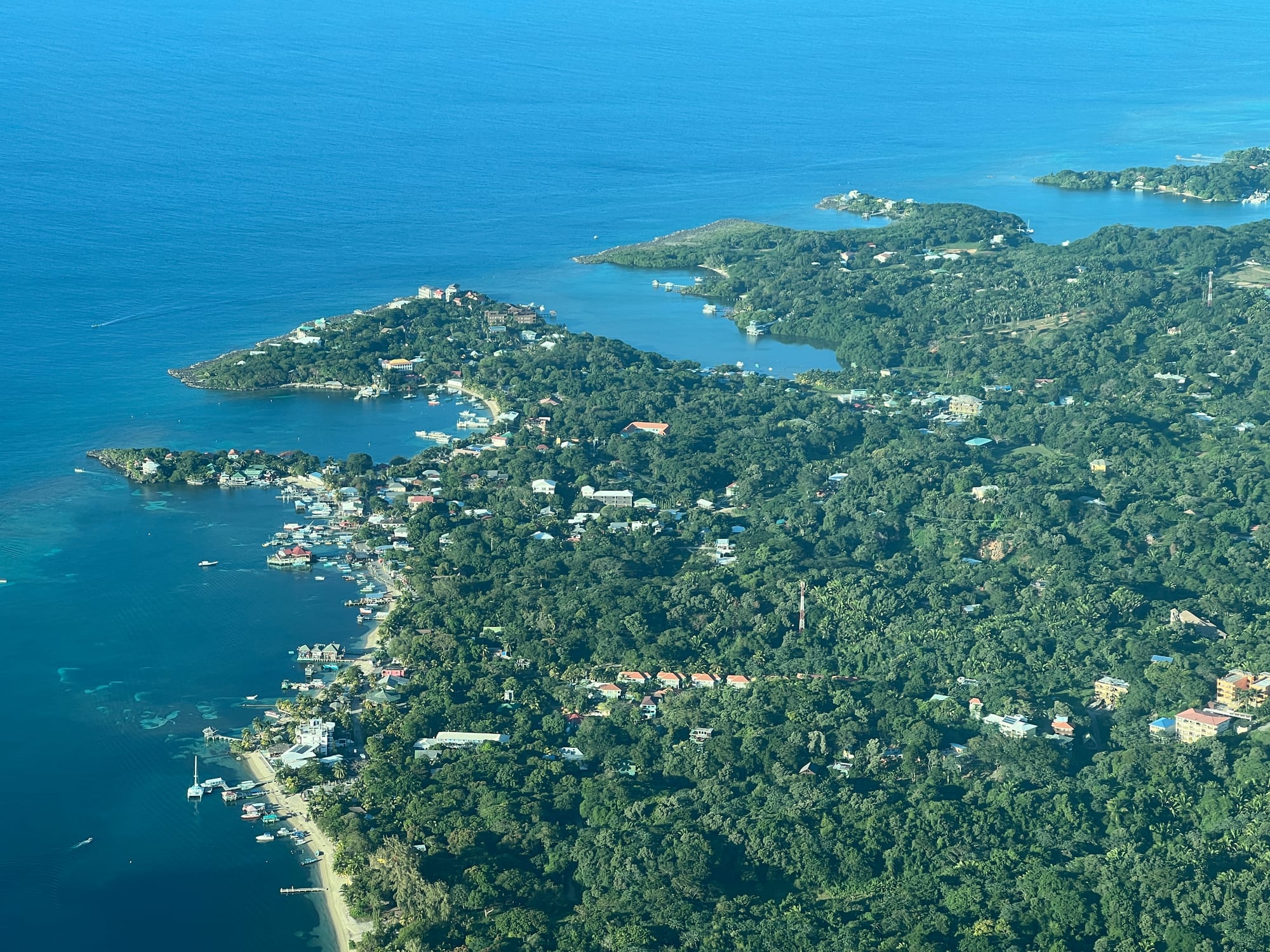
Aerial view of a green, wooded coast with houses and piers along the shore, small headlands and deep blue sea

The Bay Islands & the Caribbean East, Honduras

Roatán

West End and the western tip of Roatán from the air. (Nosferattus / Wikimedia Commons · CC0)

The largest of Honduras's Bay Islands, a long, narrow coral island about 65 kilometres off the north coast on the southern edge of the Mesoamerican Barrier Reef. Once a haunt of pirates and settled by Garífuna exiles and Cayman Islanders, it is now a diving, beach and cruise-ship island, English-speaking at heart and growing fast with migrants from the mainland.

Neighbourhoods

  • West End
    • Diving and snorkelling
    • Nightlife
    • Best for food

    The island's tourism, social and diving hub: a paved road along the shore lined with shops, small hotels, dive shops, bars and restaurants, many right on the water. The reef lies a short swim offshore, and there is live music in the evenings.

    Open in Maps
  • West Bay
    • Beaches
    • Snorkelling

    The far western end of the island, built around a long white-sand beach with the reef an easy swim from the shore. Several large resorts stand on the beach, and it fills up when cruise ships are in port.

    Open in Maps
  • Sandy Bay
    • Quiet and residential
    • Diving and snorkelling

    A mainly residential stretch of the north coast between West End and Coxen Hole, with a long beach, snorkelling a short swim out, a botanical garden and a marine research institute.

    Open in Maps
  • Coxen Hole
    • Local life
    • Close to public transport

    The largest town on the island and capital of the Bay Islands department, on the south coast, with the airport, the main cruise port, banks, shops and the market from which island buses leave. A working town rather than a resort.

    Open in Maps
  • French Harbour and the east
    • Local life
    • Off the beaten track

    Beyond the town of French Harbour, near the middle of the island, the road runs on to Oak Ridge with its brightly painted wooden houses, the Garífuna village of Punta Gorda and the quiet beaches and mangroves of the east end.

    Open in Maps

Things to do

Beaches and the reef

  • West Bay Beachbeach

    A long white-sand beach on the west coast with a thriving reef within easy swimming distance, rated in 2011 among the world's five best beaches for snorkelling by a Caribbean travel magazine.

    Open in Maps
  • West End reefattraction

    Shallow reef about 200 metres off the West End shore, dropping further out into a wall, reached by swimming from the beach or by dive boat.

    Open in Maps
  • Camp Bay Beachbeach

    The largest natural beach in the Bay Islands, at the quiet east end of the island beyond Oak Ridge, reached by a dirt road.

    Open in Maps

Villages and island life

  • Punta Gordaneighborhood

    The oldest Garífuna community in Honduras, founded on the north coast by people deported from St Vincent in 1797, where village tours show Garífuna life.

    Open in Maps
  • Oak Ridgeneighborhood

    A small fishing village on the eastern south coast with brightly coloured wooden houses, explored on foot or by water taxi around the harbour.

    Open in Maps
  • Carambola Botanical Gardenspark

    Gardens of tropical plants in Sandy Bay, one of the island's sights away from the beach.

    Open in Maps

Nature at the east end

  • Mangrove forestpark

    The mangroves past Camp Bay at the eastern end of the island, best seen on boat and kayak tours.

    Open in Maps
  • Port Royallandmark

    A settlement on the east of the island founded by English pirates and later the site of a British fort, beyond the end of the paved road.

    Open in Maps

Seasonal events

  • Garífuna arrival anniversaryApril (12 April)

    Honduras marks the landing of the Garífuna at Punta Gorda on 12 April 1797.

  • Caribbean Cup freediving competitionMay

    An international freediving competition held each year at West Bay Beach, whose calm, clear water suits the sport.

  • Fishing tournamentSeptember

    The yearly international sport-fishing tournament, held on the second weekend of September.

Eat and drink

Long-standing places and food districts in Roatán. Hours, ratings and directions come from your maps app, always current.

Island classics

  • Conch and seafoodrestaurant

    Sopa de caracol, conch soup cooked in coconut milk with cassava and green bananas, and fried fish are staples of the island's kitchens.

    Open in Maps
  • Coconut bread and rice and beansrestaurant

    Coconut runs through island cooking, from coconut bread and coconut flan to seafood cooked in coconut milk, with rice and beans on the side and roadside baleadas.

    Open in Maps

Food districts and markets

  • West End restaurants and barsneighborhood

    The densest choice of restaurants and bars on the island, many on the water, with live music in the evenings.

    Open in Maps
  • Coxen Hole marketmarket

    The market in the island's main town, where local shoppers buy food and the buses to West End leave from across the street.

    Open in Maps
  • Punta Gordaneighborhood

    The island's Garífuna village on the north coast, where Garífuna food can be found.

    Open in Maps

Experience Roatán

History

The first people of the Bay Islands are thought to have been related to the Pech or other mainland peoples. After Columbus reached neighbouring Guanaja on his fourth voyage, the Spanish began trading in the islands for slave labour, and disease did still more damage. Between 1550 and 1700 the English occupied the islands on and off, and English, French and Dutch pirates made settlements from which they raided Spanish treasure ships; Coxen Hole is named after the pirate captain John Coxen. A British garrison held the island from 1742 to 1749, rebuilding the old fort at Port Royal.

In 1797, after defeating the Garífuna on St Vincent, the British deported them to Roatán. Most moved on to Trujillo on the mainland, but some founded Punta Gorda, the first permanent settlement on the island since Columbus's time. In the 1830s settlers came from the Cayman Islands after Britain abolished slavery, first former slaveholders and then, in larger numbers, freed people; Coxen Hole was founded in 1835, and the Caymanians became the island's largest group. Britain declared the Bay Islands a colony in the 1850s but ceded them to Honduras within a decade, and in 1860 the American filibuster William Walker, invited by British settlers, was captured and executed.

From the late twentieth century migrants from the mainland tripled the population, and fishing and then diving brought foreign settlers and visitors. Hurricane Mitch damaged the island in 1998. Since about 2005 cruise ships and large hotels have transformed the west. The private zone of Próspera, set up under a 2013 constitutional amendment allowing such zones, continues to operate after the zone law was repealed in 2022 and the Supreme Court declared the zones unconstitutional in 2024.

Culture & Customs

Roatán is culturally Caribbean and looks as much to the English-speaking Caribbean as to mainland Honduras. Islanders of British and African Caribbean descent speak Bay Island English, a form of English with many older words and its own accent. They call themselves Islanders; mainland Hondurans have long called them "caracoles", snails, a name Islanders find offensive, and the two communities have a long-standing rivalry rooted in differences of language and custom.

Punta Gorda on the north coast is the oldest Garífuna community in Honduras, with its own language, drumming and dances, and Honduras marks the Garífuna landing there on 12 April 1797. Spanish-speaking migrants from the mainland now make up the largest share of the population, especially in Coxen Hole and around French Harbour, and Spanish is the language of the schools.

Life is tied to the sea. Diving shaped the modern island, and conservation is a local cause: a community-based organisation, the Roatán Marine Park, was founded by dive operators and local businesses in 2005 to protect the reefs, beach clean-ups are a regular event, and in 2019 the island banned plastic bags, bottles and styrofoam. West Bay hosts an international freediving competition each May, and an international sport-fishing tournament is held every September.

Daily Life

The island is split into two municipalities, Roatán in the west and José Santos Guardiola in the east. The Roatán municipality had about 41,800 people at the 2013 census, and Coxen Hole, the largest town, about 8,300 in 2021. Most of the infrastructure is on the western half of the island, in Coxen Hole, West End, Sandy Bay and French Harbour.

Tourism and fishing drive the economy: dive shops, hotels, restaurants, taxis and the cruise ports serve the visitors, while the fishing fleet works from French Harbour and Oak Ridge. When cruise ships are in, thousands of extra visitors fill the beaches and towns for the day, and prices rise.

Rapid growth has put pressure on the island. Deforestation, run-off, poorly managed waste and pollution threaten the reef and the land, and Coxen Hole and West End have had new water and sewer systems built since the 2000s. The main roads on both coasts were repaved and widened by 2020, and buses, taxis and water taxis carry most daily journeys.

Food

Island cooking is Caribbean, and coconut and coconut milk turn up in both sweet and savoury dishes, from coconut bread and coconut flan to seafood cooked in coconut milk. Sopa de caracol, conch soup made with coconut milk, cassava and green bananas, is one of the most representative dishes of Honduran cuisine, and fried fish comes straight off the boats. Rice and beans is a popular side dish, and roadside baleadas — flour tortillas folded over refried beans with fresh cheese or cream — are as popular on the island as on the mainland.

In Punta Gorda, the island's Garífuna village, Garífuna dishes add to the mix. West End has the island's widest choice of restaurants and bars, many of them on the water, and West Bay and French Harbour have restaurants of their own, while in Coxen Hole the market sells food to local households.

Sport fishing off the reef brings in marlin, tuna, wahoo and mahi-mahi among others, and a cold Honduran beer is the usual drink in the beach bars of West End and West Bay.

Planning tools

Budget

Roatán is expensive by Honduran standards, with many prices quoted in US dollars. Simpler rooms and hostels exist away from the beachfront, but the resorts of West Bay are costly. Diving, boat trips and taxis are the main extra costs, and prices for food and services rise sharply when cruise ships are in port.

Daily Budget Midrange
USD 110–240 (hotel, restaurant meals, two dives a day)
Daily Budget Shoestring
USD 40–70 (hostel or simple cabin, local food, buses and shared water taxis)

Shop and eat out when the cruise ships have left port, and choose licensed dive operators.

Best Time to Visit

February to August is the best time, with calmer seas and clearer water. From about October to January cold fronts from the north bring rain and wind, and hurricanes are a risk from June to November. Diving is possible all year. Beaches are busiest on days when several cruise ships are in.

Suggested Number of Days

Four or five days give time for the beaches and a few days of diving or snorkelling. Allow a week or more for a dive course, for the quieter east end, or to add a hop to Utila; bad weather can cancel boat trips and add a day.

First Visit
4–5 days
With Surroundings
7–10 days

Transportation

A paved road runs along the island from West Bay through West End, Sandy Bay, Coxen Hole and French Harbour to Oak Ridge and Punta Gorda, and becomes a dirt road beyond. Buses run frequently by day between Coxen Hole and West End and about hourly to Oak Ridge. There are hundreds of taxis, water taxis link West End and West Bay in about 10–15 minutes, and scooters can be rented in West End.

Agree taxi fares before setting off, as prices are bargained.

Airport & Station Connections

Juan Manuel Gálvez International Airport at Coxen Hole has nonstop flights from several US cities and San Salvador, seasonal flights from Canada, and domestic links to San Pedro Sula, Tegucigalpa and Puerto Lempira. A ferry crosses twice daily from La Ceiba on the mainland in one to one and a half hours, though rough seas can cancel sailings. Cruise ships dock at the Port of Roatán in Coxen Hole and at a second cruise centre at Dixon Cove, about 5 kilometres east.

Walkability

West End can be walked end to end along its shore road, and West Bay's beach is easy on foot, but the island as a whole is long and hilly, and the villages are linked by the main road rather than by footpaths. Buses, taxis and water taxis cover the gaps.

Safety

Honduras has had one of the highest homicide rates in the world, driven by gangs (MS-13 and Barrio 18) and drug trafficking, and San Pedro Sula and parts of Tegucigalpa remain dangerous. The Bay Islands are the safest part of Honduras, though theft, break-ins and occasional robberies occur on Roatán, and diving and boat safety standards vary. Mosquitoes, which can carry dengue, and sand fleas are a nuisance on the coast.

Choose licensed dive operators, avoid isolated beaches after dark, use insect repellent, and watch for motorboats when swimming out to the reef. Check current official travel advice before travelling.

Climate

No figures are published for the island itself; for the region as a whole, the islands are hot and humid, around 27–31°C all year, with sea breezes and a rainy stretch from about October to January brought by cold fronts from the north. Hurricanes are a risk from June to November.

Summer
the region's hot season, 28–33°C, with sea breezes and the hurricane season from June
Winter
the region's cooler season, 24–30°C, with rain and wind from northern cold fronts from October to January

Local Customs

English is the native language of Islanders of British and African Caribbean descent, Spanish of the many residents from the mainland, and Garífuna is spoken in Punta Gorda; most people are bilingual. Islanders call themselves Islanders, and the Spanish nickname "caracoles" is considered offensive. Taxi drivers do not expect a tip.

Leave plastic bags, bottles and styrofoam at home: the island has banned their use and sale.

Common Payment Methods

The currency is the Honduran lempira, but US dollars are accepted all over the island, with change usually given in lempiras. Coxen Hole has the island's main banks, and prices are often quoted in dollars.