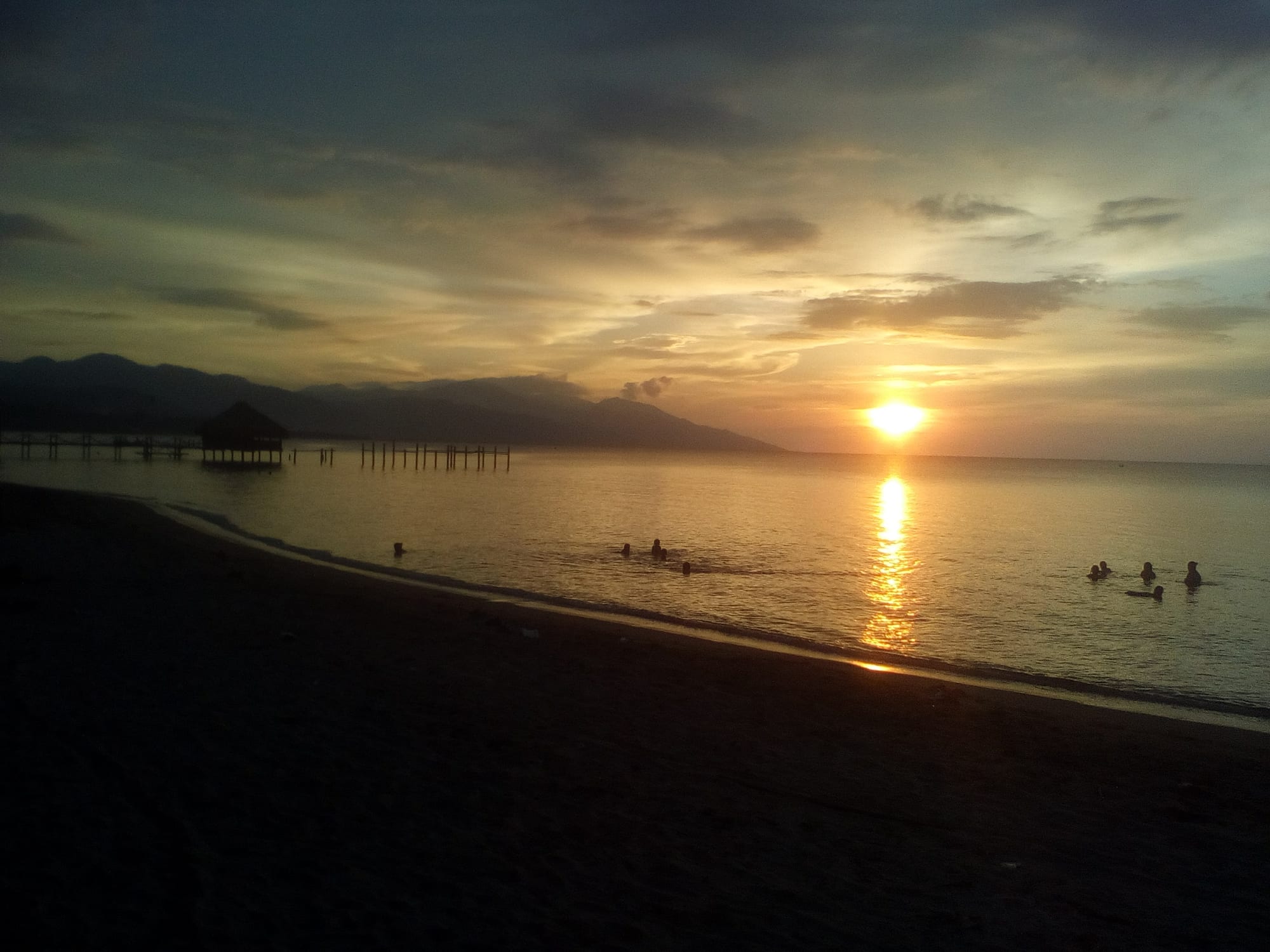
Sunset over a calm bay with swimmers in the water, a thatched pier on stilts and dark mountains along the shore

The Bay Islands & the Caribbean East, Honduras

Trujillo

Sunset over the Bay of Trujillo on Honduras's Caribbean coast. (P. Jesson Collins / Wikimedia Commons · CC BY 4.0)

The capital of Colón department, on a bluff above the Bay of Trujillo on Honduras's Caribbean coast, with the mountains Capiro and Calentura rising behind it. Founded in 1525 near where Columbus first touched the Central American mainland, it was a colonial capital and a pirates' target; today it is a small port and beach town with Garífuna villages along its shore.

Neighbourhoods

  • The old town
    • First-time visitors
    • Historic district
    • Views

    The centre on the bluff above the bay, around the central square, the cathedral and the Fortress of Santa Bárbara. Souvenir shops and restaurants face the square, and the fortress walls look straight down on the beach and the water.

    Open in Maps
  • The beachfront below the fort
    • Beaches
    • Best for food
    • Sunsets

    The sandy shore at the foot of the bluff, right below the fort, with seafood restaurants on the sand.

    Open in Maps
  • The Garífuna villages
    • Garífuna culture
    • Beaches
    • Quiet

    Santa Fe, San Antonio and Guadalupe are Garífuna fishing villages strung along the beaches near the town, where the Garífuna language, drumming and cooking are part of everyday life.

    Open in Maps

Things to do

Historic town

  • Fortress of Santa Bárbaralandmark

    The Spanish fort of around 1550 on the bluff above the bay, also known as El Castillo, with cannon still trained on the water and a museum of pre-Hispanic, colonial and republican objects found in the area.

    Open in Maps
  • William Walker's gravelandmark

    The marble tombstone in the old cemetery of the American filibuster captured and executed in Trujillo in 1860, a local curiosity close to the fort.

    Open in Maps
  • St. John the Baptist Cathedrallandmark

    The town's cathedral on the central square beside the fortress, with a clock dating from the late 1880s; the church was fully restored in 2011.

    Open in Maps
  • Rufino Galán Museummuseum

    An eclectic private collection in Barrio Miramar, from pre-Columbian figurines to pieces of downed US military aircraft from the Contra era, with river-fed bathing pools behind it.

    Open in Maps

Beaches, lagoon and mountains

  • Bay of Trujillo beachesbeach

    Long sandy beaches curve around the calm bay from the foot of the fort to the Garífuna villages.

    Open in Maps
  • Capiro Calentura National Parkpark

    The two forested mountains just behind the town, protected since 1992, where hikes to the summits give wide views and wildlife is plentiful.

    Open in Maps
  • Guaimoreto Lagoon Wildlife Refugepark

    A protected lagoon beside Capiro Calentura National Park, near which the first Spanish settlement of 1524 was founded.

    Open in Maps

Short trips from the town

  • Puerto Castillaattraction

    A port village about 12 km north of Trujillo on a peninsula, once the base of a United Fruit Company division and a wartime seaplane base.

    Open in Maps
  • Santa Feattraction

    A neighbouring coastal municipality with a strong Garífuna presence.

    Open in Maps
  • Punta Caxinas (Cape of Honduras)viewpoint

    The point at the end of the road, about 21 km from Trujillo, the place Columbus named Punta de Caxinas when he first touched the Central American mainland in 1502.

    Open in Maps

Eat and drink

Long-standing places and food districts in Trujillo. Hours, ratings and directions come from your maps app, always current.

Trujillo classics

  • Beach restaurants below the fortneighborhood

    Seafood restaurants on the sand beneath the Fortress of Santa Bárbara, known for seafood and the sunset over the bay.

    Open in Maps
  • Garífuna cooking in Santa Fe and nearby villagesneighborhood

    Garífuna cooking from the villages along the bay, including tapado, a seafood soup with coconut milk and plantains, and machuca, green plantain mashed with coconut.

    Open in Maps

Cafés and bars

  • Central squareneighborhood

    Cafés, restaurants and souvenir shops around the square beside the cathedral and the fort, the town's main meeting place.

    Open in Maps

Experience Trujillo

History

Christopher Columbus landed near Trujillo on 14 August 1502, on his fourth and final voyage, the first time he touched the Central American mainland. He called the place Punta de Caxinas. In 1524 Hernán Cortés sent Cristóbal de Olid to found an outpost near the Guaimoreto lagoon; when Olid tried to set up his own realm, Francisco de las Casas removed him. Las Casas moved the settlement to the present site for its larger natural harbour and renamed it Trujillo; the town was formally founded on 18 May 1525.

Trujillo became a shipping point for gold and silver from the interior and, under Spanish rule, the capital of Honduras, until its exposed position led the capital to move inland to Comayagua. Around 1550 the Spanish built the Fortress of Santa Bárbara, but it could not hold off pirates or rival powers: French raiders sacked the town in 1558, the Dutch burned it in 1633, the largest gathering of pirates in history took place nearby in 1683, and the town was destroyed several times before 1797. For much of the 18th century the Spanish all but abandoned it as indefensible.

After independence in 1821 Trujillo began to prosper again. In 1860 the American filibuster William Walker, who had seized power in Nicaragua, captured the town, but he was defeated, taken prisoner and executed here on 12 September 1860; his grave is a local attraction. More recently the town has been discussed as a site for a proposed charter city, a plan that met with scepticism and controversy, especially over its supposed disregard for local Garífuna culture.

Culture & Customs

Trujillo carries two cultures side by side. The town itself is mestizo, Spanish-speaking and Catholic, proud of its long colonial history and of its fortress, its cathedral and its coat of arms, granted by Emperor Charles V, which shows a burning golden castle for the citizens' fights against pirates.

Along the beaches, the Garífuna fishing villages of Santa Fe, San Antonio and Guadalupe keep a culture of their own. The Garífuna, descended from Carib and African people exiled from St Vincent by the British in 1797, landed on Roatán and spread along the mainland coast. Their language, dance and music were proclaimed by UNESCO in 2001 a Masterpiece of the Oral and Intangible Heritage of Humanity, and their food and music give the coast around Trujillo much of its character.

The town's literary and historical associations add to its identity. The American writer O. Henry lived here for a time and based the town of Coralio in his book Of Cabbages and Kings on Trujillo; that fictional town, the grave of William Walker and the memory of pirate raids are all part of how Trujillo presents itself to visitors, while the old fortress houses a museum of the region's pre-Hispanic, colonial and republican past and its many cultures.

Daily Life

The city had about 22,750 people in a 2023 calculation, and it is the capital of Colón department, with government offices, schools and a cathedral serving a wide area. The municipality extends well beyond the town and took in 198 hamlets in 2013.

Today it is a small port and beach town, living from government, fishing and modest tourism. Historically, Trujillo was known for its cattle industry, raising cattle mainly for the Honduran market rather than for export. Nearby Puerto Castilla, on a peninsula to the north, was once a United Fruit Company division and is now a port controlled by the national port authority.

Life is slow and centred on the old town, the square and the beach. Fishing boats work from the Garífuna villages, and comedores serve lunch to office workers and families. Isolation shapes much of daily life: the coast road is long, and the region's land conflicts and drug trafficking have left their mark on the department of Colón.

Food

Trujillo eats from the Caribbean. Seafood is the speciality of the restaurants on the beach below the fort, and in the coastal areas seafood and some meats are prepared in many ways, including with coconut milk. Rice and beans is a popular side dish on the Caribbean coast, and tajadas, fried green bananas, often come with refried beans.

The Garífuna villages nearby keep a cooking tradition of their own. Tapado is a seafood soup made with coconut milk and plantains; hudutu is pounded plantain; machuca is green plantain mashed with coconut; and ereba is cassava bread, a staple and an important part of Garífuna identity. Sopa de caracol, conch soup, and tapado are typical soups of north-coast towns such as Puerto Cortés, Tela, La Ceiba and Trujillo.

Mainland Honduran food fills the rest of the menu. The baleada, a flour tortilla folded over refried beans, crumbled cheese and cream, is believed to have originated on the north coast, and plato típico, one of the national dishes, is meat served with refried beans, plantains, chorizo, cheese, chismol salsa and tortillas. Horchata and agua de nance are common drinks with meals.

Planning tools

Budget

Trujillo is generally much cheaper than the Bay Islands. Guesthouses, comedor meals and seafood on the beach cost little. The main extra cost is transport, since the town is far from the main cities.

Daily Budget Midrange
USD 80–160 (beach hotel, seafood restaurants, taxis and a guided hike or lagoon trip)
Daily Budget Shoestring
USD 30–50 (guesthouse, comedor and beach food, local buses and taxis)

Carry enough cash in lempiras; small places on the beach and in the villages rarely take cards.

Best Time to Visit

The drier months, roughly from February to August, are the best time for the beaches and the mountains. Cold fronts from the north bring rain and wind from about October to January, and the Atlantic hurricane season runs from June to November.

Suggested Number of Days

Two or three days cover the old town, the beach and a walk in the hills. Allowing four or five makes time for the Garífuna villages, the lagoon and the cape, and for the long journey in and out.

First Visit
2–3 days
With Surroundings
4–5 days

Transportation

The town centre is walkable, and taxis are the usual way to reach the villages, the lagoon and the trailheads. Hiring a guide is the best way to explore the national park and the lagoon.

Use taxis recommended by a hotel and avoid travelling between towns by road after dark.

Airport & Station Connections

Most visitors arrive by road. The coastal terrain has been too rugged for a direct coast road, so the route from La Ceiba or Tela makes a long inland detour. Trujillo has a small airstrip running parallel to the shore about 100 metres inland, but no commercial air service was reported there in 2020. Cruise ships call only occasionally.

Walkability

The old town, the square, the fort and the beach below are all close together and easy on foot, with a short, steep walk between the bluff and the shore. The Garífuna villages, the lagoon and the national park are further out and need a taxi or a guide.

Safety

Honduras has had one of the highest homicide rates in the world, driven by gangs (MS-13 and Barrio 18) and drug trafficking, and San Pedro Sula and parts of Tegucigalpa remain dangerous. The mainland east of the Bay Islands is less safe than the islands: drug trafficking by light aircraft and boat runs through La Mosquitia and Colón, and the Bajo Aguán valley inland has seen years of violent land conflict. Most visitors keep to the town centre and the beaches.

Avoid isolated beaches and trails after dark, hike in the national park with a guide, use hotel-recommended taxis, and never travel by road at night. Check current official travel advice before travelling.

Climate

Hot and humid all year on this stretch of coast. Across the region, temperatures stay at around 27–31°C, with a rainy stretch from about October to January brought by cold fronts from the north, and hurricanes a risk from June to November.

Summer
hot and humid across the region, about 28–33°C, with the hurricane season from June
Winter
warm across the region, about 24–30°C, with rain and wind from northern cold fronts from October to January

Local Customs

Spanish is the main language in town, and Garífuna is spoken in the villages along the beaches. Trujillo is a quiet, Catholic town with a strong sense of its colonial past, while the Garífuna communities keep their own language, drumming and dances.

Ask before photographing people, especially in the Garífuna villages, and dress modestly away from the beach and in the cathedral.

Common Payment Methods

The currency is the Honduran lempira. Cards are accepted mainly on the Bay Islands and in the big cities, so cash is needed for most things here, from beach restaurants to taxis; carrying small notes helps.