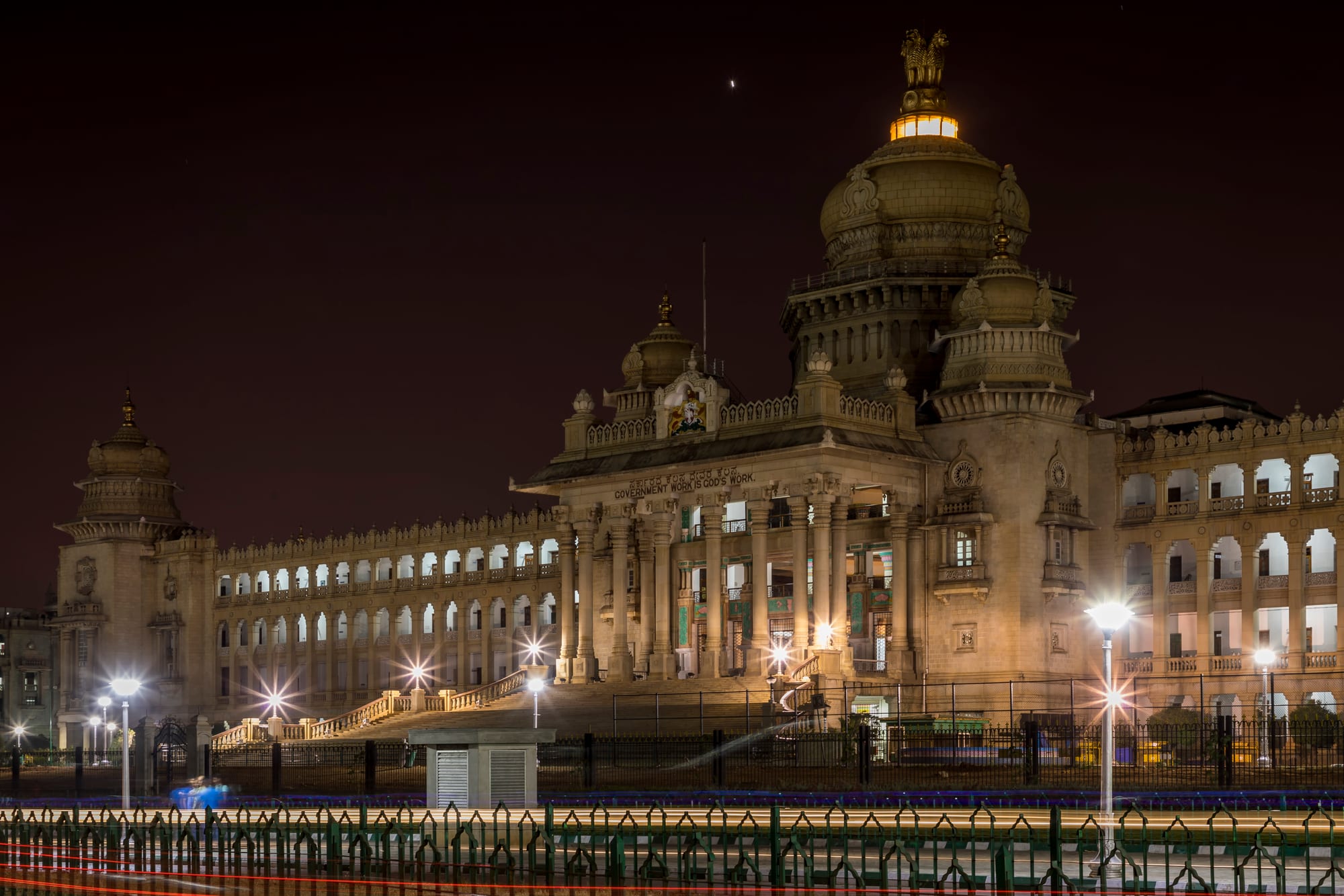
The floodlit granite facade and central dome of the Vidhana Soudha at night, with street lamps and light trails along the road in front

The South, India

Bengaluru

The Vidhana Soudha, seat of Karnataka's legislature, floodlit at night in central Bengaluru. (DeepanjanGhosh / Wikimedia Commons · CC BY-SA 4.0)

Karnataka's capital, set on the Deccan plateau about 900 metres up, which gives it a mild climate rare in southern India. A 16th-century mud fort town that the British turned into a garrison and garden city, it became the centre of India's software industry in the 1990s and is now one of the country's largest and fastest-growing cities.

Neighbourhoods

  • The central business district and MG Road
    • First-time visitors
    • Close to public transport
    • Shopping

    The colonial-era Cantonment core, between Cubbon Park and the shopping streets of MG Road, Brigade Road and Church Street. Most of the city's older hotels, bookshops, bars and government buildings are here, and two metro lines cross beneath it.

    Open in Maps
  • Indiranagar
    • Best for food
    • Nightlife
    • Close to public transport

    A planned residential layout east of the centre that filled with restaurants, bars, microbreweries and design shops as the tech boom arrived. 100 Feet Road and 12th Main are the busy axes; the quieter side streets keep their bungalows and trees.

    Open in Maps
  • Koramangala
    • Best for food
    • Young crowd
    • Cafes

    South-east of the centre and closely tied to the start-up world, with cafes, cheap eating houses and bars spread across numbered blocks. It is informal and crowded rather than scenic, and popular with students and young professionals.

    Open in Maps
  • Basavanagudi
    • Historic district
    • Best for food
    • Temples

    One of the oldest planned parts of the southern city, laid out in the 1890s after a plague. Gandhi Bazaar's flower and fruit stalls, the Bull Temple and a run of long-established tiffin rooms give it a more traditional Kannada character than the east side.

    Open in Maps
  • Malleswaram
    • Quiet and residential
    • Local life
    • Markets

    A leafy north-western neighbourhood of the same era, known for its temples, silk and sari shops, vegetable market and old-style restaurants. Sampige Road is the main artery and has its own metro station.

    Open in Maps
  • Jayanagar
    • Quiet and residential
    • Markets
    • Families

    A large grid of tree-lined blocks laid out south of Lal Bagh in the late 1940s, with a well-known shopping complex, a covered market and parks. It is residential and middle-class, with little nightlife but plenty of everyday life.

    Open in Maps
  • Whitefield
    • Business travellers
    • Malls and hotels

    Founded in the 1880s as a settlement for Anglo-Indians and Eurasians, and now a tech district some 15 kilometres east of the centre, dense with campuses, malls and hotels. The metro reaches it, but road traffic is heavy.

    Open in Maps
  • Shivajinagar
    • Markets
    • Street food
    • Historic district

    A crowded older quarter just north of the centre with a large Muslim and Tamil Christian population, Russell Market's produce halls, a busy bus station and streets of kebab shops and bakeries.

    Open in Maps

Things to do

Famous landmarks

  • Vidhana Soudhalandmark

    The granite seat of Karnataka's legislature and secretariat, built between 1952 and 1956 in a neo-Dravidian style and floodlit at night.

    Open in Maps
  • Bangalore Palacelandmark

    A palace of the Wodeyar rulers completed in 1874, with turrets, fortified towers and wood-panelled interiors, its grounds now used for fairs and events.

    Open in Maps
  • Tipu Sultan's Summer Palacelandmark

    A two-storey teak pavilion begun by Hyder Ali in 1781 and finished under Tipu Sultan in 1791, with carved pillars, arches and balconies, built inside the old fort.

    Open in Maps
  • Bangalore Fortlandmark

    The surviving Delhi Gate and two bastions of the stone fort that Hyder Ali built in 1761 in place of Kempe Gowda's mud fort, stormed by Cornwallis's army in March 1791.

    Open in Maps
  • Dodda Basavana Gudilandmark

    The Bull Temple in Basavanagudi, built in 1537 by Kempe Gowda around a large monolithic granite Nandi bull, said to be one of the biggest Nandi shrines anywhere.

    Open in Maps
  • St. Mary's Basilicalandmark

    A Gothic revival church in Shivajinagar, raised to a minor basilica in 1973 and the focus of a large September feast.

    Open in Maps

Museums and galleries

  • Visvesvaraya Industrial and Technological Museummuseum

    A hands-on science and engineering museum opened in Cubbon Park in 1962 and named after the engineer and statesman M. Visvesvaraya.

    Open in Maps
  • National Gallery of Modern Artmuseum

    Modern and contemporary Indian art shown in a colonial-era mansion and a newer wing on Palace Road.

    Open in Maps
  • HAL Aerospace Museummuseum

    India's first aerospace museum, opened in 2001 at Hindustan Aeronautics Limited's works in the east of the city, with aircraft, engines and flight simulators.

    Open in Maps
  • Government Museummuseum

    One of the oldest museums in India, opened in 1865, with sculpture, coins and antiquities from Karnataka on the edge of Cubbon Park.

    Open in Maps

Parks and lakes

  • Lal Baghpark

    A botanical garden begun under Hyder Ali and Tipu Sultan, with a Victorian glass house modelled on the Crystal Palace and one of Kempe Gowda's watchtowers on a rock outcrop.

    Open in Maps
  • Cubbon Parkpark

    A large wooded park created in 1870 in the centre of the city, officially Sri Chamarajendra Park, surrounded by red-brick government buildings and closed to traffic in the early morning.

    Open in Maps
  • Ulsoor Lakepark

    One of the largest of the city's surviving tanks, about 50 hectares of water with several wooded islands and a walking path, near the Cantonment.

    Open in Maps

Markets and shopping streets

  • Krishna Rajendra Marketmarket

    The old city's largest wholesale market, known as City Market, counted among the biggest flower markets in Asia and loudest at dawn when the produce arrives.

    Open in Maps
  • Russell Marketmarket

    A market hall in Shivajinagar built in 1927, selling meat, fish, fruit and flowers.

    Open in Maps
  • Commercial Streetmarket

    A narrow shopping street north of MG Road lined with clothing, textile and jewellery shops, busy into the evening.

    Open in Maps

Short trips from the city

  • Bannerghatta National Parkpark

    Forested hills about 22 kilometres south of the centre, with a zoo, a butterfly park and a safari enclosure for tigers and lions.

    Open in Maps
  • Nandi Hillsviewpoint

    A hill fort and summer retreat of Tipu Sultan some 60 kilometres north, reached by a winding road and visited at dawn for the view over cloud-filled valleys.

    Open in Maps
  • Devanahalli Fortlandmark

    A roughly oval walled fort with twelve semi-circular bastions near the airport, with the site of Tipu Sultan's birth marked just outside it.

    Open in Maps

Seasonal events

  • Bengaluru KaragaMarch or April, at the full moon

    A nine-day festival of the Thigala (Vahnikula Kshatriya) community around the Dharmaraya temple in the old city, in which a priest carries a decorated earthen pot through the streets by night, accompanied by drummers and sword-bearing Veerakumaras.

  • Kadalekai ParisheNovember or December

    A groundnut fair held around the Bull Temple in Basavanagudi, when farmers sell the season's first crop in the surrounding streets.

  • Lalbagh Flower ShowJanuary and August

    Flower displays filling Lal Bagh's 1890s glass house in the weeks of Republic Day and Independence Day, drawing very large crowds.

  • Bangalore Literature FestivalDecember

    A literary festival of talks and readings in English and Indian languages, held annually since 2012.

  • Bengaluru International Film FestivalFebruary or March

    A week of Indian and international cinema screened across city theatres.

Eat and drink

Long-standing places and food districts in Bengaluru. Hours, ratings and directions come from your maps app, always current.

Bengaluru classics

  • Mavalli Tiffin Roomsrestaurant

    A tiffin room near Lal Bagh that began in 1924 as the Brahmin Coffee Club and is credited with popularising rava idli, the semolina idli.

    Open in Maps
  • Vidyarthi Bhavanrestaurant

    A small Basavanagudi eating house founded in 1943, known for a thick, crisp benne (butter) masala dosa and for long queues on the pavement.

    Open in Maps
  • Koshy'srestaurant

    A St Mark's Road restaurant and bar open since 1940, long a meeting place for writers, journalists and artists, serving Anglo-Indian food alongside south Indian breakfasts.

    Open in Maps

Food districts and markets

  • V. V. Puram food streetneighborhood

    A short lane of evening stalls south of the old city, known locally as Thindi Beedhi, frying dosas, holige, gobi manchurian and sweets on the pavement.

    Open in Maps
  • Gandhi Bazaarneighborhood

    Flower sellers, fruit carts and old-style bakeries and tiffin rooms along the main street of Basavanagudi.

    Open in Maps
  • Shivajinagarneighborhood

    Kebab grills, biryani houses and bakeries around Russell Market, busiest in the evenings of Ramadan.

    Open in Maps
  • Indiranagar's breweries and restaurantsneighborhood

    The centre of the city's microbrewery scene, with regional Indian restaurants and cafes along 100 Feet Road and the 12th Main area.

    Open in Maps

Experience Bengaluru

History

Bengaluru's recorded history begins with a hero stone and with the Western Ganga and Chola periods, but the city dates itself to 1537, when the local chief Kempe Gowda I, a vassal of the Vijayanagara empire, built a mud fort and laid out the market streets, or petes, that still carry trade names such as Chickpet and Balepet. Four towers raised by his successor Kempe Gowda II marked the limits the town was expected to reach. After Vijayanagara's defeat the town passed to the Bijapur sultanate, then to the Mughals, who leased it to the Wodeyars of Mysore in 1687.

Hyder Ali and his son Tipu Sultan rebuilt the fort in stone and planted the garden that became Lal Bagh. British forces stormed the fort in 1791 during the Third Anglo-Mysore War, and after Tipu's death in 1799 the kingdom returned to the Wodeyars under British oversight. In 1809 a cantonment was established north-east of the old town, and for more than a century Bengaluru grew as two distinct places: the Kannada-speaking pete around the fort, and a garrison suburb of bungalows, churches, parade grounds and the shops of MG Road. The climate earned it a reputation as a retirement town and a garden city.

After independence public-sector science and engineering institutions concentrated here — aircraft, machine tools, telecommunications, space and defence research — giving the city a large pool of engineers. That base drew the software industry from the 1980s, and through the 1990s and 2000s Bengaluru became the centre of Indian information technology and later of its start-up sector. The population multiplied, Whitefield and Electronic City filled with campuses, and the official name changed from Bangalore to Bengaluru in 2014.

Culture & Customs

Bengaluru is a Kannada city that has absorbed most of India. Kannada literature, theatre and the Sandalwood film industry are centred here, and language politics matter: campaigns for Kannada signage and hiring recur, and long-running river water disputes with Tamil Nadu over the Kaveri periodically bring protests. At the same time roughly half the residents have roots elsewhere, and Tamil, Telugu, Hindi, Malayalam and English are all heard in a single street.

Two cultural streams run side by side. The southern and western neighbourhoods keep temple festivals, Carnatic music sabhas, sari and flower markets and old tiffin rooms; the eastern half is where pubs, live music, stand-up comedy, independent theatre and design studios cluster. The city claims India's microbrewery culture as its own, and it has long been a centre of rock and metal bands as well as of classical dance schools. Sport is followed intensely, with cricket at the M. Chinnaswamy Stadium in the middle of town.

Manners are informal by Indian standards. People are addressed in English as often as in Kannada, work hours are late, and weekend life revolves around restaurants, parks and lakes rather than around a single centre. Older residents speak with some regret of the garden city of tanks, trees and single-storey bungalows that the last three decades have largely replaced, and tree-felling for road widening is a reliable source of public campaigns.

Daily Life

About 8.4 million people lived in the city at the 2011 census and the urban area has grown well past that since, making it one of India's largest and, for much of the past decade, fastest-growing metropolitan areas. Software and services dominate the economy, alongside aerospace, defence electronics, machine tools, biotechnology and one of the country's densest concentrations of start-ups, but a very large informal workforce of drivers, construction workers, delivery riders and domestic staff keeps it running.

The day starts early, with filter coffee and idli or dosa at a darshini — a stand-up tiffin counter — and walkers circling Cubbon Park and the lakes. Offices in Whitefield, Electronic City and Outer Ring Road campuses run late, which is why evening traffic lasts for hours and why restaurants fill after nine. Many young workers live in shared flats or paying-guest accommodation near the tech corridors; families cluster in the older southern and northern layouts.

The city's pressures are well documented: congestion, the state of the roads, flooding when drains and built-over lake beds cannot take a downpour, and water supply, which depends on pumping the Kaveri uphill from far away and on groundwater that has fallen sharply. Rubbish disposal and the loss of tree cover are recurring local political issues, and the metro's expansion is the main hope attached to the traffic problem.

Food

Bengaluru's everyday food is Karnataka vegetarian cooking served fast. The darshini, a stand-up counter where customers pay first and eat at chest-high tables, was popularised in this city and put idli, vada, khara bath and kesari bath — the two together called chow chow bath — within everyone's reach. The Bangalore-style masala dosa is thicker and softer than the Tamil version, red with chilli-garlic paste inside and generous with butter; benne dosa, fried in butter, is a speciality brought from Davanagere. Rava idli, a semolina idli, is credited to a city tiffin room during wartime rice shortages.

Lunch for many is a thali or a plate of bisi bele bath, rice cooked with lentils, tamarind and a distinctive spice blend, or ragi mudde, stiff balls of finger millet eaten with a thin lamb or vegetable curry in the countryside around the city. Meat-eating Bengaluru has its own tradition of military hotels, plain Kannada eating houses serving mutton curry, pepper fry and donne biryani, the latter ladled into a bowl of dried leaves. Shivajinagar and Mosque Road add kebabs, biryani and Ramadan-night sweets.

Filter coffee, decoction mixed with hot milk and poured between a steel tumbler and its dish, is the city's drink, sold at tiffin rooms and at small standing counters everywhere. Mysore pak, obbattu or holige — a flat sweet stuffed pancake — and Dharwad pedha are the sweets most often bought. The evening food street at V. V. Puram fries snacks until late, and the microbreweries of Indiranagar and Koramangala have given the city a beer culture unusual in India.

Planning tools

Budget

Bengaluru is among the more expensive Indian cities for hotels and for eating out in Indiranagar, Koramangala or the central business district, where restaurant and craft-beer prices approach big-city levels elsewhere. Everyday costs stay low: darshini breakfasts, thali lunches, metro fares and auto-rickshaw rides are cheap, and the parks and most temples cost nothing. Airport transfers and city traffic delays are the hidden expense.

Daily Budget Midrange
USD 60–140 (mid-range hotel, restaurant meals, museum and palace tickets, taxis or ride-hailing)
Daily Budget Shoestring
USD 20–40 (guesthouse or hostel bed, tiffin rooms and thali meals, metro and buses)

Staying near a metro station saves both money and hours in traffic; eat breakfast at a darshini, where a dosa and filter coffee cost a fraction of a hotel buffet.

Best Time to Visit

October to February is the pleasant stretch, dry and mild, with cool mornings in December and January and the flower show and literature festival in the calendar. March to May is hot and dusty by local standards, though far cooler than the plains. Rain falls from June to September with the southwest monsoon and again in October and November, usually in heavy late-afternoon storms that flood roads.

Suggested Number of Days

Two days cover the central sights and one or two neighbourhoods. Four or five allow trips out to the hills and forts, or onward to Mysore. Traffic is the main constraint: crossing the city can take an hour or more, so fewer areas per day is the realistic approach.

First Visit
2 days
With Surroundings
4–5 days

Transportation

Namma Metro, now the second-largest metro network in India, is the quickest way across the centre, with an east–west line, a north–south line and a third line opened in 2025 out to Electronic City; more are under construction. Buses run by the state corporation cover the whole city, and auto-rickshaws and ride-hailing apps fill the gaps. Traffic congestion is severe and internationally known; journeys at peak times can take several times longer than the distance suggests.

Insist on the meter in an auto-rickshaw or use an app, and allow generous margins for any journey with a fixed deadline.

Airport & Station Connections

Kempegowda International Airport lies about 35 kilometres north of the centre, near Devanahalli, and is the third-busiest in India, with wide domestic and international networks; airport buses and taxis take roughly an hour and often longer in traffic. KSR Bengaluru City Junction and Yesvantpur are the main railway stations, with overnight trains to Chennai, Hyderabad, Goa and Mumbai and a short daytime run to Mysore. Long-distance buses use the Kempegowda bus station opposite the city railway station.

Walkability

Individual neighbourhoods walk well — Cubbon Park to MG Road, the lanes of Basavanagudi and Malleswaram, the shopping streets off Brigade Road — but the city as a whole does not. Pavements are uneven or occupied, crossings are few, and the distances between districts are long. Most visitors walk within one area and take the metro or a rickshaw between them.

Safety

Bengaluru is generally safe for visitors, with the usual big-city risks of pickpocketing in markets and at bus stations and occasional phone snatching from open vehicles. Road traffic is the real hazard, for pedestrians and for anyone on two wheels. Heavy monsoon downpours flood low-lying roads and underpasses, and late-night areas away from the main streets are poorly lit.

Cross with the flow of other pedestrians, agree fares or use a metered app before setting off, and avoid walking on flooded roads, where open drains are hard to see. Check current official travel advice before travelling.

Climate

The plateau setting, at around 900 metres, gives Bengaluru a mild climate for southern India, with no great extremes and pleasant evenings for most of the year. Rain arrives with the southwest monsoon from June and continues into November, often as short, intense storms.

Summer
warm and dry, typically 30–35°C in the afternoons of March to May, with cooler nights than the plains
Winter
mild and dry, around 26–28°C by day and 15–17°C at night from December to February

Local Customs

Kannada is the state language, though English and Hindi are widely understood and the city's workforce comes from all over India. Shoes come off before entering temples and many homes; modest dress is expected at religious sites. Tipping is not obligatory but small amounts are usual in restaurants and for drivers. Eating with the right hand is normal, and meals on a banana leaf are eaten this way.

Ask before photographing inside temples or in markets, and note that bars and liquor shops close on dry days announced around elections and certain public holidays.

Common Payment Methods

The currency is the Indian rupee. Bengaluru is close to cashless: UPI QR codes are accepted by almost every shop, stall and rickshaw driver, and cards work in hotels, malls and larger restaurants. Foreign visitors without an Indian bank account should carry some cash for small purchases; ATMs are plentiful.