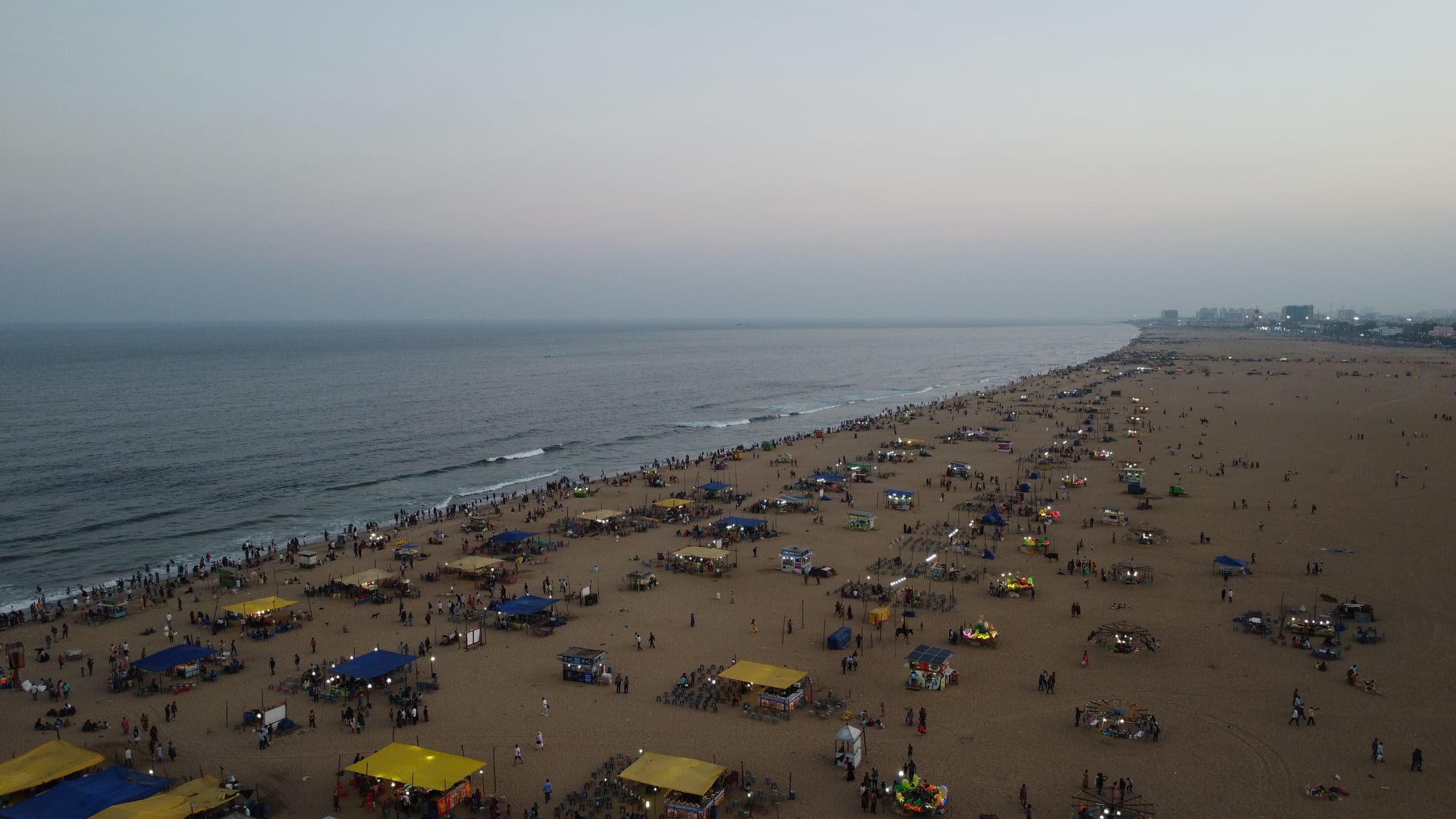
A wide sandy beach curving into the distance at dusk, crowded with people and rows of coloured food stalls beside a calm grey sea

The South, India

Chennai

Evening crowds and food stalls along Marina Beach in Chennai. (Saiphani02 / Wikimedia Commons · CC BY-SA 4.0)

Tamil Nadu's capital, spread along a flat stretch of the Bay of Bengal coast around the long sands of Marina Beach. It grew from the English East India Company's Fort St George, founded in 1639, into the main port and administrative centre of south India, and is now a centre of the Tamil film industry, Carnatic music, car manufacturing and hospital medicine.

Neighbourhoods

  • George Town
    • Historic district
    • Markets
    • First-time visitors

    The oldest commercial quarter, grown up beside Fort St George and the harbour. Its grid of wholesale streets deals in paper, hardware, gold and cloth, and it holds the Madras High Court, the Ripon Building and some of the city's earliest churches and temples.

    Open in Maps
  • Mylapore
    • Temples
    • Best for food
    • Historic district

    A settlement older than Madras itself, built around the Kapaleeshwarar temple and its tank. The four Mada streets fill with flower sellers, brass shops and coffee houses, and San Thome Basilica stands a short walk away on the seafront.

    Open in Maps
  • Triplicane
    • Budget stays
    • Street food
    • Close to the beach

    A dense old neighbourhood between the Marina and Anna Salai, centred on the Parthasarathy temple and the Wallajah Mosque. Cheap lodges, Muslim eating houses and student hangouts line its lanes, and the beach is a few minutes away.

    Open in Maps
  • T. Nagar
    • Shopping
    • Close to public transport

    Theagaraya Nagar, laid out in the 1920s, is the city's shopping heart: Ranganathan Street and Usman Road are packed with silk, jewellery and clothing stores, at their most extreme before weddings and Diwali. It is loud, crowded and central.

    Open in Maps
  • Egmore and Nungambakkam
    • Museums
    • Hotels
    • Close to public transport

    Egmore has the Government Museum, a grand railway terminus and many mid-range hotels; adjoining Nungambakkam is quieter and more expensive, with consulates, galleries, restaurants and the tree-lined stretch of Sterling Road.

    Open in Maps
  • Adyar and Besant Nagar
    • Quiet and residential
    • Beaches
    • Cafes

    South of the Adyar river, with the wooded grounds of the Theosophical Society, the Kalakshetra arts campus and, at Besant Nagar, Elliot's Beach and the cafes and stalls behind it. Residential, green and popular with families.

    Open in Maps
  • Anna Salai and the central business district
    • Business travellers
    • Close to public transport

    Formerly Mount Road, the long arterial avenue running south-west from the fort, lined with offices, cinemas, newspaper headquarters and hotels, and followed underground by the metro.

    Open in Maps

Things to do

Famous landmarks

  • Fort St Georgelandmark

    The East India Company fortress begun in 1639, the first English fortress in India, now housing the Tamil Nadu secretariat, St Mary's Church and a museum.

    Open in Maps
  • Kapaleeshwarar Templelandmark

    Mylapore's Shiva temple, rebuilt on this site in the 17th century, its 40-metre eastern gopuram added in 1906, with a stepped tank alongside and a large Panguni festival in March or April.

    Open in Maps
  • Parthasarathy Templelandmark

    A Vishnu temple in Triplicane first built by the Pallavas in the 6th century, among the oldest structures in the city and one of the 108 Divya Desams of Tamil Vaishnavism.

    Open in Maps
  • San Thome Basilicalandmark

    A white church built by the Portuguese in 1523 over a tomb traditionally held to be that of the apostle Thomas, and rebuilt to neo-Gothic designs in 1896.

    Open in Maps
  • Ripon Buildinglandmark

    The white neoclassical seat of the city corporation, opened in 1913, with a clock tower facing Central station.

    Open in Maps
  • Madras High Courtlandmark

    A red Indo-Saracenic complex of domes and minarets in George Town, completed in 1892 and among the largest judicial buildings in the world.

    Open in Maps
  • Valluvar Kottamlandmark

    A memorial to the Tamil poet Thiruvalluvar built in 1976 as a stone temple chariot, with verses of the Thirukkural carved on its walls.

    Open in Maps

Museums and the arts

  • Government Museummuseum

    Started in 1851 and the second oldest museum in India, with a celebrated collection of bronzes, Amaravati sculptures and a 19th-century theatre in its Egmore campus.

    Open in Maps
  • Kalakshetraattraction

    An arts academy founded by Rukmini Devi Arundale in 1936, on a wooded campus at Besant Nagar since 1962, central to the revival of Bharatanatyam dance.

    Open in Maps
  • The Music Academyattraction

    Inaugurated in 1928 and the best known of the city's Carnatic music institutions, whose auditorium is the main stage of the December music season.

    Open in Maps

Beaches and parks

  • Marina Beachbeach

    India's longest natural urban beach, running about 13 kilometres along the eastern edge of the city and lined with memorials, statues and evening stalls; bathing is prohibited because of the undercurrent.

    Open in Maps
  • Elliot's Beachbeach

    A calmer beach at Besant Nagar, just south of the Marina, with the Kaj Schmidt memorial at one end and cafes and snack stalls behind the promenade.

    Open in Maps
  • Guindy National Parkpark

    One of the smallest national parks in India and a rare patch of protected scrub forest inside a city, home to blackbuck, spotted deer and many birds.

    Open in Maps
  • Theosophical Society gardenspark

    Large quiet grounds at the mouth of the Adyar river, headquarters of the Theosophical Society since 1882, with a vast banyan tree and a library.

    Open in Maps

Short trips from the city

  • Mamallapuramlandmark

    About 55 kilometres south along the coast, the UNESCO-listed Group of Monuments: 7th- and 8th-century Pallava rock-cut mandapas, monolithic rathas, the Descent of the Ganges relief and the Shore Temple.

    Open in Maps
  • DakshinaChitramuseum

    A heritage village opened in 1996 at Muttukadu on the East Coast Road, with relocated traditional houses from the southern states, plus crafts and performances.

    Open in Maps
  • Cholamandal Artists' Villageattraction

    India's largest artists' commune, founded in 1966 at Injambakkam, with galleries and studios linked to the Madras Movement in modern Indian art.

    Open in Maps
  • Kanchipuram templeslandmark

    A temple and silk-weaving city about 70 kilometres west, known as the city of a thousand temples, with the Kailasanathar, Ekambareswarar and Varadharaja Perumal shrines among them.

    Open in Maps

Seasonal events

  • Madras Music Seasonmid-November to January

    Some nine weeks of Carnatic music and Bharatanatyam concerts across dozens of sabhas, with canteens attached, described as one of the world's largest cultural events.

  • Pongalmid-January

    The Tamil harvest festival, when rice is boiled over in new pots, houses are decorated with kolam patterns and the city empties towards home villages.

  • Arupathimoovar festivalMarch or April

    The Panguni festival at the Kapaleeshwarar temple, when bronze images of the 63 Nayanmar saints are carried in procession through Mylapore.

  • Madras Daylate August

    A week of heritage walks, talks and exhibitions marking the 1639 founding of the settlement that became the city.

  • Chennai International Film FestivalDecember or January

    A festival of Indian and world cinema screened at theatres across the city, held since 2002.

Eat and drink

Long-standing places and food districts in Chennai. Hours, ratings and directions come from your maps app, always current.

Chennai classics

  • Saravanaa Bhavanrestaurant

    A vegetarian chain based in Chennai and now spread across dozens of countries, serving idli, dosa, pongal and thali meals in plain, busy dining rooms.

    Open in Maps
  • Buhari Hotelrestaurant

    The Anna Salai restaurant where chicken 65, the spicy deep-fried chicken dish, originated.

    Open in Maps
  • Ratna Caferestaurant

    One of the longest-standing eating houses in Chennai, in Triplicane, known for idli served with large quantities of sambar.

    Open in Maps

Food districts and markets

  • Mylapore's Mada streetsneighborhood

    Coffee houses, sweet shops and vegetarian mess halls around the temple tank, at their busiest in the early morning and after evening worship.

    Open in Maps
  • Sowcarpetneighborhood

    The north Indian and Gujarati trading quarter of George Town, whose evening stalls sell chaat, kachori, jalebi and lassi rather than southern food.

    Open in Maps
  • Marina Beach stallsmarket

    Rows of carts along the sand selling sundal, spiced chickpeas served in paper cones, along with bajji fritters and roasted corn.

    Open in Maps

Experience Chennai

History

Mylapore was a port and temple town long before Madras existed, trading with Rome in the early centuries AD and mentioned by Ptolemy. San Thome grew beside it under the Portuguese in the 16th century. The modern city dates from 22 August 1639, when the English East India Company obtained a strip of coast from the Nayak rulers of the area and built Fort St George on it. The settlement of Madraspatnam grew around the fort, with the Company's servants in the White Town inside the walls and weavers, merchants and dubashes in the Black Town, later George Town, outside.

Madras became the Company's chief southern base, survived a French occupation in 1746 and a French siege in 1759, and was the seat of the Madras Presidency, which at its height stretched across most of the south. Railways from the 1850s, the artificial harbour completed early in the 20th century and a chain of colleges, hospitals and newspapers made it an administrative and intellectual capital. The Indian National Congress met here, and in September 1914 the German cruiser Emden shelled the oil tanks on the seafront.

After 1947 Madras became capital of Madras State, renamed Tamil Nadu in 1969, and the Dravidian movement transformed its politics. Car plants, textile firms and, later, software and hospitals reshaped the economy, and the population spread far inland along the highways. The city was renamed Chennai in 1996. The 2004 Indian Ocean tsunami struck its fishing settlements, the 2015 floods inundated large areas after exceptional rain, and water scarcity has repeatedly forced the city to bring supplies in by train and tanker.

Culture & Customs

Chennai regards itself as the guardian of Tamil culture. The December music season is the clearest expression of it: for several weeks hundreds of Carnatic concerts and Bharatanatyam recitals run in sabha halls across the city, with canteens attached that are as famous as the performances. Kalakshetra, founded in 1936, trained much of the modern dance world, and the city's temples remain working centres of music and ritual as well as of worship.

It is also the home of Tamil cinema, produced in the studios of Kodambakkam and followed with an intensity that has repeatedly put film stars into the chief minister's office. Posters, fan clubs and first-day crowds are part of street life. Literature, journalism and a strong tradition of public debate sit alongside; the city has been a publishing centre since the 19th century.

Religious life is plural and visible. Hindu temple festivals fill the streets with chariots and drums; San Thome and a long Christian presence, the Wallajah Mosque and a large Muslim population in Triplicane and the north, and Jain and Marwari communities in Sowcarpet all have their quarters. Manners are formal and fairly conservative: modest dress, shoes off indoors, and a reluctance to be loud in public. Kolam, the rice-flour patterns drawn on thresholds at dawn, is still an everyday practice.

Daily Life

About 6.7 million people live in the Greater Chennai Corporation area and some nine million in the wider metropolitan region, making it one of India's largest urban areas. The economy rests on car and component manufacturing in the industrial belts north and south of the city — which has earned it the nickname of India's Detroit — along with software services, the port, a very large healthcare sector that draws patients from across India and abroad, and finance and insurance.

Days begin early, with temple bells, kolam on the doorstep and filter coffee before the heat builds; office and school hours start earlier than in much of India for the same reason. Suburban trains and the metro carry commuters from Tambaram, Avadi and the Old Mahabalipuram Road corridor, where much of the software industry sits. Evening belongs to the beach: the Marina fills after sunset with families, cricket games, balloon sellers and sundal carts.

Water is the city's central problem. Reservoirs run low in dry years and groundwater is depleted, while the same flat terrain floods badly in the northeast monsoon, most severely in 2015 and again in 2023. Housing costs, the spread of the city over former marshland and the state of the Cooum and Adyar rivers are long-running civic arguments, and fishing communities along the coast press for recognition as the shoreline is built up.

Food

Chennai eats rice, and it eats it early. Breakfast is idli, soft steamed cakes of fermented rice and lentil; dosa, the thin crisp version of the same batter; pongal, rice and moong lentils cooked with ghee, pepper and cumin; and vada, savoury lentil doughnuts — all with sambar and coconut chutney. Lunch is the meals, a plate or banana leaf of rice with sambar, rasam, curd and several vegetable dishes, refilled until the diner stops. Filter coffee, or kaapi, is made with chicory-blended decoction and poured between tumbler and dabara to cool and froth it.

Non-vegetarian Chennai is just as distinctive. Chettinad cooking, from the banking towns south-west of the city, is peppery and rich with star anise and stone flower, and appears in restaurants across town. Biryani in the local style owes more to Ambur and Dindigul than to Hyderabad, made with seeraga samba rice. Chicken 65, fried and coated in chilli, was created at Hotel Buhari on Anna Salai. Kothu parotta — flatbread chopped on a griddle with egg, meat and masala to a loud rhythm — and mutton kola urundai are night-time food in Muslim eating houses in Triplicane and the north.

Snacks and sweets fill the gaps: sundal sold in paper cones on the Marina, murukku and thattai, Sowcarpet's chaat and jalebi, and the Burmese noodle salad atho sold near Burma Bazaar by families who came from Yangon. Mango, jackfruit and tender coconut carts appear in the hot months, and buttermilk spiced with ginger and curry leaf is drunk against the heat.

Planning tools

Budget

Chennai is cheaper than Bengaluru or Mumbai. Vegetarian mess halls and tiffin rooms serve full meals for very little, suburban trains and the metro cost almost nothing, and temples, the Marina and the beaches are free. Business hotels in Nungambakkam and along the airport corridor are the main expense, along with air-conditioned taxis, which most visitors rely on in the heat.

Daily Budget Midrange
USD 55–130 (mid-range hotel, restaurant meals, a car for a day trip, museum tickets)
Daily Budget Shoestring
USD 18–35 (lodge or hostel bed, meals plate lunches, suburban trains, metro and buses)

Eat the fixed 'meals' lunch served on a banana leaf, and use the metro along Anna Salai rather than fighting traffic by road.

Best Time to Visit

December to February is the comfortable season, and December is also when the music season fills the sabhas. March warms quickly, and April to June is severely hot and humid. The northeast monsoon brings most of the year's rain between October and December, with heavy downpours, the risk of flooding and occasional Bay of Bengal cyclones.

Suggested Number of Days

Two days are enough for the central quarters, the museum and the seafront. Four allow the coast south of the city and a temple town inland. Distances are long and afternoons are hot, which slows any plan down more than the number of sights suggests.

First Visit
2 days
With Surroundings
4 days

Transportation

Chennai Metro runs underground and elevated lines through the centre towards the airport and the northern and western suburbs, and a long-established suburban rail network serves the coast and the south-west. Buses run by the state transport corporation are cheap and comprehensive, and auto-rickshaws and ride-hailing apps are everywhere. Traffic is heavy and road discipline loose.

Use an app or insist on the meter for auto-rickshaws, and avoid travelling by road between about 08:30 and 10:30 and again in the early evening.

Airport & Station Connections

Chennai International Airport at Tirusulam is about 20 kilometres south-west of the centre, with domestic flights across India and connections to South-East Asia, the Gulf and Sri Lanka; the metro reaches it. Chennai Central handles long-distance trains north and west, and Chennai Egmore serves southern Tamil Nadu. Buses to other southern cities leave from the large terminus at Koyambedu.

Walkability

Individual quarters reward walking — the Mada streets of Mylapore, George Town's wholesale lanes, the Marina promenade, Besant Nagar — but heat, humidity, broken pavements and long distances discourage walking between them. Early mornings and evenings are the practical times to be on foot, and the beach is where the whole city walks after sunset.

Safety

Chennai is considered one of the safer large Indian cities, with the usual risks of pickpocketing in crowded markets, trains and bus stations. The real dangers are traffic, heat exhaustion between March and June, and the sea: Marina Beach has strong currents and an undertow, and swimming there is not safe. Flooding follows heavy rain in the October to December monsoon, and cyclones occasionally disrupt travel.

Do not swim off Marina Beach, drink far more water than usual in the hot months, and check weather warnings during the northeast monsoon. Check current official travel advice before travelling.

Climate

Hot and humid all year, on a flat coast with little relief. The hottest months are April to June, when the city can reach the low 40s °C; Agni Natchathiram, a fortnight in May, is the local name for the peak of the heat. Most rain comes with the northeast monsoon from October to December.

Summer
very hot and humid, commonly 35–40°C by day from April to June, with warm nights
Winter
warm and more comfortable, around 28–30°C by day and 20–22°C at night from December to February

Local Customs

Tamil is the language of daily life and Tamil pride is strong; English is widely spoken but Hindi much less so than in the north. Shoes are removed before entering temples and homes, and some temples admit only Hindus to the inner shrines. Dress is conservative by Indian city standards. Meals are eaten with the right hand from a banana leaf, and the leaf is folded inwards at the end as a sign that the food was good.

Cover shoulders and knees at temples, ask before photographing worshippers, and note that Tamil Nadu regulates alcohol sales through state-run shops and hotel bars.

Common Payment Methods

The currency is the Indian rupee. UPI QR-code payment is accepted almost everywhere, including small stalls and rickshaws, and cards work in hotels, malls and larger restaurants. Cash is still useful in markets, temples and for street food, and ATMs are common.