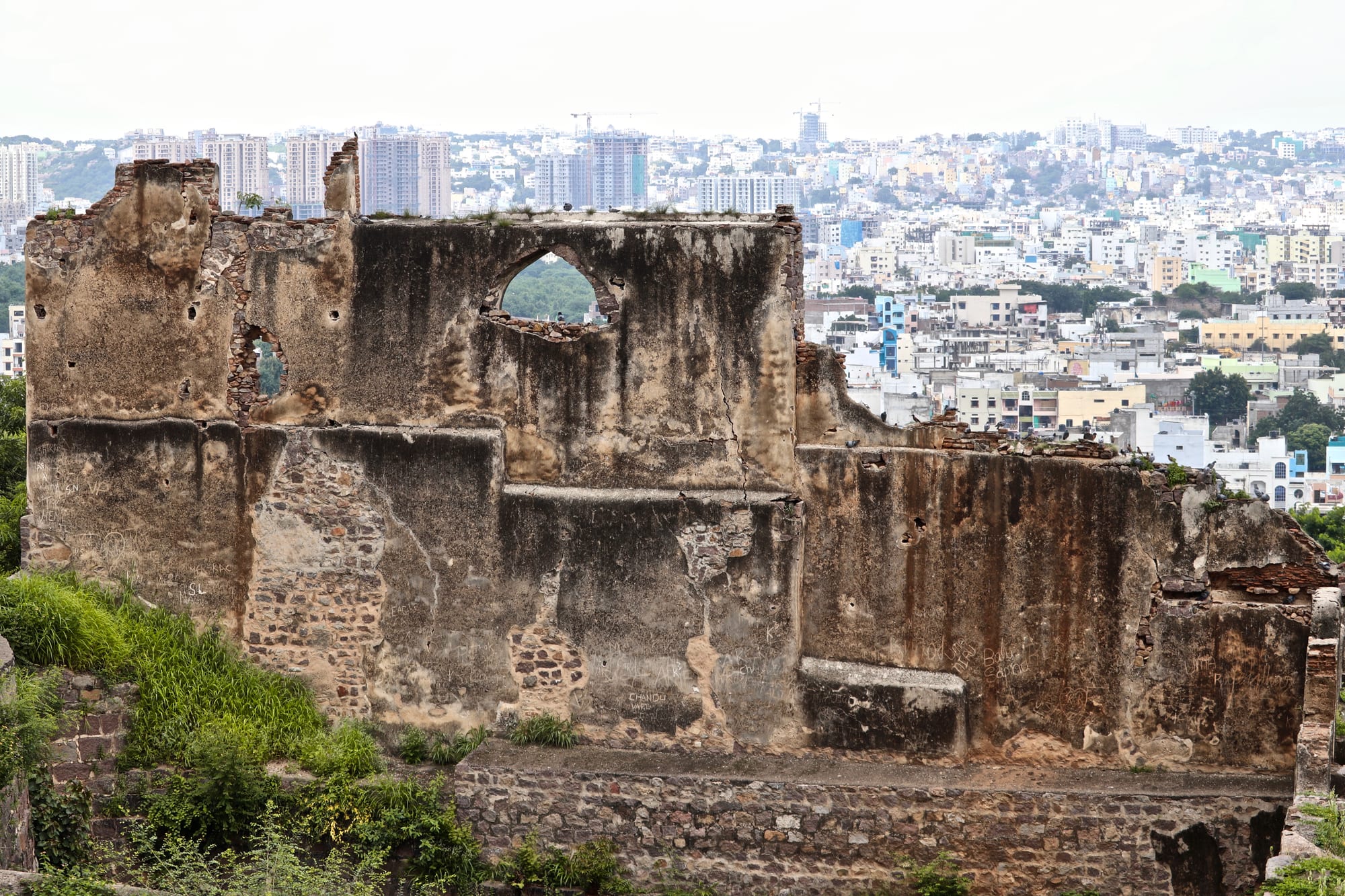
Ruined stone walls and an arched window on the Golconda hilltop, with the low white buildings and tower blocks of Hyderabad spreading out behind

The South, India

Hyderabad

The walls of Golconda Fort above the rooftops of western Hyderabad. (iMahesh / Wikimedia Commons · CC BY-SA 4.0)

The capital of Telangana, founded in 1591 on the Musi River by the Qutb Shahi sultans and later the seat of the Nizams, whose Urdu-speaking court culture still marks the city. The Charminar, Golconda Fort and the Qutb Shahi tombs stand a few kilometres from the glass campuses of HITEC City, and the kitchens in between are known across India for biryani and haleem.

Neighbourhoods

  • The Old City around Charminar
    • First-time visitors
    • Historic district
    • Best for food

    The walled Qutb Shahi core south of the Musi, laid out around the four-minaret Charminar. Bangle shops crowd Laad Bazaar, the Makkah Masjid and Chowmahalla Palace stand within a short walk, and the lanes fill with pearl traders, perfume sellers and biryani kitchens.

    Open in Maps
  • Banjara Hills and Jubilee Hills
    • Restaurants and nightlife
    • Shopping
    • Upmarket hotels

    Rocky ridges west of the centre that became the city's wealthiest districts, full of restaurants, boutiques, galleries and film-industry houses. Road No. 1 and Road No. 36 hold much of the eating out, and the wooded KBR park sits between the two.

    Open in Maps
  • HITEC City, Madhapur and Gachibowli
    • Business travellers
    • Modern hotels
    • Close to public transport

    The technology district in the west, built from the late 1990s around software and pharmaceutical campuses. Towers, malls and chain hotels line wide roads, the Shilparamam crafts village and Durgam Cheruvu lake give some relief, and the metro runs in from the centre.

    Open in Maps
  • Secunderabad
    • Rail travellers
    • Local life
    • Close to public transport

    The twin city north of Hussain Sagar, laid out as a British cantonment in the 19th century and still an army town in part. It has the main railway junction, a busy shopping stretch around Sarojini Devi Road and some of the city's best-known biryani houses.

    Open in Maps
  • Abids and Koti
    • Shopping
    • Museums
    • Central

    The commercial centre that grew up under the Nizams between the old city and Secunderabad, with the Moazzam Jahi Market, the Salar Jung Museum nearby on the river, jewellers, booksellers and a long Sunday second-hand book market on the pavements.

    Open in Maps
  • Begumpet and Somajiguda
    • Mid-range hotels
    • Central
    • Close to public transport

    A central belt beside the old airport, between Hussain Sagar and Banjara Hills, with hotels, offices and hospitals along the main road. It is convenient for the metro and for reaching both the old city and the western tech districts.

    Open in Maps

Things to do

Famous landmarks

  • Charminarlandmark

    The four-minaret, four-arched monument built in 1591 at the centre of the new city, with a mosque on its upper floor and the old bazaars radiating from its feet.

    Open in Maps
  • Golconda Fortlandmark

    A granite hill fortress that was the Qutb Shahi capital before Hyderabad was founded, known for its gates, ramparts and the acoustics of its entrance courtyard.

    Open in Maps
  • Qutb Shahi tombslandmark

    The domed granite and stucco tombs of the Qutb Shahi sultans, intricately carved and set in landscaped gardens below Golconda.

    Open in Maps
  • Chowmahalla Palacelandmark

    The Nizams' ceremonial palace near Charminar, four courtyards of Mughal and European halls, with a clock tower and a collection of vintage cars.

    Open in Maps
  • Makkah Masjidlandmark

    One of India's largest mosques, begun under the Qutb Shahis and completed in the Mughal period, standing just south-west of the Charminar.

    Open in Maps
  • Falaknuma Palacelandmark

    A palace completed in 1893 on a hill above the old city, built for a Paigah nobleman in European style and later used by the Nizams, now run as a luxury hotel.

    Open in Maps
  • Paigah Tombslandmark

    The burial ground of the Paigah nobles in the south-east of the city, celebrated for its carved stucco screens and inlaid marble.

    Open in Maps
  • Birla Mandirlandmark

    A white marble temple to Venkateswara on Naubat Pahad hill, finished in 1976, with wide views over Hussain Sagar and the city.

    Open in Maps

Museums and galleries

  • Salar Jung Museummuseum

    One of India's national museums, built around the private collection of Salar Jung III — Mughal weapons, jade, manuscripts and a much-visited musical clock.

    Open in Maps
  • Nizam's Museummuseum

    Gifts, robes and objects of the last Nizam, displayed in the Purani Haveli palace complex in the old city.

    Open in Maps
  • Shilparamamattraction

    A crafts village in Madhapur where artisans from around India sell weaving, metalwork and toys in an open-air setting.

    Open in Maps

Lakes and parks

  • Hussain Sagarpark

    The lake dug in the 1560s that separates Hyderabad from Secunderabad, with a tall stone Buddha statue on a rock at its centre and a promenade along Tank Bund.

    Open in Maps
  • Nehru Zoological Parkpark

    A large zoo laid out in open enclosures south of the Musi, opened to the public in 1963.

    Open in Maps
  • KBR National Parkpark

    A small protected patch of scrub forest and rock in Jubilee Hills, surrounding a former palace, with a walking circuit used by residents every morning.

    Open in Maps
  • Durgam Cheruvupark

    A rocky lake between Madhapur and Jubilee Hills, with a lakeside walk and a cable-stayed bridge that has become a landmark of the western city.

    Open in Maps

Markets and bazaars

  • Laad Bazaarmarket

    The lane running west from Charminar, lined with shops selling lacquered bangles set with stones, along with saris, perfume and wedding goods.

    Open in Maps
  • Moazzam Jahi Marketmarket

    A triangular granite market building of 1933–35 with a clock tower, long known for its fruit and flower trade and restored in recent years.

    Open in Maps
  • Begum Bazaarmarket

    The city's largest wholesale market, a dense grid of lanes selling spices, grain, utensils, hardware and festival goods.

    Open in Maps

Short trips from the city

  • Ramoji Film Cityattraction

    A very large film studio complex east of the city, working as a theme park with sets, gardens and shows alongside the shooting stages.

    Open in Maps
  • Osman Sagarpark

    A reservoir on the Musi west of the city, built after the 1908 flood, with a lakeside park and a Nizam-era guest house.

    Open in Maps
  • Bhongir Fortlandmark

    A fort on a single enormous granite dome about 50 kilometres east, climbed by steps for views over the Telangana plain.

    Open in Maps

Seasonal events

  • BonaluJuly to August

    A Telangana festival honouring the goddess Mahankali, when women carry decorated pots of cooked rice to temples in the old city and Secunderabad, with processions and drumming.

  • BathukammaSeptember or October

    Telangana's flower festival, in which women build conical stacks of seasonal blooms, sing around them and float them on lakes and tanks.

  • Ganesh ChaturthiAugust or September

    Ten days of neighbourhood pandals ending in processions to Hussain Sagar, where the images are immersed; the Khairatabad idol is known for its great height.

  • Ramadan and Eidvaries with the lunar calendar

    Through the fasting month the old city stays open late and hundreds of kitchens across Hyderabad cook haleem, the slow-pounded meat and wheat dish, for the evening meal.

  • NumaishJanuary to February

    The All India Industrial Exhibition, held annually since 1938 and on the Nampally grounds since 1946 — forty-six days of stalls, food and fairground rides that function as the city's winter fair.

Eat and drink

Long-standing places and food districts in Hyderabad. Hours, ratings and directions come from your maps app, always current.

Hyderabad classics

  • Hyderabadi biryanirestaurant

    The city's defining dish, rice and marinated meat cooked together sealed in a pot; the long-established biryani houses of Secunderabad and the old city are where most visitors first meet it.

    Open in Maps
  • Irani caféscafe

    Plain, high-ceilinged cafés opened by Iranian immigrants, serving milky Irani chai with Osmania biscuits and bun maska; several of the oldest are around Charminar, Nampally and Abids.

    Open in Maps

Food districts and markets

  • Charminar and Laad Bazaar lanesneighborhood

    The streets around the monument are the place for biryani, haleem in season, kebabs, naan and the sticky sweets qubani ka meetha and double ka meetha.

    Open in Maps
  • Barkasneighborhood

    A quarter settled by Arab families from Yemen who served the Nizams, known for mandi — meat cooked with rice over slow heat — and other Yemeni-influenced dishes.

    Open in Maps
  • Banjara Hills and Jubilee Hillsneighborhood

    Where the modern eating out is concentrated, from Andhra and Telangana thali houses to coastal seafood, north Indian grills and coffee bars.

    Open in Maps
  • Moazzam Jahi Marketmarket

    A 1930s market hall near Abids, long associated with the fruit and flower trade.

    Open in Maps

Experience Hyderabad

History

Hyderabad was founded in 1591 by Muhammad Quli Qutb Shah, the fifth sultan of the Qutb Shahi dynasty, on the south bank of the Musi River a few kilometres from the crowded hill fort of Golconda, whose water supply had failed to keep pace with its people. The new city was laid out on a grid around the Charminar, with the Makkah Masjid rising beside it, and grew rich on the diamond trade of the Golconda mines and on textiles shipped through the Coromandel ports. In 1687 the Mughal emperor Aurangzeb took Golconda after a long siege and ended the dynasty.

Mughal authority in the Deccan was delegated to a viceroy, and in 1724 Asaf Jah I made that office hereditary, founding the line of Nizams who ruled from Hyderabad for more than two centuries. Under British paramountcy after 1798 the state kept its own army, currency, railways and postal system, and the later Nizams built the palaces, the Osmania hospital, the High Court and the Osmania University that give the centre its Indo-Saracenic look. A catastrophic Musi flood in 1908 killed thousands and led to the reservoirs at Osman Sagar and Himayat Sagar and a replanned riverfront.

At independence the state did not accede to India, and in September 1948 it was taken over in a short military operation; the Nizam remained as titular head of state. Hyderabad became the capital of Andhra Pradesh in 1956. From the 1990s software and pharmaceutical firms transformed the western fringe into HITEC City, and after a long movement for a separate state, Telangana was created in 2014 with Hyderabad as its capital.

Culture & Customs

Hyderabad is often described as a meeting of two worlds, Deccani and Telugu, and the everyday result is a city where Urdu and Telugu are spoken side by side and a distinctive Hyderabadi Urdu, with its own idioms and humour, is heard in the old quarters. The courtly manners of the Nizams' era survive in styles of hospitality and in words for greeting and refusal; the tehzeeb, or civility, of the old city is a matter of local pride.

The Qutb Shahi and Asaf Jahi courts left a long tradition of poetry and music, and mushairas, evenings of Urdu verse, are still held. Crafts are closely identified with the city: lac bangles from Laad Bazaar, bidriware inlaid with silver on blackened alloy, Kalamkari cloth and the pearl trade that gave Hyderabad the nickname City of Pearls. The Telugu film industry, one of the largest in India, is based here and shapes the culture of the western suburbs; Ramoji Film City on the eastern edge is its best-known plant.

Festivals belong to several calendars. Bonalu and Bathukamma are Telangana's own, strongly associated with women's processions and with lakes and temples; Ganesh Chaturthi fills the streets in late summer; Ramadan turns the old city into an all-night food market; and Christmas and Diwali are both widely kept. Cricket is followed closely, with international matches at the Rajiv Gandhi Stadium in Uppal. Visitors are expected to remove shoes at places of worship, dress modestly in the old city and eat with the right hand.

Daily Life

About 6.9 million people lived in the city at the 2011 census and about 9.7 million in the wider metropolitan area, making it one of India's largest urban regions. Information technology and pharmaceuticals are the pillars of the economy — the western corridor from Madhapur to Gachibowli holds the campuses of many global software firms, while the city and its outskirts are a centre of generic drug and vaccine manufacture. Older trades persist beside them: pearls and bangles in the old city, wholesale goods in Begum Bazaar, and government employment as a state capital.

Where people live divides the city sharply. The old city south of the Musi is dense, largely Muslim and poorer; Banjara Hills, Jubilee Hills and the newer gated developments west of the Outer Ring Road are wealthy; Secunderabad, Begumpet and Uppal are middle-class and mixed. Long commutes, rising rents near the tech corridor and the spread of apartment towers into former villages are common complaints.

The day starts early, with temple bells and the call to prayer before dawn and office traffic building by eight. Irani cafés open at first light, offices in the west run on foreign hours, and evenings are for Tank Bund, malls, restaurants and family visits. The recurring civic issues are water — supply depends on distant reservoirs and the Krishna and Godavari rivers — along with flooding of built-over lake beds during heavy rain, air pollution and traffic.

Food

Hyderabadi biryani is the dish the city is known for everywhere: rice and marinated meat layered raw in a heavy pot, sealed with dough and cooked slowly in its own steam, the method called dum, and served with mirchi ka salan, a peanut and chilli sauce, and dahi ki chutney. Haleem, wheat and meat pounded for hours into a smooth paste and finished with fried onion and lime, is eaten above all through Ramadan, when kitchens across the city advertise it. Other Deccani dishes include pathar ka gosht, mutton cooked on a hot stone slab; marag, a light mutton soup; and khichdi with khatta, a sour tamarind curry, eaten at breakfast in the old city.

Sweets close a meal: double ka meetha, fried bread soaked in sweet milk with saffron and nuts, and qubani ka meetha, a compote of dried Turkish-style apricots served with cream. Bakeries sell Osmania biscuits, lightly salted and crumbly, made to be dipped in tea. Irani chai, brewed strong and cut with thickened milk, is the city's social drink, taken in the plain cafés that Irani immigrants opened from the nineteenth century, often with bun maska, a soft bread roll with butter.

Telugu food sits alongside the Deccani tradition and is equally common: rice with pappu lentils, hot Andhra and Telangana curries, gongura pickle made from sorrel leaves, and vegetarian meals served on a plate of many small bowls. Breakfast is usually idli, dosa or upma with chutney. The Arab quarter of Barkas serves mandi and shawarma, and the western suburbs have the range of national and international restaurants that the technology boom brought with it.

Planning tools

Budget

Hyderabad is inexpensive by the standards of Indian metropolitan cities. Food is the bargain: a plate of biryani or a thali costs very little, and Irani chai is cheaper still. Hotel prices are the main variable, with business rates in HITEC City and Banjara Hills far above the guesthouses of Abids and the old city. Metro fares, monument tickets and taxis are all modest.

Daily Budget Midrange
USD 55–120 (mid-range hotel, restaurant meals, monument fees, taxis or a car with driver)
Daily Budget Shoestring
USD 20–35 (guesthouse or hostel bed, street food and thali meals, metro and buses)

Rooms in the tech districts are often cheapest at weekends, when business travellers have gone; many of the best things to eat cost less than a bus fare elsewhere.

Best Time to Visit

November to February, when days are warm and dry and evenings pleasant, and the Numaish fair runs at Nampally. October brings Bathukamma and clearing skies after the monsoon. April and May are severe, passing 40°C for long spells, and June to September is humid with heavy bursts of rain that flood low-lying roads.

Suggested Number of Days

Two to three days covers the old city, Golconda and the main museums at a reasonable pace. Four or five allow for the western districts, the lakes and a trip out of town. Traffic and the sheer distance between the old and new cities are what stretch the number.

First Visit
2–3 days
With Surroundings
4–5 days

Transportation

The Hyderabad Metro runs on three lines through the centre, linking Miyapur and HITEC City in the west with Secunderabad, Nagole and the Nampally area, though it does not reach the Charminar quarter. Ride-hailing apps and metered autorickshaws are the usual way to fill the gaps, city buses are cheap and numerous, and the MMTS suburban trains connect Secunderabad, Begumpet and Lingampally.

Distances are long and traffic is heavy in the morning and evening peaks; combining a metro ride with a short autorickshaw hop is usually faster than one taxi across the city.

Airport & Station Connections

Rajiv Gandhi International Airport at Shamshabad, about 25 kilometres south of the centre, is one of India's busier airports, with domestic flights across the country and international services to the Gulf and South-East Asia; an airport expressway and coaches connect it to the city. Secunderabad Junction, Hyderabad Deccan at Nampally and Kacheguda are the main railway stations, with trains to Mumbai, Bengaluru, Chennai and Delhi, and long-distance buses use the Mahatma Gandhi terminal.

Walkability

The old city around Charminar is best seen on foot, as the lanes are too narrow and crowded for anything else, though pavements are irregular and the traffic constant. Elsewhere Hyderabad is spread over hills and wide roads and is not a walking city: Tank Bund beside Hussain Sagar, the KBR park circuit and the Durgam Cheruvu lakeside are the pleasant exceptions. Heat and dust make midday walks hard from March to June.

Safety

Hyderabad is generally a calm city for visitors, with low levels of violent crime. The everyday risks are road traffic, pickpocketing and bag snatching in crowded bazaars, overcharging by drivers and touts around the main monuments, and heat in the hot season. Monsoon downpours can flood underpasses and low streets within an hour.

Agree a fare or use an app before an autorickshaw ride, keep valuables close in the old city crowds, drink bottled or filtered water, and dress modestly at mosques and temples. Check current official travel advice before travelling.

Climate

A hot semi-arid climate on the Deccan plateau, at about 500 metres, which keeps nights cooler than on the coast. The year divides into a hot season from March to June, a monsoon from June to September and a dry, mild winter from November to February.

Summer
hot and dry before the rains — April and May often reach 38–42°C, easing to humid days near 30°C once the monsoon arrives
Winter
mild and dry, with days around 27–30°C and nights that can fall to 13–15°C in December and January

Local Customs

Hyderabad's culture mixes Telugu and Urdu-speaking traditions, and both languages are heard constantly, with English common in the tech districts. Shoes come off at mosques, temples and many homes, and modest dress that covers shoulders and knees is expected at religious sites; women should carry a scarf for mosques. Eating and giving are done with the right hand. Tipping is not obligatory but small amounts are welcome, and rounding up a restaurant bill is normal.

Ask before photographing people, particularly women and worshippers at prayer; alcohol is sold in licensed bars, hotels and shops but is out of place in the old city's traditional quarters.

Common Payment Methods

The currency is the Indian rupee. Cards are accepted in hotels, malls and larger restaurants, and QR-code payment by phone is used almost everywhere by residents, including street stalls. Visitors without an Indian bank account should carry cash in small notes for autorickshaws, bazaars and small kitchens. ATMs are plentiful across the city.