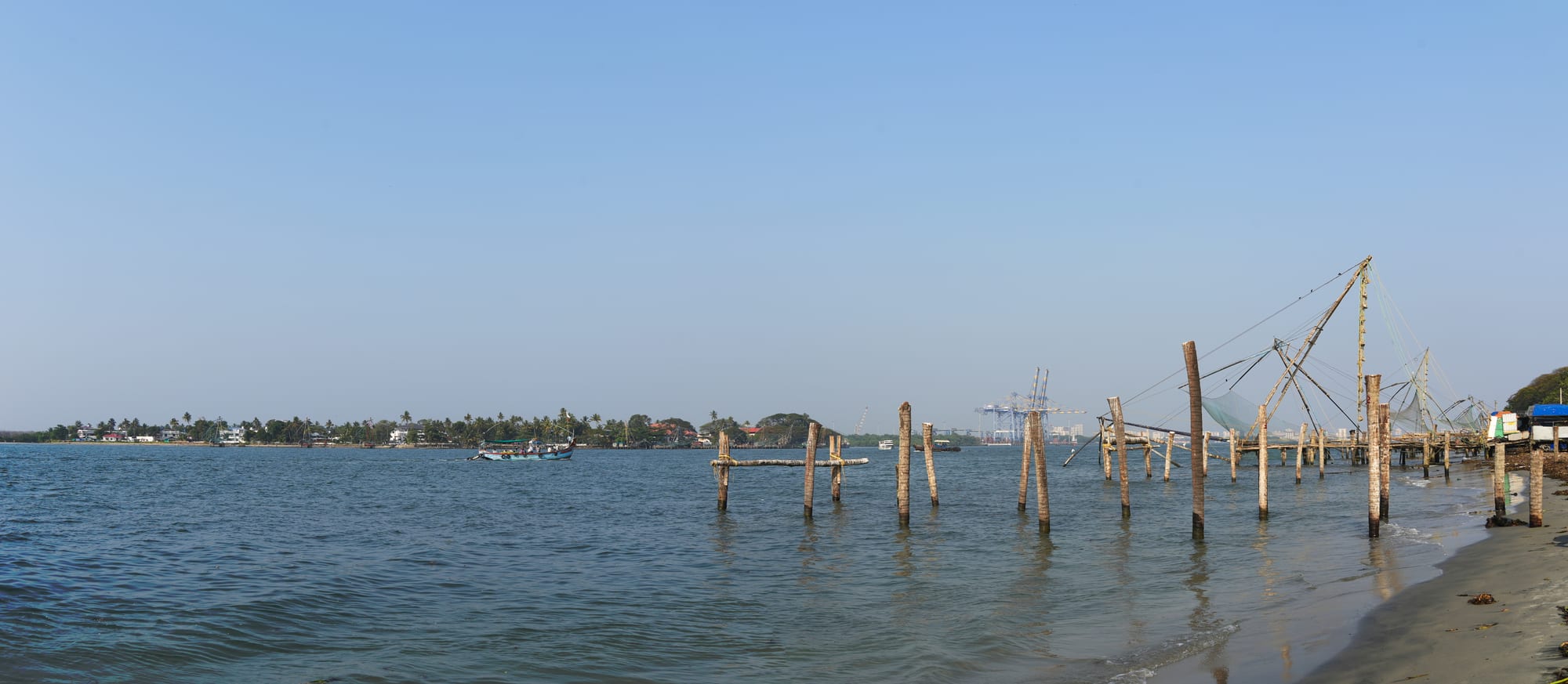
Cantilevered wooden fishing nets and weathered posts standing in calm harbour water, with a palm-fringed shore and port cranes in the distance

The South, India

Kochi

Shore-operated Chinese fishing nets on the harbour front at Fort Kochi. (Ingo Mehling / Wikimedia Commons · CC BY-SA 4.0)

Kerala's port city, spread over a peninsula, several islands and the mainland district of Ernakulam around a natural harbour on the Arabian Sea. Trade in pepper and spices drew Arab, Chinese, Jewish, Portuguese, Dutch and British merchants, leaving Fort Kochi and Mattancherry with churches, a synagogue, godowns and shore-operated fishing nets, while Ernakulam is the commercial centre.

Neighbourhoods

  • Fort Kochi
    • First-time visitors
    • Historic district
    • Walks

    The old European quarter on the tip of the peninsula, with colonial-era houses, churches, art spaces and homestays along quiet streets. The fishing nets, the beach and the ferry jetty are all within a short walk, and it is the part of the city most visitors stay in.

    Open in Maps
  • Mattancherry
    • Historic district
    • Markets
    • Crafts and shopping

    A working quarter south of Fort Kochi, with the old spice godowns and warehouses of Bazaar Road, the Dutch Palace and the lanes of Jew Town, now full of antique and craft shops. The smell of ginger, pepper and cardamom is still noticeable near the trading houses.

    Open in Maps
  • Ernakulam
    • Shopping
    • Best for food
    • Close to public transport

    The mainland city across the harbour, where most residents live and work. Marine Drive's waterfront promenade, the main shopping streets, the railway stations and the metro are here, and the boat jetty connects to the islands and Fort Kochi.

    Open in Maps
  • Willingdon Island
    • Close to public transport
    • Quiet and residential

    The largest artificial island in India, made from harbour dredgings in the 1930s, holding port installations, naval establishments, a railway terminus and a few large hotels. It is functional rather than scenic, but central to the harbour's geography.

    Open in Maps
  • Vypin
    • Beaches
    • Local life

    The long island north of the harbour mouth, reached by ferry and bridges, with fishing villages, backwater channels and, further up the coast, the wide sands of Cherai. It is residential and rural in feel despite being minutes from the city.

    Open in Maps
  • Kakkanad
    • Business travellers
    • Modern hotels

    The eastern suburb built around technology parks and offices, with newer housing, malls and business hotels. It is far from the historic quarters but close to the road out to the airport.

    Open in Maps

Things to do

Fort Kochi and Mattancherry

  • Chinese fishing netslandmark

    Cantilevered shore-operated nets on the harbour front, worked by teams of fishermen using counterweights, long a symbol of the city.

    Open in Maps
  • St Francis Churchlandmark

    One of the oldest European churches in India, built by the Portuguese in the early 16th century; Vasco da Gama was buried here before his remains were taken to Lisbon.

    Open in Maps
  • Santa Cruz Cathedral Basilicalandmark

    A Catholic cathedral near the waterfront, the present building commissioned in 1887, consecrated in 1905 and raised to a basilica in 1984, with a painted interior and Indo-European Gothic arches.

    Open in Maps
  • Mattancherry Palacemuseum

    The Dutch Palace, built by the Portuguese for the Raja of Kochi and renovated by the Dutch, known for its murals of scenes from the Ramayana.

    Open in Maps
  • Paradesi Synagoguelandmark

    Built in 1568 beside the Dutch Palace, the synagogue of the Paradesi Jewish community, with hand-painted Chinese floor tiles and glass lamps.

    Open in Maps
  • Indo-Portuguese Museummuseum

    A collection of altarpieces, vestments, silver and carved wood from the Catholic churches of the region, in Fort Kochi.

    Open in Maps
  • Fort Kochi Beachbeach

    A narrow strip of sand beside the fishing nets where ships pass close to shore, busy with walkers and snack carts in the evening.

    Open in Maps

Museums and performance

  • Hill Palace, Tripunithuramuseum

    The former palace of the Kochi royal family east of the city, now a museum of the dynasty's collections, set in gardens and a deer park.

    Open in Maps
  • Kathakali and Kalaripayattu performancesattraction

    Small theatres in Fort Kochi stage shortened Kathakali dance-dramas, with the elaborate make-up applied in front of the audience, and demonstrations of the martial art Kalaripayattu.

    Open in Maps

Water, parks and views

  • Marine Driveattraction

    A waterfront promenade in Ernakulam, officially APJ Abdul Kalam Marg, looking across the backwaters to the islands, with three walkway bridges and boat jetties.

    Open in Maps
  • Bolgatty Palacelandmark

    A palace built by the Dutch on Bolgatty Island in the harbour, said to be among the oldest Dutch palaces outside the Netherlands, later a British residency and a heritage hotel since 1976.

    Open in Maps
  • Mangalavanam Bird Sanctuarypark

    A small patch of mangrove and tidal lagoon in the middle of Ernakulam, a nesting site for egrets, herons and migratory birds.

    Open in Maps
  • Cherai Beachbeach

    A long sandy beach on Vypin island north of the city, with backwaters immediately behind it and calm water for much of the dry season.

    Open in Maps

Short trips from the city

  • Kodungallurattraction

    A town north of Kochi close to the site usually identified with the ancient port of Muziris, with temples, a mosque of great antiquity and heritage museums nearby.

    Open in Maps
  • Alappuzhaattraction

    A canal town about 55 km south, the starting point for houseboat and ferry trips through the backwaters of Vembanad Lake.

    Open in Maps
  • Athirappilly Fallsattraction

    A broad waterfall on the Chalakudy river about 70 km north-east, at its fullest during and after the monsoon.

    Open in Maps

Seasonal events

  • Kochi-Muziris BiennaleDecember to April

    India's largest art exhibition, first held in 2012 and staged roughly every two years in warehouses, godowns and heritage buildings across Fort Kochi and Mattancherry.

  • Cochin Carnivallate December to 1 January

    Ten days of processions, races, music and street events in Fort Kochi through late December, ending with a procession led by caparisoned elephants on New Year's Day.

  • OnamAugust or September

    Kerala's harvest festival, marked with flower carpets, the sadya feast on a banana leaf, and boat races and cultural programmes across the city.

  • Ernakulathappan UtsavamJanuary or February

    The week-long temple festival of the Shiva temple in central Ernakulam, with caparisoned elephants, drum ensembles and a procession that closes the main roads.

Eat and drink

Long-standing places and food districts in Kochi. Hours, ratings and directions come from your maps app, always current.

Kochi classics

  • Fish and seafood by the harbourrestaurant

    Kochi's staple is the day's catch — karimeen, seer fish, prawns, mussels and squid — grilled, fried in a chilli and turmeric coating, or cooked in a coconut and kudampuli curry.

    Open in Maps
  • Appam and stew housesrestaurant

    Breakfast places serve appam, lacy fermented rice pancakes, with coconut milk stew, puttu with black chickpea curry, and idiyappam string hoppers.

    Open in Maps
  • Toddy shopsrestaurant

    Plain roadside taverns outside the city sell fermented palm sap with fiery accompaniments such as fish curry, duck roast and tapioca, an old Kerala institution.

    Open in Maps

Markets and food districts

  • Jew Town and Bazaar Roadmarket

    The old spice trading street of Mattancherry, where warehouses still handle pepper, ginger and cardamom among antique and craft shops and small cafés.

    Open in Maps
  • Broadway marketmarket

    Ernakulam's crowded shopping street of spice sellers, dried fish, fruit stalls and cheap eating houses, the mainland's everyday market.

    Open in Maps
  • Fort Kochi caféscafe

    Old houses and godowns around Princess Street and Bastion Street hold cafés and bakeries serving coffee, tea and Kerala snacks, many attached to art spaces.

    Open in Maps

Experience Kochi

History

Kochi's harbour was created by a catastrophe: a great flood of the Periyar river in 1341 is traditionally said to have silted up the old port of Muziris to the north and opened the lagoon mouth here. A branch of the Chera line, the rajas of Kochi, established themselves nearby, and the port drew Arab, Chinese and Jewish traders to a coast that had sold pepper to the Mediterranean world since Roman times. Jewish communities had settled in the region far earlier, and Syrian Christians traced their church to the mission of St Thomas.

The Portuguese arrived in 1500 under Pedro Álvares Cabral, and Afonso de Albuquerque built Fort Manuel in 1503, the first European fort in India; Vasco da Gama died in Kochi in 1524 and was buried in St Francis Church. The Dutch took the town from the Portuguese in 1663, destroyed many of its Catholic institutions, remodelled the palace at Mattancherry and traded spices for more than a century. The British took control in 1795, and Kochi became a princely state under their paramountcy. In 1936 the engineer Robert Bristow completed a deep-water harbour, dredging the channel and building Willingdon Island from the spoil.

The princely states of Kochi and Travancore merged in 1949, and Kerala was formed in 1956. The modern city was constituted in 1967 by combining Fort Kochi, Mattancherry and Ernakulam with the islands. Since then it has become Kerala's commercial capital, with the container terminal at Vallarpadam, an oil refinery at Ambalamugal, technology parks in the east, a metro opened in 2017, and, since 2012, the Kochi-Muziris Biennale, which turned the old godowns into galleries.

Culture & Customs

Few Indian cities wear their mixed inheritance so plainly. Within a short walk of each other stand a 16th-century synagogue, Portuguese and Dutch churches, Hindu temples and mosques, and the communities behind them — Syrian Christians, Latin Catholics, Muslims of long-established trading families, Konkani and Gujarati merchants, and the small remnant of the Cochin Jewish community, most of whom emigrated to Israel after 1948 — have shaped the city's manners, architecture and food.

The performing arts are taken seriously. Kathakali, the dance-drama in which stories from the epics are told through codified gesture and expression under heavy green and red make-up, is staged in shortened evening performances for visitors, and in full overnight form at temple festivals; Mohiniyattam, Koodiyattam and the martial art Kalaripayattu are all practised in the region. Temple festivals bring drum ensembles and caparisoned elephants onto the streets, and Christian feasts bring processions and fireworks.

Kerala's wider social character is visible in Kochi: very high literacy, strong trade unions, vigorous newspaper reading and political argument, and a long history of migration to the Gulf that sustains many families. The Biennale has added a contemporary art scene, with studios, galleries and cafés in old Mattancherry warehouses, while the fishing crews still work the shore nets a few hundred metres away.

Daily Life

About 680,000 people live within the corporation limits and more than two million in the wider urban area, which spreads along the mainland and the islands. The economy rests on the port and shipbuilding, oil refining and chemicals, tourism, information technology at Kakkanad and Infopark, health care, and the trade in spices, seafood, rubber and coir that has always passed through the harbour. Remittances from Keralites working in the Gulf remain a major source of income.

Geography dictates the rhythm. Commuters cross the water by ferry, bridge and now the water metro; the metro and the arterial roads fill twice a day; and fishing boats come in early to the harbour and the jetties on Vypin. Most residents live on the mainland, in Ernakulam and the suburbs spreading east, while Fort Kochi has become quieter and more expensive as houses turn into homestays and galleries.

The recurring problems are familiar for a coastal Indian city: flooding in heavy monsoons, most severely in the Kerala floods of 2018; waste disposal, after a fire at the Brahmapuram dump filled the city with smoke in 2023; coastal erosion and pressure on the backwaters; and traffic on a street plan constrained by water. Against that, the city has invested heavily in public transport and waterfront redevelopment.

Food

Kochi eats fish. The everyday meal is rice with meen curry, in which the catch is simmered with chilli, turmeric, curry leaves and coconut and soured with kudampuli, the smoked rind of a local fruit; karimeen pollichathu, pearl-spot fish rubbed with masala and baked in a banana leaf, is the celebrated backwater dish. Prawns, mussels, squid and seer fish are fried in a red coating, and alongside the fishing nets at Fort Kochi stalls will cook a fish bought on the spot.

Breakfast is distinctive: appam, a lacy fermented rice pancake with a soft centre, eaten with coconut milk stew; puttu, steamed cylinders of ground rice and coconut, with black chickpea curry or banana; idiyappam string hoppers; and Kerala parotta, a layered flatbread, usually with beef or chicken curry later in the day. Onam brings the sadya, a vegetarian feast of many dishes served on a banana leaf, ending with payasam.

The city's communities add their own dishes — Syrian Christian duck roast and meen molee, Mappila biryani and pathiri flatbreads from Malabar, Jewish and Konkani traditions in Mattancherry — and the old spice trade is still visible in the sacks of pepper, cardamom, cloves and ginger on Bazaar Road. Toddy shops outside the city serve fermented palm sap with tapioca and fiery curries, tea shops sell strong milky chai with banana fritters, and filter coffee, tender coconut water and sambharam, spiced buttermilk, are the usual drinks.

Planning tools

Budget

Kochi is moderate by Indian standards and cheaper than Bengaluru or Mumbai. Homestays in Fort Kochi and mid-range hotels in Ernakulam are good value, and eating well costs little outside the tourist restaurants. Prices rise over Christmas and New Year and during the Biennale. Ferries and the metro are very cheap; taxis and a backwater houseboat are the main extras.

Daily Budget Midrange
USD 45–110 (heritage homestay or hotel, restaurant meals, a car with driver for a day, performance tickets and museum fees)
Daily Budget Shoestring
USD 15–30 (homestay or hostel bed, meals at local restaurants, ferries, buses and the metro)

The public ferries between Fort Kochi, Vypin and Ernakulam cost a few rupees and give the same harbour views as a tour boat.

Best Time to Visit

October to March, when the rain eases and the humidity is bearable; December and January are the driest and busiest months, with the Carnival and, in alternate years, the Biennale. April and May are hot and very humid. The southwest monsoon from June to September brings heavy rain, low prices and a green, washed-out city, and is also the season for Ayurvedic treatment courses.

Suggested Number of Days

Two or three days are enough for the historic quarters and the harbour. Four to six allow the backwaters, the beaches north of the city and the hills inland. Ferry timings and traffic across the bridges shape how much fits into a day.

First Visit
2–3 days
With Surroundings
4–6 days

Transportation

Public ferries link Fort Kochi, Ernakulam, Willingdon Island and Vypin and remain the quickest way across the harbour, alongside a network of battery-electric water metro boats, the first such system in India, which began running in 2023. An elevated metro line runs from Aluva through Ernakulam to Tripunithura, and buses, autorickshaws and app-based taxis cover the rest. Fort Kochi and Mattancherry are small enough to walk or cycle.

Crossing between Ernakulam and Fort Kochi by road means a long detour over the bridges, so the ferry is usually faster.

Airport & Station Connections

Cochin International Airport at Nedumbassery lies about 25 km north-east of the city centre and is the busiest airport in Kerala, with flights across India and to the Gulf, South-East Asia and beyond. Ernakulam Junction and Ernakulam Town stations are on the main west-coast railway, with trains to Thiruvananthapuram, Bengaluru, Chennai and Mumbai. Long-distance buses run from the Vyttila hub, which also brings together the metro and the ferries.

Walkability

Fort Kochi and Mattancherry are flat, compact and pleasant on foot, with shaded streets and a waterfront path, and the two are linked by a walk of a couple of kilometres along Bazaar Road. Ernakulam is denser and busier, with traffic and uneven pavements, though Marine Drive gives a long traffic-free promenade. Heat and humidity make midday walking hard all year.

Safety

Kochi is a calm city with low levels of violent crime and a strong tradition of public order. The usual risks are traffic, petty theft in crowded markets and on ferries, strong currents and sudden drop-offs at Cherai and other open beaches, and monsoon flooding of low-lying roads. Mosquitoes are present year-round, and dengue occurs after the rains.

Swim only where others do and in calm water, use repellent in the evenings, and take care on wet, uneven pavements during the monsoon. Check current official travel advice before travelling.

Climate

Tropical and humid, warm all year with little variation in temperature. Rain is the variable: the southwest monsoon brings very heavy falls from June to September, with a second, lighter spell from the northeast monsoon in October and November. Sea breezes make evenings on the water cooler than the interior.

Summer
hot and very humid — March to May are the warmest, with days near 31°C and little relief at night
Winter
warm and drier — days around 30°C with nights near 23°C, and long clear spells from December to February

Local Customs

Malayalam is the language, with English very widely understood. Kerala is used to visitors and comparatively relaxed, but modest dress is expected at temples, churches and mosques, and shoes are removed at temple entrances; some Hindu temples admit only Hindus. Alcohol is sold through licensed outlets, bars and toddy shops, and rules on where it may be served are strict.

Ask before photographing fishermen working the nets or rituals in temples, remove shoes where others do, and dress modestly away from the beach.

Common Payment Methods

The currency is the Indian rupee. Cards are accepted in hotels, malls and larger restaurants, and residents pay by QR code on their phones, a system foreign accounts usually cannot use. Cash is needed for ferries, autorickshaws, markets and small eating houses, and ATMs are common in Ernakulam and Fort Kochi.