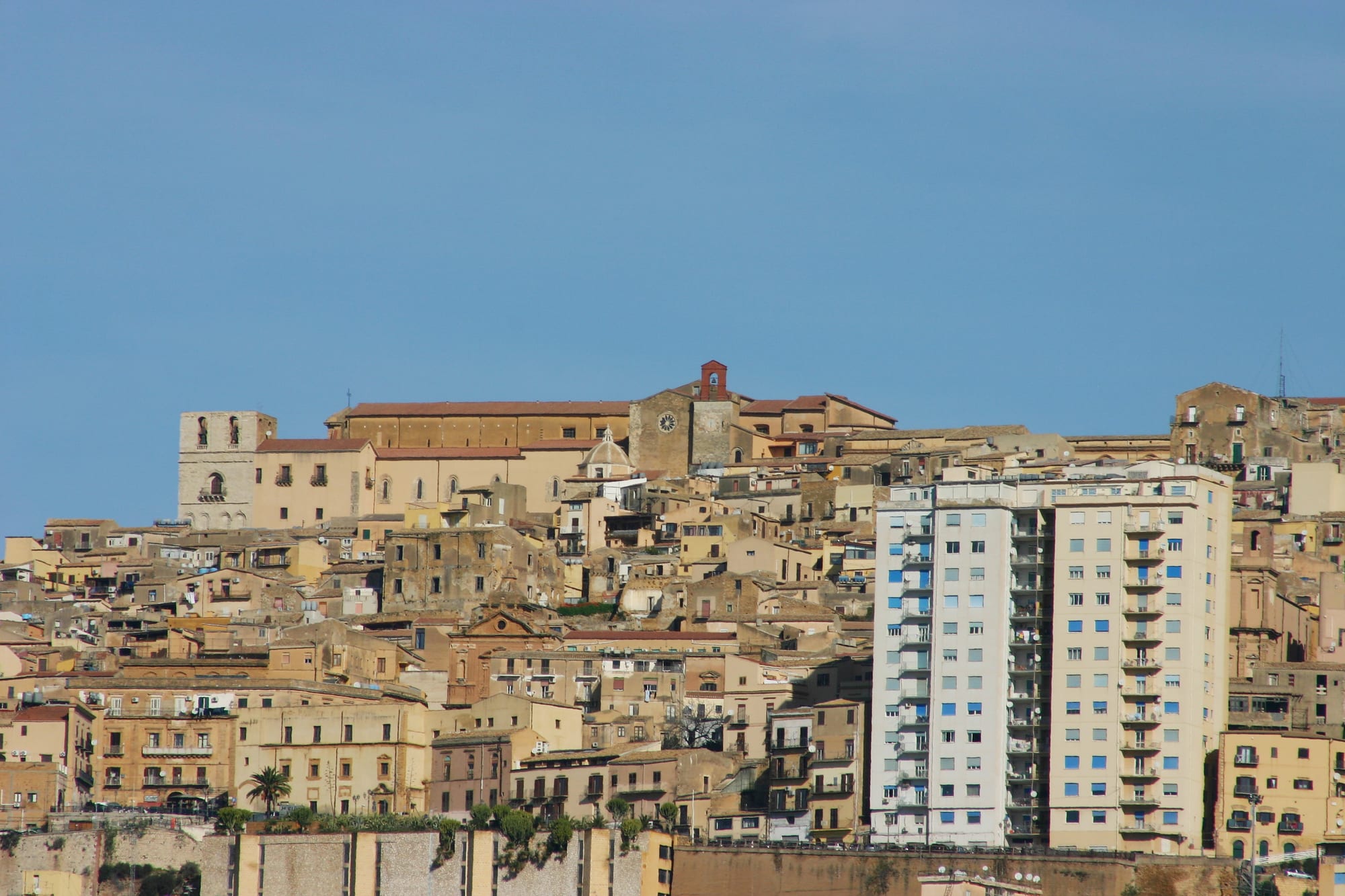
Honey-coloured old houses climbing a hill to the cathedral and its bell tower, beside a white modern apartment block

Sicily, Italy

Agrigento

The historic centre of Agrigento, crowned by the cathedral, seen from the Valley of the Temples. (José Luiz / Wikimedia Commons · CC BY-SA 4.0)

A hill city on Sicily's southern coast, founded by Greek colonists around 582 BC as Akragas, one of the leading cities of the Greek world. Below its medieval old town, the Valley of the Temples holds a line of Doric temples on a ridge facing the sea, a UNESCO World Heritage Site. Today it is a provincial capital of about 55,000 people that lives largely from tourism and farming.

Neighbourhoods

  • Historic centre (Girgenti)
    • First-time visitors
    • Historic district
    • Close to public transport

    The medieval town on the hilltop, officially given back its Sicilian name, Girgenti, in 2016. Narrow lanes and stairways climb from Via Atenea, the main pedestrian street, to the cathedral, and the central railway station and bus terminal are at its edge.

    Open in Maps
  • Valley of the Temples
    • Archaeology
    • Walks

    The archaeological park below the town, covering the site of ancient Akragas. Few people live here; it is a landscape of temples, olive and almond trees and old farm land, with the regional archaeological museum on the road between it and the centre.

    Open in Maps
  • San Leone
    • Beaches
    • Nightlife
    • Summer stays

    The seaside district south of the city at the mouth of the Akragas river, which has grown since the 1960s into a sprawl of holiday homes joined to Villaggio Mosè and Cannatello. It has a long beach, a marina for pleasure boats and the city's summer bars and beach clubs.

    Open in Maps

Things to do

The Valley of the Temples

  • Valley of the Templeslandmark

    A sacred area on the south side of the ancient city where seven monumental Doric temples were built in the 6th and 5th centuries BC; its 1,300-hectare park is described as the largest archaeological park in Europe.

    Open in Maps
  • Temple of Concordialandmark

    The largest and best-preserved Doric temple in Sicily, kept almost intact because it was turned into a Christian church in 597 AD.

    Open in Maps
  • Temple of Olympian Zeuslandmark

    The largest Doric temple ever built, begun in the 5th century BC but never finished, and now lies in ruins.

    Open in Maps
  • Temple of Heracleslandmark

    An archaic Doric temple about a kilometre west of the Temple of Concordia, with nine columns re-erected on its south-eastern side.

    Open in Maps
  • Garden of the Kolymbethrapark

    A small valley in the heart of the archaeological park where the ancient city built a great reservoir, now a garden of natural and landscape interest entrusted to the Italian heritage trust FAI since 1999.

    Open in Maps
  • Hellenistic-Roman Quarterattraction

    The excavated remains of a residential district of the ancient city, with paved streets, cisterns and houses that keep their mosaics.

    Open in Maps
  • Regional Archaeological Museummuseum

    The museum halfway between the town and the temples, with finds from ancient Akragas and a reconstructed telamon, one of the giant stone figures from the Temple of Olympian Zeus.

    Open in Maps

The old town

  • Agrigento Cathedrallandmark

    The cathedral of San Gerlando at the top of the old town, founded in the 11th century and consecrated in 1099, with wide views over the valley.

    Open in Maps
  • Santa Maria dei Grecilandmark

    A church built around 1200 on the remains of a Doric temple, once a cathedral of the Byzantine rite, with a Gothic portal.

    Open in Maps
  • Monastery of Santo Spiritolandmark

    A Cistercian convent founded in 1299, with stucco work and a cloister, known for the almond pastries made by its nuns.

    Open in Maps
  • Via Ateneaneighborhood

    The main street of the old town, entered through the Porta di Ponte and lined with palazzi, shops and cafés, where the evening passeggiata takes place.

    Open in Maps
  • Biblioteca Lucchesianaattraction

    A church library founded in 1765 beside the cathedral, with a wood-panelled reading room and a collection of manuscripts and early printed books.

    Open in Maps
  • Villa Bonfigliopark

    The municipal gardens along Viale della Vittoria, with shady paths under pines and views towards the sea.

    Open in Maps

The coast and short trips

  • San Leone beachbeach

    The city's own stretch of sandy coast south of the temples, the place where Agrigento goes to swim in summer.

    Open in Maps
  • Pirandello's birthplacemuseum

    The country house at Caos, west of the city, where the Nobel Prize-winning playwright Luigi Pirandello was born in 1867, now a small museum; his ashes were later laid in its garden.

    Open in Maps
  • Porto Empedocleattraction

    The harbour town just south-west of Agrigento, named after the philosopher Empedocles, from which the area's sulphur was shipped and where ferries leave for Lampedusa and Linosa.

    Open in Maps
  • Scala dei Turchiviewpoint

    A brilliant white marl cliff shaped like a staircase between two sandy beaches at Realmonte, made famous by the Inspector Montalbano novels; access has at times been restricted to protect it.

    Open in Maps
  • Heraclea Minoalandmark

    The ruins of a Greek city at the mouth of the Platani river, founded in the mid-6th century BC as an outpost of Selinus and long contested with Akragas.

    Open in Maps

Seasonal events

  • Almond Blossom Festival (Mandorlo in Fiore)late February or early March

    A week-long folk festival welcoming spring as the almond trees flower, with a torch of friendship lit before the Temple of Concordia and a closing parade of folk groups, Sicilian carts and bands from the town down to the Valley.

  • Christmas crib exhibitionChristmas season

    A show of more than a hundred hand-made nativity scenes set up each Christmas in the Villaseta district.

Eat and drink

Long-standing places and food districts in Agrigento. Hours, ratings and directions come from your maps app, always current.

Agrigento classics

  • Almond pastries of Santo Spiritomarket

    The nuns of the old Cistercian convent in the upper town still make traditional almond pastries, a reminder of the almond groves that cover the hills inland.

    Open in Maps
  • Via Atenea cafésneighborhood

    The old town's main street and its side lanes hold historic cafés, gelaterie and trattorias, busy with espresso and granita by day and the aperitivo in the early evening.

    Open in Maps

Cafés and bars

  • Viale della Vittorianeighborhood

    The broad avenue along the southern edge of the centre, with terrace cafés and wine bars facing the valley and the sea.

    Open in Maps
  • San Leone seafrontneighborhood

    Beach clubs and cocktail bars by the sea, where the city's nightlife moves in summer.

    Open in Maps

Experience Agrigento

History

Akragas was founded around 582–580 BC by Greek colonists from Gela, joined by settlers from Crete and Rhodes, on a plateau above the sea between the rivers Hypsas and Acragas. It was the last of the major Greek colonies in Sicily. Its early ruler Phalaris was remembered as the archetypal tyrant, said to have roasted his enemies inside a bronze bull. Under Theron, who seized power around 488 BC, the city helped defeat Carthage at the Battle of Himera in 480 BC and began the great building works of the Valley of the Temples, including the vast Temple of Olympian Zeus. Its wealth became proverbial: Plato is said to have remarked that its people built as if they would live for ever yet feasted as if there were no tomorrow.

Carthage sacked Akragas in 406 BC. The city revived, was fought over in the Punic Wars, and in 210 BC was captured by Rome and renamed Agrigentum; it prospered again on its port, sulphur and farming. After Rome fell, its people abandoned the lower city for the hilltop. Arabs took it in 828, the Normans renamed it Girgenti, and Count Roger I founded a Latin bishopric in 1087.

Girgenti declined through the Middle Ages and revived after the 18th century. Sulphur and potash were mined locally until the 1970s and shipped from Porto Empedocle. In 1927 the Fascist government imposed the Italianised name Agrigento, still controversial, and the city was heavily bombed in the Second World War. A landslide in 1966 destroyed the Addolorata quarter. The temples became a UNESCO World Heritage Site in 1997, the old centre took back the name Girgenti in 2016, and Agrigento was Italy's Capital of Culture in 2025.

Culture & Customs

Agrigento's identity is bound up with its two most famous sons. The philosopher Empedocles was a citizen of ancient Akragas, and the harbour town of Porto Empedocle is named after him. Luigi Pirandello, the playwright who won the Nobel Prize in Literature in 1934, was born in 1867 at Caos, in the countryside west of the city, and his birthplace is now a museum. It was the suggestion of the writer Andrea Camilleri, of Agrigentine origin, that led to the old town being renamed Girgenti in 2016.

The great event of the year is the Almond Blossom Festival, held as the almond trees flower at the turn of February and March. Folk groups come from many places; the festival opens with a sunset visit to the temples and the lighting of a torch of friendship before the Temple of Concordia, and closes with a parade of painted Sicilian carts and bands from the town down to the valley, while prizes go to the best-decorated balcony on Via Atenea. At Christmas the Villaseta district shows more than a hundred hand-made nativity scenes.

Daily social life centres on Via Atenea, called the city's drawing room, where the evening passeggiata brings families out to stroll and stop for coffee or an aperitivo. Sport means football with ASD Akragas, which takes the ancient name, and professional basketball with Fortitudo Agrigento.

Daily Life

About 55,000 people lived in Agrigento in 2025, making it the largest town in its province and the tenth largest in Sicily. Around 7 per cent were born abroad, the largest groups coming from Morocco, Senegal, Romania, Germany and Tunisia.

The economy rests on tourism, drawn by the archaeological sites, and on farming in the surrounding countryside. Unemployment is high — almost twice the national average in 2010. The mining that once sustained the area ended in the 1970s.

Because the archaeological park fills the ground between the hilltop and the sea, much of the population lives in outlying districts or along the coast. Villaseta grew in the 19th century around silk mills between the city and the port; Monserrato was built after the 1966 landslide to house families from the old Rabato quarter; and to the south San Leone, Villaggio Mosè and Cannatello have merged into a long coastal suburb that fills with holidaymakers in summer. In 2019 the district of Favara Ovest passed to neighbouring Favara after a referendum. Public transport changed hands in August 2026, when a new operator, TAG – Trasporti Agrigento, took over the city buses. Life slows at midday, especially in the heat of summer, and the streets fill again in the evening.

Food

Agrigento eats in the Sicilian way, and its cooking reflects the island's layers of history. The Greek colonists left a preference for fish, wheat, olives, grapes, almonds, pistachios and fresh vegetables, and dishes based on aubergine and olive oil are a feature of the local table. The Arabs brought sugar, citrus, rice and spices such as saffron and cinnamon, which shaped Sicily's sweets.

Almonds are the local emblem. The hills inland are planted with almond groves and vineyards, the trees' flowering is celebrated every year with the town's biggest festival, and the nuns of the Cistercian convent of Santo Spirito still make traditional almond pastries. Across Sicily, almonds go into marzipan fruits, frutta martorana, said to have been invented at the convent of the Martorana in the 14th century.

Island specialities are found everywhere in the town: arancini, deep-fried balls of rice stuffed most often with a meat ragù or with ham and cheese; caponata, a sweet-and-sour aubergine starter; and desserts such as cannoli and cassata. In summer, granita is the drink of choice in the cafés of Via Atenea, and in the early evening the aperitivo — a spritz, a glass of local wine or a Sicilian craft beer with small snacks — fills the terraces along Via Atenea and Viale della Vittoria. In summer the evenings move down to the bars of San Leone.

Planning tools

Budget

Agrigento is cheaper than the big resorts of eastern Sicily. Entry to the archaeological park and the museum is the main sightseeing cost, and a combined ticket covers both. Prices rise in summer, when holidaymakers fill the coast at San Leone.

Daily Budget Midrange
USD 130–260 (guesthouse or hotel, restaurant dinners, park and museum tickets, a hire car for day trips)
Daily Budget Shoestring
USD 55–95 (B&B or campsite, bakery and street-food meals, city buses)

Buy the combined park and museum ticket, and walk the temples early or late in the day to avoid the midday heat.

Best Time to Visit

Spring and autumn are the best seasons, warm enough for the coast but comfortable for walking the temples. Late February and early March bring the almond blossom and its festival. July and August are hot and dry, with very little rain, and the beaches at San Leone are crowded. Winters are mild and often sunny, a quiet time for the archaeological sites.

Suggested Number of Days

One full day covers the essentials; two allow a slower pace and an evening in the old town. Three or four days leave time for the coast and the ancient sites to the west. The summer heat slows any visit down.

First Visit
1–2 days
With Surroundings
3–4 days

Transportation

City buses run frequently from the central railway station down to the archaeological museum and the entrances of the Valley of the Temples; tickets are sold in bars and tobacconists. In summer a tourist train runs on the old line between the city, the archaeological park and Porto Empedocle. A car is the easiest way to reach the coast and sites further away, but parking in the old town is difficult.

The temples cover several kilometres of open ridge with little shade, so carry water and plan to walk between entrances or use the bus.

Airport & Station Connections

Agrigento has no airport. Since December 2023 regional trains have linked Agrigento with Palermo's Falcone Borsellino Airport in about two and a half hours, and ordinary trains to Palermo take about two hours from Agrigento Centrale station. Long-distance buses from the terminal at Piazzale Rosselli serve Palermo, Catania and other Sicilian towns; reaching the east of the island by rail is slow and needs changes.

Walkability

The old town is compact and walkable but steep, with stairways and narrow lanes rising from Via Atenea to the cathedral, and it is easily reached on foot from the central station. The Valley of the Temples lies some way below the town: the walk down is long, and most visitors take a bus to the park. Inside it, a path links the main temples.

Safety

Italy is generally safe, with low levels of violent crime against visitors. Agrigento is a calm provincial city. The practical risks are summer heat on the exposed archaeological ridge, wildfires in dry weather, and break-ins to cars left with luggage in them.

Carry water and sun protection on the temple walks, leave nothing visible in a parked car, and follow fire bans in summer. Check current official travel advice before travelling.

Climate

A hot-summer Mediterranean climate, with long, hot and dry summers and mild, relatively wet winters. Rain is rare between June and September, and spring and autumn are warm and settled, with occasional short thunderstorms.

Summer
hot and dry — daytime highs regularly reach the high 20s °C, and August, the warmest month, averages about 28.5°C
Winter
mild and often sunny — daytime highs are around 16–18°C, and January, the coldest month, averages about 11°C

Local Customs

The evening passeggiata along Via Atenea is the centre of social life, when families and friends stroll and stop for coffee or an aperitivo. The temples are a protected archaeological park, so climbing on the ruins is not allowed. Churches expect covered shoulders and knees.

Service is usually included in the bill, and rounding up is enough. Coffee is cheapest standing at the bar.

Common Payment Methods

The currency is the euro. Cards and contactless payment are widely accepted in hotels, restaurants and shops, and city bus fares can be paid by contactless card or phone on board. Carry some cash for small bars, bakeries and stalls; ATMs are found in the centre.