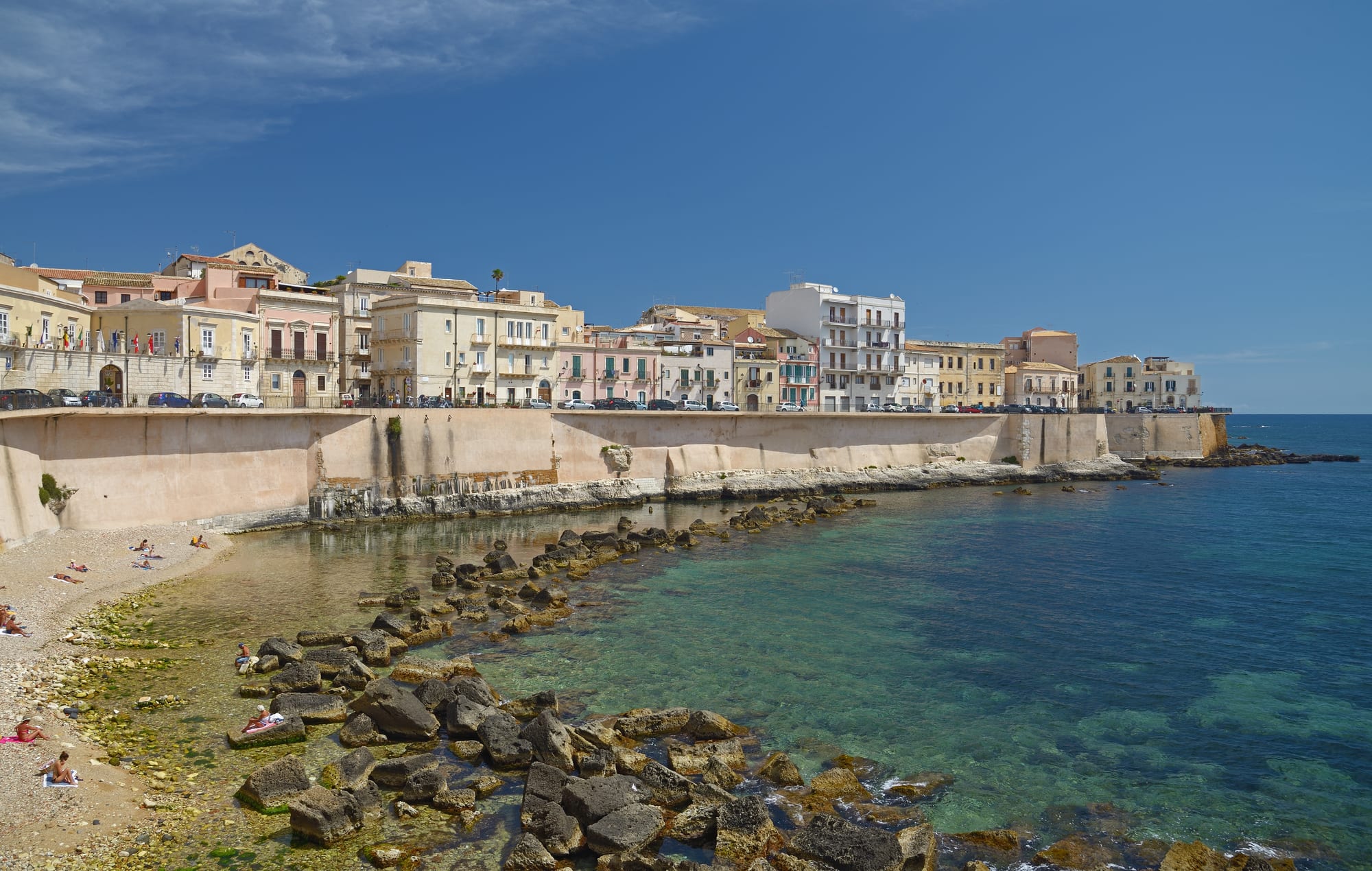
Pastel houses above a pale stone sea wall, with a small pebble beach, rocks and clear turquoise water in front

Sicily, Italy

Syracuse

The Lungomare di Levante on the eastern shore of Ortygia, Syracuse. (Ввласенко / Wikimedia Commons · CC BY-SA 3.0)

A city on Sicily's south-east coast, founded by Corinthians in 733 BC on the island of Ortygia and once one of the largest cities of the Greek world, the rival of Athens and Carthage and home of Archimedes. Ortygia's Baroque streets and the ruins of the Neapolis park form a World Heritage Site; the modern city spreads across the mainland beside them.

Neighbourhoods

  • Ortygia
    • First-time visitors
    • Historic district
    • Best for food

    The small island that is the old city, joined to the mainland by two bridges. Baroque palaces of pale local stone, the cathedral built into a Greek temple, the Fountain of Arethusa, the old Jewish quarter of the Giudecca and the market crowd its lanes, with sea walls on every side.

    Open in Maps
  • Neapolis
    • Archaeology
    • Museums

    The archaeological district on the mainland north of Ortygia, around the Temenite hill, with the Greek theatre, the Roman amphitheatre and the Ear of Dionysius in their park. The Paolo Orsi museum and the Sanctuary of Our Lady of Tears are close by.

    Open in Maps
  • Tiche and Akradina
    • Local life
    • Shopping
    • Close to the station

    The modern city on the mainland, where most Syracusans live, built over the ancient districts that gave it their names. The railway station and the intercity buses are on Corso Umberto, a walk from the bridges to Ortygia.

    Open in Maps
  • Fontane Bianche and the southern coast
    • Beaches
    • Summer

    The seaside settlements in the south of the municipality, from the Plemmirio headland to Fontane Bianche at the mouth of the Cassibile, where the city goes to swim in summer.

    Open in Maps

Things to do

Ortygia

  • Cathedral of Syracuselandmark

    The cathedral of the Nativity of Mary, built into the Doric Greek temple of Athena of the 6th century BC, on Piazza Duomo.

    Open in Maps
  • Temple of Apollolandmark

    The ruins of a 6th-century BC temple at the entrance to Ortygia, one of the most ancient Doric temples in Sicily.

    Open in Maps
  • Fountain of Arethusalandmark

    A freshwater spring by the sea where, in Greek myth, the nymph Arethusa resurfaced; papyrus grows in its pool.

    Open in Maps
  • Castello Maniacelandmark

    The castle Frederick II built between 1232 and 1240 at the tip of Ortygia, named after the Byzantine general George Maniakes.

    Open in Maps
  • Palazzo Bellomomuseum

    The regional art gallery in a medieval palace, with religious art from the churches and monasteries of the Syracuse region, including an Annunciation by Antonello da Messina.

    Open in Maps

Greek and Roman Syracuse

  • Greek Theatre of Syracuselandmark

    First built in the 5th century BC on the slope of the Temenite hill, where Aeschylus worked; ancient dramas are staged here again every season.

    Open in Maps
  • Ear of Dionysiuslandmark

    A tall, ear-shaped cave cut into the limestone of an ancient quarry, named by Caravaggio and linked by legend to the tyrant Dionysius I.

    Open in Maps
  • Roman amphitheatrelandmark

    One of the best-preserved structures of early imperial Syracuse, where gladiators entered the arena through a vaulted corridor.

    Open in Maps
  • Euryalus fortresslandmark

    The key fortress of the Greek city's walls, built under Dionysius I on the highest point of the Epipolae plateau at Belvedere.

    Open in Maps
  • Catacombs of San Giovannilandmark

    Among the largest catacombs outside Rome, entered through the roofless church of San Giovanni alle Catacombe.

    Open in Maps

Museums

  • Paolo Orsi Archaeological Museummuseum

    One of the principal archaeological museums of Europe, in the grounds of Villa Landolina, covering Sicily from prehistory to the Greek and Roman city.

    Open in Maps
  • Sanctuary of Our Lady of Tearslandmark

    The huge modern sanctuary built to house an image of the Virgin that was reported to weep in 1953, inaugurated by Pope John Paul II in 1994.

    Open in Maps

Short trips from the city

  • Notoattraction

    A Baroque town at the foot of the Hyblaean Mountains, about 32 km south-west of the city.

    Open in Maps
  • Necropolis of Pantalicalandmark

    Cemeteries of thousands of rock-cut tombs from the 13th to the 7th centuries BC, part of the same World Heritage Site as the city.

    Open in Maps
  • Ciane riverpark

    A short river just outside the city where papyrus grows wild, sharing its mouth with the Anapo.

    Open in Maps

Seasonal events

  • Feast of Santa Lucia of the QuailsFirst Sunday of May

    A repeat of the patron's feast in period costume, recalling a dove that heralded the end of a famine in 1646.

  • Classical performances at the Greek theatreMay to July

    The National Institute of Ancient Drama has staged Greek tragedies and comedies in the ancient theatre each season since 1914.

  • Feast of Santa Lucia13–20 December

    The silver statue of the city's patron is carried in procession on 13 December and returned to the cathedral a week later; since 1927 a young Swedish woman dressed in white has walked with it.

Eat and drink

Long-standing places and food districts in Syracuse. Hours, ratings and directions come from your maps app, always current.

Syracuse classics

  • Ortigia marketmarket

    The Antico Mercato di Ortigia, the old outdoor market on the island and one of its liveliest corners.

    Open in Maps
  • Ortygia's restaurantsneighborhood

    Restaurants and trattorias throughout the island serve Syracusan fish soup, spaghetti with tuna bottarga and tuna alla ghiotta.

    Open in Maps

Cafés and sweets

  • Cafés of Piazza Duomocafe

    Cafés on and around the cathedral square, where an almond granita is the Syracusan order.

    Open in Maps
  • Pastry shops of the centrecafe

    Bakeries and pastry shops selling totò, iced chocolate biscuits, giuggiulena, almond pastries and the local sponge-based cassata.

    Open in Maps

Experience Syracuse

History

Corinthian colonists led by Archias landed on Ortygia in 733 BC, drove out the Sicels and founded Syrakousai. Under rulers such as Gelon, Hiero I, Dionysius I, Agathocles and Hiero II, it became one of the largest cities of the ancient world, fought Carthage for control of Sicily and destroyed the great Athenian expedition sent against it. Its court hosted Aeschylus, Pindar and Plato. Archimedes, born here, helped defend the city when Rome besieged it; when it fell in 212 BC he was killed, and Marcellus carried its treasures to Rome. Syracuse remained the capital of Roman Sicily, St Paul stayed for three days in 61, and St Lucy was martyred here in 304.

The Byzantine emperor Constans II made Syracuse his capital from 663 to 668. It fell to the Arabs in 878 after a brutal siege, and Palermo replaced it as Sicily's capital for good. The Normans took it in 1085; from 1302 it was governed through the Queen's Chamber, which gave it unusual autonomy. Under Charles V it became a fortress, Spanish engineers cut the isthmus to make Ortygia an island again, and the Knights Hospitaller stayed a year before moving to Malta in 1530. Earthquakes in 1542 and 1693 devastated the city, and it was rebuilt in Sicilian Baroque.

Nelson's fleet called here, an American squadron was based in the port during the First Barbary War, and the city freed itself from Bourbon rule and surrendered to Garibaldi's forces in 1860. The Allies took it on 9–10 July 1943, and the armistice was signed nearby at Cassibile. A huge petrochemical complex grew to the north from the late 1950s, bringing jobs and pollution. In 2005 Syracuse and the necropolis of Pantalica became a World Heritage Site.

Culture & Customs

Syracuse claims a founding role in theatre: Plato credited the city with the birth of comedy, and Aeschylus worked in its theatre. Since 1914 the National Institute of Ancient Drama has staged Greek tragedies and comedies there again, from May to July each year, and the institute includes an academy of ancient drama. The Opera dei Pupi survives in a small puppet theatre and a puppet museum, and the city hosts film festivals and has been the set for many films.

Santa Lucia is at the heart of local identity. Her silver statue is carried through the streets on 13 December and returned to the cathedral a week later, and since 1927 a young Swedish woman dressed in white has walked in the procession — the root of the city's twinning with Stockholm. The feast is repeated on the first Sunday of May, recalling a dove that announced the end of a famine in 1646. In 1953 an image of the Virgin was reported to weep, and the vast Sanctuary of Our Lady of Tears was built in response.

Syracusans call theirs the "white city" for its pale Hyblaean stone, locally nicknamed nougat stone. The dialect turns D into R and carries many Spanish words. Papyrus, which grows wild here as nowhere else in Europe, has its own museum and institute.

Daily Life

About 116,000 people live in the municipality, according to a 2025 figure — fewer than at the 1991 peak, as emigration and low birth rates thin the population. Most live in the modern mainland districts of Tiche, Akradina and Grotta Santa; only about 4 per cent live on Ortygia itself. The municipality also includes the outlying villages of Belvedere and Cassibile and settlements along the southern coast. Foreign residents, about 5 per cent, come above all from Sri Lanka, Morocco and Romania.

Services employ the most people. The petrochemical hub to the north, one of the largest in Europe, produces a large share of Italy's refined oil products, though its weight in the local economy has declined, and solar energy is being developed. Farming matters too: the area is Italy's leading lemon district, and the new potatoes and Cassibile strawberries are well known. Tourism is growing fast.

The city has no full university of its own, though the University of Catania runs an architecture faculty here. Online outlets now carry most local news, after the last print-newspaper office in the city closed in 2021, and in 2015 Syracuse was chosen for a national research project to become a "smart city".

Food

Syracuse's cooking has been talked about since antiquity — Plato disapproved of the lavishness of Syracusan banquets — and today it is part of the Mediterranean diet. Signature dishes include Syracusan fried pasta, spaghetti with tuna bottarga, the city's fish soup and tuna alla ghiotta. Bakers make impanata, a closed pizza filled with potatoes that descends from the Spanish empanada, and the pizzolo, and arancini here take a cylindrical shape.

Local produce gives the table its character: the Siracusa lemon, Sicilian blood oranges, Syracuse new potatoes and watermelons, Monti Iblei olive oil, olives, fish and the strawberries of Cassibile. The wines include Nero d'Avola and the sweet Moscato di Siracusa.

The sweets are a point of pride. Almond granita is the local version of the semi-frozen ice, celebrated in Elio Vittorini's novel The Red Carnation. Totò are chocolate biscuits covered in icing, giuggiulena is a nougat-like Christmas sweet of sesame seeds set in honey, cuccìa, boiled wheat with sugar, is eaten on Santa Lucia's day, and the Syracusan cassata is made with sponge cake, alongside quince paste and almond pastries.

Planning tools

Budget

Syracuse costs less than Taormina and the Aeolian Islands, and Ortygia is full of B&Bs. Rooms on the island cost more in summer, but food, buses and the market keep daily spending moderate. The archaeological park, the museum and evening performances at the Greek theatre are the main extras.

Daily Budget Midrange
USD 140–270 (Ortygia B&B or hotel, restaurant dinners, site tickets, a hire car for day trips)
Daily Budget Shoestring
USD 55–100 (hostel or B&B, market and street food, buses)

Stay on Ortygia to walk everywhere, and visit the Neapolis park early in the day before the heat.

Best Time to Visit

Spring and autumn are the most comfortable seasons. The classical drama season at the Greek theatre runs from May to July, and summer brings the beaches. High summer is extremely hot and dry, with the scirocco blowing in from Africa, and autumn can bring sudden heavy rain. December brings the feast of Santa Lucia.

Suggested Number of Days

Two or three days covers Ortygia and the archaeological area. Adding the Baroque towns, the ancient necropolis and the southern beaches takes the stay to most of a week, and these are much easier with a car.

First Visit
2–3 days
With Surroundings
4–6 days

Transportation

Ortygia is best explored on foot, and the whole island is a limited traffic zone for cars. Small electric shuttle buses link Ortygia with the station and the main sights, and AST buses serve the rest of the city, the Neapolis area and the southern beaches. A car is useful for the surrounding towns and sites; Interbus and AST coaches link the city with Catania, Noto, Ragusa and Palermo.

Do not drive into Ortygia's restricted traffic zone; park on the mainland and walk or take the shuttle across.

Airport & Station Connections

Catania–Fontanarossa, Sicily's busiest airport, is the usual gateway; intercity buses between Catania and Syracuse call at the airport, taking a little over an hour. Comiso airport near Ragusa has fewer flights. Trains run along the coast from Messina via Taormina–Giardini and Catania, and a few come from Palermo. Siracusa station is about a 15-minute walk from Ortygia, beside the intercity bus stops.

Walkability

Ortygia is compact, flat and made for walking, with sea views at the end of almost every street. The archaeological park is a longer walk across the modern city along busy roads, and many visitors take a shuttle or bus instead. Summer afternoons are punishingly hot on foot.

Safety

Italy is generally safe, with low levels of violent crime against visitors. Ortygia and the archaeological area are busy and safe, and the main risks are pickpockets in summer crowds and break-ins to parked cars. Extreme summer heat, autumn floods and the area's high earthquake risk are the natural hazards.

Carry water and shade in summer, leave nothing visible in parked cars, and follow local warnings during heavy autumn storms. Check current official travel advice before travelling.

Climate

Mild, moderately rainy winters and extremely hot, dry summers, dominated by the scirocco wind; in 2023 a study named Syracuse the sunniest city in Italy. On 11 August 2021 a regional agrometeorological station near the border with Floridia recorded 48.8°C, the highest temperature ever recorded in Italy and Europe.

Summer
extremely hot and dry; in nearby Catania, temperatures pass 40°C a couple of times in most years
Winter
mild, with moderate rain; in nearby Catania, daytime highs below 10°C are extremely rare

Local Customs

Syracusans are devoted to Santa Lucia, the city's patron, martyred here in 304, and her December feast is the highlight of the year. Churches expect covered shoulders and no beachwear. The local dialect, in which D often turns into R, has many words from Spanish. Tipping is not expected as it is in North America; rounding up the bill is a courteous gesture.

Dress modestly in the cathedral and churches, and step aside for processions on feast days.

Common Payment Methods

Italy uses the euro. Cards work in hotels, restaurants and most shops; market stalls and small bars may prefer cash, and cash machines are easy to find on Ortygia and in the modern centre.