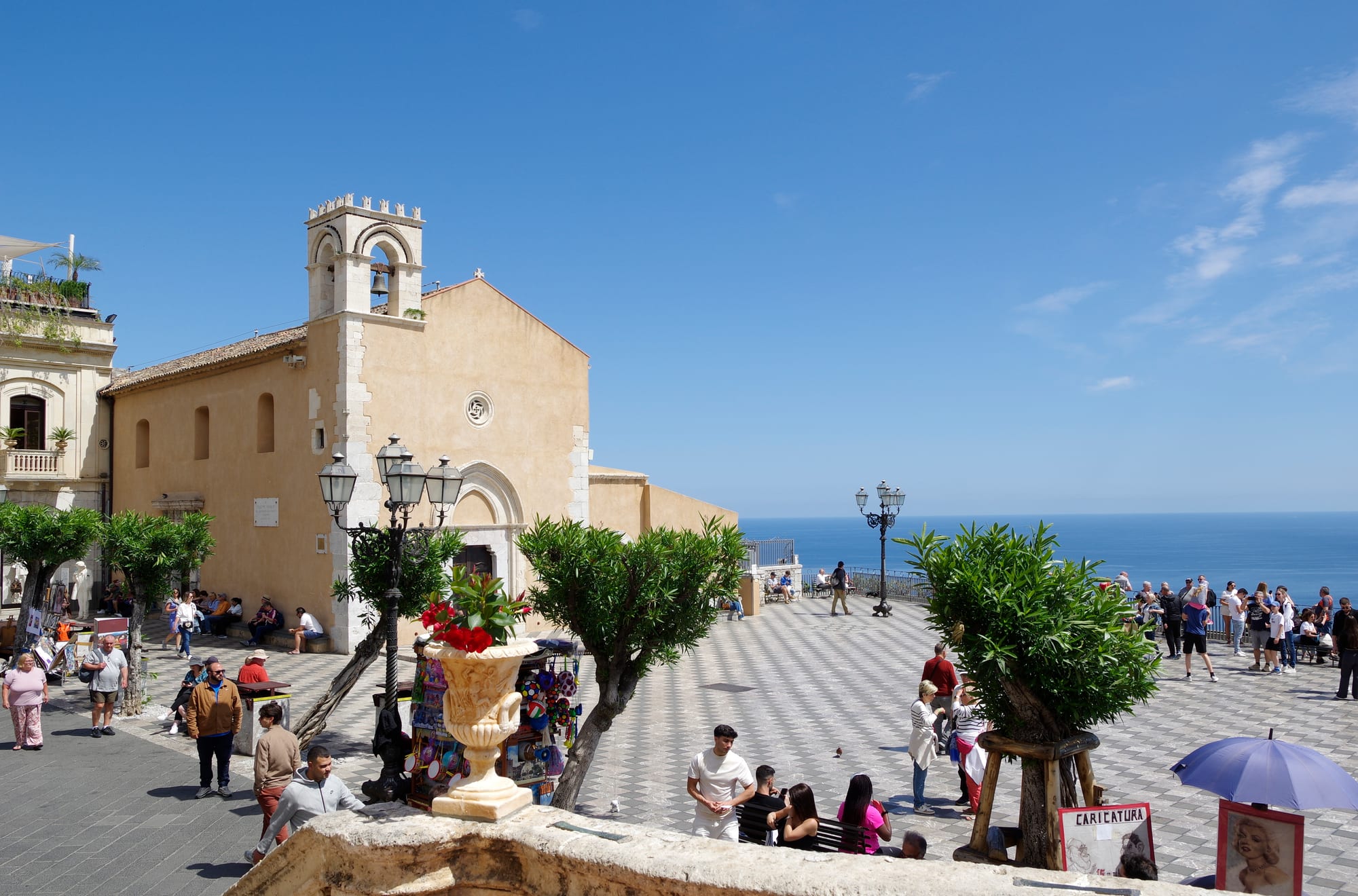
Paved square with a stone church and bell tower, strolling visitors and a balustrade overlooking the blue sea

Sicily, Italy

Taormina

Piazza IX Aprile and the church of Sant'Agostino in the centre of Taormina. (Berthold Werner / Wikimedia Commons · CC BY-SA 4.0)

A hill town on Sicily's east coast, set on a terrace of Monte Tauro high above the Ionian Sea between Messina and Catania. Founded by Greeks from nearby Naxos, it kept an ancient theatre with a famous view of Etna, became a Grand Tour stop and, since the 19th century, one of Sicily's best-known resorts, with beaches below at Mazzarò and Isola Bella.

Neighbourhoods

  • Old town and Corso Umberto
    • First-time visitors
    • Historic district
    • Shopping

    The hilltop town about 200 metres above the sea, strung along the pedestrian Corso Umberto I between Porta Messina and Porta Catania. Medieval palazzi, churches, antique shops, bars and the terrace of Piazza IX Aprile, looking over the coast to Etna, line the way.

    Open in Maps
  • Mazzarò and Isola Bella
    • Beaches
    • Swimming

    The seaside part of the town at the foot of the cliff, linked to the centre by a cable car. Shingle bays lead to Isola Bella, the islet that is now a nature reserve.

    Open in Maps
  • Castelmola
    • Views
    • Quiet evenings

    A separate tiny village on the summit above Taormina, once its acropolis, reached by a zigzag road or a steep path. It looks down over the town and the coast.

    Open in Maps

Things to do

Ancient and medieval Taormina

  • Ancient theatre of Taorminalandmark

    A Greek theatre of the 3rd century BC rebuilt largely in Roman brick, the second largest in Sicily, with its stage wall unusually well preserved and Etna framed beyond; it still hosts opera, concerts and the film festival.

    Open in Maps
  • Palazzo Corvajalandmark

    A crenellated Catalan Gothic palace, mostly of the late 14th century, around a courtyard carved with reliefs of the Creation.

    Open in Maps
  • Odeonlandmark

    The remains of a small Roman theatre, visible from the surrounding streets.

    Open in Maps
  • Naumachialandmark

    A long Roman brick wall with niches, about 120 metres long, whose original purpose is still uncertain.

    Open in Maps
  • Badia Vecchialandmark

    A 14th-century Gothic tower that once housed an abbey.

    Open in Maps
  • Saracen Castleviewpoint

    The castle built by the Arabs on the rock of Monte Tauro, about 400 metres up, next to the sanctuary of the Madonna della Rocca.

    Open in Maps

Gardens and squares

  • Piazza IX Aprileviewpoint

    The main square on the Corso, a balcony over the sea and Mount Etna, with the clock tower gate of the Porta di Mezzo at one corner.

    Open in Maps
  • Villa Comunalepark

    The Parco Duca di Cesarò, gardens with oriental-style follies created by the Englishwoman Florence Trevelyan in the late 19th century.

    Open in Maps

Beaches

  • Isola Bellabeach

    The 'Pearl of the Ionian Sea', a small island in a bay below the town, once owned by Florence Trevelyan, bought by the Region in 1990 and now a nature reserve.

    Open in Maps
  • Mazzaròbeach

    The beach and bay at the foot of the cable car, the closest swimming to the old town.

    Open in Maps

Short trips from the town

  • Giardini Naxosattraction

    The seaside resort on the bay to the south, built over Naxos, the first Greek colony in Sicily, founded in 735 BC at the mouth of the Alcantara.

    Open in Maps
  • Mount Etnaattraction

    One of Europe's tallest active volcanoes, with tourist stations at Sapienza and Piano Provenzana and a UNESCO World Heritage listing.

    Open in Maps
  • Alcantara riverpark

    The river that reaches the sea at Giardini Naxos, known for the gorge along its course.

    Open in Maps

Seasonal events

  • Castelrock1 May

    A music festival held in the main square of Castelmola on Labour Day.

  • Feast of San Pancrazio9 July

    The feast of the town's patron saint, the bishop Pancras.

  • Taormina Film FestJuly

    A film festival here since 1971, with screenings in the ancient theatre and the Silver Ribbon awards of the Italian film journalists.

  • Taormina ArteSummer

    The town's arts institution, founded in 1983, stages music, theatre and dance festivals, many of them in the ancient theatre.

  • Giuseppe Sinopoli FestivalOctober

    A music festival held since 2005 in memory of Taormina Arte's late artistic director.

Eat and drink

Long-standing places and food districts in Taormina. Hours, ratings and directions come from your maps app, always current.

Eating in Taormina

  • Restaurants and bars of Corso Umbertoneighborhood

    The main street and its side lanes are lined with restaurants, bars and cafés, many with terraces over the coast.

    Open in Maps
  • Cafés of Piazza IX Aprilecafe

    The square's cafés are where to sit with a granita, a coffee or an aperitivo and the view of Etna.

    Open in Maps

Beyond the town

  • Castelmola's restaurantsneighborhood

    Restaurants in the hilltop village above the town, with views back over Taormina and the sea.

    Open in Maps
  • Giardini Naxos seafrontneighborhood

    The resort on the bay below, with places to eat along its waterfront.

    Open in Maps

Experience Taormina

History

Sicels lived on Monte Tauro before the Greeks came, and in 735 BC colonists from Chalcis founded Naxos, the first Greek colony in Sicily, on the bay below at the mouth of the Alcantara. When Dionysius I of Syracuse destroyed Naxos in 403 BC, survivors moved up to the naturally defended hill, and under the ruler Andromachus the new city of Tauromenion grew rich and powerful. His son Timaeus, the historian, was exiled by Agathocles of Syracuse. Under Rome Tauromenium was one of Sicily's three federated cities; in 36 BC Octavian landed at Naxos to retake it from Sextus Pompey, and in 21 BC, as Augustus, he settled a colony of loyal Romans here.

The town stayed important after the fall of Rome and was one of the last Byzantine strongholds in Sicily, falling to the Arabs in 902 and again after a seven-month siege in 962–963. The Normans took it in 1078, and in 1130 it became part of Roger II's Kingdom of Sicily. Later sieges included the French capture of 1676. In 1806 King Ferdinand III, thanking the town for its loyalty to the Bourbons, gave the rock of Isola Bella to its mayor.

After unification Taormina drew wealthy travellers from northern Europe and became known as a haven for artists and gay men. The Englishwoman Florence Trevelyan laid out gardens and bought Isola Bella, and the photographer Wilhelm von Gloeden worked here; fishermen and farmers became hoteliers and shopkeepers. In the Second World War the town was a German headquarters, and on 9 July 1943, its patron's feast day, Allied bombers destroyed part of the southern quarter. In 2017 Taormina hosted the G7 summit.

Culture & Customs

Taormina's culture has long been shaped by its visitors. Grand Tour travellers came for the theatre and the view of Etna, and in the late 19th and early 20th centuries the town drew aristocrats, artists and writers — the Florio family, Gabriele D'Annunzio, Gustav Klimt and Sigmund Freud among them. The painter Robert Hawthorn Kitson built Casa Cuseni, now a historic house museum, and Greta Garbo, Marlene Dietrich and Elizabeth Taylor all visited.

The ancient theatre is the town's stage. Since 1983 Taormina Arte has organised music, theatre and dance festivals there, and the Taormina Film Fest, which moved here for good in 1971, presents the Silver Ribbon awards of Italy's film journalists. Each October the Giuseppe Sinopoli Festival honours a former artistic director. Film has made the town familiar worldwide: part of The Big Blue was shot here, and the second season of The White Lotus was set and filmed around the town.

Religious life centres on San Pancrazio, the bishop venerated as patron, whose feast falls on 9 July. Above the town, Castelmola fills its main square for the Castelrock festival every 1 May. The Taormina Sporting Club, founded in 1925, has won national titles in swimming and tennis.

Daily Life

About 10,400 people live in Taormina, a municipality that takes in not only the hill town but also Mazzarò on the coast, the railway station at the bay and the inland village of Trappitello. Foreign residents numbered just over 700 at the end of 2023, close to 7 per cent of the population. Life is lived on two levels: the old town on its terrace and the coast below, joined by hairpin roads and the cable car.

Tourism is the economy. Hotels, restaurants, bars and shops fill the old town and the coast, and cruise passengers and day-trippers arrive by bus in season. Town services have had a troubled recent history: the company that runs the buses, the cable car and the car parks went bankrupt in 2011 and returned to normal administration only in 2021.

The rhythm follows the season. From spring to autumn the Corso is crowded by day and lively late into the evening; in winter the town is far quieter, though still a place for walking.

Food

Taormina eats as eastern Sicily does. Granita, a sorbet flavoured with lemon, coffee or fruit, is a natural order on a terrace above the sea; nearby Messina is known for the creamy kind served with a brioche and traditionally eaten for breakfast. Arancini, deep-fried breaded rice balls usually filled with ragù, take a conical shape in the east of the island, inspired by Etna. From nearby Catania comes pasta alla Norma, served with fried aubergine, tomato and salted ricotta. Caponata, a sweet-and-sour stew of aubergine, celery, olives and capers, appears on menus across the island.

The sweets are those of all Sicily: cannoli, fried pastry tubes filled with sweetened ricotta; cassata, a sponge cake of ricotta, marzipan and candied fruit; and marzipan fruits. The Etna area grows blood oranges, and Bronte, a town west of the volcano, lives largely by farming pistachios.

Wines come from the slopes of Etna, and a road of Etna wineries is one of the most popular excursions from the town.

Planning tools

Budget

Taormina is one of the most expensive places in Sicily, especially in July and August, when rooms and restaurant prices are high. Staying down on the coast or in Giardini Naxos is cheaper, though the hill town itself is the place to be. Spring and autumn bring prices down.

Daily Budget Midrange
USD 170–330 (hotel in or near the old town, restaurant dinners, the theatre, an Etna trip)
Daily Budget Shoestring
USD 70–120 (hostel or simple B&B, street food, buses and the cable car)

Visit in May, June, September or October for lower prices; the Corso, the squares and the views are free.

Best Time to Visit

Early summer and autumn are the best times. July and August are very hot and crowded during the day, though the crowds thin in the evenings, and the summer is when the theatre stages its festivals. Winter is mild, quiet and good for walking.

Suggested Number of Days

Two or three days covers the town and a swim below it. Allow most of a week to add the volcano, the river gorge and the coast, which are easiest with a car or a tour. Summer heat makes the steep town slower to explore.

First Visit
2–3 days
With Surroundings
4–6 days

Transportation

Most of the old town is pedestrianised and walkable. A cable car links the centre with the beach at Mazzarò, and local buses run by ASM connect the town, the car parks, the coast, the station and the villages, though services can be infrequent. Drivers park in the long-stay car parks at Lumbi or Porta Catania and walk in.

Do not try to drive into the pedestrian centre; use the car parks and the shuttle bus or the cable car.

Airport & Station Connections

Catania–Fontanarossa, Sicily's busiest airport, is the nearest, and a direct bus runs to Taormina's bus station on Via Pirandello in about an hour and a half. Trains on the Messina–Catania line stop at Taormina–Giardini station on the seafront, about an hour from either city, but the station is a steep 2 km below the town, so a bus or taxi is needed for the climb. The motorway exit is just north of the town.

Walkability

The centre is small and car-free, and Corso Umberto makes a level walk from gate to gate. Everywhere else is steep: lanes and stairways climb to the castle and Castelmola, and the walk down to the sea is long and tiring to repeat on foot — the cable car saves the legs.

Safety

Italy is generally safe, with low levels of violent crime against visitors. Taormina is a well-policed resort with little crime beyond occasional pickpocketing in the summer crowds and theft from parked cars. The natural risks are summer heat, wildfires, and eruptions of Etna, which can disrupt flights at Catania airport.

Keep bags close in crowds, leave nothing in parked cars, carry water on the steep paths, and follow official notices on Etna. Check current official travel advice before travelling.

Climate

A Mediterranean climate of hot, dry summers and mild, wetter winters; the monthly figures below are 1961–90 averages.

Summer
hot — August, the warmest month, averages 26.6°C
Winter
mild — January, the coldest month, averages about 11°C

Local Customs

Taormina is used to visitors, but it is also a Sicilian town with its patron saint's feast and its churches, which expect covered shoulders and no beachwear. It has a long tradition of welcoming artists and of openness to gay visitors. Tipping is not expected as it is in North America; rounding up the bill is a courteous gesture.

Change out of swimwear before coming up from the beach to the town's churches and main street.

Common Payment Methods

Italy uses the euro. Cards are accepted almost everywhere in the resort, including hotels, restaurants and shops; keep a little cash for buses, small bars and beach kiosks.