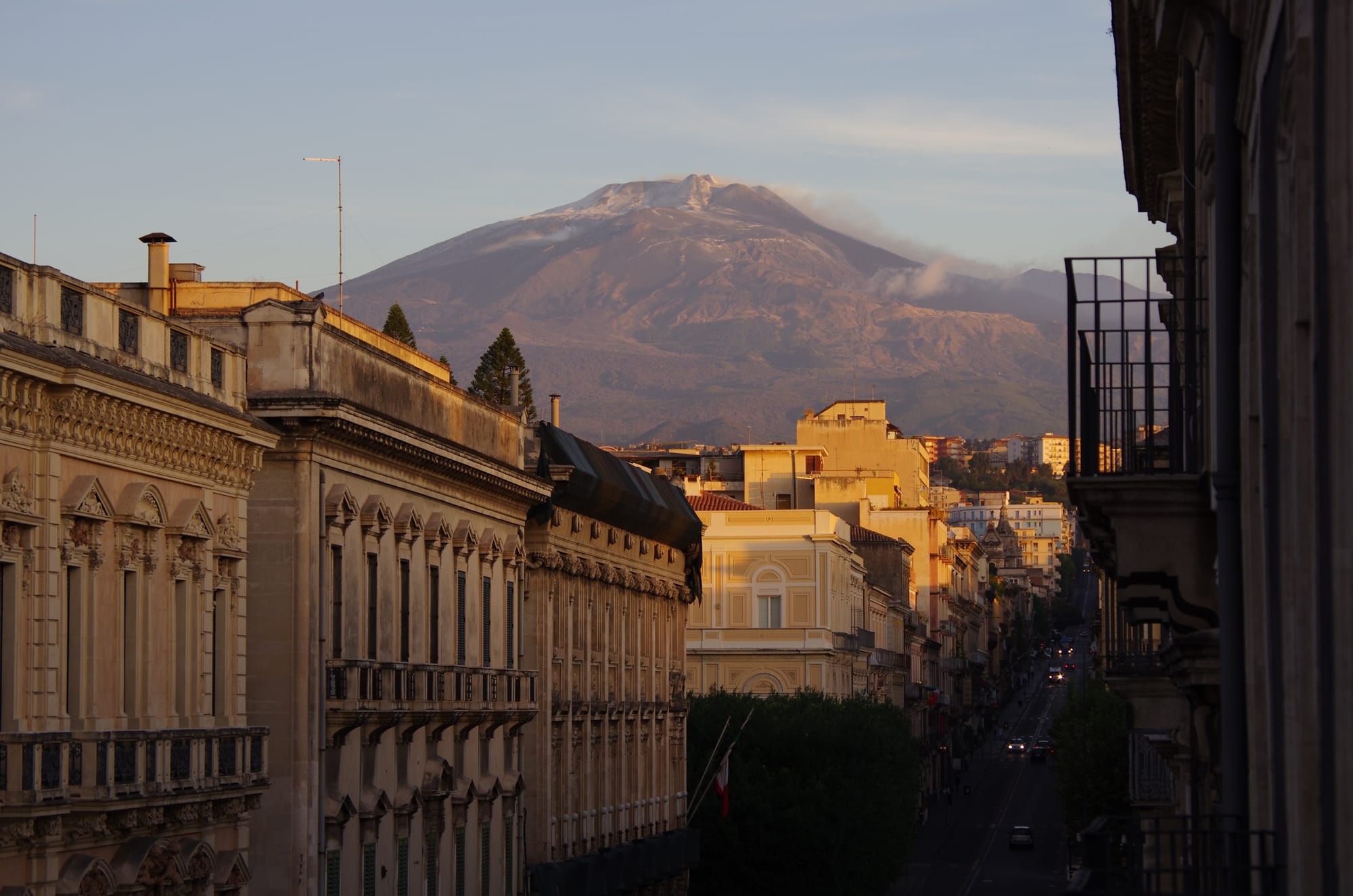
A long straight street of ornate stone palazzi in evening light, leading towards the snow-dusted cone of Mount Etna

Sicily, Italy

Catania

Mount Etna rising beyond the rooftops at the end of Via Etnea, Catania's main street. (SNappa2006 / Wikimedia Commons · CC BY 2.0)

Sicily's second city, on the Ionian coast at the foot of Mount Etna. Founded by Greek settlers in the 8th century BC, it was buried by lava and shaken down by earthquakes many times, and rebuilt after 1693 in a late-Baroque style of dark lava stone that is now a UNESCO World Heritage Site. Today it is the island's industrial and commercial centre and its main airport.

Neighbourhoods

  • Historic centre
    • First-time visitors
    • Historic district
    • Close to public transport

    The Baroque core around Piazza del Duomo, laid out with wide straight streets after the 1693 earthquake. Via Etnea runs north from the cathedral square past churches, palazzi and shops towards Etna, and the fish market, the Roman theatre and Via dei Crociferi are all a few minutes' walk away.

    Open in Maps
  • Civita
    • Local life
    • Best for food

    An old working-class quarter of the centre near the port, with streets of older houses not far from the Pescheria.

    Open in Maps
  • Borgo and Via Etnea north
    • Parks
    • Shopping
    • Close to public transport

    The upper stretch of Via Etnea, past the Bellini Garden and the university's botanical garden to Piazza Cavour, the square the Catanese simply call the Borgo. It is a busier, more everyday district, with a metro station and the terminus of the Circumetnea railway.

    Open in Maps
  • Ognina
    • Seafront
    • Fishing harbour
    • Quiet and residential

    The maritime quarter in the north-east and the city's main fishing port, around the small harbour of Porto Ulisse and the old sanctuary of Our Lady of Ognina. The black lava coast here continues to the little beach of San Giovanni li Cuti.

    Open in Maps
  • La Plaia
    • Beaches
    • Summer stays
    • Sport

    The long sandy shore running south of the city along the bay, with the sports grounds of Viale Kennedy behind it, where much of Catania goes to swim in summer.

    Open in Maps

Things to do

Baroque Catania

  • Piazza del Duomolandmark

    The main square, flanked by the city hall in the Palazzo degli Elefanti and the cathedral, with the Amenano river surfacing in a marble fountain at its southern edge.

    Open in Maps
  • Elephant Fountainlandmark

    Vaccarini's fountain of 1735–37, topped by an ancient lava elephant, u Liotru, carrying an Egyptian obelisk — the emblem of the city.

    Open in Maps
  • Catania Cathedrallandmark

    The cathedral of Saint Agatha, founded in the 11th century over Roman baths and rebuilt after the 1693 earthquake, keeping its Norman apses.

    Open in Maps
  • Badia di Sant'Agatalandmark

    An 18th-century church and convent across the street from the cathedral, with a Baroque facade.

    Open in Maps
  • Via dei Crociferineighborhood

    An 18th-century street entered under the arch of San Benedetto, often called the most beautiful in Baroque Catania for its unbroken line of churches and convents.

    Open in Maps
  • Monastery of San Nicolò l'Arenalandmark

    A former Benedictine monastery, among the largest in Europe, now home to the university's humanities faculty, beside the vast unfinished church of San Nicolò.

    Open in Maps
  • Porta Garibaldilandmark

    A triumphal arch of 1768, first named Porta Ferdinandea for the wedding of King Ferdinand and Maria Carolina of Austria.

    Open in Maps

Ancient Catania and museums

  • Roman Theatrelandmark

    The ruins of a Roman theatre and a smaller odeon among the houses of the old town, part of Catania's Greek-Roman archaeological park.

    Open in Maps
  • Roman Amphitheatrelandmark

    A section of a large 2nd-century amphitheatre, visible below street level at Piazza Stesicoro on the edge of the ancient city.

    Open in Maps
  • Castello Ursinomuseum

    Frederick II's 13th-century castle, seat of the Sicilian Parliament after the Vespers revolt, home since 1934 to the civic museum.

    Open in Maps
  • Bellini Museummuseum

    The Palazzo Gravina-Cruyllas, where the composer Vincenzo Bellini was born, now a museum devoted to him.

    Open in Maps

Parks, music and the market

  • Teatro Massimo Belliniattraction

    The 1,200-seat opera house opened in 1890 with Bellini's Norma; its season runs from December to May, and the square in front is a lively evening meeting place.

    Open in Maps
  • Bellini Gardenpark

    Catania's oldest urban park, on Via Etnea, laid out from 1864 on the site of the Prince of Biscari's garden maze.

    Open in Maps
  • Botanical Gardenpark

    The university's small botanical garden just north of the Bellini Garden, entered from Via Etnea.

    Open in Maps
  • La Pescheriamarket

    The old fish market behind Piazza del Duomo, where the stalls have filled a 16th-century passage under the city walls since at least the early 19th century.

    Open in Maps
  • Fera 'o Lunimarket

    The market of Piazza Carlo Alberto, with the Pescheria the oldest in Catania, selling food and clothes every morning except Sunday.

    Open in Maps

The coast and Etna

  • Aci Castellolandmark

    A coastal town north of the city that grew around a Norman castle built in 1076–81 on Byzantine foundations.

    Open in Maps
  • Aci Trezza and the Cyclopean Islesviewpoint

    A fishing village facing a cluster of basalt sea stacks that local legend says were the stones the Cyclops hurled at Odysseus.

    Open in Maps
  • Mount Etnapark

    One of the world's most active volcanoes and the tallest peak in Italy south of the Alps, about 3,400 metres high, a UNESCO World Heritage Site since 2013; guided excursions run from Catania.

    Open in Maps

Short trips from the city

  • Taorminaattraction

    A resort above the Ionian Sea, a tourist destination since the 19th century, with an aerial tramway down to its beaches and Isola Bella.

    Open in Maps

Seasonal events

  • Festival of Saint Agatha3–5 February, and 17 August

    One of the largest Catholic festivals in the world, when devotees in white tunics haul the saint's reliquary on a silver carriage through the city, with giant guild candles, fireworks and street-food stalls.

  • Etna Comicsearly June

    An international festival of comics, games and pop culture at the Le Ciminiere exhibition centre.

  • Opera season at the Teatro Massimo BelliniDecember to May

    Opera and concerts in the city's 19th-century theatre, including works by Bellini himself.

  • San Silvestro a mare31 December

    An international swimming race held every New Year's Eve in the old harbour of Ognina.

Eat and drink

Long-standing places and food districts in Catania. Hours, ratings and directions come from your maps app, always current.

Catania classics

  • Street-food kiosks and rosticcerieneighborhood

    Where to find the city's cone-shaped arancini, cipolline and bolognese pastries, and crispelle — fried dough filled with ricotta or anchovies.

    Open in Maps
  • Horse-meat grills near the Benedictine Monasteryneighborhood

    Horse meat is a Catanese tradition, roasted on street-side barbecues by shops known as arrusti e mancia, 'roast it and eat it', especially in the streets around the old monastery.

    Open in Maps

Markets

  • La Pescheriamarket

    The fish market behind the cathedral square, crowded with colour, noise and the cries of the fishmongers.

    Open in Maps
  • Fera 'o Lunimarket

    The big morning market of Piazza Carlo Alberto, for fruit, vegetables and street snacks as well as clothes.

    Open in Maps

Cafés and pastry shops

  • Via Etnea cafésneighborhood

    Pastry shops and cafés along the main street, for granita in summer, ricotta cannoli and almond pastries all year, and the small cassatas of Saint Agatha in February.

    Open in Maps

Experience Catania

History

Greek settlers from nearby Naxos took over a Sicel village here around 729 BC and founded Katane, with its acropolis on the hill of Montevergine. It was a centre of learning, home to the lawgiver Charondas and the poet Stesichorus, but suffered at the hands of Syracuse: Hieron expelled its people in 476 BC and renamed it Aetna, and Dionysius I sold its citizens into slavery in 403 BC. Rome took it in 263 BC, early in the First Punic War, and it became a wealthy port, even though an eruption of Etna in 121 BC buried much of the town.

Vandals, Goths and Byzantines followed, then two centuries of Arab rule, when it was known as the City of the Elephant, and the Normans. An earthquake almost destroyed Catania in 1169. Frederick II built the Castello Ursino in the 13th century; after the Sicilian Vespers of 1282 the Aragonese kings held their parliament here, and in 1434 Alfonso V founded Sicily's first university.

In 1669 Etna's lava reached the walls, which turned most of the flow into the port. In 1693 an earthquake levelled the city, and it was rebuilt in the late-Baroque style, with broad straight streets, by architects such as Giovanni Battista Vaccarini. A ferocious tornado killed 28 people in 1884, lava flows struck again in 1923 and 1928, and in 1943 Allied bombing caused heavy damage before the British Eighth Army took the city on 5 August. Industry made Catania known as the Manchester of southern Italy, and after a 1960s boom it became the commercial heart of eastern Sicily. Its Baroque centre is part of the UNESCO-listed Late Baroque Towns of the Val di Noto.

Culture & Customs

Catania's great festival belongs to Saint Agatha, its patron. From 3 to 5 February, and again on 17 August, the city honours her with one of the largest Catholic festivals in the world. Sixteen gilded candelore, each representing a medieval guild, are carried to the cathedral; devotees in long white tunics then haul her reliquary-bust on a heavy silver carriage through the neighbourhoods and up a steep slope.

The city is proud of its artists. The opera composer Vincenzo Bellini was born here, and the airport, the opera house and the main park carry his name; Giovanni Verga, born in Catania in 1840, became a leading writer of verismo, portraying the lives of Sicilian fishermen and stonemasons. In the late 1980s and 1990s an independent music scene flourished, producing Carmen Consoli, Mario Venuti and the indie rock band Uzeda. The opera season, a winter jazz festival, a tango festival and Etna Comics fill the calendar.

The elephant of lava stone in Piazza del Duomo, u Liotru, is the city's emblem, tied to legends of the sorcerer Heliodorus and perhaps to the dwarf elephants of prehistoric Sicily. Football is followed passionately: Catania FC claims around half a million supporters. Life is lived outdoors, along Via Etnea in the evening and on the beaches in summer, and the anti-Mafia movement Addiopizzo has had a Catania branch since 2006.

Daily Life

About 297,000 people live in the city itself and just over a million in the Metropolitan City of Catania, the most densely populated conurbation in Sicily. Immigrants make up about 6 per cent of residents, the largest groups born in Sri Lanka, Romania, Bangladesh, Mauritius and Senegal.

Catania is Sicily's industrial, logistical and commercial centre. STMicroelectronics has major offices here, at the heart of the high-technology cluster known as the Etna Valley, alongside chemical and pharmaceutical firms, the port and the airport; its university, founded in 1434, was the first in Sicily. Yet the city's growth stalled in the first decade of this century, and economic and social stagnation remains a theme of local life.

The fertile volcanic soil around Etna supports vineyards and citrus orchards, and the mountain is always present: its eruptions can disrupt flights. The old centre still holds dense working-class quarters such as Civita and San Cristoforo, while the 1950s demolition of San Berillo moved many families to new districts on the edge of the city. Each morning the Pescheria and Fera 'o Luni fill with shoppers, the day pauses for lunch, and in the evening the passeggiata moves along Via Etnea. In 2024 the metro was extended to Monte Po, part of a plan to carry it to Paternò and the airport.

Food

Food is central to Catania's way of life, and street food is the easiest way into it. The arancini here are shaped like a cone, a nod to Etna, and stuffed most often with meat ragù or with ham and cheese. Bakeries sell cipollina, puff pastry filled with onion, tomato and ham; the bolognese, a small pizza topped with tomato, mozzarella, ham and boiled egg under a puff-pastry lid; and crispelle, fried dough balls filled with ricotta or anchovies. At festivals the stalls sell calia e simenza, toasted chickpeas and pumpkin seeds.

The old markets have their own specialities — sangeli (cooked pork blood), quarumi (tripe), zuzzu (pork jelly), mauru (edible seaweed) and raw seafood — and horse meat is a local tradition, grilled on street-side barbecues by shops known as arrusti e mancia, "roast it and eat it". The city's best-known pasta, pasta alla Norma, with fried aubergine, tomato sauce and salted ricotta, is named after Bellini's opera; others are pasta cco niuru, black with cuttlefish ink, and maccu, a purée of broad beans.

Catania is famous for its pastry shops. Cannoli filled with ricotta and almond pastries are sold all year; for Saint Agatha's feast come cassatelle, small cassatas, and olivette, olive-shaped sweets of almond paste; at Easter, aceddi ccu l'ovu, eggs baked into biscuit. In summer the city cools down with granita.

Planning tools

Budget

Catania is one of the better-value cities in Italy, with B&Bs in the historic centre, cheap street food and markets, and good public transport from the airport. Prices rise during the Festival of Saint Agatha in early February and in high summer. Guided trips up Etna are the main extra cost.

Daily Budget Midrange
USD 130–270 (central hotel or B&B, restaurant dinners, museum tickets, a guided Etna excursion or hire car)
Daily Budget Shoestring
USD 55–95 (hostel or B&B, arancini and market food, metro and buses)

Eat at the markets and street kiosks, and book rooms early for the feast of Saint Agatha in February.

Best Time to Visit

April to June and September to October are the most comfortable months, warm and mostly dry. Summer is among the hottest in Italy, and the city empties towards La Plaia and the coast. Early February brings the Festival of Saint Agatha, one of the largest religious festivals in the world, and very crowded. Winters are among the warmest in Europe, and Etna is often snow-capped.

Suggested Number of Days

Two or three days cover the city itself. Four to six allow time for Etna and the coast, which make Catania a natural base for eastern Sicily. Volcanic activity and the summer heat can both change plans.

First Visit
2–3 days
With Surroundings
4–6 days

Transportation

The historic centre is best seen on foot. A single metro line, run by the Ferrovia Circumetnea, crosses the city from the centre at Stesicoro through the Borgo to the north-western suburbs, and was extended to Monte Po in 2024; city buses cover the rest. Urban rail stations along the coast link the centre with Ognina and the airport. The narrow-gauge Circumetnea railway round Etna has been partly replaced by buses since 2024 while the metro is extended, so check before relying on it.

Traffic is heavy and parking in the centre is difficult; a hire car is useful only for Etna and the surrounding towns.

Airport & Station Connections

Catania–Fontanarossa Airport, the largest in southern Italy, lies about 4 kilometres south-west of the city. The Alibus shuttle runs via the port to the central railway station in about 25 minutes, and a railway station named for the airport is a short walk from the terminal. The route to Rome Fiumicino is the busiest in Italy. Catania Centrale has trains along the coast to Messina and Syracuse, and the city is the hub of Sicily's motorways.

Walkability

The Baroque centre is flat at its heart and easy to walk: Piazza del Duomo, the fish market, the Roman theatre, Via dei Crociferi and the Benedictine monastery are all close together, and Via Etnea runs straight and gently uphill to the Bellini Garden. Traffic is heavy on the main roads.

Safety

Italy is generally safe, with low levels of violent crime against visitors. In Catania, pickpockets and bag-snatchers work in the markets, around the station and in the crowds of the Saint Agatha festival, and cars left with luggage in them may be broken into. Eruptions of Etna can close the airport at short notice.

Keep bags close in the markets and festival crowds, leave nothing in a parked car, go up Etna only with a guide beyond the marked areas, and check the airport's status when the volcano is active. Check current official travel advice before travelling.

Climate

A hot-summer Mediterranean climate. Summers are among the hottest in Italy, and winters among the warmest in Europe. Rain falls mainly from October to March, leaving late spring and summer almost dry; Etna shelters the city from northern winds, and snow is almost unknown.

Summer
hot and dry — 35°C is usual on summer days, and 40°C is passed a couple of times in most years
Winter
mild — daytime temperatures are generally around 17°C, highs below 10°C are extremely rare, and nights can occasionally approach freezing

Local Customs

Saint Agatha, the patron saint, is at the heart of the city's identity: her feast fills the streets for three days in February, and her image is everywhere. Evenings bring a slow stroll along Via Etnea. Churches expect covered shoulders and knees. Addiopizzo, a movement of businesses and consumers who refuse to pay Mafia protection money, is active in the city.

Service is usually included in the bill, and rounding up is enough. Coffee is cheapest standing at the bar, and haggling is normal at the morning markets.

Common Payment Methods

The currency is the euro. Cards and contactless payment are widely accepted in hotels, restaurants and larger shops, but market stalls and street-food kiosks often prefer cash. ATMs are found throughout the centre and at the airport.