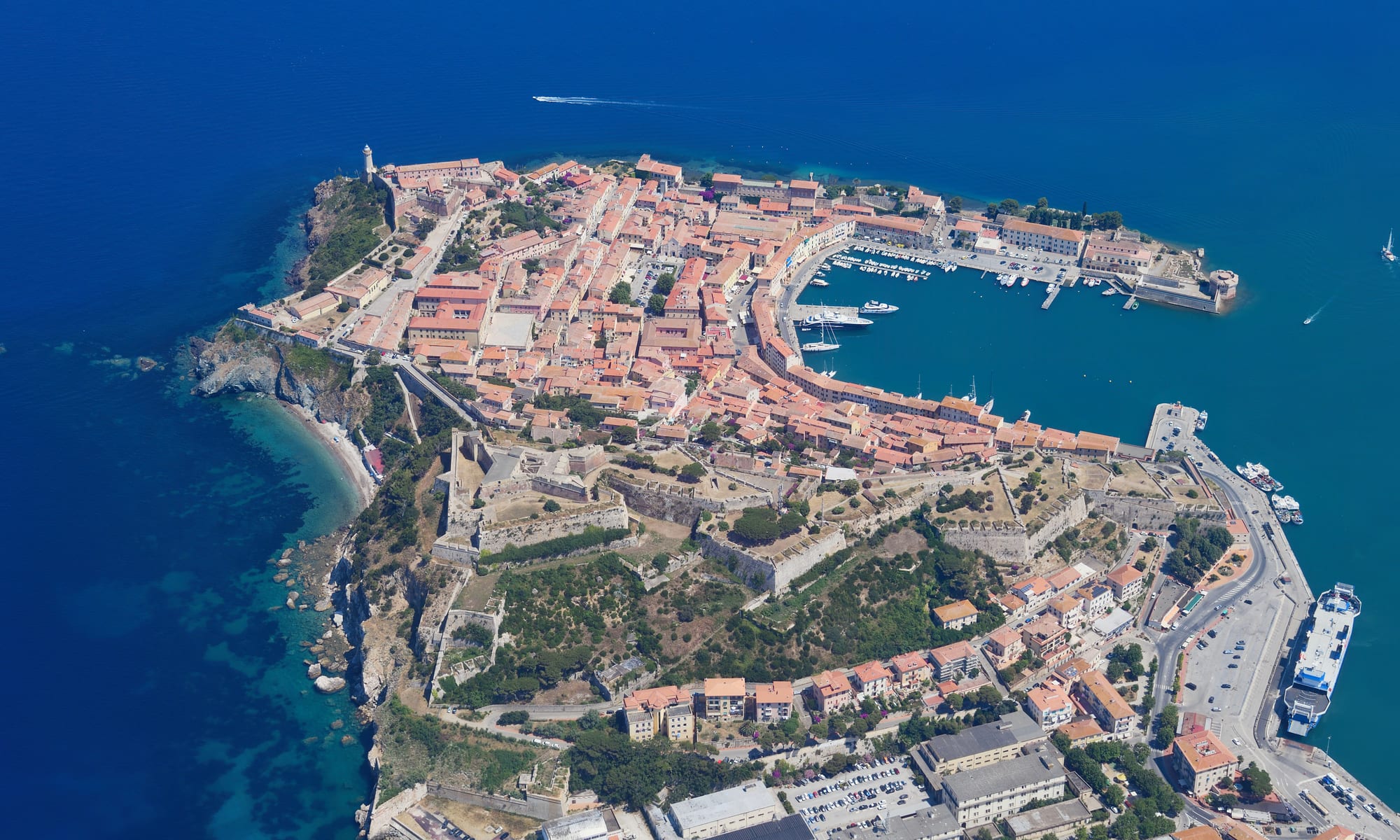
Aerial view of Portoferraio's orange-roofed old town on a headland, with its fortifications, harbour and deep blue sea

Tuscany, Italy

Elba

Portoferraio, Elba's main town and port, seen from the air above its Medici fortifications and harbour. (Carsten Steger / Wikimedia Commons · CC BY-SA 4.0)

The largest island of the Tuscan Archipelago, ten kilometres off Piombino, with Portoferraio — the fortified harbour town founded by Cosimo I de' Medici — as its main town and port. Iron mining shaped the island for more than two thousand years, Napoleon ruled it in exile in 1814–15, and beaches, hill villages and Monte Capanne now draw summer crowds.

Neighbourhoods

  • Portoferraio old town
    • First-time visitors
    • Historic district
    • Close to public transport

    The Medici town of Cosmopoli, climbing a small hill bordered on three sides by the sea, between the harbour and the forts of Stella and Falcone. Napoleon's town residence, museums and the long line of bastions are here, and the island's buses start from the town.

    Open in Maps
  • Marina di Campo and the south coast
    • Beaches
    • Families

    The main town of Campo nell'Elba, on a bay of the south coast, with the island's small airport nearby at La Pila. Local buses link it with nearby beaches and villages.

    Open in Maps
  • Marciana Marina and the west
    • Evening strolls
    • Mountains
    • Quiet

    A small harbour town with two little beaches, a Medici tower and an 18th-century seafront from the old quarter of Il Cotone, popular for evening walks and shopping. Above it rise the hill village of Marciana and Monte Capanne.

    Open in Maps
  • Porto Azzurro and Capoliveri
    • Harbour life
    • Hill villages

    The south-eastern corner of the island: Porto Azzurro, the old Porto Longone, where Spain built fortresses in the late 16th century, and the hill village of Capoliveri above the iron-bearing hills around Monte Calamita.

    Open in Maps

Things to do

Portoferraio's forts and Napoleon

  • Forte Stella and the lighthouselandmark

    The star-shaped fort built by Cosimo I de' Medici in 1548 on the headland above the old town, with the Portoferraio lighthouse on its northern rampart.

    Open in Maps
  • Palazzina dei Mulinimuseum

    Napoleon's town residence during his exile, high above the sea in the old town, where the original flag he gave the island in 1814 is kept.

    Open in Maps
  • Villa San Martinomuseum

    Napoleon's second residence on the island, in the countryside outside Portoferraio, open to visitors like the Palazzina dei Mulini.

    Open in Maps
  • Villa romana della Linguellaattraction

    The excavated remains of a Roman seaside villa at the harbour mouth, beside the Linguella tower that guarded the Medici dock.

    Open in Maps
  • Pinacoteca Foresianamuseum

    Portoferraio's art gallery, one of the town's museums.

    Open in Maps

Beaches and the coast

  • Fetovaiabeach

    One of the island's best-known beaches, reachable by bus from the main towns.

    Open in Maps
  • Marina di Campobeach

    The main town of Campo nell'Elba, set on a bay of the south coast.

    Open in Maps

Around the island

  • Monte Capanneviewpoint

    The island's highest mountain, at about 1,017 metres, reached from Marciana by a cable car that takes 14 minutes to the summit, among Mediterranean scrub and woodland.

    Open in Maps
  • Marciana Marinaattraction

    A small harbour town with a Medici tower built against pirate raids and a seafront promenade that keeps its 18th-century layout.

    Open in Maps
  • Porto Azzurroattraction

    The former Porto Longone on the east coast, where Philip II of Spain had two fortresses built after capturing it in 1596.

    Open in Maps
  • Capoliveriattraction

    A hill village in the island's south-east, first named in a document of the Republic of Genoa.

    Open in Maps
  • Arcipelago Toscano National Parkpark

    The national and marine park that takes in Elba and the other islands of the Tuscan Archipelago, with walking routes across the island's interior.

    Open in Maps

Eat and drink

Long-standing places and food districts in Elba. Hours, ratings and directions come from your maps app, always current.

Elba classics

  • Aleatico and schiaccia briacaneighborhood

    The island's sweet red Aleatico, a dessert wine, is traditionally drunk with schiaccia briaca, Elba's typical cake; wine shops in Portoferraio sell both.

    Open in Maps
  • Seafood restaurants on the Portoferraio harbourneighborhood

    Restaurants around the old Medici harbour serve fresh fish and seafood from the island's waters.

    Open in Maps

Bars and evenings

  • Marciana Marina seafrontneighborhood

    The promenade from Il Cotone to the Medici tower is the island's favourite place for an evening walk, with bars, cafés and shops along the water.

    Open in Maps

Experience Elba

History

The island was first inhabited by the Ligures Ilvates and was known in antiquity for its iron. The Greeks called it Aethalia, "smoky", after the fumes of its furnaces, and told how the Argonauts had rested here. The Etruscans mined its iron, and after 480 BC the Romans held it as Ilva; the remains of two Roman seaside villas lie at Portoferraio. In the Middle Ages Elba passed to Pisa, then to the Appiani, lords of Piombino, and in 1544 Barbary pirates devastated it.

Portoferraio was founded in 1548 by Cosimo I de' Medici, Grand Duke of Tuscany, as Cosmopoli, "Cosimo's city", to balance the Spanish citadel at Porto Azzurro, and was ringed with walls and forts that still stand. Medici edicts drew Jewish settlers, who built a synagogue in 1631–32 and were confined to a ghetto from 1702. A British garrison held the town through a siege in 1801, but the Peace of Amiens gave it to France in 1802. In 1814, after his abdication, Napoleon was made sovereign of the island; he landed at Portoferraio on 4 May, carried out economic and social reforms, and escaped to France with about 1,000 men on 26 February 1815. Elba then returned to Tuscany and joined Italy in 1860.

In the 19th century the town grew as the shipping port for the iron ore of Rio Marina, which gave it its present name, "iron port". German forces occupied the island in the Second World War until a mainly French Allied force liberated it in June 1944, after fighting and bombing that damaged Portoferraio. Mining ended from the 1970s, and tourism has since made the island an international seaside destination.

Culture & Customs

Napoleon's ten months remain the island's best-known story. Both of his homes, the Palazzina dei Mulini in town and the Villa San Martino in the countryside, can be visited, and the flag he gave Elba on his arrival, raised on the highest point of Portoferraio on the day he landed, is kept at the Palazzina. The Medici forts and bastions that frame Portoferraio are the town's other emblem.

The island's identity is local and maritime. In the Elban dialect Portoferraio is "Ferajo" or "Feraja", and the island has its own football team, which joined the ConIFA federation of teams outside FIFA in 2020 and played its first match in 2021. In January 2023 the town placed memorial panels at the old Jewish cemetery wall and in the street of the former ghetto, recalling a community that lived here from the 17th century.

Cycling has a following: the champion Fausto Coppi trained on Elba's roads late in his career, and a fountain on the road from Rio nell'Elba to Porto Azzurro is named after him. Walking routes lead past Etruscan furnace sites, Roman granite quarries and old stone villages, and the evening stroll along the seafronts of Portoferraio and Marciana Marina is part of every summer.

Daily Life

About 31,000 people lived on Elba in 2026, divided among seven municipalities, and the population rises considerably in summer. Portoferraio, the largest, had about 11,700 residents. Seniors make up more than a quarter of residents, and immigrants about an eighth; in Portoferraio the largest groups were born in Ukraine, Moldova, Romania, Morocco and Albania.

Iron mining sustained the island for centuries until it wound down from the 1970s; today tourism dominates, from hotels and campsites to boat hire, restaurants and diving. Life follows the seasons: the population swells in summer, when the ferries from Piombino bring a steady stream of visitors and the coastal roads fill. The central part of the island narrows to about four kilometres, and the main towns, Portoferraio and Campo nell'Elba, lie there.

The interior is wild by comparison: the granite massif of Monte Capanne in the west is home to mouflon and wild boar, and the iron hills of Monte Calamita lie in the east.

Food

Elba's best-known product is its wine, above all Aleatico, a sweet, fortified red dessert wine that has become famous beyond Italy and is protected as Elba Aleatico DOCG; the grape is best known for the cult wine Aleatico di Portoferraio. It is traditionally drunk with schiaccia briaca, the island's typical cake. Elba Ansonica is the island's white wine, and limoncino, a lemon liqueur, is another local speciality.

At the table the island eats fresh fish and seafood, alongside good bread and Tuscan staples such as the bread-and-tomato salad, panzanella, and the thick steak, bistecca. Tuscan cooking grew out of a habit of not throwing anything away, which turned leftover bread into dishes like panzanella and ribollita.

Restaurants and bars cluster around Portoferraio's old harbour and along the seafront at Marciana Marina, and in summer every beach and village has its places to eat. Local wines and limoncino are sold in shops in Portoferraio to take home, and the island's spring water is also prized: the Fonte Napoleone, at the foot of Monte Capanne, is known for its quality.

Planning tools

Budget

Elba is one of Tuscany's pricier places in August, when visitors from the mainland fill the island and room prices peak. Outside midsummer it is far cheaper, and campsites across the island keep costs down. Ferry crossings, especially with a car, and a hire car or scooter are the main extra costs.

Daily Budget Midrange
USD 170–330 (hotel or apartment, seafood dinners, a hire car or scooter, ferry crossings)
Daily Budget Shoestring
USD 80–140 (campsite or simple room, pizza and bakery lunches, island buses)

Visit in June or September for warm sea and smaller crowds, and book August crossings and rooms well ahead.

Best Time to Visit

Late spring to early autumn is beach season. July and especially August are the busiest months, when day-trippers from the mainland crowd the island; June and September are calmer. Rain falls mostly in autumn, and winter is the quietest season.

Suggested Number of Days

Three or four days give time for Portoferraio and a sample of the island's beaches and villages; even then many corners remain unseen. A week suits a beach holiday or serious walking, and the number depends mostly on whether there is a car or scooter.

First Visit
3–4 days
With Surroundings
5–7 days

Transportation

Buses start from Portoferraio and run a fairly comprehensive network to the main towns and villages, with frequent stops along the coastal roads; Marina di Campo has short local routes. Cars, scooters and boats can be hired in Portoferraio. Roads are narrow and winding, and the island has a network of cycling trails and dirt roads for mountain bikes.

Many visitors bring a car on the ferry; in high summer a scooter or the bus is easier to park.

Airport & Station Connections

Ferries run from Piombino, ten kilometres away on the mainland, to Portoferraio and also to Cavo, Rio Marina and Porto Azzurro on the east coast, operated by Toremar, Moby Lines, Blunavy and Sardinia Ferries. Marina di Campo Airport, at La Pila on the south of the island, has flights to the Italian mainland.

Walkability

Portoferraio's old town is compact but steep, with stepped streets climbing from the harbour to the forts. Beyond the towns, the island is better covered by bus, car or bike, though walking trails cross the interior, from coastal paths to mountain routes on Monte Capanne.

Safety

Italy is generally safe, with low levels of violent crime against visitors. On Elba the practical concerns are break-ins at beach car parks, summer heat, strong winds at times, and narrow, winding roads shared with cyclists and scooters.

Keep valuables out of sight in parked cars, carry water and sun protection on beaches and trails, and take care on mountain roads. Check current official travel advice before travelling.

Climate

Mediterranean, except on Monte Capanne, where winters are moderately cold. The island lies in the rain shadow of Corsica, so it is drier than the mainland, and most rain falls in autumn.

Summer
warm and dry, cooled by sea breezes — in nearby Piombino, on the mainland opposite, July averaged almost 24°C in 1946–55
Winter
mild and damp — in nearby Piombino January averaged 8.8°C in 1946–55; snow is rare in the lowlands and melts quickly

Local Customs

Island life follows Tuscan rhythms — espresso standing at the bar, unhurried meals and the evening stroll along the seafront — and Napoleon's residences are among the island's best-known sights.

Cover up away from the beach, especially in churches, and ask before photographing people.

Common Payment Methods

Italy uses the euro. Cards work widely; keep a little cash for small purchases, bars and beach kiosks. Many Italian towns levy a per-night tourist tax collected at the accommodation.