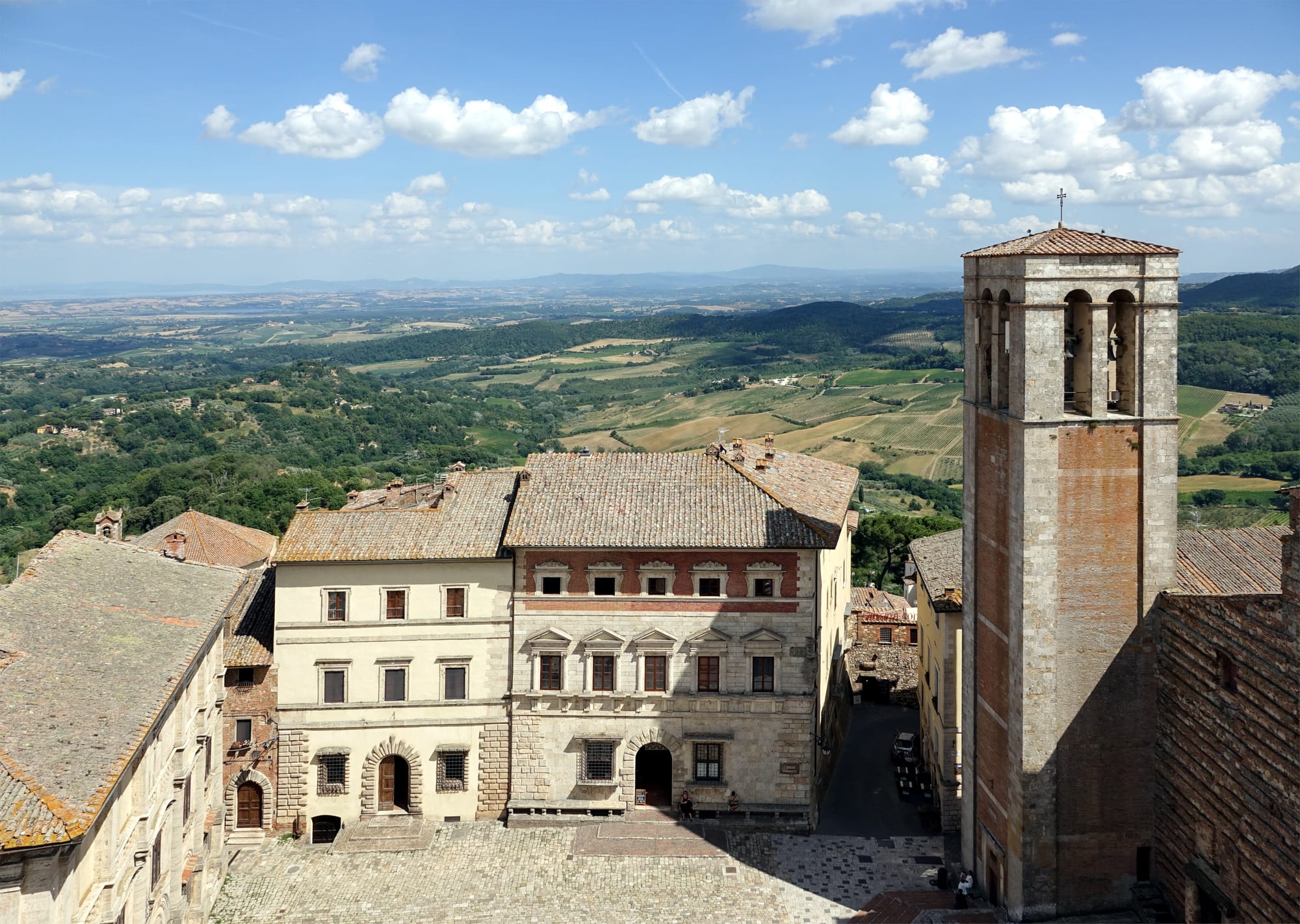
Palaces and a brick bell tower on Montepulciano's Piazza Grande, with green fields and hills stretching to the horizon

Tuscany, Italy

Montepulciano

Piazza Grande in Montepulciano, with the countryside of southern Tuscany beyond. (Gzen92 / Wikimedia Commons · CC BY-SA 4.0)

A medieval and Renaissance hill town on a 605-metre limestone ridge in southern Tuscany, between the Val d'Orcia and the Val di Chiana. Florentine-era architects lined its main street with palaces, and its vineyards make Vino Nobile di Montepulciano. Today it lives on wine and visitors, who come for its piazza, its cellars and the August barrel race.

Neighbourhoods

  • Piazza Grande and the upper town
    • First-time visitors
    • Historic district

    The cathedral square at the top of the town, framed by the Palazzo Comunale, the Contucci palace and the Palazzo Tarugi. Wine cellars burrow into the hillside under the surrounding streets, and the square is the finish of the Bravio and the stage for the summer Bruscello.

    Open in Maps
  • The Corso
    • Shopping
    • Best for food
    • Wine tasting

    The main street, which climbs about one and a half kilometres from Porta al Prato to Piazza Grande under a series of names. Most of the town's shops, restaurants and tasting cellars line it, between Renaissance palaces and churches.

    Open in Maps
  • San Biagio and the slopes
    • Architecture
    • Views
    • Walks

    Below the walls on the road to Chianciano, the domed travertine church of San Biagio stands alone among fields and cypresses, linked to the town by a steep walk.

    Open in Maps
  • Montepulciano Stazione and the valley
    • Quiet and residential
    • Close to public transport

    The lower part of the municipality in the Val di Chiana, a village that grew up around the old railway station, with the small Lago di Montepulciano nearby and vineyards all around.

    Open in Maps

Things to do

Famous landmarks

  • Piazza Grandelandmark

    The town's main square, surrounded by the cathedral, the Palazzo Comunale, the Contucci palace and the Palazzo de' Nobili-Tarugi.

    Open in Maps
  • Montepulciano Cathedrallandmark

    Santa Maria Assunta, built from 1594 and consecrated in 1712, whose high altar holds Taddeo di Bartolo's Assumption triptych of 1401, with the painter's self-portrait as the apostle Thaddeus.

    Open in Maps
  • Palazzo Comunaleviewpoint

    The town hall designed by Michelozzo on the model of Florence's Palazzo Vecchio, whose clock tower can be climbed for a view over the town.

    Open in Maps
  • San Biagiolandmark

    Antonio da Sangallo the Elder's church of 1518–45 outside the walls, built of white travertine on a central plan with a large dome and two bell towers.

    Open in Maps

Museums and wine cellars

  • Museo Civico di Montepulcianomuseum

    The town museum in the 14th-century Palazzo Neri Orselli, founded in 1954, with archaeological finds, paintings and terracottas by the Della Robbia family.

    Open in Maps
  • Cellars around Piazza Grandeattraction

    Wine houses such as Contucci open cellars cut into the hillside under the old town, where Vino Nobile ages in very large oak barrels.

    Open in Maps

Short trips from the town

  • Pienzaattraction

    The town between Montepulciano and Montalcino considered the touchstone of Renaissance urbanism, a UNESCO World Heritage Site since 1996.

    Open in Maps
  • La Foceattraction

    A large Val d'Orcia estate whose 15th-century villa and gardens were restored by Iris and Antonio Origo in the 1920s, with gardens designed by Cecil Pinsent.

    Open in Maps
  • Chianciano Termeattraction

    A neighbouring town between the Val di Chiana and the Val d'Orcia, reached along the road past San Biagio.

    Open in Maps
  • Lago di Montepulcianopark

    A small lake on the floor of the Val di Chiana, at about 249 metres above sea level.

    Open in Maps
  • Chiusiattraction

    The ancient Etruscan Clevsin, whose legendary king Lars Porsena is said to have founded Montepulciano, and today the nearest main-line railway station.

    Open in Maps

Seasonal events

  • Bruscello Polizianomid-August

    Folk theatre with songs and music, performed by local non-professional actors on the cathedral steps in Piazza Grande around 15 August.

  • Bravio delle bottilast Sunday of August

    Teams from the town's eight contrade roll 80-kilogram wine barrels uphill from the Colonna del Marzocco to Piazza Grande, after a week of processions and parties.

  • Cantiere Internazionale d'Artesummer

    A summer school and music festival for young performers and composers, founded by Hans Werner Henze in 1976, with performances across the town.

Eat and drink

Long-standing places and food districts in Montepulciano. Hours, ratings and directions come from your maps app, always current.

Montepulciano classics

  • Tasting cellars on the Corsoneighborhood

    Cellars along Via Ricci and Via di Gracciano nel Corso pour Vino Nobile, Rosso di Montepulciano and Vin Santo for tasting.

    Open in Maps
  • Restaurants around Piazza Grandeneighborhood

    Trattorias and wine bars in the upper town serve pici, pecorino and other dishes of southern Tuscany.

    Open in Maps

Markets

  • Thursday marketmarket

    The weekly market of produce and other goods, held on Thursday mornings by the bus station.

    Open in Maps

Experience Montepulciano

History

Legend says the Etruscan king Lars Porsena of Clusium, modern Chiusi, founded the town; finds show a settlement existed in the 4th and 3rd centuries BC. In Roman times it held a garrison guarding the roads of the area, and after the fall of the Western Empire it grew as a religious centre under the Lombards — a document of 715 records a church at Castello Pulliciano on the site of the later San Biagio.

In the 12th century Siena attacked the town repeatedly, and the townspeople, the Poliziani, resisted with help from Perugia, Orvieto and sometimes Florence. The 14th century brought feuds between noble families until the Del Pecora took control. From 1390 Montepulciano was an ally, and later a possession, of Florence, and until the mid-16th century it enjoyed its finest period, when Antonio da Sangallo the Elder, Vignola, Baldassarre Peruzzi and Ippolito Scalza built palaces and churches. The humanist poet Angelo Poliziano was born here in 1454, and families such as the Bellarmino, Tarugi and Contucci gave the Church a pope, cardinals and dozens of bishops.

After Florence conquered Siena in 1559 the town lost its strategic role and declined, although it became a bishop's seat and began its cathedral in 1594. After Italian unification it passed from the province of Arezzo to that of Siena and became the main agricultural market of the area, while industry moved down towards the railway, which reached the valley in 1884. Since the Second World War tourism has become a large part of the town's economy.

Culture & Customs

The town's year peaks in August. The Bruscello, a form of Tuscan peasant theatre sung and acted by non-professionals, has been staged every year since 1939 on the cathedral steps around 15 August, telling stories that range from the epic to the farcical. On the last Sunday of the month comes the Bravio delle botti, a race held since 1974 in place of a horse race recorded from 1373: pairs of runners from the eight contrade, each with its own colours, push 80-kilogram barrels up through the streets to Piazza Grande, competing for a painted cloth bearing the town's patron saint.

Music has a strong place. The composer Hans Werner Henze founded the Cantiere Internazionale d'Arte here in 1976, a summer workshop where artists and townspeople stage performances together, and several works have had their premieres at the festival; the Teatro Poliziano is the town's theatre. The rock band Baustelle, formed in 1994, has its roots in the town.

Local pride centres on the town's Renaissance heritage and its famous sons: Angelo Poliziano, the Renaissance scholar and poet, and St Agnes of Montepulciano, born near the town in 1268. Visitors also come because scenes of the Twilight films were shot here. Montepulciano is twinned with Moulins in France.

Daily Life

About 13,000 people live in the municipality, which takes in the hill town and villages in the valley below, among them Montepulciano Stazione. Wine is the backbone of the local economy: the Vino Nobile consortium brings together all the producers of the area, and vineyards cover much of the surrounding land. Tourism, growing since the Second World War, supports the shops, cellars and restaurants of the historic centre.

Within the walls, many streets are closed to traffic, and most commercial life runs along the Corso, which stretches about one and a half kilometres from Porta al Prato to Piazza Grande. The weekly market fills the square by the bus station on Thursday mornings, and the town's weekly newspaper, L'Araldo Poliziano, covers mainly news of the diocese of Montepulciano-Chiusi-Pienza.

The town is governed by an elected mayor and council; Michele Angiolini, first elected in 2019, was re-elected in June 2024 with about 53 per cent of the vote.

Food

Montepulciano's fame rests on Vino Nobile di Montepulciano, a red wine with DOCG status made mainly from Sangiovese, known locally as Prugnolo gentile, blended with Canaiolo Nero and small amounts of other local grapes, and aged for at least two years, one of them in oak. With Brunello di Montalcino and Chianti Classico it is one of the principal red wines of Tuscany. The poet Francesco Redi praised it as the king of all wines. It should not be confused with Montepulciano d'Abruzzo, a wine made from a different grape in another region. The area also makes Rosso di Montepulciano and Vin Santo di Montepulciano, both with DOC status; Vin Santo is a Tuscan dessert wine, often made from dried white grapes.

The town is also known for pici and pecorino cheese. Pici are a thick, hand-rolled Tuscan pasta, like fat spaghetti. Other Tuscan staples appear on the menus: ribollita, a soup that began as the previous day's vegetable soup reheated; game such as wild boar and hare in sauces for pappardelle; and cantucci, oblong almond biscuits.

Planning tools

Budget

Montepulciano costs less than Florence, though summer and harvest-time rooms in and around the town fill and rise in price. Cellar tastings are often free or cheap, and the main extra cost is a hire car, which makes the Val d'Orcia and the Val di Chiana easy to explore.

Daily Budget Midrange
USD 160–320 (farm stay or room in town, sit-down dinners, wine tastings, a hire car)
Daily Budget Shoestring
USD 80–140 (simple B&B, trattoria lunches, buses)

Car parks below the walls fill quickly in late summer, so arriving early in the day helps.

Best Time to Visit

Spring and early autumn are the most comfortable seasons, with green or harvest-coloured hills. August is hot and busy, but it brings the Bruscello and the Bravio delle botti. Winter is quiet and cool, with cold nights.

Suggested Number of Days

One or two days cover the town itself at an easy pace. With a car, three to five days allow time for the wine country and the neighbouring towns of the Val d'Orcia and the Val di Chiana; buses make the same trips slower.

First Visit
1–2 days
With Surroundings
3–5 days

Transportation

The historic centre is walked along steep streets, and driving inside it without a resident's permit brings fines. Buses leave from Piazza Pietro Nenni for Siena (about 75 minutes, none on Sundays), Pienza (about 30 minutes), Chiusi (hourly) and Montalcino (with a change). A car is the practical way to see the countryside.

From the bus station, a pedestrian short cut with a lift and stairs climbs to the top of the cliff, entered from Via delle Lettere.

Airport & Station Connections

The nearest main-line railway station is at Chiusi, about half an hour's drive away, with frequent trains to Florence and Rome; buses link it with the town. By road, Montepulciano is a few kilometres from the A1 motorway, about 124 kilometres from Florence and 186 kilometres from Rome.

Walkability

The old town is made for walking, and many streets are car-free, but almost every route is steep: the Corso climbs about one and a half kilometres to Piazza Grande, and the walk back up from San Biagio is hard work. Comfortable shoes matter on the stone paving.

Safety

Italy is generally safe, with low levels of violent crime against visitors. In Montepulciano the practical concerns are steep, uneven streets, summer heat, break-ins at countryside car parks and narrow, winding country roads shared with cyclists.

Keep valuables out of sight in parked cars, carry water in summer, and arrange a driver or a taxi after cellar tastings. Check current official travel advice before travelling.

Climate

A sub-Mediterranean climate: hot and breezy in summer, with wide swings between day and night in winter. Spring and autumn are mild.

Summer
warm to hot — afternoons average 25–32°C, sometimes reaching 35°C or more, with nights of 15–20°C
Winter
cool — afternoons average 10–14°C and nights 3–5°C

Local Customs

Life follows Tuscan rhythms: espresso standing at the bar, unhurried meals at set times and the evening stroll along the Corso. Loyalty to the eight contrade runs high around the Bravio in August.

Dress modestly in the cathedral and San Biagio, ask before photographing people, and drink in moderation at tastings.

Common Payment Methods

Italy uses the euro. Cards work widely; keep a little cash for small purchases, bars and the market. Many Italian towns levy a per-night tourist tax collected at the accommodation.