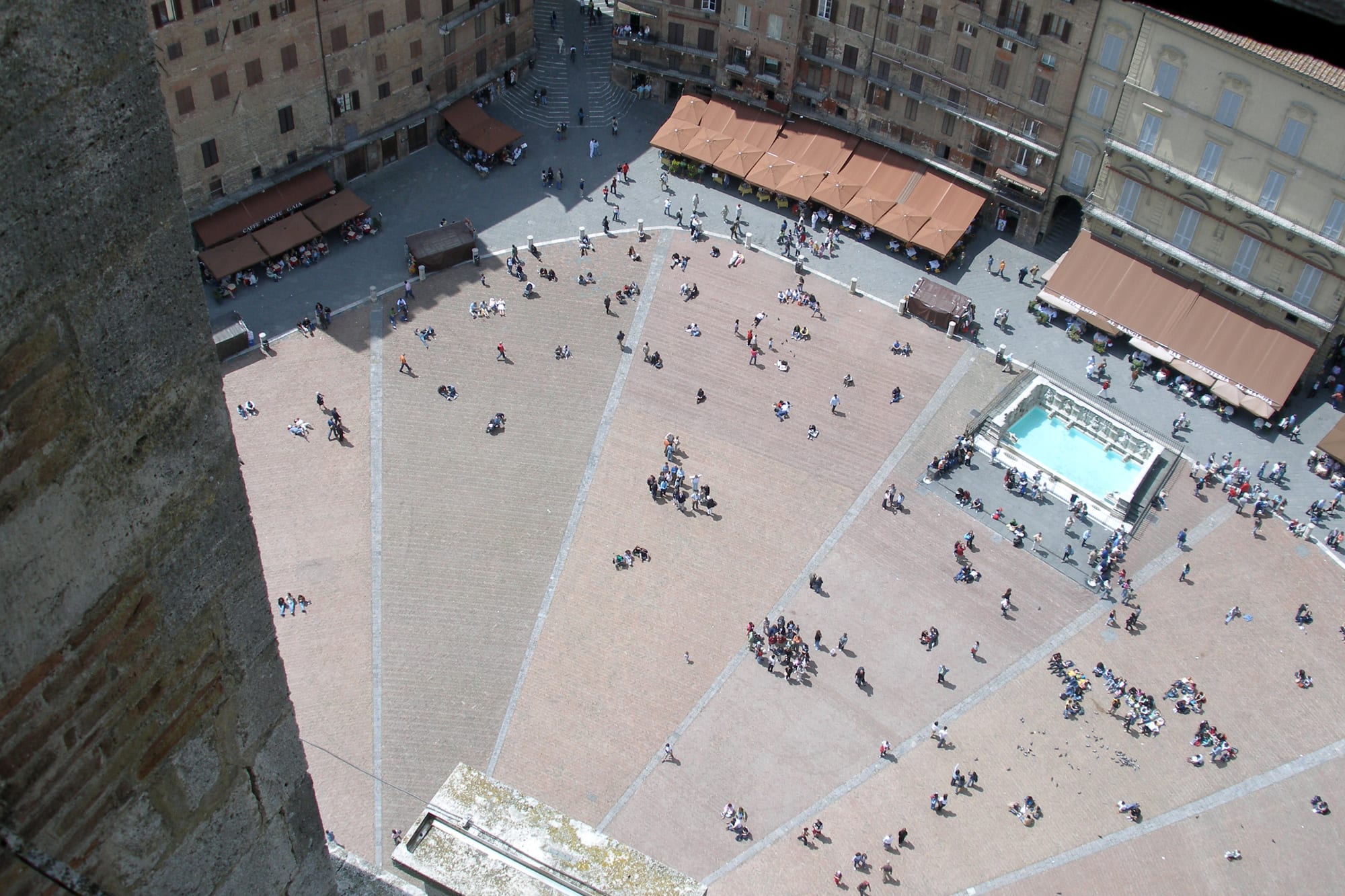
Looking down on the fan-shaped brick paving of Piazza del Campo, with people, café awnings and the Fonte Gaia fountain

Tuscany, Italy

Siena

Piazza del Campo and the Fonte Gaia seen from the Torre del Mangia in Siena. (Vyacheslav Argenberg / Wikimedia Commons · CC BY 4.0)

A hill city in central Tuscany, settled by the Etruscans and refounded as the Roman colony of Saena Iulia, that grew rich on wool and banking as Florence's medieval rival. Its brick Gothic centre, a UNESCO World Heritage Site, still turns on the shell-shaped Piazza del Campo, and its seventeen contrade still race the Palio around it every summer.

Neighbourhoods

  • Terzo di Città
    • First-time visitors
    • Historic district
    • Museums

    One of the three 'thirds' of the old city, on the hill to the south-west of the Campo. The cathedral, the baptistery, the Santa Maria della Scala hospital museum and the Pinacoteca are here, along Via di Città and its Gothic palaces.

    Open in Maps
  • Terzo di San Martino
    • Quiet and residential
    • Historic district

    The south-eastern third, falling away from the Campo along Banchi di Sotto and Via del Porrione towards the city gates. Its streets are quieter, more residential and home to several contrade with their own churches and museums.

    Open in Maps
  • Terzo di Camollia
    • Shopping
    • Close to public transport
    • Local life

    The northern third, along the shopping street of Banchi di Sopra past Palazzo Salimbeni, the head office of the Monte dei Paschi. It takes in San Domenico, the medieval fountain of Fontebranda and the Medici fortress, near the long-distance bus stops and the main car parks.

    Open in Maps

Things to do

Famous landmarks

  • Piazza del Campolandmark

    The shell-shaped main square, regarded as one of Europe's greatest medieval squares, where the Palio is run and the Strade Bianche cycle race finishes.

    Open in Maps
  • Palazzo Pubblicolandmark

    The town hall on the Campo, begun in 1297 for the republic's Council of Nine, whose civic museum holds Ambrogio Lorenzetti's frescoes of Good and Bad Government.

    Open in Maps
  • Torre del Mangiaviewpoint

    The town hall's tower, built in 1338–1348 and 102 metres high, one of the tallest secular towers of medieval Italy, with views over the Campo and the hills.

    Open in Maps
  • Siena Cathedrallandmark

    The striped Romanesque–Gothic cathedral built between 1215 and 1263, whose plan to become one of Europe's largest churches was halted by the Black Death in 1348.

    Open in Maps
  • Baptistery of San Giovannilandmark

    The baptistery beside the end of the cathedral's choir, built in 1316–1325, with a bronze and marble font made by Donatello, Ghiberti and Jacopo della Quercia.

    Open in Maps
  • Fonte Gaialandmark

    The fountain on the Campo, first completed in 1342 when water was piped from 25 km away, with a frame by Jacopo della Quercia now replaced by 19th-century copies.

    Open in Maps
  • Palazzo Salimbenilandmark

    A Gothic palace off Banchi di Sopra that houses the main offices of the Monte dei Paschi, founded in 1472 and the oldest bank in the world.

    Open in Maps

Museums and churches

  • Santa Maria della Scalamuseum

    One of Europe's first hospitals, which cared for abandoned children, the poor, the sick and pilgrims for centuries, and is now a museum facing the cathedral.

    Open in Maps
  • Museo dell'Opera del Duomomuseum

    The cathedral museum, home to Duccio's Maestà of 1308–11 and Giovanni Pisano's Gothic sculptures from the cathedral front.

    Open in Maps
  • Pinacoteca Nazionalemuseum

    One of the largest collections of Sienese gold-ground paintings of the 14th and 15th centuries, in two palaces in the centre.

    Open in Maps
  • Basilica of San Domenicolandmark

    A large brick Gothic church, also called the Basilica Cateriniana for its links with Catherine of Siena, with a Maestà by Guido da Siena and works by Matteo di Giovanni and Il Sodoma.

    Open in Maps
  • Accademia Musicale Chigianaattraction

    A music academy in the 14th-century Palazzo Chigi-Saracini on Via di Città, holding summer concerts and a museum of musical instruments.

    Open in Maps

Walks and green spaces

  • Fortezza Mediceapark

    The fortress Cosimo de' Medici built in 1561–1563 after conquering the city, now a walk on the ramparts beside the stadium and a venue for festivals and concerts.

    Open in Maps
  • Fontebrandalandmark

    One of Siena's medieval fountains, in the contrada of Oca beside the city gate of the same name.

    Open in Maps

Short trips from the city

  • Monteriggioniattraction

    A small walled town north of Siena, mentioned by Dante in the Divine Comedy and built by the Sienese in 1214–19 as a front-line fortress in their wars against Florence.

    Open in Maps
  • Abbey of Monte Oliveto Maggioreattraction

    A large red-brick Benedictine monastery standing out against the grey clay hills of the Crete Senesi, the mother house of the Olivetans.

    Open in Maps
  • San Gimignanoattraction

    A small walled hill town that keeps about a dozen of its medieval tower houses, giving it one of the best-known skylines in Tuscany.

    Open in Maps

Seasonal events

  • Strade Bianchefirst or second Saturday of March

    A professional cycle race over the white gravel roads of the Crete Senesi, starting and finishing in Siena, with the finish on the Campo.

  • Palio di Siena2 July and 16 August

    Ten of the seventeen contrade race bareback for three laps of the earth-covered Campo, in a race that usually lasts no more than 90 seconds, after a historical pageant.

  • Estate Musicale Chigianasummer

    The Chigiana academy's season of summer concerts.

Eat and drink

Long-standing places and food districts in Siena. Hours, ratings and directions come from your maps app, always current.

Siena classics

  • Picirestaurant

    Thick, hand-rolled pasta like fat spaghetti, from the province of Siena, usually of flour and water only, served with meat sauces and other dressings.

    Open in Maps
  • Panforte, ricciarelli and cavalluccirestaurant

    Siena's sweets: chewy panforte of fruit and nuts, almond ricciarelli biscuits dating back to the 14th century, and anise-scented cavallucci, all traditional at Christmas.

    Open in Maps

Markets and food streets

  • Wednesday market at the Fortezzamarket

    A large weekly market held on Wednesday mornings around the Medici fortress.

    Open in Maps
  • Restaurants of the Terzo di Cittàneighborhood

    Trattorias on the streets around Via di Città, the cathedral and the house of St Catherine, serving Tuscan cooking a few steps from the main sights.

    Open in Maps

Experience Siena

History

Siena was first settled in Etruscan times, and a Roman town called Saena Iulia was founded on the site under Augustus. Local legend gives it a grander origin: it was said to have been founded by Senius and Aschius, sons of Remus, and wolves, recalling the mother-wolf of Romulus and Remus, spout water on the Fonte Gaia in the Campo. The first known record of the community dates from 70 AD, when a Roman senator complained that he had been mocked with a fake funeral during an official visit to the small colony.

The city's golden age came in the 13th and 14th centuries. Wool and banking made it rich, guilds regulated its trades, the University was founded in 1240, and the republic built the cathedral, the Palazzo Pubblico and the Campo. Siena had about 50,000 people before the Black Death of 1348 killed roughly half of them and halted the vast extension of the cathedral, whose unfinished walls still stand. Painters such as Duccio, Simone Martini and the Lorenzetti brothers gave the city its own school of art, and in the 1330s Ambrogio Lorenzetti painted the Good and Bad Government frescoes for the council chamber. In 1472 the Monte dei Paschi was founded; it is the oldest bank in the world still operating.

The long rivalry with Florence ended in the Italian War of 1551–1559, when Florence and Spain besieged the city. Siena surrendered to Spain on 17 April 1555 after eighteen months of resistance, and in 1559 the republic was ceded to the Medici, whose new fortress was built in 1561–1563 to hold the city. After the Medici line died out in 1737, Siena passed with the rest of the grand duchy to the Habsburg-Lorraine dynasty. The historic centre was inscribed as a UNESCO World Heritage Site in 1995.

Culture & Customs

Siena's identity is built on its seventeen contrade, the city wards originally formed as battalions for its defence. Each has an animal or emblem — the Eagle, Caterpillar, Snail, Owl, Dragon, Giraffe, Porcupine, Unicorn, She-wolf, Seashell, Goose, Wave, Panther, Forest, Tortoise, Tower and Ram — and its own boundary, church, museum and celebrations; the feast of one of the city's patron saints marks the start of the contrada year. The rivalries come to a head in the Palio on 2 July and 16 August, when ten contrade send bareback riders three times around the Campo, covered with earth for the race, in about ninety seconds, after a long historical pageant. The prize is a painted banner bearing an image of the Virgin Mary.

Art is the other pillar. The Sienese school of Duccio, Simone Martini and the Lorenzetti brothers developed in parallel with Florence's and influenced painting across Europe; in 2024 and 2025 an exhibition on the rise of Sienese painting was held at the Metropolitan Museum in New York and the National Gallery in London. Catherine of Siena, born and raised in the city in the 14th century and now a patron saint of Italy, is venerated at San Domenico.

Music continues at the Accademia Musicale Chigiana, founded in 1932 by Count Guido Chigi-Saracini, which runs master classes and summer concerts in his palace on Via di Città. The Strade Bianche cycle race finishes in the Campo each March, and in 2025 the city won the European Green Leaf Award for 2027.

Daily Life

About 53,000 people live in the comune, according to the 2026 figure. The population is old — more than a quarter are over 65 — and about one resident in seven is an immigrant. The University of Siena, founded in 1240 as the Studium Senese, keeps a student population in the old centre.

The main activities are tourism, services, agriculture, handicrafts and light industry, with growth in biotechnology. The Monte dei Paschi, the oldest bank in the world, still has its head office in Palazzo Salimbeni, and in 2025 it acquired Mediobanca, becoming Italy's third-largest bank. A seasonal confectionery industry turns out panforte, ricciarelli and cavallucci for Christmas and pane co' santi for All Saints' and All Souls' days.

Inside the walls the city is divided into the three terzi — Città, San Martino and Camollia — and the seventeen contrade within them, each with its own boundary and identity, so that a Sienese belongs to a ward as well as to the city. Cars are largely kept out of the centre, and small buses serve its streets and link it with the newer districts below the walls.

Food

Sienese cooking belongs to the Tuscan tradition but has its own specialities. Pici, thick hand-rolled pasta like fat spaghetti, come from the province of Siena; the dough is usually just flour and water, rolled into strands slightly thinner than a pencil and uneven because they are made by hand, and served with meat sauces and other dressings.

The city is best known for its sweets. Panforte is a chewy cake dense with fruit and nuts, an Italian Christmas tradition associated above all with the province of Siena. Ricciarelli, soft almond biscuits, date from 14th-century Siena and are counted among its signature sweets along with cenci and cavallucci, Christmas pastries made with anise, walnuts, candied fruit, coriander and flour and traditionally sweetened with millefiori honey. Pane co' santi is baked for All Saints' Day on 1 November and All Souls' Day the next day.

The surrounding province produces some of Tuscany's best-known wines, with Chianti Classico to the north and Brunello di Montalcino and Vino Nobile di Montepulciano to the south. A large market fills the area around the Fortezza on Wednesday mornings.

Planning tools

Budget

Siena costs less than Florence for rooms, but prices rise steeply in the days around the Palio in July and August, when the city fills up. Many visitors come for the day from Florence, so evenings and nights are quieter and better value. Combined museum tickets help with the cathedral complex.

Daily Budget Midrange
USD 170–320 (mid-range hotel in or near the walls, sit-down dinners, museum tickets for the cathedral and town hall)
Daily Budget Shoestring
USD 80–130 (hostel or simple B&B, bakery and trattoria lunches, buses and regional trains)

Book months ahead to stay during the Palio, and park outside the walls rather than trying to drive into the centre.

Best Time to Visit

April to June and September to October give mild days for walking the steep streets. The Palio on 2 July and 16 August brings the city's greatest spectacle along with crowds and heat. Winters are cool, and the centre is quiet outside the Christmas season of panforte and ricciarelli.

Suggested Number of Days

Many visitors come for a single day, but staying overnight allows the city to be seen without the day-trip crowds. Allow three or four days to add the hill towns and countryside nearby; a Palio visit needs extra time around the race days.

First Visit
1–2 days
With Surroundings
3–4 days

Transportation

The centre is a limited-traffic zone of steep, narrow streets and is best walked. Small buses run through some central streets, and other lines link the gates with the railway station and the outskirts. Car parks near the Fortezza and around the walls are the usual places to leave a car.

Buy bus tickets at newsstands or tobacconists before boarding, as they cost more from the driver.

Airport & Station Connections

There is no major airport at Siena: most air travellers land at Florence or Pisa, and buses also link Siena with the airports of Pisa and Bologna. Trains run from Florence about hourly, directly or with a change at Empoli. The station lies about 2 km below the centre, linked by buses and by escalators through a shopping centre; coaches from Florence stop near the old town.

Walkability

The walled centre is compact and almost free of cars, but it sits on three ridges, so streets climb and drop steeply and some lanes are stepped. Everything inside the walls is within about twenty minutes' walk of the Campo. The walk up from the station takes about twenty to thirty minutes.

Safety

Italy is generally safe, with low levels of violent crime against visitors. Siena is a calm city; the main risks are pickpocketing in the crowds of the Campo and the cathedral at busy times, and the press of people during the Palio, when the centre of the square is packed for hours.

Anyone watching the Palio from the centre of the Campo should arrive early, carry water and expect not to leave until after the race. Check current official travel advice before travelling.

Climate

A typical inland Mediterranean climate: warm, dry summers and cool, damp winters.

Summer
warm — August is the hottest month, averaging 24.4°C; about ten days a year pass 34°C, and the record is 39.6°C
Winter
cool — January is the coldest month, averaging 6.4°C

Local Customs

The contrade are taken seriously: each has its own colours, church, museum and animal emblem, and their flags and scarves are worn with pride, especially around Palio time, so the rivalries are best treated with respect. Churches expect covered shoulders and knees.

Service is usually included in the bill, and rounding up is enough. Coffee is cheapest standing at the bar.

Common Payment Methods

The currency is the euro. Cards and contactless payment are widely accepted in hotels, restaurants and shops; carry some cash for small bars, bakeries and the weekly market. ATMs are found throughout the centre.