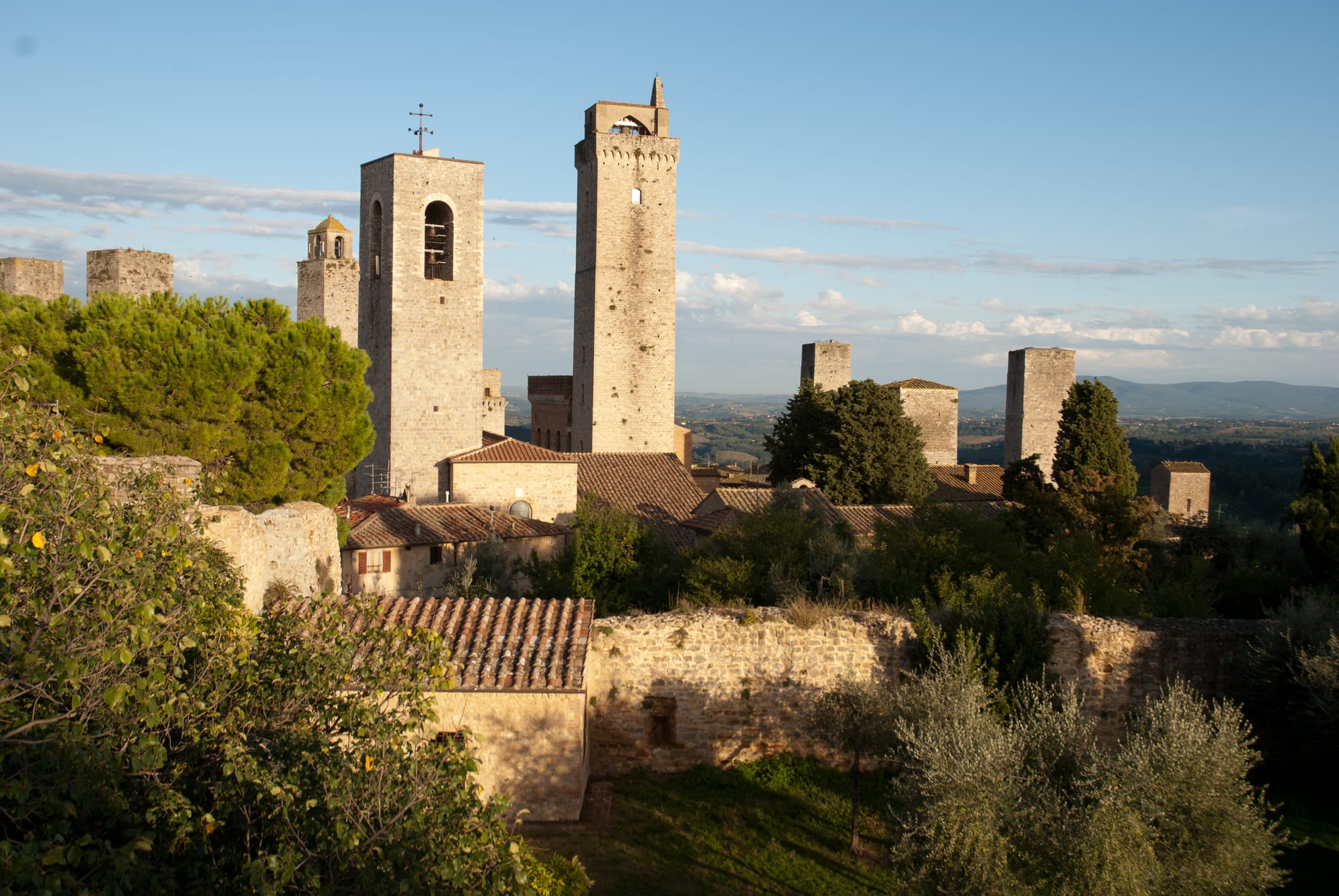
Stone medieval towers of San Gimignano rising above tiled roofs, old walls and olive trees in warm evening light

Tuscany, Italy

San Gimignano

Medieval tower houses above the rooftops and walls of San Gimignano. (Thomas Quine / Wikimedia Commons · CC BY 2.0)

A small walled hill town in the Val d'Elsa, in the province of Siena, known for the medieval tower houses that survive above its rooftops. Saffron, Vernaccia wine and pilgrims on the Via Francigena made it rich; plague and Florentine rule froze it in time. Today its frescoed churches and squares draw day visitors from Florence and Siena.

Neighbourhoods

  • Piazza della Cisterna and Piazza del Duomo
    • First-time visitors
    • Historic district

    The two linked squares at the heart of the town. The triangular Piazza della Cisterna, with its 14th-century well, is ringed by towers and medieval houses; a passage beside an open loggia leads to Piazza del Duomo, with the Collegiata at the top of its steps and the Palazzo Comunale beside it.

    Open in Maps
  • Via San Giovanni and Porta San Giovanni
    • Close to public transport
    • Shopping

    The southern approach, where buses arrive at the town gate and Via San Giovanni climbs between stone houses and shops to the central squares. It is the busiest street in the daytime, when day trippers walk up from the gate.

    Open in Maps
  • Via San Matteo and Sant'Agostino
    • Quieter streets
    • Churches

    The northern half of the town, reached along Via San Matteo towards Porta San Matteo. The square in front of the church of Sant'Agostino is calmer than the centre, and small restaurants sit in the side alleys.

    Open in Maps
  • The Val d'Elsa countryside
    • Wine
    • Farm stays
    • Quiet and rural

    The municipality spreads over vineyards, olive groves and woods around the hill, with small villages such as Ulignano, Badia a Elmi and Pancole. This is where Vernaccia is grown and where many visitors stay on farms outside the walls.

    Open in Maps

Things to do

Famous landmarks

  • Collegiata di Santa Maria Assuntalandmark

    The town's main church, a collegiate church and minor basilica covered in fresco cycles by Domenico Ghirlandaio, Benozzo Gozzoli, Taddeo di Bartolo, Lippo Memmi and Bartolo di Fredi; the Chapel of Santa Fina holds the saint's shrine.

    Open in Maps
  • Palazzo Comunale and Torre Grossamuseum

    The seat of the town government since the 13th century, now a civic museum and gallery with works by Pinturicchio, Filippino Lippi and Benozzo Gozzoli, from which visitors climb the Torre Grossa, at 54 metres the tallest tower in town.

    Open in Maps
  • Torre Rognosalandmark

    A 51-metre tower of the 13th century above Piazza del Duomo, one of the best preserved in the town and the second tallest after the Torre Grossa.

    Open in Maps
  • Piazza della Cisternalandmark

    The main square, triangular and brick-paved, named after a cistern of 1287 and surrounded by towers and medieval palaces, with a well at its centre.

    Open in Maps
  • Sant'Agostinolandmark

    The town's second-largest church, a 13th-century building whose apse is painted with Benozzo Gozzoli's seventeen-panel cycle on the life of St Augustine, from 1463–67.

    Open in Maps

Museums and viewpoints

  • SanGimignano1300museum

    A museum built around a large scale reconstruction of the town as it was in the 13th and 14th centuries, explaining medieval life in Tuscany.

    Open in Maps
  • Rocca di Montestaffoliviewpoint

    The ruins of the fortress on the town's highest point, dating from 1348, with a panorama over the Tuscan countryside.

    Open in Maps
  • Vernaccia di San Gimignano Wine Experienceattraction

    The town's documentation and tasting centre for its Vernaccia wine, housed in the villa within the Rocca di Montestaffoli.

    Open in Maps

Short trips from the town

  • Santa Maria Assunta in Cellolelandmark

    A Romanesque former parish church at Pancole, within the municipality, first mentioned in 1109 and consecrated in 1238.

    Open in Maps
  • Certaldoattraction

    A Valdelsa town that was home to the family of Giovanni Boccaccio, author of the Decameron, who was buried there in 1375.

    Open in Maps
  • Volterraattraction

    A walled mountaintop town whose history goes back before the 8th century BC, with Etruscan, Roman and medieval buildings.

    Open in Maps
  • Monteriggioniattraction

    A small walled hill town referenced in Dante's Divine Comedy, Siena's ally in its medieval wars with Florence.

    Open in Maps

Seasonal events

  • Festa di San Gimignanolate January

    The feast of the town's patron, St Geminianus, after whom the town was renamed.

  • Festa di Santa FinaMarch

    The feast of Santa Fina, born in the town in 1238, whose shrine is in the Collegiata; a second thanksgiving celebration in her honour is held on the first Sunday of August.

  • Ferie delle Messimid-June

    A historical festival of medieval re-enactment held in the town each June.

  • San Silvestro tra le TorriNew Year's Eve

    The end-of-year celebration in Piazza del Duomo.

Eat and drink

Long-standing places and food districts in San Gimignano. Hours, ratings and directions come from your maps app, always current.

San Gimignano classics

  • Vernaccia and saffron shopsneighborhood

    Shops across the old town offer tastings of Vernaccia di San Gimignano, the local white wine, and sell the town's saffron.

    Open in Maps
  • Restaurants in the side alleysneighborhood

    The main squares are the busiest places to eat; smaller trattorias in the alleys and near Sant'Agostino serve homemade pasta, game and Tuscan dishes.

    Open in Maps

Markets and cafés

  • Thursday marketmarket

    Thursday is the weekly market day in the central squares.

    Open in Maps
  • Cafés on Piazza della Cisternacafe

    Tables around the well in the main square, the place for a coffee, an ice cream or a glass of Vernaccia among the towers.

    Open in Maps

Experience San Gimignano

History

In the 3rd century BC a small Etruscan village stood on the hill. Local tradition holds that the place took its present name in 450 AD, after Bishop Geminianus of Modena intervened to spare it from the followers of Attila the Hun; a church was dedicated to him, and in the 6th and 7th centuries a walled village grew up around it. From 929 the town was ruled by the bishop of Volterra. It sat on the Via Francigena, the pilgrim road to Rome, and grew rich on the produce of the hills around it, above all saffron, used in cooking and for dyeing cloth and sold as far as France, the Low Countries, Syria and Egypt, and Vernaccia wine.

In 1199 the town freed itself from the bishops and set up its own podestà. The next two centuries were marked by the struggle between Guelphs and Ghibellines and by feuds between local families, who built ever taller tower houses; by the end of the Middle Ages there were 72, some up to 70 metres high, until the council ruled that none could top the tower beside the Palazzo Comunale. Dante visited on 8 May 1300 as an ambassador of the Guelph League.

The Black Death of 1348 killed about half the townspeople, and the weakened town submitted to Florence. Many towers were cut down to the height of the houses, and with little later building the town stayed in its medieval state until the 19th century, when it began to be valued as an artistic and tourist destination. The area was bombed by the Allies for ten days during the Second World War. Today the historic centre is a UNESCO World Heritage Site, with about a dozen of its towers still standing.

Culture & Customs

San Gimignano's identity is bound up with its towers and its frescoes. The Collegiata, the Palazzo Comunale and Sant'Agostino hold frescoes and paintings by Ghirlandaio, Benozzo Gozzoli, Lippo Memmi and Pinturicchio, a wealth of art for a town of its size. Its patron is St Geminianus, but the town also honours Santa Fina, born here in 1238, whose chapel in the Collegiata carries frescoes by Ghirlandaio and whose feast falls in March. The medieval poet Folgore da San Gimignano, whose sonnets date from around 1308–1316, carries the town's name.

The towers have drawn writers and film-makers. E. M. Forster turned the town into Monteriano in his 1905 novel Where Angels Fear to Tread, M. C. Escher made a woodcut of the towers in 1923, Franco Zeffirelli filmed most of the Assisi scenes of Brother Sun, Sister Moon here, and Tea with Mussolini was shot partly in the town. A 15th-century version of it appears in the video game Assassin's Creed II.

The calendar mixes religious feasts with the Ferie delle Messi, a medieval re-enactment in mid-June, and a New Year's Eve celebration in Piazza del Duomo. The local speech, shared across the Val d'Elsa, is a blend of Florentine and Sienese dialects, a reminder of the town's changing masters. San Gimignano is twinned with Český Krumlov in the Czech Republic, Meersburg in Germany and Mestia in Georgia.

Daily Life

The municipality, home to 7,463 people at the end of 2025, covers some 138 square kilometres of the Val d'Elsa, rising from the plain of the Elsa river to over 600 metres. Only part of the population lives within the walls; the rest live in villages such as Badia a Elmi, the largest, Ulignano and Santa Lucia, and on farms across the hills. Foreign residents made up a little under a tenth of the population at the end of 2019.

San Gimignano is an agricultural town famous for its Vernaccia vineyards and its saffron, and tourism dominates the economy of the old centre, where wine shops, galleries and restaurants line the main streets. The daily rhythm follows the visitors: the streets fill from mid-morning as coaches and buses arrive, and empty again in the evening, when those who stay sit on the steps of the Collegiata in the quiet. Thursday is market day in the centre.

The town is run by an elected mayor and council. Andrea Marrucci, first elected in 2019, was re-elected in June 2024 with almost 85 per cent of the vote.

Food

The town's wine is Vernaccia di San Gimignano, a white made from the old Vernaccia grape on the sandstone hillsides around the town. It was the first Italian wine to receive DOC status, in 1966, and was raised to DOCG in 1993. Shops across the old town pour it for tasting, and the municipality runs a tasting and documentation centre for it in the villa at the Rocca di Montestaffoli.

Saffron, the spice made from the dried stigmas of the saffron crocus, made the town rich in the Middle Ages and is still grown here as Zafferano di San Gimignano. The town is also known for its pecorino, a sheep's-milk cheese, and for a dry-aged ham infused with saffron, sold as Golden Ham.

The rest of the table is Tuscan. Ribollita, whose name means "reboiled", began as the previous day's vegetable soup heated up again; pici are thick hand-rolled pasta, like fat spaghetti; and wild boar and hare go into sauces for pappardelle. Desserts include cantucci, oblong almond biscuits, the chewy fruit-and-nut dessert panforte, and ricciarelli, almond biscuits made with sugar, honey and egg white.

Planning tools

Budget

San Gimignano is busy and fairly expensive by day, when tour groups fill the main streets, and prices around the central squares reflect it. Rooms inside the walls are few, so many visitors stay on farms in the surrounding countryside. A hire car is a real cost but makes the nearby hill towns easy.

Daily Budget Midrange
USD 160–320 (farm stay or room inside the walls, sit-down dinners, museum tickets, a hire car)
Daily Budget Shoestring
USD 80–140 (simple B&B, trattoria lunches in the side streets, trains and buses)

Eat in the alleys away from the main squares, and stay a night to see the town after the day visitors have left.

Best Time to Visit

Spring and early autumn bring warm days and green or harvest-gold countryside. Summer is the hottest and most crowded season, and the town is quietest in the evenings, when day visitors have returned to Florence and Siena. Winter is cool and calm, with the patron's feast in late January.

Suggested Number of Days

Many visitors come for a single day, but one night in town shows its quieter side once the coaches have gone. Three or four days, ideally with a car, allow time for the wine country and the neighbouring hill towns of the Val d'Elsa.

First Visit
1–2 days
With Surroundings
3–4 days

Transportation

The walled town is closed to visitors' cars; pay car parks sit just outside the walls, with free spaces further away. An electric shuttle bus runs from Porta San Giovanni past Piazza della Cisterna to Porta San Matteo. Buses link the town with Poggibonsi and, with a change at Colle di Val d'Elsa, Volterra; Sunday services are fewer and more crowded.

Buses leave from Porta San Giovanni; tickets are sold at the tourist office or the bar just inside the gate.

Airport & Station Connections

The town has no railway station. Trains run to Poggibonsi, whose station is labelled Poggibonsi-S.G., and a bus climbs from there to the town; from Florence many connections change at Empoli. The nearest international airports are Florence Airport and Pisa International Airport, Tuscany's two main airports. Volterra is about two hours away by bus with a change.

Walkability

The old town is small enough to walk from one gate to the other in about twenty minutes, along streets of stone paving that climb and dip along the ridge. A footpath runs around part of the outside of the walls, with views of the countryside away from the crowds.

Safety

Italy is generally safe, with low levels of violent crime against visitors. In San Gimignano the practical concerns are crowded streets in the middle of the day, break-ins at countryside car parks, summer heat and narrow winding roads outside the walls.

Keep valuables out of sight in parked cars, carry water on hot days, and take care on uneven paving. Check current official travel advice before travelling.

Climate

An inland Mediterranean climate, with hot dry summers and cool wet winters. In nearby Siena, rainfall is heaviest in November and lightest in July.

Summer
warm to hot — in nearby Siena August is the hottest month, averaging 24.4°C, and about ten days a year pass 34°C
Winter
cool — in nearby Siena January is the coldest month, averaging 6.4°C

Local Customs

Life follows Tuscan rhythms: espresso standing at the bar, unhurried meals at set times and the evening stroll through the piazza. Local feasts honour St Geminianus and Santa Fina, and the Collegiata and Sant'Agostino are working churches.

Dress modestly in the churches, keep voices low during services, and ask before photographing people.

Common Payment Methods

Italy uses the euro. Cards work widely; keep a little cash for small purchases, bars and market stalls. Many Italian towns levy a per-night tourist tax collected at the accommodation.