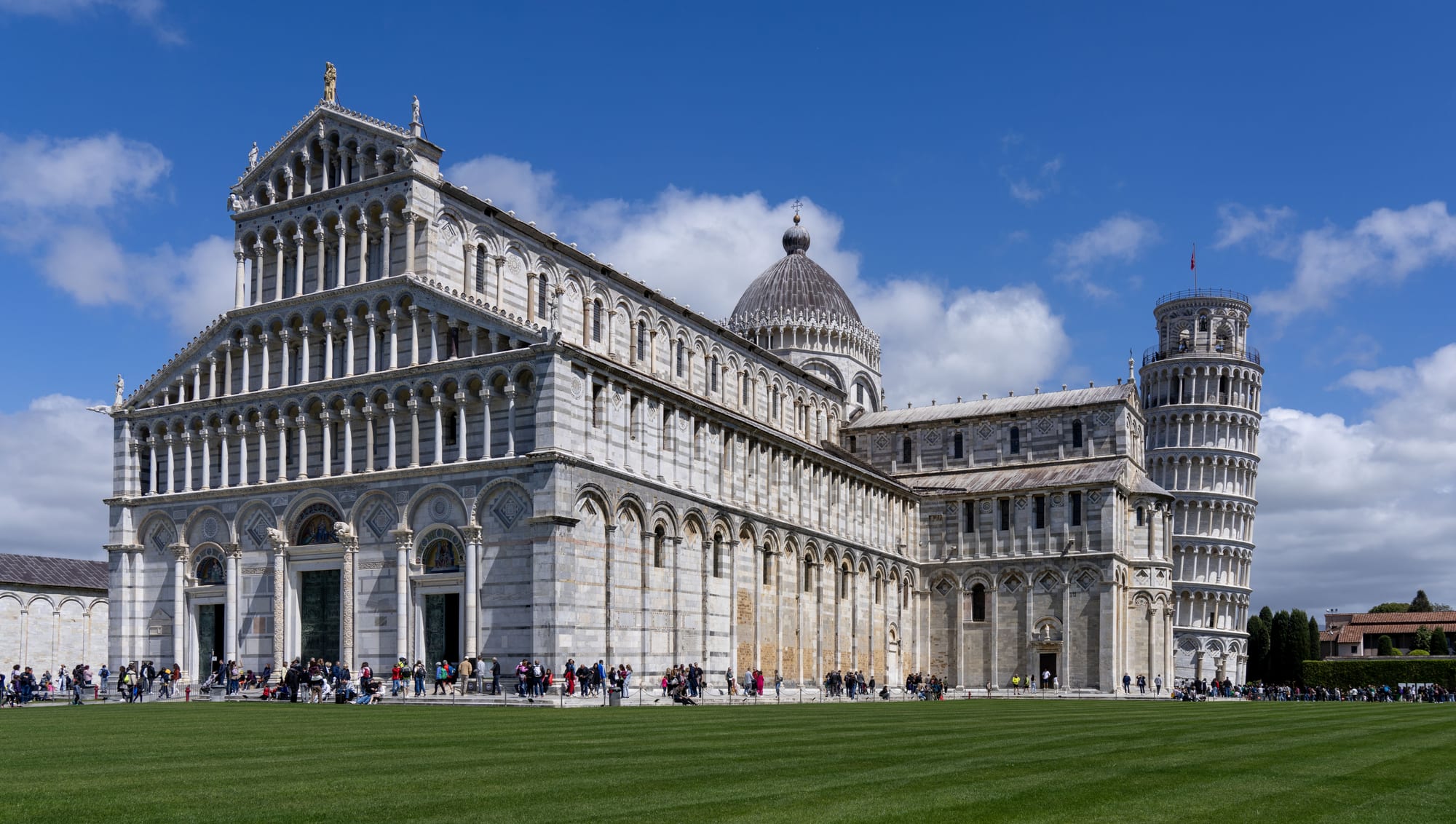
The white marble cathedral of Pisa with its arcaded front and dome, and the Leaning Tower behind it, above a green lawn

Tuscany, Italy

Pisa

Pisa Cathedral and the Leaning Tower on the Piazza dei Miracoli, seen from the baptistery. (PaestumPaestum / Wikimedia Commons · CC BY 4.0)

A university city on the Arno, about 10 km from the Ligurian Sea, that was once one of Italy's four great maritime republics. The wealth of its fleets paid for the cathedral, baptistery, cemetery and leaning bell tower of the Piazza dei Miracoli; beyond that walled lawn, palaces line the riverside Lungarni and tens of thousands of students fill the streets.

Neighbourhoods

  • Piazza dei Miracoli
    • First-time visitors
    • Historic district

    The walled lawn in the north-west corner of the old city holding the cathedral, baptistery, Camposanto and Leaning Tower, with the busiest souvenir stalls and crowds in the streets around it. The small San Rossore station is close by.

    Open in Maps
  • North bank: Borgo Stretto and the Cavalieri
    • Students and nightlife
    • Best for food
    • Historic district

    The medieval heart of the city between the cathedral and the river — the arcaded shopping street of Borgo Stretto, the Piazza dei Cavalieri with the Scuola Normale, and the little vegetable market of Piazza delle Vettovaglie, whose bars fill with students in the evening.

    Open in Maps
  • South bank: Corso Italia and the station
    • Close to public transport
    • Shopping

    South of the Arno, the Corso Italia shopping street runs from the Ponte di Mezzo to Pisa Centrale station, past the Lungarno palaces, Palazzo Blu, the small Gothic Santa Maria della Spina and Keith Haring's Tuttomondo mural.

    Open in Maps
  • Marina di Pisa
    • Beaches
    • Quiet and residential

    The city's seaside resort at the mouth of the Arno, about 10 km west, mostly built during the boom of the late 1800s and developed again in the 1930s.

    Open in Maps

Things to do

Piazza dei Miracoli

  • Leaning Tower of Pisalandmark

    The cathedral's bell tower, which began to lean during construction in the 12th century on soft ground; the tilt reached 5.5 degrees by 1990 and was reduced to nearly four by stabilisation work in 1993–2001.

    Open in Maps
  • Pisa Cathedrallandmark

    The oldest of the square's great buildings, the cathedral of the Assumption, a masterpiece of the Pisan Romanesque faced in white marble.

    Open in Maps
  • Pisa Baptisterylandmark

    The round baptistery of St John, begun in 1152 by Diotisalvi and completed in Gothic style in 1363, known for the echo of its dome.

    Open in Maps
  • Camposanto Monumentalelandmark

    The monumental cemetery on the north side of the square, said to be built around soil brought from Golgotha during the Third Crusade, with Roman sarcophagi and medieval frescoes.

    Open in Maps

The city and the Lungarni

  • Piazza dei Cavalierilandmark

    The political centre of medieval Pisa, rebuilt in the 16th century for the Knights of St Stephen and now the home of the Scuola Normale.

    Open in Maps
  • Santo Stefano dei Cavalierilandmark

    The knights' church on the square, begun in 1565 for the order Cosimo I founded to fight Saracen piracy, with a bell tower designed by Vasari.

    Open in Maps
  • Santa Maria della Spinalandmark

    A small Pisan Gothic church on the south bank of the Arno, built around 1230 and named for a thorn said to come from Christ's crown; it was taken down and rebuilt higher in 1871 to escape the river.

    Open in Maps
  • Tuttomondoattraction

    Keith Haring's 1989 mural on the rear wall of Sant'Antonio Abate, one of the last public works he painted before his death.

    Open in Maps
  • Orto botanico di Pisapark

    Established in 1544 under Cosimo I as the first university botanical garden in Europe, with greenhouses, ponds and a shell-decorated 16th-century institute.

    Open in Maps

Museums

  • National Museum of San Matteomuseum

    Medieval art gathered from the churches of the city and province, in a former convent on the Lungarno Mediceo.

    Open in Maps
  • Palazzo Blumuseum

    A former aristocratic palace on the Lungarno Gambacorti, now a centre for temporary exhibitions.

    Open in Maps
  • Museum of Ancient Shipsmuseum

    Roman ships and their cargoes, found by chance in 1998 near San Rossore station, shown in the halls of the Medici Arsenals.

    Open in Maps

Short trips from the city

  • Pisa Charterhousemuseum

    A former Carthusian monastery at Calci, about 10 km outside the city, now home to the university's natural history museum.

    Open in Maps
  • Luccaattraction

    The neighbouring walled city on the Serchio, known for its almost intact Renaissance walls and the oval Piazza dell'Anfiteatro.

    Open in Maps
  • Livornoattraction

    Tuscany's port city to the south, laid out by the Medici as an ideal town and free port, and the most modern of the Tuscan cities.

    Open in Maps

Seasonal events

  • Luminara di San Ranieri16 June

    On the eve of the patron saint's day, the palaces along the Lungarni are lit with thousands of small candles, ending with fireworks.

  • Feast of San Ranieri17 June

    The feast of the city's patron saint, the day after the Luminara.

  • Gioco del Pontelast Saturday of June

    A costumed contest on the Ponte di Mezzo between the two halves of the city, revived in 1927 from a game played from perhaps the 1200s until 1807.

Eat and drink

Long-standing places and food districts in Pisa. Hours, ratings and directions come from your maps app, always current.

Pisa classics

  • Cecinarestaurant

    A very thin savoury cake of chickpea flour, widely eaten in Pisa and usually stuffed into small focaccia.

    Open in Maps
  • Caffè dell'Usserocafe

    A café founded in 1775 on the ground floor of the Gothic Palazzo Agostini on the Lungarno.

    Open in Maps

Markets and food districts

  • Piazza delle Vettovagliemarket

    A small vegetable market in an arcaded square, surrounded by cafés, trattorias and bars that serve aperitivo in the evening.

    Open in Maps
  • Borgo Stretto and Piazza Gambacortineighborhood

    The streets either side of the Ponte di Mezzo, where bars and pubs lay on evening aperitivo for a largely student crowd.

    Open in Maps

Experience Pisa

History

Pisa's name is most often traced to an Etruscan word meaning "mouth", for its position near the mouth of the Arno, and excavations in the 1980s and 1990s, including the 5th-century BC tomb of an Etruscan prince, confirmed its Etruscan origins. It became a Roman colony in 180 BC and a municipium in 89 BC. The city was once on the shore, but silt from the Arno and the Serchio pushed the coast west: Strabo put it 4 km from the sea, and today it lies nearly 10 km inland, though ships long sailed up the river to its quays.

Its power as one of the four great maritime republics peaked in the 11th and 12th centuries, when Pisan fleets fought across the Mediterranean and, in 1136, sacked Amalfi. Trade and plunder paid for the cathedral and the other monuments of the Piazza dei Miracoli. The decline began on 6 August 1284, when Genoa destroyed the Pisan fleet at Meloria; in 1290 the Genoese wrecked Porto Pisano. Pisa, always Ghibelline, still defeated Florence at Montecatini in 1315, but after a long siege the Florentines took the city in 1405 when a corrupted captain opened the San Marco gate at night. A later revolt held out against Florentine troops for fifteen years before the city fell again.

Under Florence Pisa became a city of learning. Its university was founded in 1343, and the physicist Galileo Galilei was born in the city. Napoleon founded the Scuola Normale in 1810, and the Sant'Anna School followed in 1987. The city suffered repeated destruction in the Second World War. The Piazza dei Miracoli was declared a UNESCO World Heritage Site in 1987, and engineers stabilised the leaning tower between 1993 and 2001.

Culture & Customs

Pisa is a university city first: the University of Pisa is especially known for physics, mathematics, engineering and computer science, and the Scuola Normale and the Sant'Anna School are among Italy's elite research institutions. Students organise parties, shows and cultural events and fill the central streets at night, and away from the Piazza dei Miracoli their presence sets the tone of the city.

The year's great civic moments come in June. On the evening of 16 June the Luminara di San Ranieri lights the façades along the Lungarni with thousands of small candles, called lampanini in the local speech, before fireworks and a night of celebration; the next day is the feast of the patron saint. On the last Saturday of the month the Gioco del Ponte, a costumed contest on the Ponte di Mezzo with roots possibly in the 1200s, revived in 1927, sets the two halves of the city against each other. Pisa also takes part in the Regatta of the Historical Maritime Republics with Amalfi, Genoa and Venice. Local dialect poetry is kept alive by competitions such as the Cèa d'Oro.

Pisa has more than twenty historic churches besides the cathedral and at least two other leaning towers, at San Nicola and San Michele. Keith Haring's Tuttomondo, painted in 1989 on the wall of Sant'Antonio Abate, is a much-loved modern landmark. Football is the main sport, and Pisa SC play at the Arena Garibaldi, opened in 1919.

Daily Life

About 90,000 people live in the comune, and around 195,000 in the wider Pisan area that takes in Calci, Cascina, San Giuliano Terme, Vecchiano and Vicopisano. The University of Pisa alone has tens of thousands of students, a large number for a city of this size, and they fill the central streets in term time.

The economy rests on education and research, the university hospital, tourism and the airport, the main one for Tuscany. Most visitors come for a few hours to see the tower and leave, so daily life in the centre — markets in Piazza delle Vettovaglie, shopping on Corso Italia and Borgo Stretto, the evening walk along the Lungarni — runs largely apart from the crowds on the Piazza dei Miracoli.

The Arno divides the old city into a northern half, with the cathedral, the Piazza dei Cavalieri and the university buildings, and a southern half around Corso Italia and the station; their rivalry is played out in the Gioco del Ponte. Newer residential districts spread beyond the walls, and the city's own seaside resort, Marina di Pisa, lies about 10 km west at the mouth of the Arno.

Food

Pisan cooking mixes the sea, the river and the countryside. A popular dish is cecina, a very thin savoury cake of chickpea flour, which the Genoese once called "the gold of the Pisans"; legend dates its invention to the age of the maritime republics. In Pisa it is usually eaten stuffed into small focaccia.

Traditional dishes include long pasta dressed with anchovies and turnip greens, bean soups and bordatino, a peasant dish of puréed beans with cavolo nero and maize flour, pasta or rice with clams, and frog soup. Fish recipes use grey mullet from the mouth of the Arno, grilled; boiled weever; and grilled salt cod with chickpeas. Cèe alla pisana, baby eels, were once the city's emblematic dish, but catching, selling and eating them is now banned.

Evenings revolve around aperitivo, a drink with a light buffet, in the bars around Piazza delle Vettovaglie, Piazza Gambacorti and Via delle Case Dipinte, and the Caffè dell'Ussero has served the Lungarno since 1775.

Planning tools

Budget

Pisa is cheaper than Florence for rooms and food, and many visitors only stop for a few hours at the tower, so evenings in the centre are aimed at students and residents rather than tourists. The Leaning Tower climb and combined tickets for the square's monuments are the main sightseeing costs.

Daily Budget Midrange
USD 160–300 (mid-range hotel, sit-down dinners, tower and monument tickets, a train trip to Lucca or the coast)
Daily Budget Shoestring
USD 75–120 (hostel or simple hotel, cecina, pizza by the slice and student bars, walking)

Book a timed slot for the tower climb in busy months; the Lungarni, the squares and Tuttomondo cost nothing.

Best Time to Visit

April to June and September to October are the most comfortable. June brings the Luminara on the 16th, San Ranieri's day on the 17th and the Gioco del Ponte at the end of the month. July and August are hot and the Piazza dei Miracoli very crowded; winter is mild and quiet, though the university keeps the city busy in term time.

Suggested Number of Days

One full day covers the Piazza dei Miracoli and the old centre; a night allows the city to be seen after the tour groups leave. Allow three or four days to add neighbouring cities and the coast by train or bus.

First Visit
1–2 days
With Surroundings
3–4 days

Transportation

The centre is small and best walked or cycled. Buses link the station, the riverside and the Piazza dei Miracoli. The Pisamover, a driverless people mover opened in 2017, runs about 2 km between Pisa Centrale and the airport in a few minutes. Trains run from Pisa Centrale to Florence, Lucca, Livorno, Rome and Genoa.

Validate bus tickets on boarding, and use the small San Rossore station for the Piazza dei Miracoli when arriving from Lucca.

Airport & Station Connections

Galileo Galilei International Airport, the main airport for Tuscany, lies in the San Giusto district on the southern edge of the city, linked to Pisa Centrale station by the Pisamover. Trains from Pisa Centrale reach Florence, Lucca, Livorno, Genoa and Rome, and the A12 motorway crosses the Arno near its mouth.

Walkability

Very good. The centre is flat and compact: the walk from Pisa Centrale along Corso Italia, over the Ponte di Mezzo and up Borgo Stretto to the Leaning Tower takes about half an hour and passes many of the sights. The airport is less than 2 km from the station on foot.

Safety

Italy is generally safe, with low levels of violent crime against visitors. Pisa's main risk is pickpocketing and street selling around the Leaning Tower and in the crowds of the Piazza dei Miracoli; the student nightlife areas are busy and lively late at night.

Keep bags closed while taking photographs at the tower, and ignore street sellers pressing goods into hands. Check current official travel advice before travelling.

Climate

On the border between humid subtropical and Mediterranean, with summers that still get some rain. Heat waves from North Africa can push temperatures to about 38°C, and snow is rare.

Summer
warm to hot, with heat-wave peaks near 38°C; the record is 39.5°C, set in August 1943
Winter
mild and damp; snow is rare, and the record low is −13.8°C, set in January 1985

Local Customs

Pisa is a student city, and much of its evening life revolves around aperitivo in the bars around Piazza delle Vettovaglie and the Lungarni. The cathedral is a working church: shoulders and knees should be covered. Service is usually included in the bill, and rounding up is enough.

Coffee is cheapest standing at the bar. Lunch is usually from about one, dinner from about eight.

Common Payment Methods

The currency is the euro. Cards and contactless payment are accepted almost everywhere; carry some cash for small bars, cecina shops and the market. ATMs are easy to find in the centre and at the station.