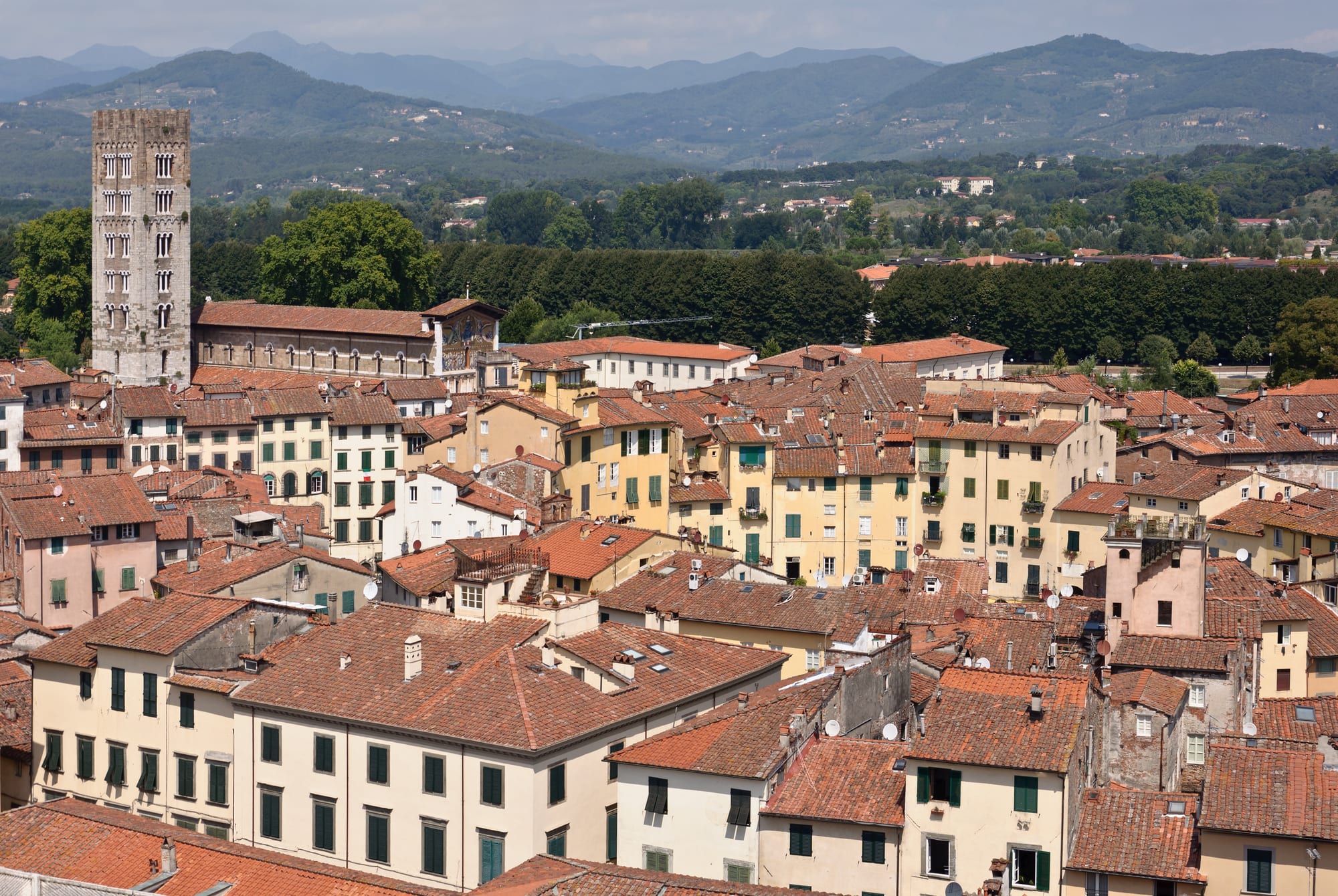
Red-tiled roofs and pastel houses of Lucca, with a tall stone bell tower, a line of trees on the walls and green hills beyond

Tuscany, Italy

Lucca

Lucca seen from the Torre Guinigi, with the Basilica of San Frediano and its bell tower. (Myrabella / Wikimedia Commons · CC BY-SA 3.0)

A city on the Serchio in the fertile plain of northern Tuscany, whose old centre keeps its Roman street grid inside one of Europe's best-preserved rings of Renaissance walls, now a tree-lined promenade. Rich on medieval silk and independent as a republic for almost 500 years, it is the birthplace of Puccini and the home of Europe's largest comics festival.

Neighbourhoods

  • San Michele and Via Fillungo
    • First-time visitors
    • Shopping
    • Historic district

    The centre of the walled city, laid on the Roman grid: Piazza San Michele sits on the site of the ancient forum, and the main shopping street, Via Fillungo, runs north past the clock tower. The cathedral, Piazza Napoleone and the museums are a few minutes' walk away.

    Open in Maps
  • Anfiteatro and San Frediano
    • Best for food
    • Historic district

    The north-eastern quarter of the old town, around the oval Piazza dell'Anfiteatro, whose ring of houses follows the shape of the Roman amphitheatre, the Guinigi tower with trees on its top, and the Romanesque basilica of San Frediano with its golden mosaic front.

    Open in Maps
  • The walls and outside the gates
    • Parks
    • Quiet and residential
    • Close to public transport

    The ring of ramparts and bastions, a 4 km public park, separates the old town from the newer districts that grew up beyond it. The railway station lies just south of the walls, and the football stadium just outside the north-east wall.

    Open in Maps

Things to do

Walls, squares and towers

  • Walls of Luccatrail

    Renaissance walls 4.2 km round, among the best preserved in Europe, built against Florence but never used in war; they became a promenade and park in the 1820s and are walked or cycled end to end.

    Open in Maps
  • Piazza dell'Anfiteatrolandmark

    An oval square whose ring of buildings follows the shape of the Roman amphitheatre, entered through four gateways.

    Open in Maps
  • Guinigi Towerviewpoint

    A 45-metre tower of the 14th-century merchant family Guinigi, crowned by holm oaks, with 230 steps to the top and views over the roofs.

    Open in Maps
  • Torre delle Oreviewpoint

    The clock tower on Via Fillungo, which can be climbed for a view along the main street.

    Open in Maps

Churches

  • Lucca Cathedrallandmark

    The cathedral of San Martino, where a small octagonal shrine in the nave holds the Holy Face crucifix and a labyrinth carved on a portico pier may pre-date the one at Chartres.

    Open in Maps
  • San Michele in Forolandmark

    A Romanesque basilica built over the Roman forum, seat of the commune's Major Council until 1370.

    Open in Maps
  • Basilica of San Fredianolandmark

    A Romanesque church whose façade was covered in the 13th–14th centuries with a huge golden mosaic of the Ascension.

    Open in Maps

Museums and palaces

  • Museo Nazionale di Villa Guinigimuseum

    The main museum of the city's pre-modern art, in the late-Gothic villa built in 1413–1418 for Paolo Guinigi, ruler of Lucca.

    Open in Maps
  • Museo Nazionale di Palazzo Mansimuseum

    A Baroque silk merchant's palace with tapestries, decorated rooms and a gilded bedroom alcove.

    Open in Maps
  • Palazzo Pfannermuseum

    A palace of 1667 with a formal garden attributed to Filippo Juvarra, an outdoor staircase and loggia, and frescoed salons.

    Open in Maps

Short trips from the city

  • Villa Reale di Marliaattraction

    A late-Renaissance villa in neighbouring Capannori, known for its gardens and follies.

    Open in Maps
  • Ponte della Maddalenalandmark

    The medieval 'Devil's Bridge' over the Serchio near Borgo a Mozzano, a hump-backed crossing on the Via Francigena probably commissioned around 1080–1100.

    Open in Maps
  • Torre del Lagoattraction

    The village between Lake Massaciuccoli and the sea where Puccini lived and is buried, with an open-air theatre for the Festival Puccini.

    Open in Maps

Seasonal events

  • Lucca Summer FestivalJuly

    A series of open-air concerts by international stars in Piazza Napoleone and other venues.

  • Luminara di Santa Croce13 September, the evening before the feast of the Holy Cross

    A long candlelit procession winds through the old town for the feast of the Holy Cross, accompanied by bands, crossbowmen and figures in medieval dress.

  • Lucca Comics & Gameslate October to early November

    The largest comics festival in Europe and the second biggest in the world after Tokyo's Comiket, filling the old town with stands and cosplayers.

Eat and drink

Long-standing places and food districts in Lucca. Hours, ratings and directions come from your maps app, always current.

Lucca classics

  • Tordellirestaurant

    Lucca's ravioli, with a thicker dough than usual and a filling of meat and herbs.

    Open in Maps
  • Minestra di farro and garmugiarestaurant

    Two soups of the Lucca countryside: spelt soup, and garmugia, a spring soup of artichokes, asparagus, broad beans and peas.

    Open in Maps
  • Buccellato di Luccarestaurant

    A traditional Lucca ring-shaped sweet bread with sultanas and anise.

    Open in Maps

Food streets

  • Via Fillungoneighborhood

    The main street of the old town, lined with cafés, pastry shops and food stores between the shops.

    Open in Maps
  • Piazza dell'Anfiteatroneighborhood

    Restaurants and cafés set their tables out across the oval square in good weather.

    Open in Maps

Experience Lucca

History

The Romans gave Lucca, which they called Luca, the shape it still has. It became a Roman colony in 180 BC and a municipium in 89 BC; the rectangular grid of the historic centre preserves the Roman street plan, Piazza San Michele stands on the site of the forum, the Piazza dell'Anfiteatro follows the oval of the amphitheatre, and the outline of a Roman theatre survives in Piazza Sant'Agostino. In 56 BC Caesar, Pompey and Crassus met here to renew the First Triumvirate.

From 576 to 797 Lucca was the capital of the Lombard Duchy of Tuscia and minted its own coins, and in the 10th and 11th centuries it was the capital of the margraviate of Tuscany. The Holy Face, a large wooden crucifix said by legend to have been carved by Nicodemus, arrived in the 8th century and is still the city's most precious relic. From the 11th century Lucca grew rich on silk: Lucca cloth, woven with gold or silver thread, rivalled the silks of Byzantium. For almost 500 years it remained an independent republic, the second-largest Italian city state after Venice to keep a republican constitution, and it built its great walls in fear of Florence.

In 1805 Napoleon turned the republic into a principality for his sister Elisa Bonaparte Baciocchi. From 1815 it was a Bourbon-Parma duchy, and in 1847 Lucca lost its independence and was annexed to the Grand Duchy of Tuscany. The walls, which had never been tested in war, were turned into a public promenade in the 1820s; their only test came in the Serchio flood of November 1812. Under the Italian Social Republic in the Second World War, an internment camp at Lucca held political prisoners, foreigners and Jews.

Culture & Customs

Lucca is a city of music. Giacomo Puccini, composer of La Bohème and Madama Butterfly, was born here, as were Luigi Boccherini, Alfredo Catalani, Francesco Geminiani and earlier composers such as Nicolao Dorati and Gioseffo Guami. Puccini later lived and worked by Lake Massaciuccoli at Torre del Lago, where he is buried and where an open-air opera festival bearing his name draws around 40,000 people each summer. In July the Lucca Summer Festival brings international rock and pop stars to Piazza Napoleone.

The city's religious life centres on the Holy Face, kept in a small octagonal shrine in the cathedral. On the evening before the feast of the Holy Cross on 14 September, the Luminara di Santa Croce winds through the old town as a long candlelit procession with religious brotherhoods, bands, crossbowmen and figures in medieval dress, and a medieval fair is held in the tunnels beneath the San Pietro bastion during September.

At the end of October and the start of November, Lucca Comics & Games turns the old town over to comics, animation, games and video games; it is Europe's largest comics festival and the second biggest in the world, and the streets fill with costumed fans. The city also hosts a literary festival, LuccAutori, every October since 1995, and Cartasia, a biennial exhibition devoted entirely to paper art.

Daily Life

About 89,000 people live in the comune and around 380,000 in the province. Most residents live outside the walls in the newer districts and villages of the plain, while the old town combines homes above shops with offices, schools and the university campus in the former San Francesco convent; the deconsecrated church of San Ponziano is now the university library.

The city is known as an Italian "city of art" for its almost intact walls and well-preserved centre, and its festivals and monuments draw visitors through the year. Driving inside the walls is mostly limited to residents, so much of the centre moves on foot and by bicycle.

The walls themselves are the city's park and meeting place: the 4 km pedestrian promenade on top links the bastions of Santa Croce, San Frediano, San Martino and others, and is walked and cycled by residents and visitors alike. The local football club plays at the Stadio Porta Elisa just outside the north-east wall, and the Serchio, which flooded the plain in 1812, still runs along the northern edge of the city.

Food

Lucca's cooking belongs to Tuscany but has its own dishes. Tordelli are its ravioli, made with a thicker dough than usual and filled with meat and herbs. Soups draw on the countryside: minestra di farro, made with spelt, and garmugia, a spring soup of artichokes, asparagus, broad beans and peas.

A traditional sweet is buccellato di Lucca, a ring-shaped sweet bread made with sultanas and anise, distinct from the Sicilian cake of the same name.

Eating out centres on the trattorias of the old town and the tables set out in the Piazza dell'Anfiteatro and the squares around San Michele. Pane lucchese, unlike most Tuscan bread, is salted. Rovelline alla lucchese are slices of breaded fried meat finished in the pan with tomato and capers, and biroldo is a sausage of pig's blood and offal. Other sweets include castagnaccio, made with chestnut flour and called torta di neccio in local dialect; pasimata, an Easter sweet bread; and torta co' becchi, a shortcrust tart, often of chocolate, custard or greens, whose folded rim forms 'beaks'. Biadina and China Massagli are local herb liqueurs, and the hills produce the Colline Lucchesi and Montecarlo DOC reds.

Planning tools

Budget

Lucca costs noticeably less than Florence for rooms and meals, and most of its pleasures — the walls, the squares, the churches — are free. Prices rise sharply during Lucca Comics & Games and the summer concert season, when rooms in and around the walls fill up.

Daily Budget Midrange
USD 160–300 (mid-range hotel inside the walls, sit-down dinners, museum and tower tickets, bike hire)
Daily Budget Shoestring
USD 75–120 (hostel or simple B&B, bakery and trattoria lunches, regional trains)

Book months ahead for Lucca Comics week; bike hire near the gates and the station makes the walls circuit easy.

Best Time to Visit

April to June and September to October bring mild weather for walking and cycling the walls. July has the summer festival and concerts, but days are hot; mid-September brings the Luminara, and late October the comics festival, which packs the city. Winters are cool and quiet, with occasional night frosts.

Suggested Number of Days

One or two days is enough for the walled city at an easy pace. Allow three or four to explore the villas, valleys and coast nearby, or to combine Lucca with neighbouring cities by train.

First Visit
1–2 days
With Surroundings
3–4 days

Transportation

Driving inside the walls is mostly reserved for residents, so visitors park outside the gates and walk or cycle; bikes can be hired at the station and near several gates. Buses run from Piazzale Verdi, just inside the western walls, to Pisa, Florence and Barga.

Cyclists share the walls and the narrow streets with pedestrians, so ride slowly and use a bell.

Airport & Station Connections

The nearest airport is Pisa's Galileo Galilei, linked to Lucca by a direct bus or by the Pisamover and a train from Pisa Centrale. Lucca station, just south of the walls, is on the line between Viareggio and Florence, with regional trains to Florence, Pisa, Viareggio and Aulla.

Walkability

Excellent. The walled city is flat and compact, and almost everything is within about fifteen minutes on foot of Piazza San Michele. The walk or ride around the walls is about 4 km, and ramps lead up from the gates.

Safety

Italy is generally safe, with low levels of violent crime against visitors. Lucca is a calm, small city; the main risks are bicycles in the narrow streets and on the walls, and pickpockets in the dense crowds of Lucca Comics & Games.

Keep valuables close in festival crowds and take care crossing the ring road outside the walls. Check current official travel advice before travelling.

Climate

A Mediterranean climate with hot summers and cool, damp winters, when clear nights can bring frost from mid-December to late February. Temperatures climb quickly in spring, with May afternoons regularly above 22°C.

Summer
hot — afternoons reach or pass 30°C, heat waves top 35°C, and the record is 41.5°C
Winter
cool — afternoons of about 10–14°C and nights of 2–4°C, with occasional frost down to about −3°C

Local Customs

Lucca is proud of its long independence and its musicians, Puccini above all. Churches expect covered shoulders and knees. Service is usually included in the bill, and rounding up is enough.

Coffee is cheapest standing at the bar. Lunch is usually from about one, dinner from about eight.

Common Payment Methods

The currency is the euro. Cards and contactless payment are widely accepted; carry some cash for small bars, bakeries and market stalls. ATMs are found throughout the old town and at the station.