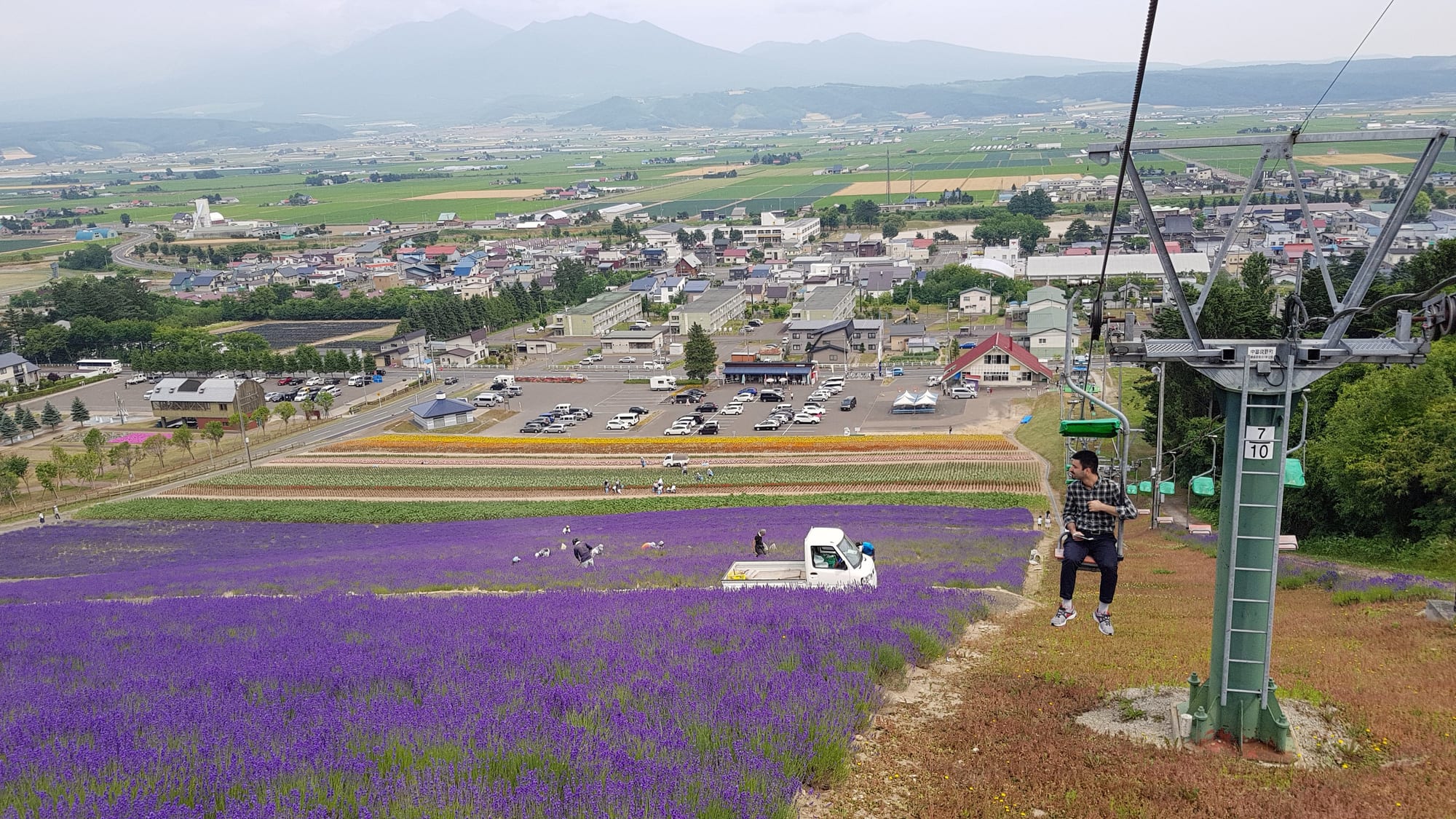
Rows of purple lavender and coloured flowers on a hillside above a small town, with farmland and hazy mountains beyond

Hokkaido, Japan

Furano

Lavender on a hillside above the Furano basin, with farmland and the mountains of central Hokkaido behind. (Blondinrikard Fröberg / Wikimedia Commons · CC BY 2.0)

A farming town in a broad basin near the centre of Hokkaido, ringed by the Tokachi and Yubari mountains and often called the island's navel. Its lavender fields, planted for perfume oil and saved by tourism, draw crowds each July, while winter brings skiing on the slopes of Kitanomine above the town.

Neighbourhoods

  • The town centre and station
    • First-time visitors
    • Close to public transport
    • Best for food

    A small grid of streets around Furano Station, with shops, everyday restaurants, business hotels and the bus stands. Almost everything in town is within a few minutes' walk, and the flower farms and mountains begin immediately beyond it.

    Open in Maps
  • Kitanomine
    • Skiing
    • Resorts
    • Nightlife

    The slope on the town's western edge where the ski lifts start, with hotels, pensions, ski hire and a cluster of bars and restaurants that wake up in winter. In summer a gondola runs for the view over the basin.

    Open in Maps
  • Nakafurano and the flower farms
    • Flowers and photography
    • Quiet and residential

    The neighbouring town north of Furano, where the best-known lavender fields stripe the hillsides in July. It is farming country the rest of the year, with roadside shops selling melons, sweetcorn and dairy.

    Open in Maps
  • Rokugō and the eastern farmland
    • Quiet and residential
    • Countryside drives

    Scattered farms and woodland east of the centre, the setting for a long-running television drama that made Furano familiar across Japan. Log cabins and small cafés sit among fields that run up to the hills.

    Open in Maps
  • The Sorachi river valley
    • Countryside drives
    • Walks

    The flat valley floor north and south of the town, a patchwork of onion, potato and wheat fields crossed by the river and the railway, with wide views of the Tokachi range on clear days.

    Open in Maps

Things to do

Flower farms and the countryside

  • Farm Tomitaattraction

    The farm at Nakafurano that kept growing lavender when the perfume trade collapsed, now one of Hokkaido's most visited attractions, with distilling sheds, shops and strips of mixed flowers.

    Open in Maps
  • Furano Cheese Factoryattraction

    A municipal dairy on the southern edge of town where cheese, butter and ice cream are made from local milk, with workshops and a viewing window.

    Open in Maps
  • Furano wineryattraction

    A hillside winery run by the town, producing wine from grapes bred to survive Hokkaido winters, with a tasting room and views over the basin.

    Open in Maps

Mountains, snow and views

  • Furano Ski Resortattraction

    Ski slopes above the town in two linked zones, Furano and Kitanomine, run by Prince Hotels and used for Alpine and Snowboard World Cup events, with dry snow and a short transfer from the centre.

    Open in Maps
  • Mount Tokachilandmark

    An active volcano in the range east of the basin, with hot springs on its flanks and climbing routes from the Tokachidake trailheads.

    Open in Maps
  • Daisetsuzan National Parkpark

    Japan's largest national park until 2024, and still among its biggest, begins in the mountains north-east of the town, a high volcanic plateau of alpine meadows, ropeways and long hiking routes.

    Open in Maps

Short trips

  • Bieineighborhood

    A village of rolling patchwork hills about 25 kilometres north, photographed endlessly for its lone trees, crop stripes and wide horizons.

    Open in Maps
  • Shirogane Blue Pondattraction

    A pond in the hills above Biei, formed behind erosion-control works built after the 1988 eruption of Mount Tokachi, whose water is a striking blue, with dead larch trunks standing in it.

    Open in Maps
  • Asahikawaneighborhood

    Hokkaido's second city, about 55 kilometres north, known for its soy-based ramen and a zoo designed around how animals move.

    Open in Maps

Seasonal events

  • Lavender seasonJuly

    The fields around Nakafurano and the town flower for a few weeks in midsummer, the busiest time of the year, when extra trains run to a seasonal halt near the farms.

  • Hokkai Heso Matsurilate July

    The belly-button festival, in which participants paint faces on their stomachs and dance through the streets, playing on the town's claim to sit at the navel of Hokkaido.

  • Ski seasonDecember to March

    Lifts run on the slopes above the town through the winter, with competitions, night skiing and a much quieter town than in July.

Eat and drink

Long-standing places and food districts in Furano. Hours, ratings and directions come from your maps app, always current.

Furano classics

  • Omelette curry restaurantsneighborhood

    Furano omu-curry, a local invention served by a group of restaurants in town, pairs a rice omelette with curry made using the area's own vegetables, cheese or wine, and is served with a glass of local milk.

    Open in Maps
  • Wine and cheese from the townneighborhood

    The municipal winery and dairy sell their own bottles, cheeses and ice cream, and their products appear on menus across the town.

    Open in Maps
  • Kitanomine's winter restaurantsneighborhood

    The ski-slope base has izakaya, ramen counters, soup-curry shops and bars serving lamb, hotpot and Hokkaido beer through the season.

    Open in Maps

Markets and farm produce

  • Roadside farm stallsmarket

    Summer stalls and roadside stations along the valley sell Furano melons, sweetcorn, onions, potatoes, asparagus and pressed juices straight from the surrounding fields.

    Open in Maps
  • Station-area restaurantsneighborhood

    The streets around the station hold the town's everyday kitchens — ramen, curry, izakaya and bakeries — open all year rather than only in the tourist seasons.

    Open in Maps

Experience Furano

History

The basin was Ainu land, and the name is generally traced to an Ainu word for a smell or flame — a reference to the sulphurous streams running off the volcanoes of the Tokachi range to the east. Japanese settlement began in the 1890s, when the Meiji government's colonisation policy sent farmers north; they cleared forest, drained the valley floor and planted rice, beans and potatoes in a climate far colder than anything they had farmed before. The railway arrived soon after and made the town the market and shipping point for the whole basin.

Lavender came later and by accident. Grown for perfume oil from the 1950s, it suited the dry basin and spread across the district until the early 1970s, when cheaper imported and synthetic fragrance collapsed the price and most growers ploughed their fields under. A few fields were kept, and a photograph of one of them in the national railway's 1976 calendar brought the first visitors. The flowers were replanted for the view rather than the oil, and the industry that had died became the town's identity.

Television did the rest. Kita no Kuni kara, a drama series set on a farm outside Furano, ran on and off from the early 1980s for more than twenty years and made the town's woods and log cabins familiar across Japan. Meanwhile the ski slopes above Kitanomine were developed into a resort that has held World Cup alpine races, and the town set up its own winery and cheese factory to add value to local produce. Like most of rural Hokkaido, Furano has been losing population since, and the balance between farming and tourism runs through everything it does.

Culture & Customs

Furano's public identity rests on two things: flowers and the claim to be the navel of Hokkaido. The town sits close to the geographical centre of the island, and it turns that into an annual festival at which participants paint faces around their navels and dance through the streets — an event of real local affection rather than a tourist invention, and the fixed point of the summer calendar.

The rest of the year is agricultural. Seasons are talked about as work: the asparagus in spring, melons and sweetcorn in high summer, onions and potatoes in autumn, snow from November. Farmers open shops and cafés, run stays for visitors and sell direct from roadside stalls, and many households now take income from both fields and tourism. The television drama filmed here left a lasting local pride and a run of small museums and preserved sets in the woods east of town.

Winter changes the town's population as much as its weather. Ski instructors, seasonal staff and visitors arrive at Kitanomine, including a steady number from Australia and elsewhere in Asia, though on a smaller scale than Niseko. Hot springs in the hills are the standard way to end a day in any season, with the usual etiquette — wash first, no swimwear, keep quiet — expected of everyone.

Daily Life

Just over 20,000 people live in Furano, and the number has been falling for decades as young people leave for Sapporo and Tokyo and the population ages. The town serves a wider basin of farming villages, and its hospital, schools and shops are the ones those villages use.

Agriculture is the base of the economy: onions, potatoes, wheat, carrots, soybeans, dairy and the melons the district is known for, grown on large, mechanised holdings by Japanese standards. Processing adds to it, through the town's cheese factory and winery and through the wine and juice made from local fruit. Tourism provides the rest, sharply concentrated in July and in the ski months, and many businesses employ seasonal staff twice a year.

Daily life follows the fields and the snow. Work starts early in summer, when light comes before four in the morning, and winter means clearing snow from drives and roofs and driving on ice. The quiet months of May and November are when the town feels most itself. Local concerns are those of rural Hokkaido — depopulation, finding successors for farms, keeping rail services and hospitals, and managing visitor pressure on a landscape that is somebody's working crop.

Food

Furano eats what it grows, and its best-known dish was invented to show that off. Furano omu-curry is a rice omelette served with curry, made to a set of local rules — the rice is grown in the basin, the vegetables come from the district, the plate includes cheese or wine or another Furano product, and it comes with a glass of local milk. A group of restaurants in town serve their own versions.

Dairy and produce run through everything else. The town's cheese factory makes soft and hard cheeses, butter and ice cream, some of it flavoured with squid ink or wine; melons from the basin are sold as gifts and eaten as soft serve; sweetcorn is grilled in summer, potatoes steamed with butter, and asparagus eaten in a short spring season. Onions from the valley go into curry, soup and Hokkaido-style stews.

The winery on the hill produces red, white and sparkling wine from cold-resistant grapes, alongside grape juice, and is sold across the island. Otherwise the food is Hokkaido's: soup curry, jingisukan lamb grilled on a domed pan, ramen — Asahikawa's soy-based bowl is the nearest tradition — and hotpots in winter. Roadside stations and farm stalls are the cheapest and freshest place to buy any of it.

Planning tools

Budget

Furano is inexpensive for most of the year, with pensions, business hotels and farm stays and modest restaurant prices. Two periods are the exception: July, when lavender crowds fill every room, and the ski season, when the Kitanomine hotels charge resort rates. A hire car is the main extra cost, as the farms and viewpoints are scattered.

Daily Budget Midrange
USD 110–220 (mid-range hotel or onsen inn, restaurant dinners, hire car, farm and museum entries)
Daily Budget Shoestring
USD 45–80 (pension or hostel, ramen and farm-stall food, local trains and buses)

Book July and the ski season months ahead; in summer, the flower farms themselves are free to enter and the cost is getting to them.

Best Time to Visit

July for the lavender, when the fields are at their peak and the town is at its busiest. June and August are green, warm and far calmer, and September brings the harvest and early autumn colour in the mountains. December to March is ski season, cold and deep in snow. Late spring and November are quiet, with little open.

Suggested Number of Days

A day or two covers the town and the nearby farms. Three or four allow the hills to the north, the volcanic range to the east or a stay on the ski slopes. Travel time between sights is the main constraint, especially without a car.

First Visit
1–2 days
With Surroundings
3–4 days

Transportation

A hire car is the practical way to see the area, as the farms, viewpoints and villages are spread over a wide basin. Local trains on the Furano Line run north towards Biei and Asahikawa, with a seasonal halt serving the flower farms in summer, and buses link the town with the ski slopes and Asahikawa. Cycling is popular in summer, though the hills are steady work.

Winter driving means snow tyres and ice; in July the roads and car parks around the flower farms are congested in the middle of the day.

Airport & Station Connections

Asahikawa Airport is the nearest, about 40 kilometres north, with flights from Tokyo and a bus that takes roughly an hour to the town. New Chitose Airport near Sapporo is about two and a half hours away by bus or car. Trains reach Furano from Asahikawa in around an hour and a quarter, and from Sapporo in about two and a half hours with a change, with extra direct services in the lavender season.

Walkability

The town centre is small and level enough to cross on foot in fifteen minutes, and the station, shops and restaurants sit close together. The flower farms, the cheese factory, the winery and the ski base are all several kilometres out, so walking alone will not cover the area. Pavements are snow-covered for much of the winter.

Safety

Crime is very low. The hazards are rural and seasonal: icy roads and pavements in winter, heavy snow, brown bears in the surrounding forests and mountains, and volcanic activity in the Tokachi range, which is monitored and can restrict access. Summer heat is mild but the sun on open farmland is strong.

Carry a bear bell and check trail notices before walking in the mountains, follow volcanic warnings around Tokachidake, and stay on paths at the flower farms — the fields are working crops. Check current official travel advice before travelling.

Climate

An inland basin climate with wide temperature swings: cold, snowy winters and warm summer days that fall away sharply at night. The surrounding mountains keep the air dry, which is what makes the snow light and the flowers reliable, and the June rainy season of southern Japan does not reach here.

Summer
warm days and cool nights, generally 20–28°C in July and August
Winter
very cold and snowy, generally -12 to -3°C from December to February, with heavy snowfall

Local Customs

Tipping is not practised. Shoes come off in pensions, farm stays and many restaurants, and quiet is expected on trains and in the countryside. The flower fields are farms, not parks: rows are walked around rather than through, and drones and tripods are often restricted. Tattoos may bar entry to some hot-spring baths.

Ask before photographing farm workers or private property, and in hot springs wash thoroughly before entering the water and leave swimwear out.

Common Payment Methods

The currency is the Japanese yen. Cards are accepted at hotels, the larger farms and shops and the ski resort, but small restaurants, farm stalls and rural businesses are often cash-only, and IC transit cards are less useful here than in the cities. Convenience stores and the post office have cash machines that accept foreign cards.