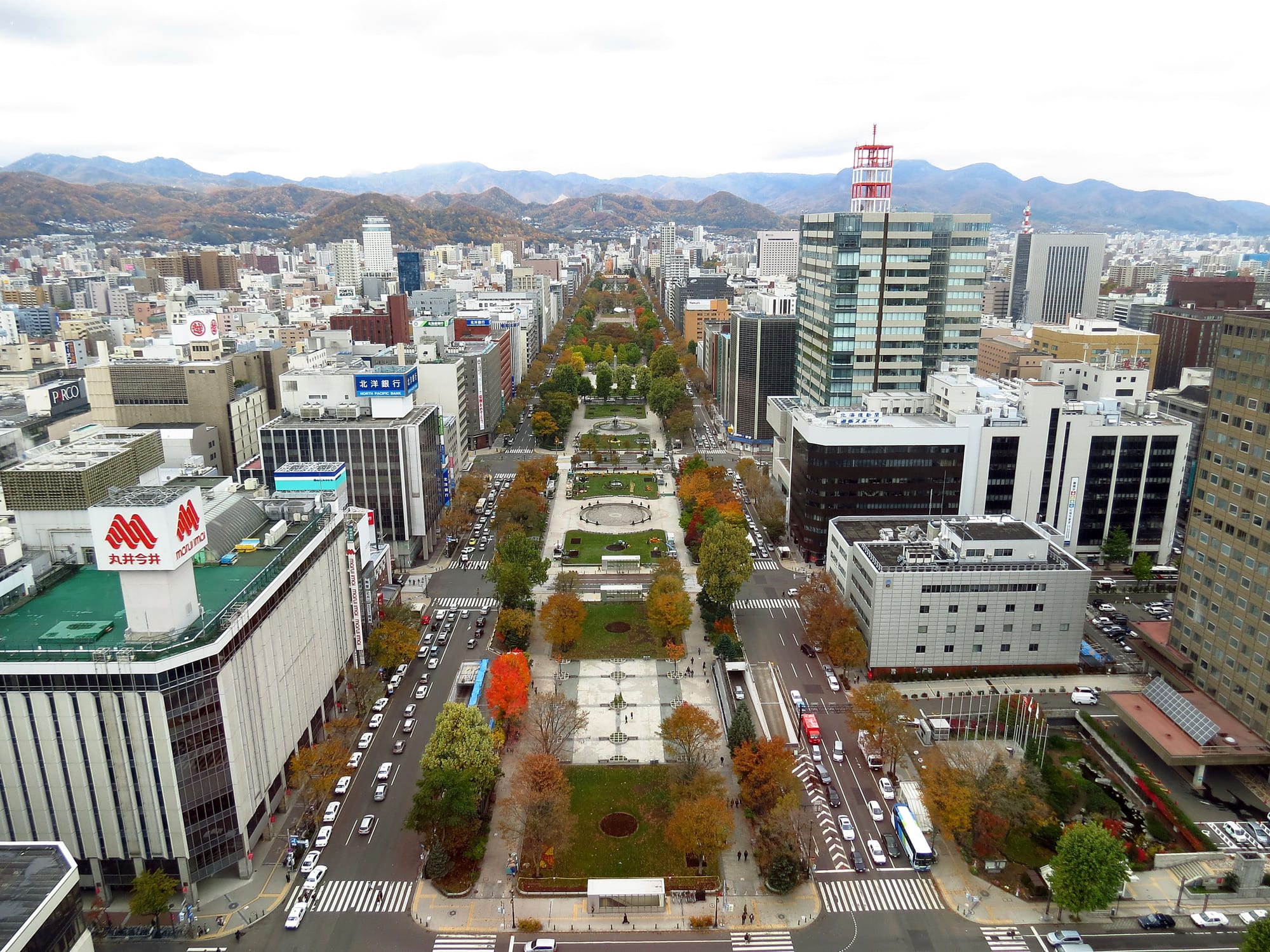
A long tree-lined park running in a straight line through a grid of city blocks in autumn, with low mountains on the horizon

Hokkaido, Japan

Sapporo

Odori Park cutting across central Sapporo, seen from the Sapporo TV Tower in autumn. (redlegsfan21 / Wikimedia Commons · CC BY-SA 2.0)

Hokkaido's capital and Japan's fifth-largest city, laid out on an American-style grid in 1869 on land the Ainu called Sat-poro-pet. Mountains rise straight from its western edge, several metres of snow fall each winter, and the city is known for its February snow festival, its beer, miso ramen and the long green axis of Odori Park.

Neighbourhoods

  • Odori and the central grid
    • First-time visitors
    • Shopping
    • Close to public transport

    The heart of the city, where the park runs east to west between numbered blocks of department stores, offices and covered shopping arcades. The TV Tower stands at its eastern end and the Clock Tower and old government building are a few streets north.

    Open in Maps
  • Sapporo Station and the north
    • Close to public transport
    • Shopping
    • Hotels

    The rail hub, with department stores, an observation floor and a dense cluster of hotels above and around the tracks. North of it lie the elm-lined grounds of Hokkaido University, and an underground walkway runs south to Odori.

    Open in Maps
  • Susukino
    • Nightlife
    • Best for food
    • Late-night eating

    One of the largest entertainment districts in northern Japan, a few blocks of neon south of Odori packed with izakaya, bars, karaoke and ramen counters. It stays busy into the small hours and includes the alley of ramen shops known as Ramen Yokocho.

    Open in Maps
  • Maruyama
    • Quiet and residential
    • Best for food
    • Walks

    A well-off district on the western edge below wooded Mount Maruyama, with the city's main Shinto shrine, a zoo, a botanical fringe of parks and a reputation for good small restaurants and bakeries.

    Open in Maps
  • Nakajima Park and the south
    • Parks
    • Quiet and residential

    South of Susukino, a large park of ponds, a concert hall and a preserved Meiji-era guest house, surrounded by residential blocks. It is an easy walk from the nightlife but much quieter, and the streetcar loop passes nearby.

    Open in Maps
  • Jōzankei
    • Hot springs
    • Autumn colour

    A hot-spring resort in a river gorge about 27 kilometres south-west, inside the city limits and within Shikotsu-Toya National Park. Ryokan and public baths line the valley, which is known for autumn foliage.

    Open in Maps

Things to do

Famous landmarks

  • Odori Parkpark

    A park about 1.5 kilometres long running through the centre of the grid, used for the Snow Festival, summer beer gardens and the winter illumination.

    Open in Maps
  • Sapporo TV Towerlandmark

    A steel tower of 1957 at the east end of Odori Park, with an observation deck looking straight down the park's length.

    Open in Maps
  • Sapporo Clock Towerlandmark

    A white wooden hall of 1878 built for the agricultural college, with an American-made clock, now a small museum of the city's founding.

    Open in Maps
  • Former Hokkaidō Government Officelandmark

    A red-brick, American-influenced building of 1888 set in a formal garden, long the seat of the island's administration.

    Open in Maps
  • Hokkaido Shrinelandmark

    The island's principal Shinto shrine, founded in 1869 in the woods of Maruyama Park and a major site for new-year visits and spring blossom.

    Open in Maps

Museums and the beer story

  • Sapporo Beer Museummuseum

    A red-brick building of 1890, raised as a sugar factory and later used by the brewery, a museum since 1987 tracing the history of brewing in Hokkaido, with tastings and a beer hall alongside.

    Open in Maps
  • Hokkaido Museummuseum

    The island's main history and nature museum, in parkland on the eastern edge of the city, covering Ainu culture, settlement and wildlife.

    Open in Maps
  • Historical Village of Hokkaidomuseum

    An open-air museum of more than fifty relocated buildings of the Meiji to Shōwa eras — farmhouses, shops, a fishing village — served by a narrow-gauge horse-drawn tram.

    Open in Maps
  • Hokkaido University Museummuseum

    The university founded as the Sapporo Agricultural College in 1876 keeps a free museum in its old buildings, among poplar and elm avenues open to the public.

    Open in Maps

Parks and viewpoints

  • Mount Moiwaviewpoint

    A forested peak on the south-western edge reached by a ropeway, giving the standard night view over the grid of city lights.

    Open in Maps
  • Moerenuma Parkpark

    A park on a former waste site in the north-east, designed by the sculptor Isamu Noguchi as a single work of land art, with a glass pyramid and a grassed artificial hill.

    Open in Maps
  • Maruyama Parkpark

    Woodland and cherry trees at the foot of Mount Maruyama beside the Hokkaido Shrine, with a short climb through primeval forest to the summit.

    Open in Maps
  • Ōkurayama Ski Jump Stadiumviewpoint

    The 1972 Olympic ski jump on the western hills, with a view back over the city from the top of the inrun and a winter sports museum at its base.

    Open in Maps

Sport and nights out

  • Susukinoneighborhood

    The nightlife district south of Odori, whose crossing of neon signs is one of the city's best-known sights in itself.

    Open in Maps
  • Sapporo Domeattraction

    A domed stadium in the south of the city, home of the football club Hokkaido Consadole Sapporo, which hosted three matches of the 2002 World Cup and is also used for concerts and events.

    Open in Maps
  • Es Con Field Hokkaidoattraction

    The baseball park of the Hokkaido Nippon-Ham Fighters, opened in 2023 in Kitahiroshima just outside the city, with a retractable roof and a village of shops and baths around it.

    Open in Maps

Short trips from the city

  • Shikotsu-Toya National Parkpark

    The national park that begins on the city's southern edge, taking in hot-spring valleys, volcanoes and two caldera lakes.

    Open in Maps
  • Otaruattraction

    A canal port about 30 kilometres north-west, with stone warehouses, glassworks and sushi counters, reached in around half an hour by train.

    Open in Maps
  • Lake Shikotsuattraction

    Japan's second-deepest lake, a caldera lake south of the city inside Shikotsu-Toya National Park and ringed by active volcanoes.

    Open in Maps

Seasonal events

  • Sapporo Snow Festivalearly February

    Large snow and ice sculptures fill Odori Park and Susukino for about a week, drawing crowds from across Japan and abroad; it began with school students' snow statues in 1950.

  • Yosakoi Soran FestivalJune

    Thousands of dancers in teams perform a modern dance built on the Soran Bushi fishermen's song, on Odori Park stages and through the streets; the festival began in 1992.

  • Sapporo Lilac FestivalMay

    The city's symbol tree flowers in Odori Park, marked with market stalls, wine tastings and open-air concerts as the short northern spring arrives.

  • Odori beer gardensJuly and August

    The park's blocks are given over to open-air beer gardens run by the major breweries, one of the city's summer rituals.

  • Sapporo White Illuminationlate November to January

    Lights are strung through Odori Park and the station area from late November into January, alongside a Christmas market in the park.

Eat and drink

Long-standing places and food districts in Sapporo. Hours, ratings and directions come from your maps app, always current.

Sapporo classics

  • Ramen Yokochoneighborhood

    A short covered alley in Susukino lined with tiny ramen counters, the traditional place to eat the city's miso ramen — a rich, fatty broth often topped with butter and sweetcorn.

    Open in Maps
  • Sapporo Beer Gardenrestaurant

    Beer halls in the brick buildings of the old brewery, where jingisukan — mutton and vegetables grilled on a domed iron pan — is eaten with the brewery's beer.

    Open in Maps
  • Soup curry restaurantsneighborhood

    A thin, heavily spiced broth served with rice and whole vegetables and chicken, a Sapporo speciality now found in dozens of shops devoted to it.

    Open in Maps

Markets and food districts

  • Nijo Marketmarket

    A compact central market of fish stalls and small restaurants selling crab, salmon roe and sea urchin, and rice bowls heaped with them.

    Open in Maps
  • Sapporo Central Wholesale Market outer shopsmarket

    The public shops and restaurants beside the city's wholesale fish market in the west, busiest early in the morning for crab, scallops and seafood breakfasts.

    Open in Maps
  • Susukino izakayaneighborhood

    Hundreds of small drinking restaurants serving Hokkaido produce — grilled scallops, zangi fried chicken, potato with butter — with beer, local sake and whisky.

    Open in Maps

Experience Sapporo

History

Sapporo is a planned city barely older than its buildings. The name comes from the Ainu, who knew the river crossing here as Sat-poro-pet, understood as a dry or large river, and who lived across the plain long before Japanese settlement. In 1869 the new Meiji government renamed Ezo as Hokkaido and set up a colonisation office, which chose this site on the Ishikari plain for the island's capital and laid it out on a rectangular grid measured north, south, east and west from a firebreak that became Odori Park.

The work was done with foreign advice. American experts were hired to plan farming on the frontier, and the Sapporo Agricultural College, founded in 1876, was led briefly by William S. Clark, remembered for the parting words "Boys, be ambitious". A brewery opened in 1876 using local barley and the cold winters, and became Sapporo Beer. Settlers arrived from across Japan, timber and coal moved through the city, and a village of a few thousand grew into the administrative and commercial centre of the island.

Growth accelerated after the Second World War, and in 1972 Sapporo hosted the Winter Olympics, the first held in Asia, which brought the subway, the Ōkurayama jump and a new scale of infrastructure. The population passed a million by 1970 and has since reached about 1.96 million, concentrating two-fifths of Hokkaido's people in one place while the countryside empties. A later attempt to bring the Winter Games back was set aside, and the extension of the Shinkansen from Hakodate towards the city continues, now due to open in fiscal 2038.

Culture & Customs

Sapporo thinks of itself as a young, open city, and other Japanese tend to agree: almost every family arrived within the last 150 years, dialect is mild, hierarchy sits a little lighter, and the grid, the wide roads and the low-rise sprawl look more North American than Japanese. The Ainu presence, long suppressed, is acknowledged more openly now, and the name of the city and of many rivers and mountains around it are Ainu words.

Winter organises the culture. The Snow Festival, which began in 1950 when students built a few snow statues in Odori Park, now fills the park with large sculptures each February and is the city's best-known export after its beer. The lilac, the city flower, marks the short spring, the beer gardens fill the park in summer, and lights go up along the same axis at the end of the year.

Beer is a civic identity as much as an industry, and so is ramen: the miso bowl developed in the city's post-war stalls is served everywhere from alley counters to hotel dining rooms. Sport matters — the football club Hokkaido Consadole Sapporo, the Nippon-Ham Fighters baseball team just outside the city, ski jumping on the western hills — and skiing is an ordinary weekend activity rather than a speciality. Susukino gives the city a nightlife out of proportion to its size.

Daily Life

About 1.96 million people live in Sapporo, two-fifths of Hokkaido's population, in ten wards spread across a plain that runs from the mountains to the Ishikari river. It is a city of offices, government, universities, hospitals, retail and tourism rather than heavy industry, with a well-established software and technology cluster and an economy tied to the rest of the island's farming and fishing.

Most residents live in apartment blocks or suburban houses along the subway lines, and commuting is short by Japanese standards. Snow shapes the routine for almost half the year: clearing it from doorways before work, roof-clearing crews, lorries hauling it to designated dumping sites, and a municipal budget where snow removal is a major line. Underground shopping concourses and covered arcades exist because of it.

Sapporo keeps growing slowly while the towns around it shrink, which puts the island's depopulation debate on the city's doorstep — it absorbs young people from rural Hokkaido and then loses many of them to Tokyo. Other current issues are an ageing population, the cost of winter heating and infrastructure, pressure on housing from tourism, and the long wait for the Shinkansen. Summer evenings are spent outdoors, in the park, at a beer garden or up Mount Moiwa, and winter weekends on the ski slopes within an hour of the centre.

Food

Sapporo's dish is miso ramen: a heavy, opaque broth of pork stock and fermented soybean paste with curly yellow noodles, usually topped with sweetcorn, a slice of butter, bean sprouts and minced pork. It was developed in the city's ramen shops in the years after the war and spread across Japan from here; the alley of counters in Susukino known as Ramen Yokocho is the traditional place to try it, though shops all over the city do it as well or better.

Jingisukan, named after Genghis Khan, is the other local institution — mutton or lamb and vegetables grilled on a domed cast-iron pan so the fat runs down, eaten with beer in the halls of the old brewery and in small restaurants everywhere. Soup curry, a thin, spicy broth with whole chicken legs and roasted vegetables over rice, is a Sapporo speciality that has become a Hokkaido staple. Zangi is the local marinated fried chicken.

Beyond that, Sapporo eats the island's produce: kaisendon, bowls of rice covered with sea urchin, salmon roe, scallops and crab, at Nijo Market and the stalls beside the wholesale market; ishikari nabe, a salmon and vegetable hotpot named after the river; potatoes with butter, sweetcorn grilled in the park, dairy soft serve and cheese; and Yubari melons as luxury gifts. Sapporo Beer and Nikka whisky, distilled at nearby Yoichi, are the drinks, and Shiroi Koibito biscuits the standard souvenir.

Planning tools

Budget

Sapporo is cheaper than Tokyo for both rooms and food, and its seafood is better value. Prices spike around the Snow Festival in early February, when hotels book out months ahead, and again in the summer holidays. Ramen, soup curry and market bowls keep eating costs low; day trips and a rail pass or hire car are the main extras.

Daily Budget Midrange
USD 110–220 (mid-range hotel, seafood and beer-hall dinners, subway, some day trips)
Daily Budget Shoestring
USD 50–85 (hostel or business hotel, ramen and market bowls, subway and local trains)

Book far ahead for early February, and use a rechargeable IC card for the subway, streetcar and buses.

Best Time to Visit

June to September is mild and fresh, with festivals in Odori Park and easy access to the mountains — a relief from the humid heat further south. February is the other peak, cold and deep in snow, for the Snow Festival and the ski resorts within reach. Autumn colour comes early, from late September in the hills.

Suggested Number of Days

Two or three days are enough for the city centre and one outing. Four to six allow the coast, the hot springs and the national park nearby. Winter needs more time than summer, because snow slows every journey and festival crowds fill the centre.

First Visit
2–3 days
With Surroundings
4–6 days

Transportation

Three subway lines cross the city under the grid and run frequently, a streetcar makes a loop through the southern centre, and JR trains serve the suburbs and the airport. Buses fill the gaps, and a rechargeable IC card pays for all of them. An underground pedestrian concourse links the station with Odori and Susukino, which matters in winter.

Taxis are plentiful but slow in snow; allow much longer for every journey between December and March.

Airport & Station Connections

New Chitose Airport, about 45 kilometres south-east, is Hokkaido's main gateway and has flights every few minutes from Tokyo as well as other domestic and international routes; rapid trains reach Sapporo Station in around forty minutes. By rail from Tokyo, the Hokkaido Shinkansen runs to Shin-Hakodate-Hokuto in just under four hours, with a limited express on to Sapporo; the line's extension to the city is under construction and its opening has been put back to fiscal 2038. Ferries from Honshu dock at Tomakomai and Otaru.

Walkability

The centre is one of the easiest Japanese cities to navigate on foot: streets run on a numbered grid counted from the corner of Odori Park, so an address gives its own directions. Odori to Susukino or the station is a walk of ten to twenty minutes, much of it possible underground. Snow and ice make pavements hard going for months, and grip soles are worth having.

Safety

Crime is very low and the city is comfortable at night, with the usual caution around nightlife touts in Susukino, who steer drinkers towards bars that overcharge. Winter is the real hazard: icy pavements, snow and ice falling from roofs, and poor visibility in blizzards. Hokkaido lies in an earthquake zone, and a 2018 quake cut power across the island.

Ignore street touts in Susukino and choose bars yourself, wear boots with grip in winter and keep clear of roof edges, and learn the earthquake drill. Check current official travel advice before travelling.

Climate

A cold, snowy version of Japan's climate, spared the June rainy season that affects the rest of the country. Snow lies from December to March and the city clears several metres of it a season, one of the heaviest falls of any large city in the world. Summers are warm and humid, but rarely oppressive.

Summer
warm and humid, generally 20–27°C in July and August, with cool nights
Winter
cold and snowy, generally -8 to 0°C from December to February, with heavy and frequent snowfall

Local Customs

Tipping is not practised and can cause confusion. Shoes come off in ryokan, some restaurants and any home; trains and buses are kept quiet. Hokkaido manners are seen as more relaxed than in older Japanese cities, but the basics hold: queue, do not eat while walking in busy streets, and handle money using the small tray on the counter. Tattoos may bar entry to some public baths.

At Shinto shrines rinse hands at the basin before approaching, and ask before photographing people; in hot springs, wash thoroughly before entering the water and leave swimwear out.

Common Payment Methods

The currency is the Japanese yen. Cards and IC cards are accepted in most hotels, chains, department stores and the transport system, but small restaurants, market stalls, older ramen counters and some rural inns remain cash-only. Cash machines at convenience stores and post offices reliably take foreign cards.