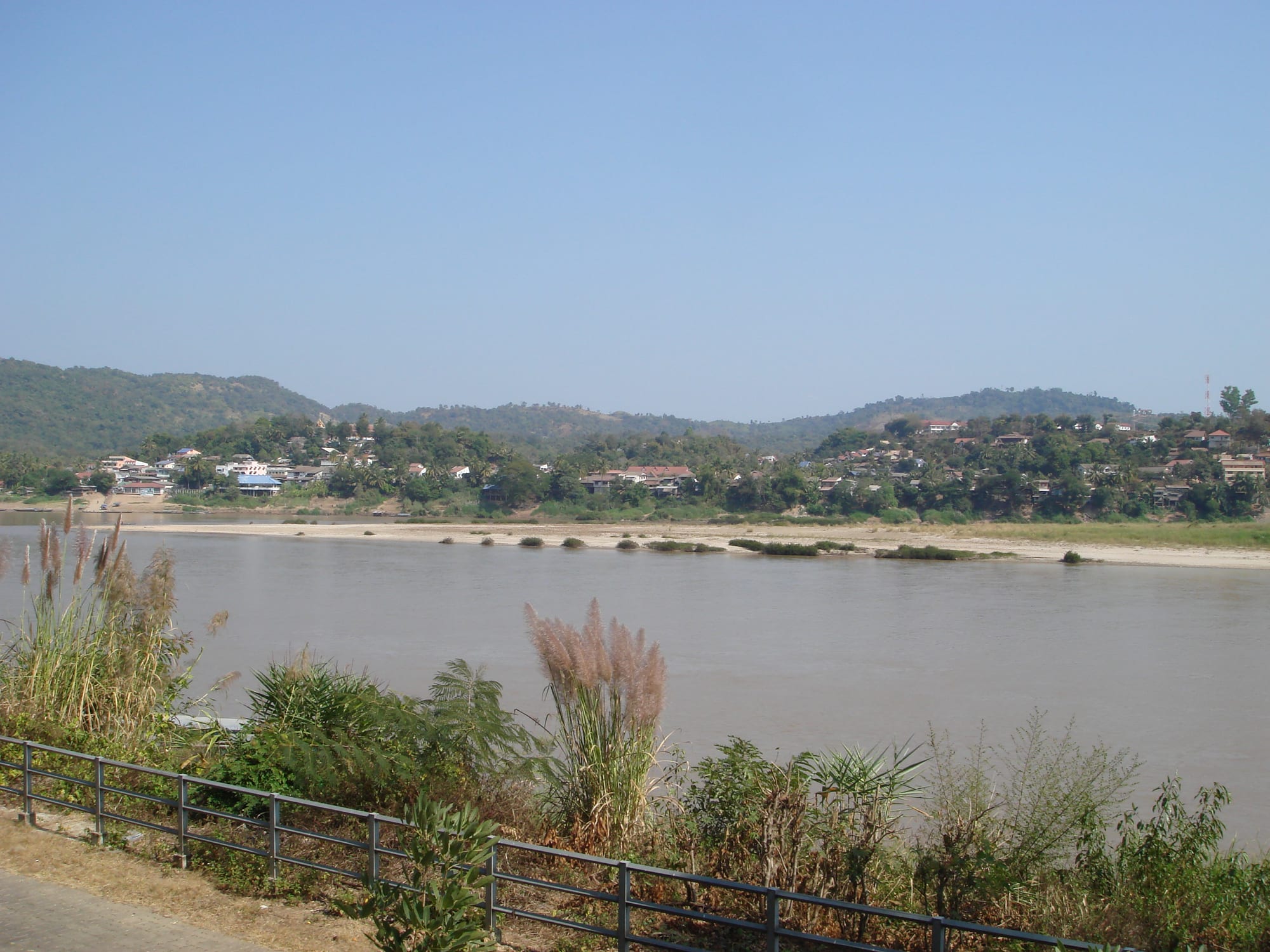
The town of Huay Xai on a wooded hillside above the wide brown Mekong, seen across the river from Thailand

Luang Prabang & the North, Laos

Huay Xai

Huay Xai on the Lao bank of the Mekong, seen from Chiang Khong in Thailand. (Ondřej Žváček / Wikimedia Commons · CC BY 2.5)

The capital of Bokeo province in north-western Laos, strung along a bluff above the Mekong opposite the Thai town of Chiang Khong. A frontier trading post under the French, it is now a border crossing linked to Thailand by a bridge, and the pier where the two-day slow boat down the Mekong to Luang Prabang begins.

Neighbourhoods

  • The riverfront main street
    • First-time visitors
    • Best for food
    • River views

    A single long road running above the Mekong through the middle of town, lined with guesthouses, travel agents, noodle shops and shops selling Thai goods. Steps drop from it to the boat landings, and the view across the water to Thailand is the town's main outlook.

    Open in Maps
  • The temple hill
    • Historic district
    • Quiet and residential
    • Viewpoints

    The rise at the northern end of the main street, where a long stairway climbs past naga balustrades to a hilltop monastery. Lanes of wooden houses and small gardens run off it, and the French-era fort stands on the ridge above.

    Open in Maps
  • The bridge and bus station area
    • Close to public transport
    • Practical stops

    A newer strip of workshops, warehouses and guesthouses several kilometres out of town near the Mekong bridge and the bus station. Little happens here beyond arriving and leaving, but it is where buses to Luang Namtha and Luang Prabang start.

    Open in Maps

Things to do

Landmarks and temples

  • Wat Chom Khao Manilatlandmark

    The hilltop monastery above the main street, reached by a long stairway, built in 1880 in teak in Shan style and holding a stele dated 1458, with a view over the Mekong to Thailand.

    Open in Maps
  • Fort Carnotlandmark

    The remains of a French colonial fort on the ridge behind the town, built in the 1900s to watch the Mekong frontier, later used as barracks by the Lao army and listed as a heritage site in 2025.

    Open in Maps
  • Fourth Thai–Lao Friendship Bridgelandmark

    The road bridge over the Mekong between Huay Xai and Chiang Khong, opened in December 2013, which replaced the ferry and is the northernmost road crossing between the two countries.

    Open in Maps

The river and the forest

  • The Mekong slow boat piertransit hub

    The landing where long wooden boats leave for the two-day journey downriver to Luang Prabang, with a night ashore at Pakbeng.

    Open in Maps

Short trips from the town

  • Nam Kan National Protected Area (Bokeo Nature Reserve)park

    Mixed deciduous forest and mountains inland from the town, some 1,230 square kilometres set aside to protect the black-crested gibbon, which was found here in 1997 after being thought extinct, and reached on multi-day trips from Huay Xai.

    Open in Maps
  • The Gibbon Experienceattraction

    A conservation project in the Nam Kan forest, set up after the black-crested gibbon was found again, where visitors travel by zipline between huts built high in the canopy and stay overnight.

    Open in Maps
  • Chiang Khongneighborhood

    The Thai town directly across the Mekong, with its own riverside road and markets, reached by the bridge with the right visa or stamp.

    Open in Maps
  • Golden Triangle Special Economic Zoneattraction

    A casino and hotel zone created in 2007 in Ton Pheung district upriver, near the meeting point of Laos, Thailand and Myanmar; the United States sanctioned its operator, Kings Romans, in 2018 over alleged money laundering and trafficking, which the company denies.

    Open in Maps

Seasonal events

  • Pi Mai Lao (Lao New Year)mid-April

    Three days of water-throwing, temple visits and sand stupas on the riverbank, celebrated on both sides of the Mekong.

  • Boun Bang Fai (rocket festival)May or June

    Home-made bamboo rockets are fired into the sky before the rains to ask for a good wet season.

  • Boun Ok PhansaOctober

    The end of the Buddhist rains retreat, marked with offerings at the monasteries and candle-lit floats set on the Mekong.

Eat and drink

Long-standing places and food districts in Huay Xai. Hours, ratings and directions come from your maps app, always current.

Markets and food streets

  • Huay Xai morning marketmarket

    The town's produce market, busiest soon after dawn, selling river fish, sticky rice, herbs, bamboo shoots and bags of noodle soup to take away.

    Open in Maps
  • The riverfront roadneighborhood

    Small restaurants and guesthouse kitchens along the main street serve Lao and Thai dishes, grilled Mekong fish and cold Beerlao, with tables facing the water.

    Open in Maps
  • Noodle shops near the bus stationneighborhood

    Plain shophouses cooking khao piak sen and feu for travellers waiting on early buses, the cheapest and most local eating in town.

    Open in Maps

Experience Huay Xai

History

The bluff at Huay Xai has been a crossing point on the upper Mekong for as long as goods have moved between the Lao side and what is now northern Thailand. The settlement grew around a monastery built in 1880, and the Tai and Lao villages of the surrounding hills traded forest products, salt and cattle down to the river.

French officers arrived as the protectorate pushed its border up the Mekong, and in the 1900s a small fort was built on the ridge above the town, later known as Fort Carnot, to watch the frontier with Siam and the British territories beyond. Huay Xai became the administrative seat of the far north-west, a customs post and a garrison in a district better known for opium than for anything else. In the 1960s and 1970s the wider Golden Triangle, where Laos, Thailand and Myanmar meet a short way upriver, carried a large share of the world's illicit opium trade, and the Mekong here was a smuggling route as much as a trade route.

After 1975 the town settled into its role as a provincial capital; Bokeo was split from Luang Namtha province in 1983, with Huay Xai as its centre. The border reopened to foreign travellers in the 1990s, and the slow boat to Luang Prabang made the town the first stop in Laos for many. The Fourth Thai–Lao Friendship Bridge opened downstream in December 2013, replacing the ferry and changing the shape of the town.

Culture & Customs

Huay Xai is a lowland Lao town surrounded by a strikingly mixed countryside. Khmu villages occupy the middle slopes of Bokeo, and Hmong, Lahu, Akha and Tai Lue communities farm higher ground, coming down to the town's market to sell and buy. Bokeo is one of the more ethnically varied provinces in Laos, and the market is the place where that shows most plainly, in dress, language and what is on the stalls.

The Buddhist calendar still sets the year. Alms are collected at dawn, novices study at the hilltop monastery, and the big festivals are kept with care: Pi Mai in April, when water is thrown for days on end; Boun Bang Fai, the rocket festival before the rains; and the end of the rains retreat in October, when candle-lit floats are set on the Mekong. The baci ceremony, in which white cotton threads are tied round the wrist to call the spirits home, marks weddings, departures and welcomes.

Thailand is visible from every part of town and its influence is strong: Thai television, music, pop culture and consumer goods cross the river daily, and many residents have worked or have family on the other bank. The result is a border culture that is thoroughly Lao in its manners — soft voices, indirect speech, patience with delay — while looking outward in its tastes.

Daily Life

Huay Xai is a small provincial capital; the town and its district together hold only a few tens of thousands of people, and the built-up centre is barely two kilometres long. Life runs on the border. Customs, immigration, freight forwarding, warehousing and the trade in Thai food, fuel and manufactured goods employ a good share of the town, alongside provincial government offices, and lorries queue at the bridge for the crossing to Chiang Khong.

Beyond the town, households live from rice, maize, rubber and banana plantations, cattle and forest products. Chinese investment has reshaped parts of the province, from plantations to the special economic zone upriver, and sapphire mining gives Bokeo its name, which means gem mine. Tourism matters too, though much of it passes through: travellers arrive in the afternoon and leave on the boat the next morning, which supports guesthouses, ticket agents and noodle shops more than anything larger.

The day starts before six, when the market fills and the noodle pots go on, and much of the business of the town is done by mid-morning. Afternoons are slow and hot, the riverfront cools at dusk, and by nine the main street is quiet. Electricity, roads and mobile coverage have all improved since the bridge opened, though the province is thinly populated, with about 179,000 people at the 2015 census, and young people commonly look for work across the river.

Food

Eating in Huay Xai is Lao with a strong Thai accent. Sticky rice, khao niao, is the staple, taken by hand from a woven basket and used to pick up everything else. Laap, minced meat or fish dressed with lime, fish sauce, herbs and toasted ground rice, is the dish of celebrations and ordinary meals alike, and tam mak hoong, the Lao green papaya salad, is pounded to order with chillies, lime and fermented fish sauce, hotter and less sweet than its Thai cousin.

The Mekong supplies the town's best food. River fish is grilled whole over charcoal, stuffed with lemongrass and coated in salt as ping pa, or steamed in banana leaves with dill and herbs as mok pa. Khai paen, the crisp pressed sheets of river weed from the upper Mekong, are fried and eaten with the smoky chilli paste jaew bong. Breakfast is a bowl of khao piak sen, thick rice noodles in chicken broth, or feu, the Lao version of Vietnamese pho, or the northern khao soi, flat noodles in clear broth under a spicy minced pork and tomato sauce, which is nothing like the Thai curry of the same name.

Coffee is drunk strong and sweet with condensed milk, and baguettes left over from the French period are split and filled with pâté and pickles as khao jii. Beerlao is the beer everywhere; lao-lao, the clear rice spirit, appears at every baci and celebration.

Planning tools

Budget

Huay Xai is an inexpensive town. Guesthouse rooms, noodle shops and local buses cost little, and the main outlays are the slow boat down the Mekong, a guided trip into the Bokeo forest and any border transport. Prices for both food and rooms are higher than in villages inland because almost everything is trucked in from Thailand.

Daily Budget Midrange
USD 50–120 (comfortable riverside hotel, restaurant meals, the slow boat or a guided forest trip)
Daily Budget Shoestring
USD 20–35 (guesthouse room, market food and noodle shops, local transport)

Cash machines in town are reliable but can run empty at weekends, so withdraw kip before taking the boat downriver, where there are none until Luang Prabang.

Best Time to Visit

November to February brings dry, warm days, cool nights and a river still high enough for comfortable boat travel. March and April are hot and often hazy with smoke from field burning. The monsoon from June to October turns the Mekong fast and brown and makes forest trips muddy, though the hills are at their greenest.

Suggested Number of Days

Most travellers stay a single night, arriving from Thailand and leaving on the morning boat. Three or four days allow a forest stay in Bokeo or a slower look at the town and the border. Boat and bus departures, which mostly go early, shape how long anyone stays.

First Visit
1 day
With Surroundings
3–4 days

Transportation

The town is small enough to cross on foot, and tuk-tuks and shared songthaews cover the few kilometres between the centre, the bus station and the bridge. Boats are the other way out: the slow boat to Luang Prabang and local craft along the Mekong. Buses and minibuses run east to Luang Namtha, Oudomxay and Luang Prabang on winding mountain roads.

Agree the fare for a tuk-tuk before setting off, and allow extra time for the transfer between the bridge and the boat pier, which are at opposite ends of town.

Airport & Station Connections

Most people arrive overland from Thailand, crossing the Mekong on the Fourth Thai–Lao Friendship Bridge from Chiang Khong by shuttle bus; Chiang Rai and its airport are a few hours away on the Thai side. From within Laos, buses climb in from Luang Namtha and Oudomxay in most of a day, and the slow boat arrives from Luang Prabang after two days on the river, with a night at Pakbeng. The town has a small domestic airport, with flights to Vientiane and Luang Prabang that vary by season.

Walkability

The centre is one long street above the river, walkable end to end in half an hour, with stairways down to the boat landings and up to the temple hill. Pavements are patchy and the slopes are steep in places. The bus station and the bridge are several kilometres out and need a ride.

Safety

Huay Xai is quiet and crime against visitors is rare, with petty theft the main risk. The Mekong runs fast and deep, especially in the wet season, and boat travel is safer with a life jacket. The wider Golden Triangle zone in Bokeo is associated with casinos, illegal gambling and trafficking, and scams around border transport and visas are common.

Use the official border post and refuse offers to arrange visas privately, keep valuables close on crowded boats, and treat river swimming with caution after rain. Check current official travel advice before travelling.

Climate

A tropical monsoon climate, hot in the lowland river valley but cooler than central Laos at night in winter. The dry season runs from November to April, with heat building through March and April, and the rains fall from May or June to October.

Summer
hot and humid, generally 30–35°C by day, with heavy afternoon rain from June to October
Winter
dry and warm, about 25–30°C by day, with mornings that can drop near 12°C and river mist

Local Customs

Lao manners hold: greet with a nop, the palms pressed together, speak softly and avoid public anger. Shoulders and knees are covered at the monastery, shoes come off at the door of a temple hall or a house, and Buddha images are not touched or climbed on. Monks are not touched by women. Tipping is not expected, though small change is welcome.

Ask before photographing people, especially monks and market traders, and dress modestly in town; Thai baht is widely accepted but change is often given in kip.

Common Payment Methods

The currency is the Lao kip. Cash is used for almost everything, and Thai baht and sometimes US dollars are accepted near the border, usually at a poor rate. Cards work at a few hotels only. There are cash machines and money changers on the main street and at the bridge, but none along the river route downstream.