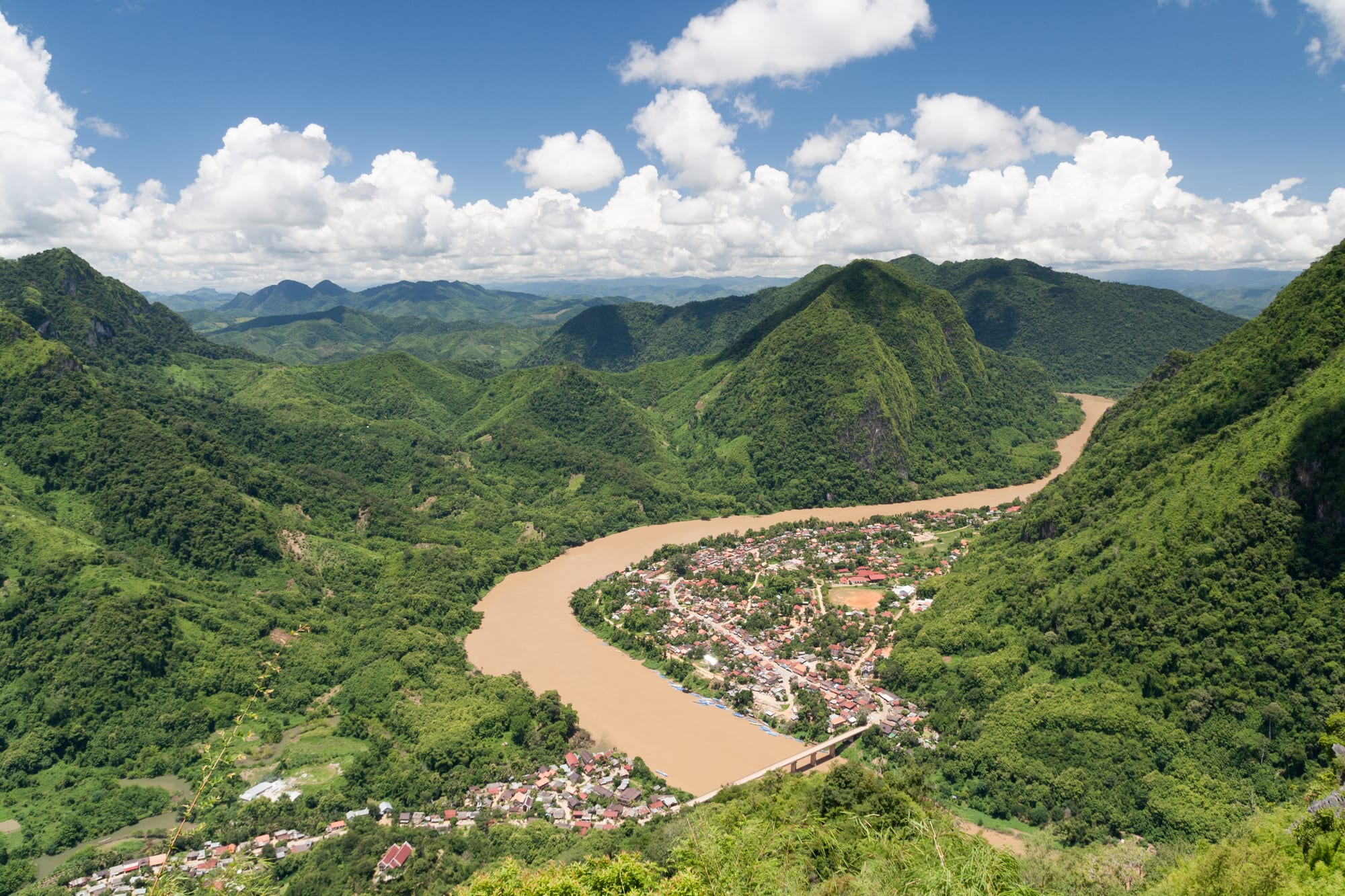
A brown river curving between steep green limestone hills, with the red and white roofs of a small village on the bend

Luang Prabang & the North, Laos

Nong Khiaw

Nong Khiaw on a bend of the Nam Ou, seen from the hills above the village. (Ekrem Canli / Wikimedia Commons · CC BY-SA 4.0)

A village in northern Laos where the road from Luang Prabang crosses the Nam Ou on a high bridge, hemmed in by limestone cliffs and forested peaks. Long a river trading point and a place of shelter during the bombing of the 1960s and 1970s, it now lives from farming, fishing and travellers who come to climb its viewpoints and take boats upriver.

Neighbourhoods

  • The bridge and the main road
    • First-time visitors
    • Close to transport
    • Shops

    The centre of the village, where the road from Luang Prabang crosses the Nam Ou on a concrete bridge. Minibuses, shops, small restaurants and tour offices are grouped at either end, and the bridge itself is the best place to watch the river and the cliffs.

    Open in Maps
  • The east bank riverside
    • Riverside
    • Quiet and residential
    • Views

    A strip of guesthouses and bungalows on the bank downstream of the bridge, many with balconies facing the cliffs across the water. Paths run between vegetable plots and wooden houses, and the boat landing for trips upriver is at the end.

    Open in Maps
  • The west bank and Ban Sop Houn
    • Local life
    • Cheaper stays
    • Walks

    The quieter side of the river, where village houses, a school and small kitchens line the road as it climbs away towards the caves and the trailheads. Chickens, drying rice and workshops give it more everyday life than the guesthouse strip.

    Open in Maps

Things to do

Viewpoints and walks

  • Pha Daeng Peak Viewpointviewpoint

    A steep climb up ladders and earth steps behind the village to a ridge looking down on the river bend and the surrounding karst peaks, the best known of several climbs from the village.

    Open in Maps
  • Nong Khiaw bridgeviewpoint

    The road bridge over the Nam Ou, a Chinese gift that joins the two halves of the village and its best-known landmark, and the easiest place to take in the cliffs, the boats and the river in both directions.

    Open in Maps

Caves and the river

  • Tham Pha Thok cavesattraction

    Caves in a cliff a short walk east of the village, reached by steps; caves along this stretch of the Nam Ou sheltered villagers and local administration through the bombing of the 1960s and 1970s.

    Open in Maps
  • The Nam Ouattraction

    The tributary of the Mekong that runs through the village between limestone walls, carrying longtail boats and fishing nets, and dammed in seven stages by a Chinese-built hydropower cascade that has ended the old through-boat from Luang Prabang.

    Open in Maps

Short trips from the village

  • Muang Ngoi Neuaattraction

    A small riverside town of a few hundred people about an hour upriver by boat, set among cliffs, with wartime shelter caves, paddy fields and walking routes to surrounding hamlets.

    Open in Maps

Seasonal events

  • Pi Mai Lao (Lao New Year)mid-April

    Three days of water throwing, temple offerings and family visits, celebrated in the village and the hamlets around it at the hottest time of year.

  • Boun Ok PhansaOctober

    The end of the Buddhist rains retreat, marked with offerings at the monastery and candle-lit floats set on the river.

  • Hmong New YearNovember or December

    Celebrated after the harvest in the Hmong villages of the surrounding hills, with new clothes, silver jewellery and ball-tossing courtship games.

Eat and drink

Long-standing places and food districts in Nong Khiaw. Hours, ratings and directions come from your maps app, always current.

Village kitchens

  • Riverside restaurantsrestaurant

    Simple kitchens on both banks serving Lao standards — laap, grilled river fish, sticky rice, fried noodles and buffalo stews — alongside sandwiches and fruit shakes for travellers.

    Open in Maps
  • The morning marketmarket

    A small market near the bridge that trades at first light in river fish, forest greens, chillies, bamboo shoots and sticky rice steamed in baskets.

    Open in Maps
  • Barbecue stalls by the bridgemarket

    Grills set up in the late afternoon for skewers of pork and chicken, sai oua sausage and whole fish packed with lemongrass and salt.

    Open in Maps

Experience Nong Khiaw

History

The village grew where the Nam Ou narrows between limestone walls, at a natural crossing and mooring point on a river that carried trade between the upper Lao valleys, the Mekong and the towns of the south. Lao and Tai households settled the flat ground on the bends, while Khmu villages held the slopes and Hmong communities the higher ridges; rice, fish, forest products and, later, opium moved along the water. For most of its history the settlement was reached only by boat or footpath.

The 20th century brought the war. Northern Laos lay on the supply routes fought over during the conflict in neighbouring Vietnam, and the Nam Ou valley was bombed heavily between 1964 and 1973 in the campaign known as the Secret War. Villagers along the river lived for long periods in caves in the cliffs, farming at night; the caves at Tham Pha Thok, a short walk from the bridge, were among the shelters used. Bomb casings still turn up as fence posts and planters in villages across the province.

After 1975 the valley remained remote and poor. A road was pushed through and the bridge built, ending the river's monopoly on travel, and from the 1990s backpackers began arriving from Luang Prabang, drawn by the cliffs and the boats to Muang Ngoi Neua. A cascade of seven Chinese-built hydropower dams was raised along the Nam Ou, with the later stages from 2017, changing water levels and ending the boat journey that used to link the village with Luang Prabang. Guesthouses, cafés and trekking agencies have since multiplied along the single road.

Culture & Customs

Nong Khiaw sits at a meeting point of lowland and upland Laos. The village itself is largely Lao and Buddhist, with a monastery, early alms rounds and the festival calendar that goes with it, while the hamlets in the hills around are mostly Khmu and Hmong, each with its own language, dress and spirit practices. Market mornings and school buses bring the groups together, and homestay trekking has made the differences part of what visitors come to see — something guides handle with varying care.

Daily manners are those of rural Laos: soft voices, the nop in greeting, shoulders covered near the monastery, shoes left at the door. Weaving and basketwork are done in several villages upriver, and Hmong households make embroidered cloth and silver ornaments for New Year. Rice spirit, lao-lao, circulates at weddings, house blessings and the baci ceremony, in which white cotton threads are tied around the wrists to call the spirits home.

The war is part of local memory rather than a museum subject. Older residents remember the caves, and clearance teams still work in the district. Visitors who ask are generally answered plainly, but the conversation belongs to those who start it, and photographing damaged land or ordnance is taken badly.

Daily Life

A few thousand people live in the village and the hamlets along the road and river, a number that swells at market time and falls when young people leave for Luang Prabang, Vientiane or Thailand to work. Most households still farm: rice on the terraces and the flats, maize and cassava on the slopes, vegetables by the water, with buffalo and pigs kept beside the houses. Fishing on the Nam Ou supplements it, though catches have fallen since the dams changed the river.

Tourism is the other economy, seasonal and concentrated on one road — guesthouse rooms, boat trips, trekking guides, minibus tickets and a scattering of cafés and bars. It brought electricity, better roads and mobile signal faster than they reached comparable villages, and it makes the wet months lean. Chinese and Lao investment in dams and roads has also brought construction work and, for some families, resettlement compensation.

The day is early: markets before dawn, farming and school in the morning, a quiet hot afternoon, and boats returning as the light goes. Electricity supply and mobile coverage are reliable but not guaranteed, medical care means a small clinic, and anything serious involves the road to Luang Prabang. Rising visitor numbers, the state of the river and the price of rice are the everyday subjects.

Food

Cooking here is rural northern Lao and revolves around sticky rice, khao niaw, steamed in bamboo baskets and eaten with the fingers at every meal. The river supplies most of the protein: small fish grilled whole over charcoal, stuffed with lemongrass and rubbed with salt, or steamed in banana leaf as mok pa. Laap, minced meat or fish with herbs, lime, chilli and toasted rice powder, is the dish for guests, and jaew — a pounded chilli dip, often with tomato or aubergine — is on nearly every table.

The forest and the fields fill the rest of the plate. Bamboo shoots are boiled into soup with dill and yanang leaf, river weed is dried and fried, and wild greens, mushrooms and herbs come in from the hills according to season. Sai oua, coarse pork sausage with lemongrass and galangal, and skewers of pork and chicken are grilled by the bridge in the late afternoon. Khao soi, flat noodles under a spicy pork and tomato sauce, and khao piak sen, soft rice noodles in broth, are the usual breakfasts.

Drinks are simple: strong Lao coffee with condensed milk, fruit shakes, Beerlao and lao-lao, the clear rice spirit distilled in the villages and poured at any celebration. Khmu and Hmong households also make lao hai, a fermented rice beer drunk through reeds from a shared jar.

Planning tools

Budget

One of the cheapest places to stay in northern Laos. Simple bungalows and guesthouse rooms, village kitchens and a handful of bars keep daily costs low, and the main expenses are boats upriver, guided treks and the minibus in and out. There are few places to spend more, though a small number of comfortable lodges face the river.

Daily Budget Midrange
USD 45–90 (riverside lodge, restaurant meals, a guided trek or a private boat)
Daily Budget Shoestring
USD 15–30 (basic bungalow, village kitchens and market food, shared minibus, a short boat trip)

Bring enough kip: cash machines in the village are few and unreliable, and boats, guides and guesthouses expect cash.

Best Time to Visit

November to February gives the clearest views from the peaks, dry trails and cool mornings with mist filling the river valley. March and April are hot, and haze from field burning can hide the cliffs altogether. The rains from June to September turn the hills a deep green and raise the river, but climbs become slippery and road journeys slow.

Suggested Number of Days

Two days suit most visits to the village itself. Three or four allow a night upriver, a longer trek or a homestay in the hills. Slow transport in and out means arrivals and departures each take much of a day.

First Visit
2 days
With Surroundings
3–4 days

Transportation

The village is small enough to cross on foot in fifteen minutes, and bicycles and scooters can be hired near the bridge. Longtail boats leave from the landing for villages upriver, minibuses run to Luang Prabang, Oudomxay and Luang Namtha, and the road east leads towards Vieng Thong and Sam Neua.

Boat departures depend on demand and river levels, so ask at the landing the day before rather than relying on a fixed schedule.

Airport & Station Connections

Most travellers come from Luang Prabang, about 140 kilometres south by road, on a minibus over winding mountain roads. Buses and shared vans also run from Oudomxay and from Luang Namtha. Boats connect the village with Muang Ngoi Neua and, at some water levels, further up the Nam Ou, but the dams have ended the old river journey down to Luang Prabang. The nearest airport and railway station are in Luang Prabang.

Walkability

Everything in the village is walkable: the bridge, the boat landing, the shops and the guesthouse strip lie within a kilometre or so of one another, along a single road with light traffic. Beyond the village the ground rises quickly, and the viewpoint climbs are steep, rough and slippery after rain. There is little lighting after dark, so a torch is useful.

Safety

The village is quiet and crime is rare. The real risks are outdoors: steep and unmaintained viewpoint trails, fast water and rocks in the Nam Ou, and unexploded ordnance left by the bombing of the 1960s and 1970s, which is still found in this part of Laos. Medical care is very basic and the nearest hospital is in Luang Prabang.

Keep to marked paths on treks and never dig or light fires off-trail, wear proper shoes on the climbs, and avoid swimming when the river is high. Check current official travel advice before travelling.

Climate

Tropical monsoon weather softened by altitude and the river valley, with a dry season from November to April and rain from May to October. Mornings are often misty, and the surrounding cliffs hold cloud after rain.

Summer
hot and humid, generally 28–34°C, with heavy rain and full rivers from June to September
Winter
warm days around 25–29°C but cold at dawn, sometimes near 10°C, with thick valley mist

Local Customs

Village manners are conservative. Shoulders and knees are covered at the monastery and in the hamlets, shoes are removed before entering a house, and swimwear belongs at the river rather than on the road. Many people in the hills are Khmu or Hmong rather than Lao, with their own languages and beliefs; photographs of people, houses and ceremonies should be asked for first.

Tipping is not expected but guides and boatmen appreciate it; the village goes quiet early, and loud music or drinking late at night is out of keeping with it.

Common Payment Methods

The Lao kip is used for almost everything, and cash is essential. A small number of cash machines stand near the bridge but can be empty or out of service, and card payment is accepted at very few places. Thai baht and US dollars are sometimes taken by guesthouses at poor rates, so it is best to arrive with kip from Luang Prabang.