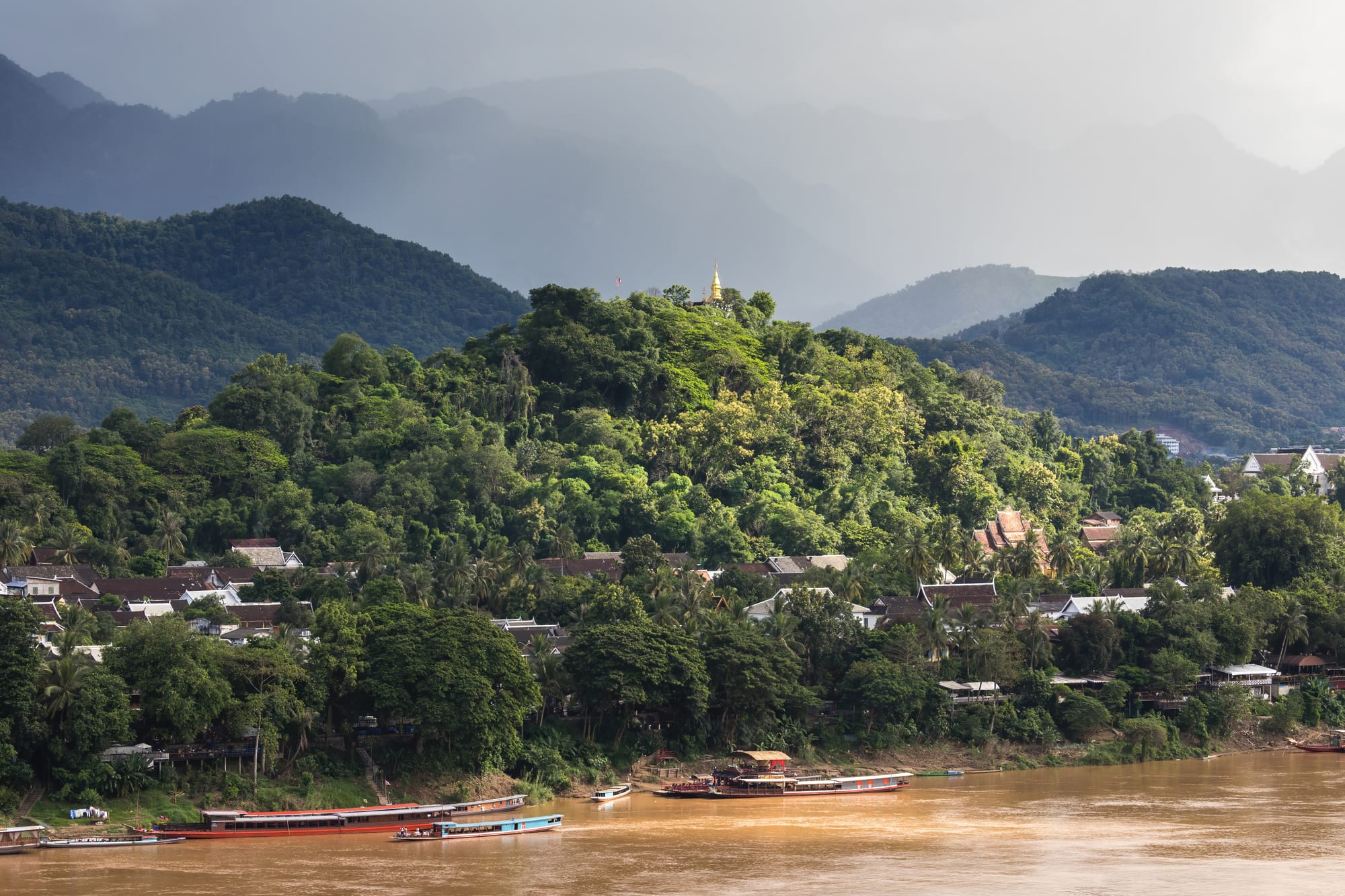
Wooded Mount Phou Si with a gold stupa on top rising above white-walled houses, palms and long boats moored on the brown Mekong

Luang Prabang & the North, Laos

Luang Prabang

Mount Phou Si above the rooftops of Luang Prabang, seen across the Mekong. (Basile Morin / Wikimedia Commons · CC BY-SA 4.0)

The former royal capital of Laos, set on a narrow peninsula where the Nam Khan meets the Mekong among forested hills. Monasteries with sweeping roofs stand among French-era shophouses in a centre listed by UNESCO in 1995. Today it is a small, slow town of monks, guesthouses, riverside cafés and morning markets, reached since 2021 by railway.

Neighbourhoods

  • The peninsula and Sakkaline Road
    • First-time visitors
    • Historic district
    • Temples

    The tip of the peninsula between the two rivers, where the oldest monasteries stand along a single low street of shophouses. Wat Xieng Thong is at the far end, and the lanes on either side drop to the Mekong and the Nam Khan. Most of the heritage guesthouses are here, and the night market fills the main road after dark.

    Open in Maps
  • Around Mount Phou Si and the Royal Palace
    • First-time visitors
    • Museums
    • Close to the centre

    The middle of the old town, where the hill divides the peninsula. The former palace, now the national museum, faces the Mekong, and stairways climb the hill from both sides. Restaurants, travel agents and the main post office cluster here, and the morning alms round passes along the street below.

    Open in Maps
  • The Nam Khan bank and Ban Phan Luang
    • Quiet and residential
    • Riverside
    • Best for food

    The quieter eastern side of the peninsula, with cafés and small hotels on the low bank above the Nam Khan. A bamboo footbridge, rebuilt each dry season, crosses to the gardens and vegetable plots of Ban Phan Luang, which feels like a village a few minutes from the centre.

    Open in Maps
  • Ban Phosi and the new town
    • Local life
    • Markets
    • Cheaper stays

    South-west of the peninsula, where most residents actually live. Phosi market, hardware shops, noodle stalls and schools serve the town rather than visitors, and prices are lower. The bus stations and the road to the airport are on this side.

    Open in Maps
  • Chomphet, across the Mekong
    • Quiet and residential
    • Walks
    • Day trips

    Reached by a short ferry from the old town, a strip of riverside villages and old monasteries below wooded slopes. Paths link the temples and lead up to viewpoints looking back over the peninsula, and there are a few small guesthouses.

    Open in Maps

Things to do

Monasteries and royal monuments

  • Wat Xieng Thonglandmark

    The royal monastery at the tip of the peninsula, built between 1559 and 1560 under King Setthathirath, with roofs sweeping almost to the ground and a tree of life in glass mosaic on its rear wall.

    Open in Maps
  • Royal Palace Museummuseum

    The palace built in 1904 for King Sisavang Vong, kept as it was left in 1975 and now the national museum, with the throne hall and royal apartments.

    Open in Maps
  • Wat Mai Suwannaphumahamlandmark

    The largest monastery in the town, beside the palace, built around the turn of the 19th century, with a deep tiered roof and gilded reliefs of village life and the Ramayana along its front wall.

    Open in Maps
  • Wat Visounlandmark

    The town's oldest monastery site, founded in the early 16th century by King Visoun to house the Phra Bang and rebuilt after the raid of 1887, known for the rounded stupa beside it called That Makmo, the watermelon stupa.

    Open in Maps
  • Wat Sensoukharamlandmark

    A bright red and gold monastery on the main street, built in 1718 by King Kitsarath with stones carried from the Mekong, where many of the town's novices study.

    Open in Maps

Museums and crafts

  • Traditional Arts and Ethnology Centremuseum

    A small independent museum of the dress, textiles and customs of the ethnic groups of northern Laos, with a shop selling work made in the villages.

    Open in Maps

Viewpoints and walks

  • Mount Phou Siviewpoint

    The wooded hill of about 100 metres in the middle of the peninsula, climbed by a few hundred steps past shrines to the stupa of Wat Chom Si at the summit, with views along both rivers.

    Open in Maps
  • The Nam Khan bankviewpoint

    The tributary that joins the Mekong at the tip of the peninsula, with a bamboo footbridge put up each dry season and a path along the low bank.

    Open in Maps

Markets and the river

  • Luang Prabang night marketmarket

    Stalls of Hmong textiles, paper lanterns and silverwork laid out along the main street each evening, with a lane of food stalls beside it.

    Open in Maps
  • Phosi Marketmarket

    The town's working market in the newer district, busiest soon after dawn, selling river fish, herbs, sticky rice and household goods.

    Open in Maps
  • Luang Prabang railway stationtransit hub

    The station on the Laos–China Railway about nine kilometres outside town, opened with the line in December 2021, which cut the journey to Vientiane to about two hours.

    Open in Maps

Short trips from the town

  • Kuang Si Fallsattraction

    Tiered limestone cascades about 29 kilometres south of town, falling through turquoise pools in forest, with a bear rescue centre at the entrance.

    Open in Maps
  • Pak Ou Cavesattraction

    Two caves in a cliff where the Nam Ou meets the Mekong, about 25 kilometres upstream and some two hours by boat, filled with hundreds of small Buddha images left by pilgrims.

    Open in Maps
  • Tad Sae Waterfallattraction

    A wide set of low limestone cascades about 18 kilometres south-east of town, reached by a short boat ride along the Nam Khan and strongest in the wet season.

    Open in Maps

Seasonal events

  • Pi Mai Lao (Lao New Year)mid-April

    The town's biggest festival, marked with water throwing, processions of the Phra Bang, sand stupas on the riverbank and several days of ceremony.

  • Boun Bang Fai (rocket festival)May

    Home-made bamboo rockets are fired into the sky at village monasteries to call for rain before the planting season.

  • Boun Ok Phansa and the boat racesOctober

    The end of the three-month Buddhist rains retreat, when candle-lit floats are set on the Mekong and longboat crews from the villages race on the river.

  • Luang Prabang Film FestivalDecember

    A free festival of Southeast Asian cinema screened in the town, with talks and outdoor showings.

Eat and drink

Long-standing places and food districts in Luang Prabang. Hours, ratings and directions come from your maps app, always current.

Luang Prabang classics

  • Or lam and jaew bongrestaurant

    The town's two best-known dishes — a thick stew of meat, aubergine, dill and wood-ear mushroom peppery with sakhan wood, and a smoky chilli paste made with dried buffalo skin — appear on almost every Lao menu on the peninsula.

    Open in Maps
  • Khao soi Luang Prabangrestaurant

    The northern breakfast noodle — flat rice noodles in clear broth under a spicy minced pork and tomato sauce, quite unlike the curried Thai dish that shares the name.

    Open in Maps
  • Khai paenmarket

    Sheets of Mekong river weed pressed with sesame and garlic, dried and fried, sold as a snack with jaew bong at market stalls.

    Open in Maps

Markets and food streets

  • The night market food lanemarket

    A narrow lane off the main night market where stalls sell grilled fish and sai oua sausages, coconut pancakes and plates filled from trays of noodles and vegetables.

    Open in Maps
  • Phosi Marketmarket

    The main produce market in the new town, where herbs, river fish, sticky rice and bamboo shoots are sold from dawn, with noodle stalls along one side.

    Open in Maps
  • Cafés on the Nam Khanneighborhood

    The eastern bank of the peninsula is lined with small cafés and bakeries serving Lao coffee, grown on the Bolaven Plateau and often poured over condensed milk, and French-style bread.

    Open in Maps

Experience Luang Prabang

History

The site was settled long before it was royal: known as Muang Sua and later Xieng Dong Xieng Thong, it commanded the meeting of the Mekong and the Nam Khan on the trade route between the upper river and the Lao plains. In 1353 Fa Ngum founded the kingdom of Lan Xang here with Khmer support, and the town took its present name from the Phra Bang, the golden Buddha image that became the dynasty's emblem. King Setthathirath moved the capital to Vientiane in the 1560s, but Luang Prabang kept the Phra Bang, its monasteries and its prestige, and when Lan Xang broke apart in 1707 it became the seat of its own kingdom, which later paid tribute to Siam.

In 1887 the town was sacked and burned by Chinese Haw raiders; the French envoy Auguste Pavie helped King Oun Kham escape, and the episode drew Laos into the French protectorate declared in 1893. The monarchy stayed in Luang Prabang under French rule, and the palace on the riverbank was built for King Sisavang Vong in 1904. French administrators added the brick and stucco shophouses that stand among the monasteries, giving the centre its mixture of steep temple roofs and shuttered façades.

Independence, war and revolution followed. The Pathet Lao abolished the monarchy in 1975, and the last king, Savang Vatthana, was taken to a camp in Houaphanh, where he died. The town was closed and quiet for years. UNESCO inscribed the centre on the World Heritage List in 1995 for the way its monasteries and colonial buildings survive together, tourism grew quickly afterwards, and the Laos–China Railway reached the town in 2021.

Culture & Customs

Luang Prabang is the religious centre of Lao Buddhism, and the calendar of its monasteries still sets the rhythm of the town. Dozens of wats house novices, many of them boys sent from villages in the hills for an education, and their orange robes are part of every street scene. Before sunrise the monks walk in single file along the main road for tak bat, collecting sticky rice from kneeling residents — a ceremony that has become a point of friction where visitors crowd too close.

The town's identity is also royal. Court traditions shaped its cooking, its silverwork and its classical dance, and Pi Mai in April is celebrated here with processions of the Phra Bang, masked figures representing the town's guardian spirits and a long week of ceremony that ends with sand stupas built on the riverbank. At the end of Buddhist Lent in October, candle-lit floats are set on the Mekong and villages race longboats.

Crafts survive in the villages around the town: weaving in silk and cotton, mulberry paper, silverwork and, across the Mekong, pottery. Hmong embroidery is sold at the night market. Manners are quiet and formal by Southeast Asian standards — a soft voice, the nop rather than a handshake, shoulders covered near temples — and the heritage rules that limit new building and keep the centre low-rise are part of how residents see the place.

Daily Life

The town is small — its protected centre takes in 33 of its 58 villages, while the province around it held some 432,000 people at the last census. Rents and heritage rules there have pushed families out to Ban Phosi and the newer districts to the south-west, where schools, offices and the produce market are, so the peninsula is now mostly guesthouses, restaurants, shops and monasteries with a resident core of monks and older households.

Tourism is the main employer, alongside government, small trade and farming in the villages within a few kilometres. The railway changed the town's position: Vientiane is a couple of hours away, Chinese visitors and goods arrive directly, and land near the station has risen in value. The gains are uneven, and seasonal — the wet months are slow — while young people commonly go to Vientiane or Thailand for work.

The day starts before dawn with the alms round and the market, and the heat of the afternoon empties the streets. Evening belongs to the night market, the riverside restaurants and the food lane, and and the old town goes quiet early, with little open late. Ordinary concerns are the cost of living and a national currency that has lost value against the baht and the dollar, the pressure of visitor numbers on a small centre, and river levels that fall further each dry season.

Food

Luang Prabang has the most distinctive cooking in Laos, refined by the royal court and shaped by the forest and the river. Or lam, the dish most associated with the town, is a thick stew of meat or offal with aubergine, long beans, dill and wood-ear mushrooms, given a numbing heat by sakhan, a peppery climbing vine, and thickened with crushed sticky rice. Jaew bong, a dark sweet-smoky chilli paste made with garlic, galangal and strips of dried buffalo skin, is eaten with sticky rice and raw vegetables and carried home by the jar.

The river provides khai paen, sheets of Mekong weed pressed with sesame seeds, tomato and garlic, dried in the sun and fried until brittle, usually served with jaew bong. Grilled fish stuffed with lemongrass, sai oua — coarse pork sausage with lemongrass, galangal and kaffir lime — and mok pa, fish steamed in banana leaf, appear at every market grill. Breakfast is khao soi, flat rice noodles in a clear broth topped with a spicy minced pork and tomato sauce, or khao piak sen, soft hand-cut noodles in chicken soup.

Sticky rice, eaten with the fingers from a woven basket, accompanies almost everything, and laap, minced meat with herbs, lime and toasted rice powder, is the dish of celebrations. French influence survives in baguettes and pastries and in strong Lao coffee served with condensed milk, and lao-lao, a clear rice spirit, and lao hai, a communal rice beer drunk through reeds, are poured at festivals.

Planning tools

Budget

Luang Prabang is the most expensive town in Laos, because heritage hotels and restaurants fill the protected old centre. Eating at markets and noodle shops and staying in the new town brings costs down sharply. The larger expenses are boat trips, a hired driver or minivan to the waterfalls, and train tickets.

Daily Budget Midrange
USD 50–120 (heritage hotel, restaurant dinners, guided boat trips, a private driver or the train)
Daily Budget Shoestring
USD 20–35 (guesthouse room, market and noodle-shop meals, bicycle hire, shared transport to the falls)

Carry kip for markets, boats and temple entry; cash machines are reliable in town but not on trips upriver.

Best Time to Visit

November to February is the most comfortable season, dry and warm by day with cool mornings and the rivers still high enough for boats. March and April are hot and often hazy with smoke from field burning, though Pi Mai in April is celebrated here with more ceremony than anywhere in Laos. The rains from June to September bring green hills, full waterfalls and brief heavy downpours.

Suggested Number of Days

The old town is small and can be walked in a couple of days. Four or five allow for waterfalls, a boat trip upriver and villages across the Mekong. Travellers arriving by slow boat or continuing north often stay longer, and the pace of the town encourages it.

First Visit
2–3 days
With Surroundings
4–5 days

Transportation

The old town is closed to large vehicles and best covered on foot or by bicycle, which most guesthouses rent. Tuk-tuks wait at the palace and the markets and charge by the trip after a little negotiation. Minivans and shared vans run to the waterfalls and to the railway station, boats leave from the Mekong landings, and long-distance buses use stations on the edge of town.

Agree the fare before getting into a tuk-tuk, and allow extra time to reach the railway station, which is several kilometres outside the centre.

Airport & Station Connections

Luang Prabang International Airport is about four kilometres from the old town, with flights from Vientiane, Bangkok, Hanoi and other regional cities. The Laos–China Railway station, about nine kilometres from the old town, links it to Vientiane in roughly two hours and north towards the Chinese border. Buses run on winding mountain roads to Vang Vieng, Vientiane and the northern towns, and the two-day slow boat from Huay Xai on the Thai border arrives at the Mekong landing.

Walkability

One of the easiest towns in Southeast Asia to walk. The peninsula is about two kilometres long and flat apart from Mount Phou Si, traffic is light, and most monasteries, restaurants and hotels lie within ten or fifteen minutes of one another. Pavements are uneven in places and the riverbank paths are muddy after rain; the new town and the railway station need transport.

Safety

Crime is low and the town is relaxed, with the usual small risks of theft from open guesthouse rooms and from bags left on bicycles. The greater hazards are traffic on the road to the waterfalls, fast water and slippery rocks at Kuang Si after rain, and the strong current of the Mekong. Unexploded ordnance remains a danger in rural northern Laos, so marked paths matter on any walk into the hills.

Keep to marked paths on treks, take care on wet rocks at the falls, avoid swimming in the rivers when they run high, and use a licensed guide for village walks. Check current official travel advice before travelling.

Climate

A tropical monsoon climate tempered by the hills, with a dry, mild winter, a hot spring and a wet summer. Mornings on the rivers are often misty from November to February.

Summer
hot and humid, generally 28–34°C, with heavy afternoon rain from June to September and green, full rivers
Winter
dry and pleasant, about 25–30°C by day, falling to 12–15°C at dawn, with mist over the Mekong

Local Customs

This is the most conservative Buddhist town in Laos. Shoulders and knees are covered in monasteries, shoes come off at the door, and women do not touch monks or hand objects to them directly. The dawn alms round, tak bat, is a religious act rather than a display: it is watched quietly from a distance, without flash, and food should only be offered by those who understand the ritual. Voices stay soft, and the greeting is the nop, a slight bow with the palms together.

Tipping is not traditional but is welcomed in restaurants and for guides and drivers; the protected old town is quiet early, and nights end well before midnight.

Common Payment Methods

The currency is the Lao kip. Hotels, tour operators and larger restaurants accept cards and often quote in US dollars or Thai baht, but markets, tuk-tuks, boats and small kitchens are cash only. Cash machines are plentiful in the old town, with withdrawal limits and fees, and it is worth drawing enough kip before heading upriver or into the hills.