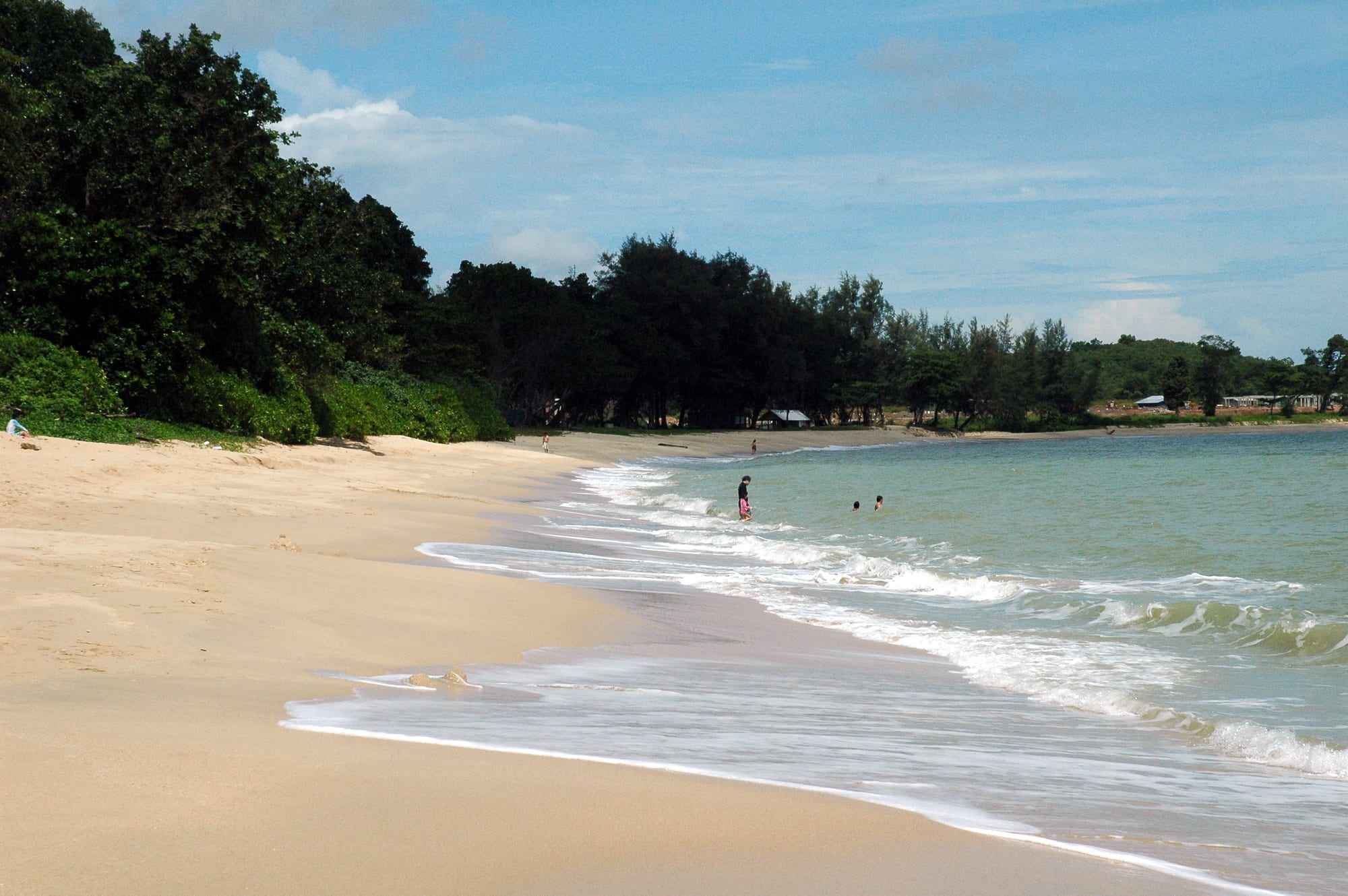
A wide curve of pale sand at Desaru with small breaking waves and a dense line of dark trees along the shore

Malacca & the Southern Peninsula, Malaysia

Desaru

The beach at Desaru on the South China Sea coast of Johor. (Jpatokal / Wikimedia Commons · CC BY-SA 4.0)

A beach resort area on the South China Sea coast of Johor, about an hour and a quarter by road from Johor Bahru. Once a stretch of casuarina-backed sand behind a fishing coast, it was developed from the late 1970s as a holiday destination for Malaysians and Singaporeans, and has grown into a long line of hotels, golf courses and family attractions.

Neighbourhoods

  • Desaru Coast
    • Resorts
    • Families
    • Golf

    The newer integrated development at the southern end of the beach, built around several large hotels, two golf courses, a water park and a small retail village. Everything is within the estate and linked by shuttle, and it is the part of Desaru most visitors mean when they name the place.

    Open in Maps
  • The older beach strip
    • Beaches
    • Quiet and residential
    • Budget stays

    The original run of hotels, chalets and apartment blocks north along the shore, dating from the first wave of development in the 1980s and 1990s. Simpler and cheaper, with seafood restaurants, stalls and public access points to the sand.

    Open in Maps
  • Bandar Penawar
    • Local life
    • Everyday shopping
    • Budget food

    The small planned service town a few kilometres inland, among the plantations. Banks, supermarkets, a market and ordinary coffee shops serve the plantations and the resorts, and rooms here cost a fraction of those on the beach.

    Open in Maps
  • Tanjung Balau
    • Fishing villages
    • Seafood
    • Local beaches

    A headland and fishing village north of the main strip, where boats are pulled up on the sand and a small museum explains the fishing life of the Johor coast. The beach here is rockier and quieter than Desaru's main stretch.

    Open in Maps

Things to do

The coast

  • Desaru beachbeach

    A long stretch of pale sand backed by casuarina trees on the open South China Sea, with surf that picks up considerably in the monsoon months and calm swimming for much of the rest of the year.

    Open in Maps
  • Tanjung Balau fishing villageattraction

    A working fishing settlement on a rocky headland north of the resorts, with boats on the sand, a small fishermen's museum and views along the coast.

    Open in Maps
  • Sungai Lebamattraction

    The largest tributary of the Johor River, a mangrove river and wetland behind the coast, where boat trips run at dusk to see fireflies in the trees along the banks.

    Open in Maps

Family attractions

  • Adventure Waterpark Desaru Coastattraction

    A large water park at the southern end of the development, with wave pools, slides and a river circuit, the main wet-weather draw on the coast.

    Open in Maps
  • Desaru Coast golf coursesattraction

    Two courses laid out through coastal forest and dunes beside the resorts, which draw much of the coast's weekend traffic from Singapore.

    Open in Maps

Short trips from the coast

  • Kota Tinggiattraction

    The district town inland on the Johor River, a base for trips to the waterfalls and the forest behind the coast, with a district museum.

    Open in Maps
  • Kota Tinggi Waterfallsattraction

    A set of falls on the slopes of Gunung Muntahak, north-west of the coast, with pools for bathing and a long-standing recreation area around them.

    Open in Maps
  • Johor Lamalandmark

    The site of a 16th-century royal capital on the Johor River, with the earthworks of a fort destroyed by the Portuguese in 1587 and a small museum.

    Open in Maps
  • Pengerangattraction

    The district at Johor's south-eastern corner, with fishing villages, a British-built coastal fort and a very large oil refining and petrochemical complex.

    Open in Maps
  • Sungai Rengitattraction

    The town centre of Pengerang south of Desaru, a collection of fishing villages known for seafood restaurants, weekend markets and Chinese temples.

    Open in Maps

Seasonal events

  • School and public holidaysMalaysian and Singaporean school breaks, and long weekends through the year

    The coast fills with families and the hotel rates rise sharply; the roads from Johor Bahru and the causeway are slowest on Friday evenings.

  • Hari Raya Aidilfitriat the end of Ramadan

    The main Malay festival brings open houses in the villages and plantation towns inland and a busy week on the beach afterwards.

Eat and drink

Long-standing places and food districts in Desaru. Hours, ratings and directions come from your maps app, always current.

On the coast

  • Seafood restaurants along the beach roadrestaurant

    Open-sided kitchens serving grilled fish, chilli crab, squid and prawns from the boats at Tanjung Balau and Sungai Rengit, usually with rice and stir-fried greens.

    Open in Maps
  • Resort restaurants at Desaru Coastrestaurant

    The hotels and the retail village hold most of the area's sit-down dining, from Malay and Chinese menus to international food, and are the main option after dark inside the estate.

    Open in Maps

Inland and in town

  • Bandar Penawar coffee shopsneighborhood

    Everyday kopitiam and Malay warung food in the service town — nasi lemak, mee goreng, roti canai and strong local coffee at a fraction of resort prices.

    Open in Maps
  • Sungai Rengit seafoodneighborhood

    A row of Chinese seafood restaurants in the small town to the south, long popular with day visitors from Johor Bahru and Singapore.

    Open in Maps

Experience Desaru

History

The coast where Desaru now stands was, until the 1970s, a thinly settled shore of fishing villages and mangrove rivers at the far south-eastern corner of the peninsula, behind which the federal land development agency FELDA and the Johor state schemes had cleared jungle for oil palm and rubber smallholdings. The planned town of Bandar Penawar was built inland as a service centre for those settlements, and the beach itself, a long stretch of sand facing the South China Sea, was almost empty.

Development began at the end of the 1970s, aimed at creating a holiday coast within reach of both Johor Bahru and Singapore. The first hotels, chalets and a golf course opened through the 1980s, and Desaru became a familiar name to Singaporean families, who came by ferry across the strait and then by road. Growth stalled at times — some early properties closed or changed hands — and for years the place had the slightly faded air of a resort built ahead of its market.

The second wave came in the 2010s, when a large integrated development, Desaru Coast, was built at the southern end of the beach with international hotel brands, two golf courses, a water park and a conference centre, opening in stages from the late 2010s. The Senai–Desaru Expressway and the long bridge over the Johor River cut the drive from Johor Bahru in 2011, and a ferry terminal opened in 2022 with services from Tanah Merah in Singapore. Time magazine listed Desaru among the world's greatest places in 2021. The older strip to the north still trades alongside it, and the plantations and fishing villages that were here first continue much as before.

Culture & Customs

Desaru has no old town and no deep local tradition of its own: it is a resort grafted onto a farming and fishing coast. The culture that surrounds it belongs to the villages and the land settlement schemes inland, which are overwhelmingly Malay and Muslim, with Javanese and Bugis ancestry common among families whose forebears crossed from the islands generations ago. Mosques mark the centre of each settlement, Friday prayers set the rhythm of the week, and the major festivals of Hari Raya empty the plantations as families return to their villages.

Fishing shapes the coast north and south of the resorts. Boats go out overnight and land their catch in the morning at Tanjung Balau and Sungai Rengit, where the small museum at Tanjung Balau records the equipment, boat types and beliefs of the Johor fishing communities. Chinese Malaysians run many of the seafood restaurants and shops in the coastal towns, and Chinese New Year is marked in Sungai Rengit and Kota Tinggi.

Inside the resorts the atmosphere is international and largely Singaporean, with golf, buffets and family activity, and English and Mandarin as common as Malay. The contrast between the two worlds is unusually sharp here, and visitors who leave the estate find the ordinary dress and manners of small-town Johor: modest clothing, quiet greetings and an early night.

Daily Life

Few people live at Desaru itself; the resident population is concentrated in Bandar Penawar, a small planned town, and in the fishing and plantation villages along the coast and inland, within the Kota Tinggi district. Most households depend either on oil palm — planting, harvesting and the mills that process the fruit — or on fishing, or on work in the hotels, the golf courses and the water park.

The resort economy provides the wages that keep young people from moving to Johor Bahru or across the border, though many still leave, and a large share of the hotel and construction workforce is made up of migrant workers from Indonesia and Bangladesh. Pengerang's refinery and petrochemical complex, an hour to the south, has drawn thousands of workers to the district since the 2010s and changed the character of villages that were fishing settlements a decade ago.

Life runs early: boats return at dawn, the plantation day starts before the heat, and the market at Bandar Penawar is busiest in the morning. Weekends bring a surge of cars from the causeway, filling the coast road and the seafood restaurants, then draining away on Sunday evening. Coastal erosion, the effect of the monsoon on fishing incomes and the pace of development are the local concerns.

Food

Seafood is the coast's own food. Boats land mackerel, squid, prawns and crab, and the restaurants at Tanjung Balau, along the beach road and in Sungai Rengit cook them simply: fish grilled in banana leaf with sambal, squid fried with salted egg, crab in a thick chilli gravy, prawns in butter and curry leaves, with rice and stir-fried kangkung alongside. Ikan bakar, charcoal-grilled fish, is the dish to look for at the roadside.

Johor's mainland dishes are all here. Mee rebus, yellow noodles in a thick spiced gravy with boiled egg and green chilli, and laksa Johor, a fish and coconut gravy served with spaghetti, appear in the warungs inland, and otak-otak, the spiced fish paste grilled in leaves that made nearby Muar famous, is sold in packets at roadside stalls. Nasi lemak, coconut rice with sambal, anchovies and egg, is the standard breakfast everywhere.

The plantations and farms inland supply tropical fruit through the year: dragon fruit, jackfruit, papaya, rambutan and, in season, the durians that Johor grows in quantity. Inside the resorts the food is international, with buffets and hotel restaurants, but the cheapest and most local eating is in the coffee shops of Bandar Penawar, where a plate of rice with two or three dishes costs very little.

Planning tools

Budget

Desaru is one of the more expensive places to stay in Johor. The resorts at Desaru Coast are priced for Singaporean weekends and school holidays, while the older beach hotels and apartments are far cheaper, and rooms in Bandar Penawar cheaper still. Food inside the resorts costs several times what the same dish costs in town, and golf and the water park add quickly.

Daily Budget Midrange
USD 70–130 (beach hotel or resort, restaurant meals, a hire car)
Daily Budget Shoestring
USD 30–55 (apartment or small hotel inland, local coffee shops, a hire car shared or local buses)

Weekday rates are much lower than weekend ones, and the public beach access points and the villages cost nothing.

Best Time to Visit

March to October, when the sea on this coast is calmest and the weather most settled. The north-east monsoon runs from about November to February, bringing heavy rain, rough surf and strong currents, though the resorts stay open and the golf and indoor attractions carry on. Weekends and school holidays are the busiest times all year.

Suggested Number of Days

Two or three days suits a beach stay. Four or five allow the villages along the coast, the river trips and the towns and waterfalls inland. Golfers and families with small children usually stay longer in one place.

First Visit
2–3 days
With Surroundings
4–5 days

Transportation

A car is close to essential. The resorts are strung along several kilometres of coast road, the inland towns are further again, and public transport is limited to infrequent buses between Kota Tinggi, Bandar Penawar and Sungai Rengit. Hotels run shuttles within the Desaru Coast estate and to the ferry terminal, and ride-hailing is available but thin outside peak hours.

Fill up with fuel in Bandar Penawar or Kota Tinggi rather than relying on stations along the coast road.

Airport & Station Connections

Desaru is roughly 90 kilometres by road from Johor Bahru, about an hour and a quarter on the Senai–Desaru Expressway and the bridge over the Johor River, and around three and a half to four hours from Kuala Lumpur. The nearest airports are Senai, outside Johor Bahru, and Singapore Changi. The ferry terminal at Desaru Coast has run services from Tanah Merah in Singapore on most days of the week since 2022, with sailings diverted to Tanjung Pengelih in bad weather, and buses reach Kota Tinggi, Bandar Penawar and Sungai Rengit.

Walkability

Not a walking destination. The beach itself is long and flat and can be walked for kilometres, and each resort is compact inside its own grounds, but the hotels, the water park, the golf courses and the towns are spread out along a road with little shade and few pavements, and the humidity discourages walking in the middle of the day.

Safety

Desaru is a quiet and secure area with little crime beyond occasional theft from cars and rooms. The real hazards are in the sea: this is an open coast with surf, rip currents and a strong undertow, particularly in the monsoon months, and there have been drownings over the years. Jellyfish appear seasonally, and the coast road carries fast traffic.

Swim only where the water is calm and patrolled, keep children in sight at the water's edge, and take local warnings about currents seriously. The specific caution is eastern Sabah: the UK government advises against all but essential travel to all islands and dive sites off the coast of eastern Sabah, from Sandakan to Tawau, because of the threat of kidnapping; mainland Sabah is not included in that warning. Check current official travel advice before travelling.

Climate

Hot and humid all year on an exposed east-facing coast. Sea breezes make the beach more comfortable than inland Johor, but rain is frequent and the north-east monsoon between about November and February brings the heaviest downpours, rough seas and occasional flooding on the low ground behind the shore.

Summer
hot and humid, about 24–33°C, with calm seas and afternoon thunderstorms
Winter
about 23–31°C, with monsoon rain, rough surf and strong currents from about November to February

Local Customs

This is a conservative rural part of Johor outside the resort gates. Swimwear is fine on the beach and around hotel pools but not in the villages or the town, where covering shoulders and knees is the norm. Friday midday prayers interrupt the working day, and alcohol is served in resorts and Chinese restaurants rather than in Malay eating places.

Tipping is not expected; greet people with a nod or a light handshake, and ask before photographing fishermen and their boats.

Common Payment Methods

The currency is the Malaysian ringgit. Resorts, the water park and larger restaurants take cards, and QR payment is common, but the village restaurants, stalls and small shops in Bandar Penawar and Sungai Rengit work in cash. Cash machines are in the towns rather than on the beach road, so it is worth drawing money before arriving.