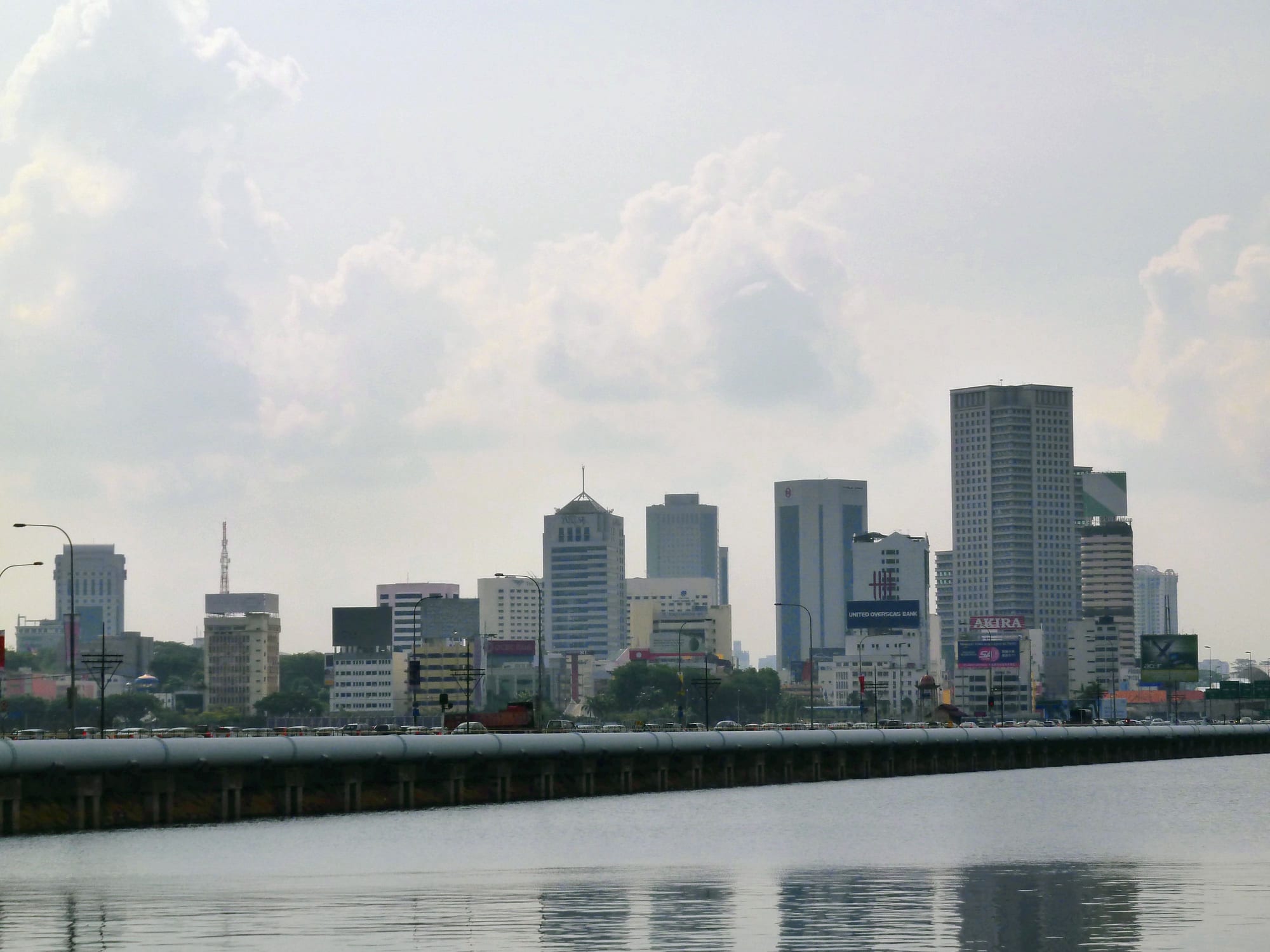
The towers of Johor Bahru's city centre rising behind a raised causeway lined with traffic, seen across grey water

Malacca & the Southern Peninsula, Malaysia

Johor Bahru

Johor Bahru's city centre seen across the Johor Strait, with the causeway to Singapore in the foreground. (ペウゲオト / Wikimedia Commons · CC BY-SA 3.0)

The capital of Johor and Malaysia's southern gateway, facing Singapore across a narrow strait. Founded in the mid-19th century and made the state capital by Sultan Abu Bakar, it grew from a riverside town into a working border city of malls, factories and new townships, with a royal mosque, a palace and an old Chinese shophouse quarter at its centre.

Neighbourhoods

  • City centre
    • First-time visitors
    • Close to public transport
    • Shopping

    The grid of streets between the waterfront and the railway, holding the state mosque, the old palace grounds, the big malls and the immigration complex. Most hotels are here, and everything in the centre is within a short walk or a cheap Grab ride.

    Open in Maps
  • Jalan Tan Hiok Nee heritage quarter
    • Historic district
    • Best for food
    • Cafés

    A few blocks of restored two-storey shophouses in the old Chinese commercial core, named after a 19th-century Teochew merchant. Coffee shops, small galleries and craft stores sit among long-running businesses, and a street market fills the lane on some weekend evenings.

    Open in Maps
  • Stulang and the waterfront
    • Views
    • Ferries
    • Quiet and residential

    The shore east of the causeway, where the strait is in view from parks and promenades and a ferry terminal runs services towards Singapore's Changi side. A mix of older flats, hotels and new waterfront towers.

    Open in Maps
  • Iskandar Puteri
    • Families
    • Theme parks
    • Modern development

    A planned city west of Johor Bahru built as the administrative and investment core of the Iskandar Malaysia zone, with the Johor state government complex at Kota Iskandar, Legoland Malaysia, Puteri Harbour and university campuses. Distances are large and a car is needed.

    Open in Maps
  • Tebrau and the eastern suburbs
    • Best for food
    • Local life
    • Shopping

    The suburban belt along and beyond Jalan Tebrau, with many of the city's shopping malls, housing estates such as Taman Molek and Austin Heights, and the seafood restaurants of the Permas Jaya side.

    Open in Maps

Things to do

Famous landmarks

  • Sultan Abu Bakar State Mosquelandmark

    Johor's state mosque, built between 1892 and 1900 on a rise above the strait, its Victorian and Moorish design topped with minarets in the form of British clock towers.

    Open in Maps
  • Istana Besarlandmark

    The grand palace built for Sultan Abu Bakar in 1866 in a hillside park above the water; the Royal Abu Bakar Museum of the Johor court's collections, set inside it, has been closed to the public since 2012.

    Open in Maps
  • Sultan Ibrahim Buildinglandmark

    The tall art deco former state secretariat, completed in 1940 on Bukit Timbalan, visible across the city centre and used by the Japanese army in 1942 to plan the invasion of Singapore.

    Open in Maps
  • Arulmigu Sri Rajakaliamman Glass Templelandmark

    A Hindu temple whose interior is covered almost entirely in glass mosaic, a project begun in the 1990s at a shrine dating from the early 20th century.

    Open in Maps
  • Johor Bahru Old Chinese Templelandmark

    A temple of the 1870s in the old town, a symbol of unity among the city's Chinese dialect groups, with five deities each worshipped by one of them, and the starting point of the annual Chingay procession.

    Open in Maps
  • Johor–Singapore Causewaytransit hub

    The road and rail embankment across the strait, opened to traffic in 1923 and completed in 1924, one of the busiest land borders in the world and the reason the city's rhythm begins before dawn.

    Open in Maps

Parks and the waterfront

  • Danga Baypark

    A long waterfront development west of the centre with a promenade, open space and a family amusement area facing the strait.

    Open in Maps
  • Johor Zooattraction

    The oldest zoo in Malaysia, opened in 1928 beside the palace grounds by Sultan Ibrahim and handed to the state government and the public in 1962.

    Open in Maps

Markets and shopping

  • Johor Bahru City Squareattraction

    The central shopping mall beside the immigration complex, one of several in a city where weekend shopping by Singaporean visitors is a major trade.

    Open in Maps

Short trips from the city

  • Legoland Malaysiaattraction

    The theme park at Iskandar Puteri, about 15 kilometres west, opened in 2012 as the first Legoland in Asia, with a water park and model displays of Asian landmarks.

    Open in Maps
  • Pasir Gudangattraction

    The port and industrial town east of the city, known for its container terminal and for the kite museum and kite-flying ground on Kite Hill above the strait.

    Open in Maps
  • Tanjung Piaipark

    The southernmost point of mainland Eurasia, at the tip of the Pontian district west of the city, where boardwalks run through protected mangroves out to a headland facing the shipping lanes.

    Open in Maps
  • Kukupattraction

    A fishing village in the Pontian district on the Straits of Malacca, known for its open-air seafood restaurants built on stilts over the water and the mangrove island offshore.

    Open in Maps
  • Pengerangattraction

    A coastal district at Johor's south-eastern corner, once a string of fishing villages and now dominated by a very large oil refining and petrochemical complex.

    Open in Maps

Seasonal events

  • Chingay processionFebruary or March, around Chinese New Year

    A night procession of deities carried from the old Chinese temple through the city centre, with lanterns, flag bearers and lion dance troupes, held for well over a century.

  • Ramadan bazaarsthe month of Ramadan, which moves through the year

    Large evening street markets of grilled meat, curries, rice dishes and sweet drinks, set up across the city in the weeks before Hari Raya.

  • Hari Raya Aidilfitriat the end of Ramadan

    The main Malay festival, marked by open houses, mosque prayers and a mass return to home villages that empties and then refills the city.

Eat and drink

Long-standing places and food districts in Johor Bahru. Hours, ratings and directions come from your maps app, always current.

Johor Bahru classics

  • Kacang pool stallsrestaurant

    A stew of mashed broad beans with minced beef, a fried egg and lime, eaten with toasted bread — a Johor speciality of Arab descent served in coffee shops across the city.

    Open in Maps
  • Laksa Johor and mee rebusrestaurant

    Two state dishes found in ordinary kitchens and food courts — fish and coconut gravy served with spaghetti, and yellow noodles in a thick spiced gravy with egg and green chilli.

    Open in Maps

Food districts and markets

  • Jalan Tan Hiok Nee and the old townneighborhood

    Shophouse coffee shops, Teochew and Hainanese kitchens and newer cafés in the heritage quarter, with a night market on the lane on some weekends.

    Open in Maps
  • Jalan Wong Ah Fookneighborhood

    The main street through the city centre, named after a 19th-century Cantonese contractor, lined with malls, hawker stalls and late-opening restaurants near the border crossing.

    Open in Maps
  • Permas Jaya seafoodneighborhood

    Chinese-style seafood restaurants east of the centre serving chilli crab, steamed fish and butter prawns, busiest on weekend evenings.

    Open in Maps
  • Tebrau night marketsmarket

    Rotating evening street markets in the eastern suburbs, where satay, grilled fish, fried noodles and cut fruit are sold from stalls set up for one night a week.

    Open in Maps

Experience Johor Bahru

History

The settlement began as Tanjung Puteri, a small fishing and trading place on the Johor Strait, developed from the 1850s under Temenggong Daing Ibrahim as Chinese planters were brought in to open pepper and gambier estates along the rivers under the kangchu system, which gave a headman rights over a river and its settlement. In 1866 his son Abu Bakar moved the seat of government across from Telok Blangah in Singapore and renamed the town Johor Bahru, the new Johor.

Abu Bakar, who became sultan in 1886 and is remembered as the father of modern Johor, built the Istana Besar above the water, laid out a grid of streets, and gave the state its own written constitution, the Undang-undang Tubuh Negeri Johor. The state mosque that carries his name was finished after his death. British influence arrived later here than elsewhere on the peninsula, with a general adviser accepted only in 1914, and the causeway to Singapore opened in 1923, binding the two places together.

Johor Bahru was the last place on the peninsula held by British and Commonwealth forces in January 1942 before the retreat across the causeway to Singapore, and the Japanese used the town as a headquarters. After independence it remained a modest state capital until the late 20th century, when manufacturing, the port at Pasir Gudang and cheap land beside a wealthy neighbour transformed it. The Iskandar Malaysia development zone, launched in 2006, brought new townships, university campuses and theme parks to the western side, and the city has grown fast, and unevenly, ever since.

Culture & Customs

Johor's identity is strongly royal. The sultan and the state flag, the state anthem and Bangsa Johor — the idea of a Johorean people across ethnic lines — are part of everyday public life, and the royal family's affairs are followed closely. The local Malay dialect is distinctive, with vocabulary from Javanese and Bugis brought by settlers from across the archipelago, and Johor's kampung culture includes kuda kepang, a trance dance performed with flat horse figures that came from Java.

The Chinese community, mostly Teochew with Hokkien, Hakka, Cantonese and Hainanese alongside, traces itself to the gambier and pepper era, and its most visible expression is the Chingay procession, when deities from the old temple are carried through the streets at night behind lanterns and lion dancers. Indian Malaysians are a long-standing presence too, with Tamil temples in the old town and in the estates outside it.

The strongest single influence on daily culture, though, is Singapore. Hundreds of thousands cross the strait in both directions each day, families are split across the border, television and music from both countries are watched here, and the exchange rate shapes where people shop, eat and work. Locals are used to visitors and to being a day trip; conversation slips easily between Malay, English, Mandarin and Chinese dialects.

Daily Life

About 860,000 people live in the city proper, and some 1.8 million in the wider Johor Bahru district, which takes in Iskandar Puteri to the west and the port town of Pasir Gudang to the east. The population is mixed, with Malay, Chinese and Indian communities and a large number of migrant workers from Indonesia, Bangladesh and Nepal in factories and construction.

The economy runs on manufacturing and electronics, the container and oil terminals along the coast, petrochemicals at Pengerang, property development, retail aimed at Singaporean shoppers, and a fast-growing cluster of data centres drawn by land and power. Tens of thousands of residents commute daily to jobs in Singapore, earning in a currency worth several times the ringgit, which lifts some households sharply above their neighbours and pushes up local prices.

That daily crossing sets the rhythm of the city. Buses and motorcycles queue for the causeway from before five in the morning, and the return flow fills the evening; the length of the queue is a constant subject of complaint and of news reporting. Weekends bring the traffic the other way, with Singaporean cars filling mall car parks. Housing costs, an oversupply of unsold flats in some of the new developments, traffic and flooding after heavy rain are the recurring local issues.

Food

Johor Bahru eats late and eats out. Its best-known local dish is kacang pool, mashed broad beans cooked with minced beef and spices, topped with a fried egg and eaten with toasted bread — a dish of Middle Eastern origin that has become a Johor breakfast. Laksa Johor is the state's own version of laksa, a thick fish and coconut gravy traditionally served not with rice noodles but with spaghetti, a habit attributed to the travelling tastes of the royal household. Mee rebus, yellow noodles under a thick spiced gravy thickened with sweet potato, with boiled egg, green chilli and fried shallots, is sold everywhere.

Chinese food here is Teochew and Hainanese in character: fish ball noodles, braised duck, steamed fish, and the strong local coffee and kaya toast of the old shophouse coffee shops. Seafood restaurants along the eastern shore serve crab in chilli or butter sauce, and the Ramadan bazaars fill with grilled chicken, beef rendang, murtabak and coloured drinks for the breaking of the fast. Indian Muslim stalls supply roti canai in the morning and nasi kandar through the day.

Fruit is a serious matter in Johor: durians from the orchards inland, pineapples from the Pontian district, and, in season, rambutan and mangosteen piled on roadside tables. Cheap local dishes stand beside the international chains of the malls, and many visitors cross the causeway specifically to eat.

Planning tools

Budget

Johor Bahru is cheaper than Singapore next door, which is why so many Singaporeans cross to shop, eat and see a dentist, and that demand keeps malls, hotels and popular restaurants dearer than in other Malaysian towns of its size. Hawker food and Grab rides remain inexpensive. Rooms cost most at weekends, school holidays and around the major festivals.

Daily Budget Midrange
USD 70–130 (city-centre or waterfront hotel, restaurants, taxis or a hire car)
Daily Budget Shoestring
USD 25–45 (guesthouse or budget hotel, hawker food, buses and short Grab rides)

Weekday rooms are markedly cheaper than weekend ones, and the mosque, the palace park and the heritage streets cost little or nothing to see.

Best Time to Visit

The city can be visited all year: it is hot and humid throughout, with afternoon thunderstorms in most months. The wettest and least settled months are the north-east monsoon, roughly November to February, when heavy rain can flood low-lying parts of Johor. Weekends and Singaporean public holidays bring the heaviest border queues and the highest room rates.

Suggested Number of Days

The central sights sit close together and one or two days covers them. Three or four allow the western townships, the theme park and the coast west of the city. Anyone crossing to or from Singapore should add time for the border.

First Visit
1–2 days
With Surroundings
3–4 days

Transportation

The city is spread out and built around its roads, so most journeys beyond the centre are made by car or by Grab, which is cheap and widely used. Causeway Link and other operators run city and cross-border buses from the terminal at JB Sentral, and an urban rail or bus rapid transit system for the main corridors has been under discussion by the state government since 2017. A cross-strait rail link between Bukit Chagar and Woodlands North in Singapore is under construction, with services targeted to begin in 2027. Traffic is heavy around the border complex and the malls at weekends.

Cross between Johor Bahru and Singapore outside the morning and evening commuter peaks, and allow far longer at weekends and on public holidays.

Airport & Station Connections

Senai International Airport lies about 30 kilometres north of the centre, roughly 40 minutes by road, with flights to Kuala Lumpur, Borneo and regional cities. Many visitors instead use Singapore Changi and cross by road. JB Sentral, beside the immigration complex, is the southern terminus of the Malaysian railway, with trains north to Gemas and Kuala Lumpur and a shuttle across the strait; long-distance buses use the Larkin terminal north of the centre.

Walkability

The city centre is walkable in parts — the heritage streets, the mosque and the palace park are close together, and the walk from JB Sentral into the old town is short. Beyond that, wide roads, flyovers and long blocks make walking unpleasant, and the heat and humidity shorten any walk. Covered links join some of the central malls.

Safety

Johor Bahru is generally safe for visitors, but it has a higher rate of street crime than most Malaysian cities, particularly bag-snatching by motorcyclists and break-ins to parked cars. Crowds around the border complex and the malls attract pickpockets, and traffic is the everyday hazard for anyone on foot.

Carry bags on the side away from the road, leave nothing visible in a parked car, and use Grab rather than walking between districts at night. The specific caution is eastern Sabah: the UK government advises against all but essential travel to all islands and dive sites off the coast of eastern Sabah, from Sandakan to Tawau, because of the threat of kidnapping; mainland Sabah is not included in that warning. Check current official travel advice before travelling.

Climate

Equatorial and close to sea level: hot, humid and rainy all year, with no dry season. Days are usually bright in the morning and stormy in the late afternoon, and the heaviest and most persistent rain comes with the north-east monsoon between about November and February.

Summer
hot and humid, about 24–33°C, with frequent afternoon thunderstorms
Winter
about 23–32°C with heavier monsoon rain from about November to February, and a risk of flooding in low-lying areas

Local Customs

Johor is a Malay sultanate with a large Chinese and Indian population, and respect for the royal family is taken seriously. Modest dress is expected in mosques and temples, where shoes come off and robes are usually lent at the door; Friday midday prayers slow the working day. Alcohol is sold in shops, bars and Chinese restaurants but not in Malay eating places.

Tipping is not expected, though small change is left in cafés; eat and pass things with the right hand, and ask before photographing people at prayer.

Common Payment Methods

The currency is the Malaysian ringgit. Cards and QR payment apps work in malls, hotels and chain restaurants, and cash machines are everywhere, but hawker stalls, markets and small coffee shops still run on cash. Singapore dollars are accepted in some border shops at poor rates; changing money at a licensed dealer gives more.