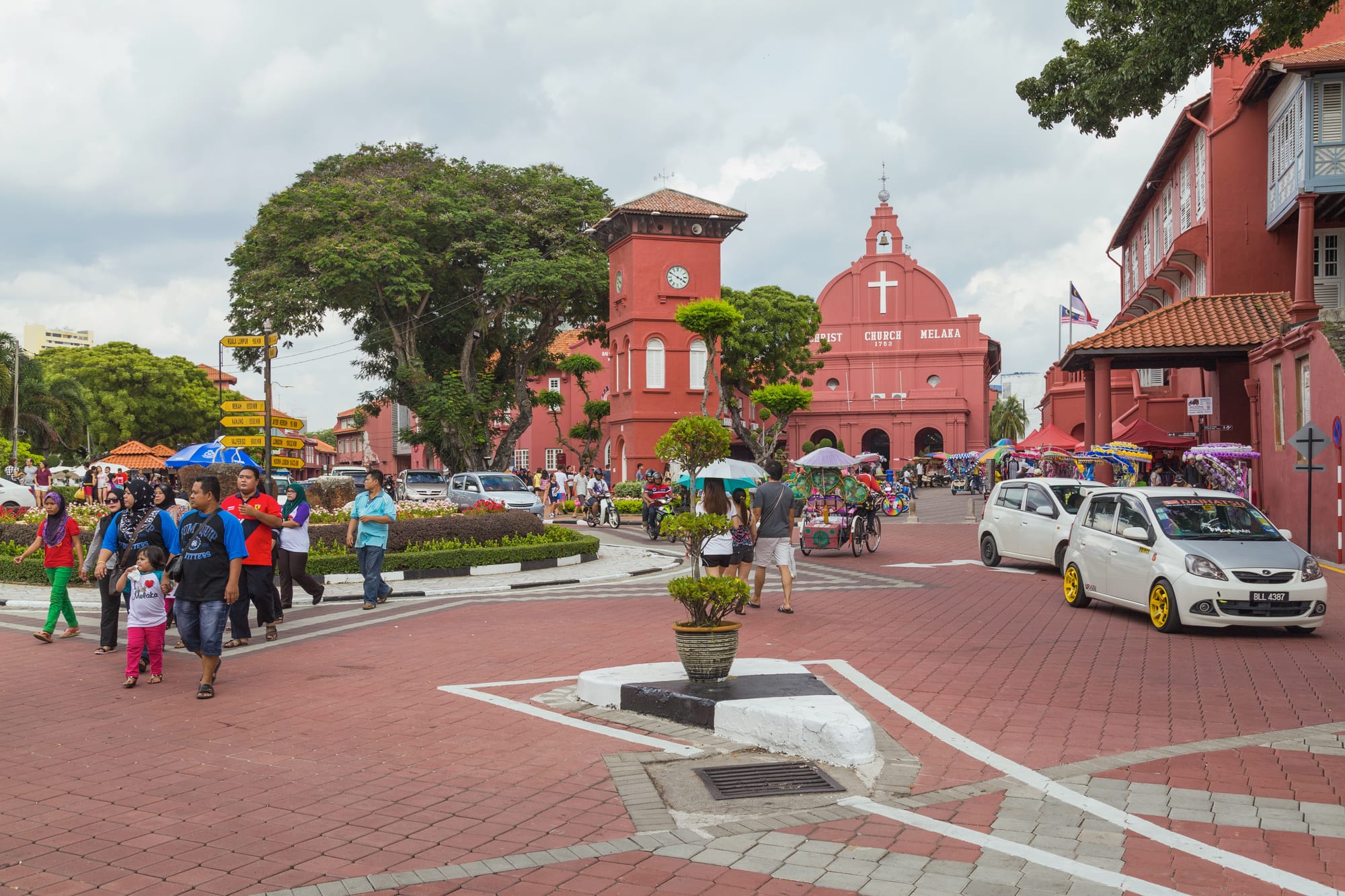
A square of deep red colonial buildings with a clock tower and a church facade, trishaws and people crossing the red-paved street

Malacca & the Southern Peninsula, Malaysia

Malacca City

Christ Church, the clock tower and the Stadthuys around Dutch Square in the old centre of Malacca City. (Marcin Konsek / Wikimedia Commons · CC BY-SA 4.0)

The capital of Malacca state, on the strait that carries its name, was the greatest trading port of Southeast Asia in the 15th century and was then ruled in turn by Portugal, the Netherlands and Britain. Its compact old town of red Dutch buildings, Chinese shophouses and Peranakan mansions was inscribed by UNESCO in 2008, together with George Town.

Neighbourhoods

  • Dutch Square and Bandar Hilir
    • First-time visitors
    • History
    • Museums

    The colonial heart on the east bank, where the red Stadthuys, Christ Church and the clock tower stand below St Paul's Hill and the surviving gate of the Portuguese fortress. Most of the city's museums are within a few minutes' walk, and the riverside path starts here.

    Open in Maps
  • Chinatown and Jonker Street
    • Best for food
    • Shopping
    • Historic district

    The old Chinese quarter across the river, a grid of narrow streets lined with shophouses, clan halls, temples and Peranakan mansions. Antique shops, cafés, guesthouses and boutique hotels fill the ground floors, and a night market takes over Jonker Street at weekends.

    Open in Maps
  • Kampung Morten
    • Quiet and residential
    • Malay heritage
    • Photography

    A Malay village of traditional stilt houses with tiled front stairs, on a bend of the river a short walk upstream from the centre. It survives as a residential kampung inside the city, with one house open as a small museum.

    Open in Maps
  • The Portuguese Settlement
    • Seafood
    • Local life
    • Evenings

    A seaside quarter east of the centre, begun in the 1920s for the Kristang community descended from Portuguese settlers and locals. Its square of seafood restaurants and its festivals are the most visible expression of a creole culture found almost nowhere else.

    Open in Maps
  • Melaka Raya and the reclaimed waterfront
    • Hotels
    • Nightlife
    • Shopping

    The modern district south of the old town, built on reclaimed land, with malls, hotel towers, chain restaurants and bars. It has little historic interest but holds much of the city's accommodation and is a short walk or ride from Dutch Square.

    Open in Maps
  • Klebang and the coast
    • Beaches
    • Sunsets
    • Snacks

    The shore road north-west of the centre, with a long man-made beach, kite-flying on weekend afternoons and stalls known for coconut shakes. The mosque built out over the water at Pulau Melaka is close by.

    Open in Maps

Things to do

The colonial centre

  • Stadthuysmuseum

    The red Dutch town hall of 1650, said to be the oldest surviving Dutch building in the East, now holding the city's history and ethnography museum.

    Open in Maps
  • Christ Churchlandmark

    A Dutch Protestant church of 1753 built of laterite and brick, the oldest functioning Protestant church in Malaysia, with a ceiling of beams each cut from a single tree and old tombstones, Portuguese and Armenian among them, set in the floor.

    Open in Maps
  • St Paul's Churchlandmark

    The roofless hilltop church begun by the Portuguese in 1521, where the body of Francis Xavier was briefly buried; old gravestones were aligned along its walls in the 1930s and its terrace overlooks the strait.

    Open in Maps
  • A Famosalandmark

    The Porta de Santiago, the last standing gate of the Portuguese fortress of 1511, at the foot of St Paul's Hill.

    Open in Maps
  • Malacca Sultanate Palacemuseum

    A wooden reconstruction of the 15th-century sultan's palace, built from descriptions in the Malay Annals, housing a museum of the sultanate's court culture.

    Open in Maps
  • Maritime Museummuseum

    A replica of the Flor de la Mar, a Portuguese carrack wrecked off the coast, with galleries on the port's trading history inside the hull.

    Open in Maps

Temples, mosques and Chinatown

  • Cheng Hoon Teng Templelandmark

    The oldest functioning temple in Malaysia, founded in 1645 on the Chinatown street known as Harmony Street, serving Taoist, Confucian and Buddhist worship under carved and gilded roofs.

    Open in Maps
  • Kampung Kling Mosquelandmark

    A mosque established in 1748 and rebuilt in brick in 1872, on the same street, with a tiered pyramidal roof and a pagoda-like minaret, mixing Sumatran, Chinese and Indian styles.

    Open in Maps
  • Sri Poyyatha Vinayagar Moorthi Templelandmark

    A Hindu temple of 1781 a short way along the same street, the oldest surviving Hindu temple in Malaysia, built for the Chitty community of Tamil descent.

    Open in Maps
  • Baba & Nyonya Heritage Museummuseum

    Three linked shophouses on Heeren Street kept as a Peranakan family home, with carved furniture, beadwork, porcelain and family photographs.

    Open in Maps
  • Jonker Streetmarket

    Chinatown's main street of antique shops, cafés and shophouses, closed to traffic at weekend evenings for a night market of food stalls and souvenirs.

    Open in Maps
  • Malacca Straits Mosquelandmark

    A mosque built on stilts over the water at Pulau Melaka, so that it appears to float at high tide, known for its sunsets over the strait.

    Open in Maps

River, hills and viewpoints

  • Malacca Riverattraction

    The river that made the port, now lined with a walkway past painted shophouses, murals and old warehouses, with cruise boats running upstream and down.

    Open in Maps
  • Bukit Chinaattraction

    A hill of some 12,000 graves, said to be the largest Chinese cemetery outside China, with the Poh San Teng temple and an old well at its foot.

    Open in Maps
  • Menara Taming Sariviewpoint

    A revolving observation tower near the waterfront giving a view over the old town, the river mouth and the strait.

    Open in Maps
  • St John's Fortlandmark

    A small hilltop fort east of the centre, rebuilt by the Dutch in the 18th century from Portuguese fortifications, unusual for having its cannon pointed inland against attack from the land side.

    Open in Maps

Short trips from the city

  • Melaka Zooattraction

    The country's second-largest zoo, at Ayer Keroh on the northern edge of the city, with Malayan wildlife in open enclosures.

    Open in Maps
  • Tanjung Bidarabeach

    A quieter stretch of beach up the coast in Alor Gajah district, a nesting site for hawksbill turtles and used by local families at weekends.

    Open in Maps
  • Alor Gajahneighborhood

    A small inland town north of the city, with a town square marked by a large bronze sculpture of a kris.

    Open in Maps

Seasonal events

  • Chinese New YearJanuary or February

    Lanterns along Jonker Street, lion dances and temple offerings at Cheng Hoon Teng, with reunion dinners emptying the restaurants of customers on the eve.

  • Festa San Pedrolate June

    The Kristang community's feast of St Peter in the Portuguese Settlement, with blessing of the fishing boats, decorated houses, music and dancing.

  • Hari Raya Aidilfitrivaries with the Islamic calendar

    The end of Ramadan, preceded by bazaars of festive food and followed by open houses; the city fills with families visiting over the holidays.

  • DeepavaliOctober or November

    The Hindu festival of lights, marked at the old Temple Street shrine and in the Chitty village, where the community keeps its own customs.

  • Christmas in the Portuguese SettlementDecember

    The Kristang quarter decorates its houses and holds carol singing and communal meals through the month, a long-standing local tradition.

Eat and drink

Long-standing places and food districts in Malacca City. Hours, ratings and directions come from your maps app, always current.

Malacca classics

  • Nyonya restaurants on Heeren and Jonker streetsneighborhood

    Peranakan kitchens in converted shophouses serving ayam pongteh, itek tim, Nyonya laksa and kuih, the cooking that defines the city.

    Open in Maps
  • Chicken rice ball shopsneighborhood

    A Malacca speciality — rice rolled into small balls and served with poached chicken and chilli sauce — sold at a cluster of long-queued shops near Jonker Street.

    Open in Maps
  • Satay celup restaurantsneighborhood

    Skewers of meat, seafood and vegetables dipped by diners into a communal pot of bubbling peanut sauce at the table, a local invention with several well-known houses.

    Open in Maps

Streets, markets and the coast

  • Jonker Street night marketmarket

    Weekend evening stalls through Chinatown selling grilled squid, popiah, quail eggs, cendol and pineapple tarts alongside clothes and souvenirs.

    Open in Maps
  • Portuguese Settlement seafoodneighborhood

    Open-air stalls on the square by the sea serving grilled fish, chilli crab and the Kristang devil's curry, busiest at sunset.

    Open in Maps
  • Klebang coconut shake stallsneighborhood

    Roadside stalls on the coast road blending coconut water, flesh and ice cream into a drink people queue for on weekend afternoons.

    Open in Maps
  • Cendol and gula Melakamarket

    Shaved ice with green rice-flour noodles, coconut milk and the dark palm sugar named after the city, sold at cafés and stalls across the old town.

    Open in Maps

Experience Malacca City

History

Malacca was founded in 1396 by Parameswara, a prince from Palembang in Sumatra, who settled at the river mouth and built a port at the narrowest point of the strait. Within a few decades it controlled the trade between the Indian Ocean and the South China Sea: Ming fleets under Zheng He called here, Gujarati, Arab, Javanese and Chinese merchants settled, and the rulers converted to Islam, making the city the centre from which Islam and Malay court culture spread through the archipelago. Its laws, its literature and the legends of the warrior Hang Tuah all date from this age.

Portuguese forces under Afonso de Albuquerque took the city in 1511 and built the fortress of A Famosa on the hill; the sultan's line fled south and founded Johor. The Dutch East India Company captured Malacca in 1641 after a long siege, built the Stadthuys and Christ Church, and ran it for more than a century and a half, though by then trade was already slipping away. Britain took over under the Anglo-Dutch Treaty of 1824 and joined Malacca to Penang and Singapore as the Straits Settlements; most of the fortress had already been pulled down by the British in 1807, when the Porta de Santiago was spared.

The 19th and early 20th centuries were quiet ones: Singapore drew away the shipping, and Malacca lived on rubber, tin shipment and its shops. Japanese forces occupied it from 1942 to 1945. In 1957, after independence, its economy turned increasingly to tourism and manufacturing. In 2008 the old town was inscribed on the UNESCO World Heritage List as one of the Historic Cities of the Straits of Malacca, together with George Town in Penang, and large reclamation projects have since extended the shoreline well beyond the old waterfront.

Culture & Customs

Malacca's population is Malay, Chinese and Indian, as in the rest of the country, but it also holds communities that exist almost nowhere else. The Baba-Nyonya, or Peranakan Chinese, descend from traders who settled from the 15th century onwards and married locally, adopting Malay dress, language and cooking while keeping Chinese religion and clan ties; their shophouses, beaded slippers and porcelain define the old streets. The Kristang, of Portuguese descent, live mainly in the Portuguese Settlement and still speak a Portuguese-based creole, Papia Kristang. The Chitty are Hindus of Tamil descent whose ancestors married Malay and Chinese women, with their own village and festivals.

The calendar reflects this. Chinese New Year fills Jonker Street with lanterns and lion dances; the Kristang keep Festa San Pedro in June and an elaborate Christmas; Hari Raya and Deepavali bring open houses; and processions leave the old temples for the streets on festival days. Tamil, Hokkien, Malay, English and Kristang can all be heard within a few blocks.

Craft and performance survive alongside the tourism: beadwork and Nyonya kebaya, dondang sayang, a slow sung poetic duet that began in Malacca under Portuguese musical influence, and Portuguese-descended dances at the settlement. Manners are those of a small, conservative town that receives millions of visitors, and residents of the heritage zone are used to cameras but not untroubled by them.

Daily Life

Malacca City has a population of around 580,000, in a state of roughly a million. Many live outside the heritage core, in Melaka Raya, Ayer Keroh, Batu Berendam and the newer housing on reclaimed land, and they come into the old town for work, worship and food rather than to live in it.

Tourism is the city's largest industry, along with manufacturing — electronics and furniture in the industrial estates around Batu Berendam and Ayer Keroh — government offices, education and small trade. The weekly rhythm is unusual: quiet from Monday to Thursday, with shops and museums half empty, then a surge from Friday evening, when coaches arrive and the night market opens. Many residents work in that weekend economy.

Rising rents in the heritage shophouses, the conversion of family homes into hotels and cafés, traffic and the effect of land reclamation on the shoreline and the old port view are constant local debates. Away from that, life is small-town: morning markets, school runs, mosque and temple, an evening meal at a hawker centre and a river that runs through the middle of it all.

Food

Malacca's signature cooking is Nyonya, the Peranakan blend of Chinese technique and Malay spice. Ayam pongteh braises chicken with fermented soybean paste and potatoes; itek tim is a sour duck soup with salted vegetables; Nyonya laksa serves noodles in a spicy coconut gravy; and kuih — small steamed cakes in bright colours, often scented with pandan and coconut — fill the bakery windows. The Kristang contribute curry debal, a fiery "devil's curry" of leftover meats with vinegar and chillies, eaten at the Portuguese Settlement.

Two dishes belong to the city in particular. Chicken rice balls, in which the rice is pressed into small rounds and served with poached chicken, are a Malacca habit found at shops near Jonker Street. Satay celup, a local invention, sets a pot of thick peanut sauce bubbling in the middle of the table, into which diners dip skewers of meat, fish balls, vegetables and offal, paying by the stick at the end.

The city's sweet tooth runs on gula Melaka, the dark palm sugar named after it. It sweetens cendol, shaved ice with coconut milk and green rice-flour strands, and appears in kuih and desserts across Malaysia. Other local stops are the pineapple tarts sold as gifts, popiah rolls, grilled seafood at the settlement and the coconut shakes of the Klebang coast road, with kopi and teh tarik from the old coffee shops.

Planning tools

Budget

Malacca is inexpensive, with guesthouses and hostels in the old shophouses, cheap hawker food and free sights in the streets themselves. Boutique heritage hotels and weekend rates are the main cost, and prices rise sharply from Friday to Sunday and on public holidays when visitors arrive from Kuala Lumpur and Singapore.

Daily Budget Midrange
USD 70–130 (heritage or resort hotel, restaurants, taxis or a hire car)
Daily Budget Shoestring
USD 25–40 (guesthouse, hawker food, walking and local buses)

Visit midweek for lower room rates and quieter streets; the churches, temples, squares and riverside walk cost nothing, and the museums are cheap.

Best Time to Visit

The city works all year, being sheltered by Sumatra and slightly drier than much of the peninsula. The Jonker Street night market runs on weekend evenings, which is also when crowds and room rates peak. Chinese New Year is lively but very busy, and the Kristang feasts fall in June and December. Rain is heaviest around April and from October to November.

Suggested Number of Days

Two days cover the old town, its museums and the food. Three or four allow for the coast, the outlying temples and the state's small inland towns. The heat, rather than the distances, sets the pace in a place this compact.

First Visit
2 days
With Surroundings
3–4 days

Transportation

The old town is small enough to cross on foot, and trishaws decorated with flowers and speakers work the tourist routes around Dutch Square. Town buses run from the central station at Melaka Sentral to Bandar Hilir, Grab is cheap and widely used, and river boats link the centre with points upstream. A hire car helps for the coast and the interior, though parking in the old town is difficult at weekends.

Agree the price of a trishaw ride before setting off, and expect the streets around Jonker to be closed to traffic on weekend evenings.

Airport & Station Connections

Malacca City is about 150 kilometres south-east of Kuala Lumpur, roughly two hours by express bus, with frequent services to Melaka Sentral from the capital, its airport and Singapore. The nearest mainline railway station is at Pulau Sebang, about 40 kilometres north. Melaka airport at Batu Berendam handles a small number of regional flights.

Walkability

One of the most walkable places in Malaysia. Dutch Square, St Paul's Hill, Chinatown and the riverside are all within fifteen minutes of each other on foot, and the old streets are narrow and partly pedestrianised. The heat and humidity are the limiting factor, along with traffic on the roads between the old town and Melaka Raya; pavements are uneven in places and crowded at weekends.

Safety

Malacca is safe, and violent crime against visitors is very rare. The usual problems are pickpocketing in the weekend crowds on Jonker Street, bag-snatching by motorcyclists on the wider roads, and traffic in the old town's narrow lanes, where cars and trishaws share space with walkers. Heavy storms cause brief flooding in low-lying streets.

Keep bags closed and in front in the night-market crowds and watch for motorcycles in the lanes. Check the latest advice before booking any island or dive trip off eastern Sabah, wear bags on the traffic-free side, dress modestly around mosques and in the religious east-coast states, and note that drug trafficking carries a mandatory death penalty. Check current official travel advice before travelling.

Climate

Hot and humid all year, sheltered by Sumatra across the strait and a little drier than the rest of the west coast. Mornings are usually clear and the rain comes as heavy afternoon or evening thunderstorms, most often around April and from October to November.

Summer
hot and humid, about 24–33°C, with afternoon thunderstorms
Winter
much the same, about 23–32°C, with heavier rain in November and December

Local Customs

Tipping is not expected, and restaurants may add a service charge. Mosques and temples ask for covered arms and legs and shoes off at the door; robes are lent at the larger mosques. Many of the shophouses in the old town are family homes as well as businesses, so doorways and interiors should not be photographed without asking.

Ask before photographing people, houses or worship, dress modestly away from the beach areas, and keep quiet in the residential lanes of Kampung Morten and the Chitty village late at night.

Common Payment Methods

The currency is the Malaysian ringgit (MYR), written RM. Hotels, restaurants and larger shops take cards and QR payments; night-market stalls, trishaw riders and small cafés want cash. ATMs are in Melaka Raya and around Dutch Square, and money changers are easy to find in the malls.