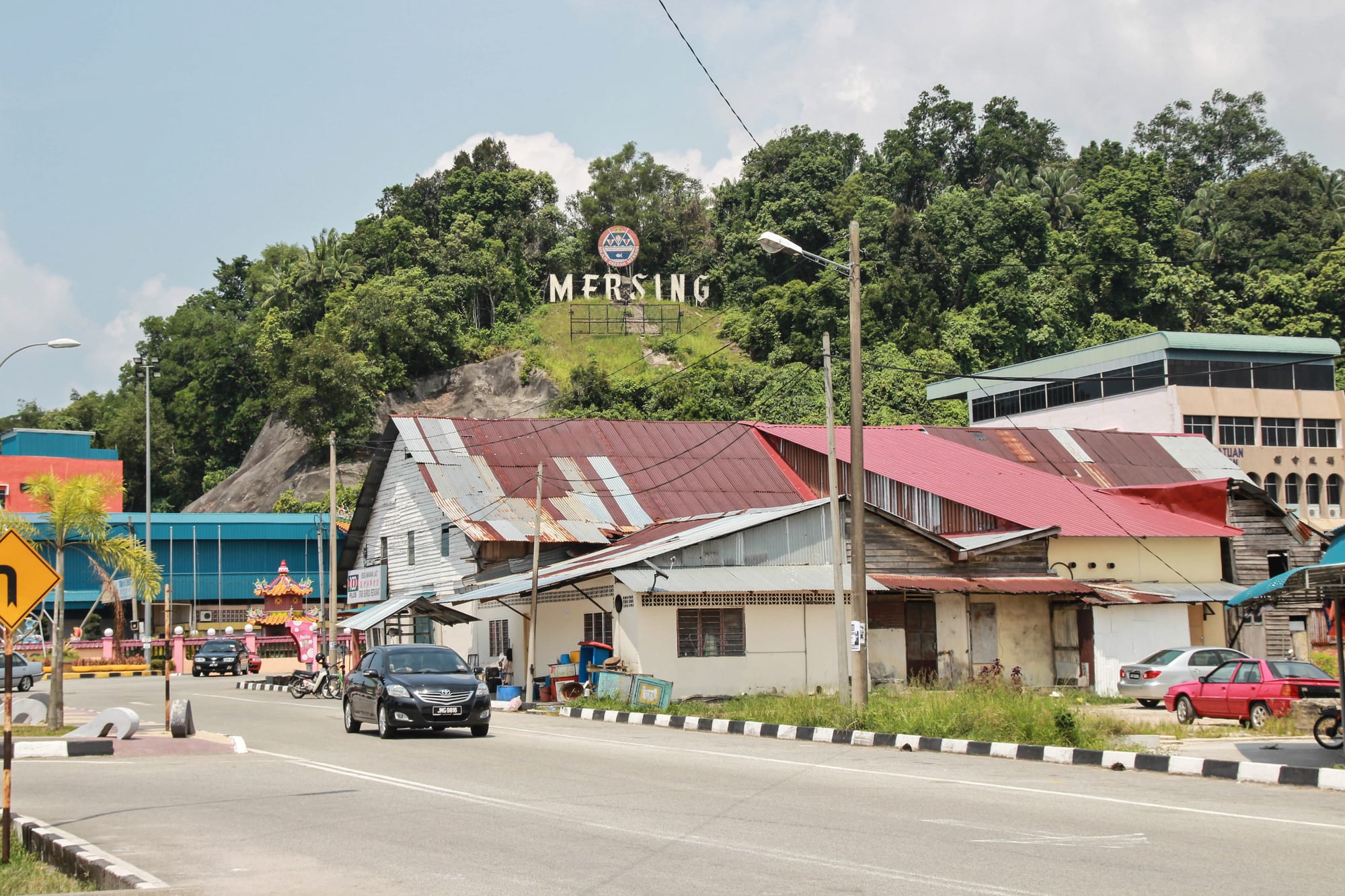
A quiet main road in Mersing past low tin-roofed shophouses, with a wooded hill behind carrying large letters spelling the town's name

Malacca & the Southern Peninsula, Malaysia

Mersing

The road through Mersing below the wooded hill that carries the town's name in large letters. (Arne Müseler / Wikimedia Commons · CC BY-SA 3.0 de)

A small fishing and market town on the east coast of Johor, at the mouth of the Mersing River. It is best known as the mainland gateway to Tioman and the other islands of the Seribuat archipelago, whose boats leave from its harbour, and it keeps the unhurried character of an east-coast town between the arrivals and departures.

Neighbourhoods

  • Town centre
    • First-time visitors
    • Budget food
    • Everyday shopping

    A few streets of low shophouses around the main road, with the market, banks, the bus and taxi terminal and most of the town's coffee shops. Almost everything a visitor needs is within a ten-minute walk, and the wooded hill behind gives the town its backdrop.

    Open in Maps
  • The harbour and the river mouth
    • Boats and ferries
    • Seafood
    • Views

    The jetty complex on the Mersing River where island boats load and fishing vessels tie up, with ticket counters, a small shopping arcade and restaurants facing the water. The esplanade beside it is where the town walks in the evening.

    Open in Maps
  • The coast road north
    • Beaches
    • Quiet and residential
    • Chalets

    A string of villages and simple beach chalets along the road towards Air Papan and Endau, with casuarina-backed sand, weekend stalls and very little development. Reaching them takes a car, a motorbike or a taxi.

    Open in Maps

Things to do

In and around the town

  • Mersing Harbour Centretransit hub

    The domed jetty terminal at the river mouth where ferries and speedboats leave for Tioman and the smaller islands, with ticket offices, shops and a waterfront promenade.

    Open in Maps
  • The hill above the townpark

    The wooded rise immediately behind the shophouse streets, carrying the town's name in large letters on its slope, with paths up through the trees and views over the roofs, the river mouth and the islands offshore.

    Open in Maps
  • Mersing waterfront and fish marketmarket

    The riverside where the fishing fleet unloads in the morning and the market sells the catch, dried fish and keropok beside fruit and vegetable stalls.

    Open in Maps
  • Air Papanbeach

    The town's nearest proper beach, a short way north along the coast road, a three-kilometre curve of sand between low hills, with food stalls that fill at weekends.

    Open in Maps

The islands

  • Tioman Islandattraction

    A mountainous, forested island of beaches, dive sites and seven villages, some 55 kilometres out from Mersing, by far the largest island served from the town and a duty-free zone; ferries also run to it from Tanjung Gemok in Pahang.

    Open in Maps
  • The Seribuat archipelagoattraction

    The scatter of more than forty islands off this coast, of which Rawa, Besar, Sibu, Tengah and Tinggi hold small resorts reached by boat from Mersing or Tanjung Leman.

    Open in Maps

Short trips inland and up the coast

  • Endau-Rompin National Parkpark

    Lowland and hill rainforest straddling northeastern Johor and southern Pahang, the second-largest national park in Peninsular Malaysia, with rivers, waterfalls and about 26 kilometres of trail; its eastern entrance at Kampung Peta lies in Mersing District, and it closes from November to March.

    Open in Maps
  • Endauattraction

    A fishing town at the mouth of the Endau River about 35 kilometres north, on the boundary with Pahang, with jetties, seafood restaurants and boats up the river towards the national park.

    Open in Maps

Seasonal events

  • The monsoon closureroughly November to February or March

    The north-east monsoon brings rough seas that suspend most island boat services and close many island resorts; the town is at its quietest and wettest in these months.

  • Hari Raya Aidilfitriat the end of Ramadan

    The main Malay festival, preceded by evening bazaars in the town and followed by open houses in the surrounding villages.

  • Chinese New YearJanuary or February

    Marked by the Chinese shopkeeping families of the old town with temple visits, lion dances and shuttered shops for several days.

Eat and drink

Long-standing places and food districts in Mersing. Hours, ratings and directions come from your maps app, always current.

Mersing classics

  • Seafood restaurants by the riverrestaurant

    Grilled fish with sambal, squid, prawns and crab straight from the fleet, cooked Chinese or Malay style and eaten at open-sided places near the jetty.

    Open in Maps
  • Mee rebus and laksa Johor stallsrestaurant

    Johor's two signature noodle dishes — a thick spiced gravy over yellow noodles, and a fish and coconut gravy served with spaghetti — sold in the town's warungs and coffee shops.

    Open in Maps

Markets and coffee shops

  • Mersing town marketmarket

    The morning market for fish, dried seafood, keropok, fruit and vegetables, with hawker stalls selling breakfast at the edges.

    Open in Maps
  • Old-town kopitiamcafe

    Chinese coffee shops in the shophouse streets serving kopi, kaya toast and soft-boiled eggs from early morning, and noodles later in the day.

    Open in Maps

Experience Mersing

History

Mersing grew where the Mersing River meets the South China Sea, a natural shelter on a coast with few harbours. Long before the town existed, the Seribuat islands and this shore were known to sailors working the route between the Malay Peninsula, Borneo and Indochina; Tioman appears in Arab and Chinese navigational accounts as a watering point, and the mainland river mouths supplied timber, rattan and fish. Malay fishing villages and small Orang Asli communities inland were the earliest settlement.

The town as it stands took shape under British administration in Johor in the late 19th and early 20th centuries, when Chinese merchants opened shops along the road and the river became a collecting point for the produce of the interior — timber, gambier, rubber and later oil palm from the estates cut out of the forest. A district office, a market and a jetty followed, and the coastal road linking Johor Bahru with Kuantan turned the settlement into a stopping place.

Before the Japanese invasion the coast around Mersing was fortified against a landing during the campaign for Malaya, and concrete defences from that effort can still be found along the shore; the attack came overland from the north instead, and by January 1942 Mersing stood on the final Commonwealth defensive line across Johor, from Batu Pahat through Kluang, as it was attacked along its length. After the war the town returned to fishing and trade until the 1970s and 1980s, when Tioman's rise as a holiday island turned Mersing into a ferry port. The harbour and its terminal grew with that traffic, which has shaped the town ever since.

Culture & Customs

Mersing's culture is that of the Johor east coast: Malay, Muslim and tied to the sea. The fishing communities keep to a routine set by tides and the monsoon, and the months when boats cannot go out are still spoken of as a season to be endured rather than a holiday. Mosques are the centre of village life along the coast road, and the loudspeaker call to prayer marks the day in the town as much as the boat horns do.

The shophouse streets belong to a Chinese community of Teochew, Hokkien and Hainanese descent, whose families came as traders and shopkeepers and who run the coffee shops, hardware stores and many of the seafood restaurants. Their temples and clan associations are small but long established, and Chinese New Year closes much of the commercial centre for several days. A smaller Indian Malaysian population and Orang Asli communities in the forest districts inland complete the mix.

Visitors are a normal part of life, but Mersing has never become a resort town itself: it sells tickets, beds and meals to people on their way somewhere else, and keeps its own rhythm. Dress in the town is modest, greetings are quiet, and the pace is slow — an evening walk on the esplanade, coffee in the shophouses, and early nights before the boats leave.

Daily Life

The town and its mukim were estimated at close to 71,000 people at the 2010 census, with the wider district spread across fishing villages, oil palm estates and inland settlements. Fishing remains central: trawlers and smaller boats work the coast and the waters around the islands, and much of the catch is trucked to Johor Bahru and Singapore or turned into dried fish and keropok, the fish crackers made along this coast.

The rest of the economy is oil palm, small-scale farming, government offices for the district, and tourism — boat operators, ticket agents, hotels, restaurants and the drivers who meet the buses. That income is strongly seasonal: from March to October the harbour is busy from early morning, and in the monsoon months the jetty empties, hotels close rooms and families rely on savings and on fishing when the sea allows.

Mornings begin with the market and the return of the boats; the middle of the day is hot and slow; evenings bring the esplanade, food stalls and football on television. Young people leave for Johor Bahru, Kuala Lumpur or Singapore for work and return for the festivals. Flooding after heavy monsoon rain, the state of fish stocks and the cost of running a boat are the standing local concerns.

Food

Mersing eats what its boats bring in. Ikan bakar — whole fish rubbed with a spice paste, wrapped in banana leaf and grilled over charcoal — is the local staple, served with rice, sambal belacan and raw vegetables. Squid, prawns and crab come fried with salted egg, in butter and curry leaves or in a thick chilli gravy at the Chinese restaurants near the river, and steamed fish with ginger and soy is the dish to order for a table.

Dried and preserved seafood is a trade in itself: salted fish, dried anchovies and keropok, the crackers made from fish or prawn paste and sold in bags from shops and stalls along the main road. Johor's mainland dishes are all present too — mee rebus, yellow noodles under a thick spiced gravy with egg and green chilli; laksa Johor, a fish and coconut gravy served with spaghetti; and nasi lemak, coconut rice with sambal and anchovies, sold from early morning.

The Chinese coffee shops supply the other half of the town's eating: kopi brewed strong and sweetened with condensed milk, kaya toast, soft-boiled eggs, and later in the day fried noodles, chicken rice and pork or fish ball soups. Fruit stalls sell rambutan, durian and mangosteen in season from the orchards inland, and cold sugarcane juice and coconut water are the standard defence against the heat.

Planning tools

Budget

Mersing is inexpensive. Guesthouses and small hotels in the town cost little, meals are hawker prices, and the main expenses are boat tickets to the islands, the marine park conservation fee and island accommodation, which is considerably dearer than anything on the mainland. Many visitors spend only a night here at each end of an island trip.

Daily Budget Midrange
USD 70–130 (hotel or island resort, restaurant meals, boat transfers and a hire car)
Daily Budget Shoestring
USD 20–35 (guesthouse, hawker food, local buses)

Keep enough cash for boat tickets and island stays, where cards are often not taken and cash machines are scarce.

Best Time to Visit

March to October, when the sea is calmest, boats run reliably and the island resorts are open. The north-east monsoon, roughly November to February or March, brings heavy rain and rough seas; services are cut back or suspended and much of the island tourism shuts down. April to August is usually the most settled stretch.

Suggested Number of Days

The town itself needs a day, and most people pass through it for a boat. Allowing four to six days makes room for a stay on one of the islands or a trip into the forest inland. Boat timings, which follow the tide and the weather, often decide the length of a stay.

First Visit
1 day
With Surroundings
4–6 days

Transportation

The town is small enough to cross on foot, and taxis and a limited local bus service cover the coast road and the villages. Express buses use the terminal in the centre, ferries and speedboats leave from the harbour, and a hire car or motorbike is the practical way to reach the beaches, Endau and the park. Ride-hailing exists but is thin.

Boat departures shift with the tide and the weather, so build slack into onward travel plans rather than booking a tight connection.

Airport & Station Connections

Mersing sits on the coastal road roughly 130 kilometres north of Johor Bahru, about two hours by car, and around four to five hours from Kuala Lumpur or Singapore by bus. Express coaches run from Johor Bahru, Kuala Lumpur, Singapore and Kuantan to the town terminal. The nearest airports are Senai, outside Johor Bahru, and Kuantan; from the harbour, boats serve Tioman and the smaller islands.

Walkability

Very walkable. The market, the bus terminal, the shophouse streets, the hotels and the jetty are all within about a kilometre of each other, mostly on flat ground, and the path up the forest hill starts at the edge of town. Beyond that, the beaches and villages along the coast road need transport, and there is little shade in the middle of the day.

Safety

A quiet town with little crime. The hazards here are at sea and in the weather: small boats in a swell, strong currents off the open beaches, and heavy rain and flooding during the monsoon, when rivers on this coast can rise quickly. Forest trails inland have leeches and slippery ground after rain.

Wear a life jacket on island boats, avoid crossings when the sea is rough, and check that island resorts and services are running before travelling at the edges of the monsoon. The specific caution is eastern Sabah: the UK government advises against all but essential travel to all islands and dive sites off the coast of eastern Sabah, from Sandakan to Tawau, because of the threat of kidnapping; mainland Sabah is not included in that warning. Check current official travel advice before travelling.

Climate

Hot and humid all year on an exposed east-facing coast, with no dry season but a clear wet extreme. From about November to February the north-east monsoon brings persistent heavy rain, rough seas and occasional flooding; from March to October conditions are hotter, brighter and much calmer at sea.

Summer
hot and humid, about 24–33°C, with calm seas and afternoon thunderstorms
Winter
about 23–31°C, with heavy monsoon rain and rough seas from about November to February

Local Customs

Mersing is a conservative small town with a Malay majority and a long-established Chinese shopkeeping community. Modest dress is expected away from the beach, shoes come off at the door of homes and mosques, and Friday midday prayers pause the working day. Alcohol is sold in Chinese restaurants and shops rather than in Malay eating places.

Tipping is not expected; use the right hand to give and receive, and ask before photographing people at the market or on the boats.

Common Payment Methods

The currency is the Malaysian ringgit. Cash machines are in the town centre, and the hotels and larger restaurants take cards, but boat tickets, stalls, the market and most island businesses run on cash. Drawing money before leaving the mainland matters here, because the islands have few machines.