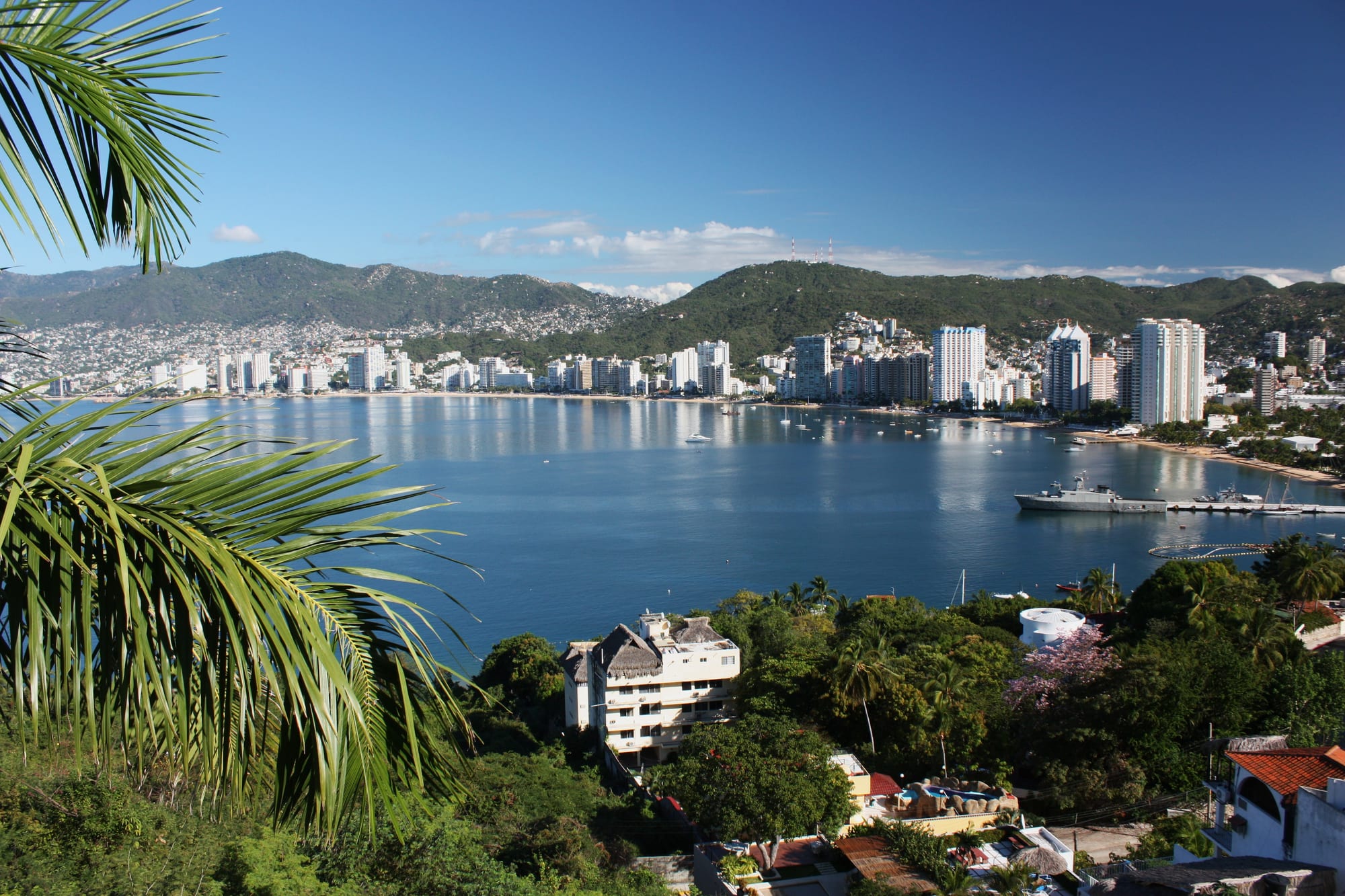
Calm blue Acapulco Bay ringed by white high-rise towers and green hills, seen past palm fronds

Oaxaca & the Pacific South, Mexico

Acapulco

Acapulco Bay and the high-rise hotels and flats along its shore. (Sally from Willamette Valley - Oregon, USA / Wikimedia Commons · CC BY 2.0)

Guerrero's largest city, on a deep semicircular bay on Mexico's Pacific coast — the colonial port of the Manila galleons that became a getaway for Hollywood stars in the mid-20th century. Gang violence since the 2000s has kept most foreign visitors away, Hurricane Otis devastated the city in 2023, and its beaches now draw mainly Mexican holidaymakers.

Neighbourhoods

  • Traditional Acapulco
    • Historic district
    • Local life
    • Beaches

    The old port at the western end of the bay, from Papagayo Park through the Zócalo and the cathedral to the beaches of Caleta and Caletilla and the cliffs of La Quebrada. Its heyday ran from the late 1930s to the 1960s; today it caters mostly to Mexican families, with older hotels, street kitchens and the city's main square.

    Open in Maps
  • Acapulco Dorado and La Costera
    • First-time visitors
    • Nightlife
    • Beaches

    The Golden Zone, developed between the 1950s and the 1970s along Costera Miguel Alemán, the boulevard that curves around most of the bay from Papagayo Park to Icacos. Tower hotels, condominiums, beach bars and nightclubs face Hornos, Condesa and the other bay beaches.

    Open in Maps
  • Acapulco Diamante
    • Upmarket
    • Quiet and residential

    The newest part of the resort, running from the scenic highway at Las Brisas past Puerto Marqués and Punta Diamante towards Barra Vieja. Luxury resorts, gated condominiums, golf courses and private villas line Boulevard de las Naciones, where almost everyone gets around by car.

    Open in Maps
  • Pie de la Cuesta
    • Sunsets
    • Quiet beaches

    A small beach town north-west of the bay, on a strip of land between the open Pacific and the Coyuca lagoon. Waves are much rougher than inside the bay, and the town is reached by local bus.

    Open in Maps
  • Puerto Marqués
    • Beaches
    • Families

    A smaller bay south-east of Acapulco Bay, with the beaches of Puerto Marqués and Majahua. It is also an archaeological site: pottery found here, dated to around 2400 BC, is among the oldest known in Mesoamerica.

    Open in Maps

Things to do

Famous landmarks

  • La Quebrada cliff diversattraction

    Professional divers leap from ledges on the cliff into a narrow, shallow inlet, timing each dive to an incoming wave, a tradition that began in the 1930s; some dive with a torch.

    Open in Maps
  • Fort of San Diegomuseum

    A star fort first built after a Dutch raid of 1615 and rebuilt in 1778–83 after an earthquake, now the Acapulco Historical Museum, covering the port's story from pre-Hispanic times to independence.

    Open in Maps
  • Our Lady of Solitude Cathedrallandmark

    The cathedral on the Zócalo, rebuilt from the 1940s in a mix of Neocolonial, Moorish and Byzantine styles, with blue domes and a gold-tiled interior.

    Open in Maps
  • Diego Rivera's mosaic wallslandmark

    The outside walls of Dolores Olmedo's house in the old town, covered by Diego Rivera in tile mosaics of Aztec deities such as Quetzalcoatl during the last two years of his life.

    Open in Maps

Beaches

  • Caleta and Caletillabeach

    Twin beaches at the western tip of the bay, sheltered by La Roqueta island and popular with Mexican families; boats leave here for the island and its snorkelling.

    Open in Maps
  • Condesa and the Costera beachesbeach

    The sweep of beaches along the Costera — Hornos, the traditional afternoon beach, Tamarindos, Condesa and Icacos — backed by hotels, beach bars and clubs.

    Open in Maps
  • Puerto Marqués beachesbeach

    Calmer sand in the neighbouring bay to the south-east, with Puerto Marqués Beach and Majahua Beach and their seafood restaurants.

    Open in Maps
  • Barra Vieja Beachbeach

    A long open-ocean beach of fine grey sand south-east of the city, with strong waves and sunsets, best known for its pescado a la talla.

    Open in Maps

Bays, lagoons and the open coast

  • Pie de la Cuestabeach

    A beach town on the open Pacific north-west of the city, between dangerous surf and the calm Coyuca lagoon.

    Open in Maps
  • La Roqueta islandpark

    The island off Caletilla beach, reached by boat, with snorkelling, a lighthouse and, offshore, an underwater statue of the Virgin of Guadalupe placed in 1958 in memory of divers who died there.

    Open in Maps
  • Tres Palos lagoonpark

    A mangrove lagoon south-east of the bay, near the airport, with boat tours and protected sea turtle nesting areas on the coast.

    Open in Maps

Seasonal events

  • Mexican Openlate February or early March

    An ATP 500 tennis tournament held in Acapulco since 2001, played on hard courts at the Arena GNP Seguros since 2022; the winner receives a giant silver gourd.

  • Guadalupe dives at La Quebrada11 December, the eve of the Virgin of Guadalupe's feast

    Freestyle cliff divers jump into the sea at La Quebrada to honour the Virgin, whose shrine the professional divers pray at before every dive.

  • Feast of San Isidro Labrador15 May

    A local festival for the patron saint of farmers, one of the city's traditional celebrations alongside Carnival.

  • Nao de China fairNovember

    A crafts and livestock fair named after the galleons that sailed between Acapulco and Manila.

Eat and drink

Long-standing places and food districts in Acapulco. Hours, ratings and directions come from your maps app, always current.

Acapulco classics

  • Thursday pozolerestaurant

    Every Thursday restaurants across the city and state serve pozole — white, red or green hominy stew with pork or chicken — with tostadas, tacos and tamales, and many add live bands, dancers or impersonators.

    Open in Maps
  • Pescado a la talla at Barra Viejaneighborhood

    The beach restaurants of Barra Vieja are known for pescado a la talla, a whole butterflied fish rubbed with chilli paste and grilled over wood.

    Open in Maps

Food districts

  • The Zócaloneighborhood

    The shady old town square beside the cathedral, lined with cafés, pavement restaurants and tiny street-corner kitchens, and the place to see the city's everyday life.

    Open in Maps
  • La Costeraneighborhood

    The bayfront boulevard, lined with seafood restaurants, beach bars and clubs that open late, especially along Condesa beach.

    Open in Maps

Experience Acapulco

History

People lived around Acapulco Bay long before the Spanish: pottery from Puerto Marqués is among the oldest found in Mesoamerica, and Olmec, Teotihuacan and Maya influences reached the area in turn. In the late 15th century the Aztecs claimed it, though the Yopis held the land until the Spanish came in the 1520s. Cortés made the bay a port in the early 1530s, with a road to Mexico City, and from 1565 the Manila galleons sailed in from Asia each year with silk and porcelain, making Acapulco the second port of New Spain after Veracruz.

The galleons drew pirates, and after a Dutch fleet sacked the town in 1615 the Fort of San Diego was built; an earthquake destroyed it in 1776 and it was rebuilt by 1783. José María Morelos burnt the city in 1810 during the War of Independence, and independence in 1821 ended the galleon trade.

Tourism began after a visit by the Prince of Wales in 1920. Hotels rose on the cliffs of La Quebrada in the 1930s, President Miguel Alemán gave the port a highway to the capital in the early 1950s, and Hollywood stars made Acapulco fashionable. The Autopista del Sol of 1993 made it a weekend escape for Mexico City. Since 2006 violence between criminal organisations has hit tourism, and most visitors now come from within Mexico. On 25 October 2023 Hurricane Otis, the first Pacific hurricane on record to make landfall at Category 5, struck just west of the city, killing at least 52 people; Hurricane John flooded it again in September 2024.

Culture & Customs

Acapulco's culture is that of a resort that has been famous for nearly a century. The city still trades on its golden age of the 1950s, when Elizabeth Taylor, Frank Sinatra and Brigitte Bardot holidayed on the bay, and nightlife remains its best-known attraction, with clubs that change names and owners frequently and beach bars along the Costera. Juan Gabriel's 1983 song "Amor eterno" pays homage to the city.

The cliff divers of La Quebrada are its living tradition. Young men began competing to dive from the highest point in the 1930s, onlookers began to tip them, and today professional divers, most of them from the family of Quebrada divers, pray at a shrine to the Virgin of Guadalupe before leaping into a narrow inlet as a wave rolls in. On the eve of the Virgin's feast on 12 December, freestyle divers jump in her honour.

The calendar mixes religious and civic events: Carnival, the feast of San Isidro Labrador in May, the Nao de China crafts and livestock fair in November, and a Festival Internacional de la Nao at the Fort of San Diego celebrating the port's old links with Asia. Since 2001 the city has hosted the Mexican Open, an ATP tennis tournament. Thursday is pozole day across Guerrero, when restaurants put on music, dancers and impersonators alongside the stew. Horse-drawn carriages called calandrias carried tourists for many years until the practice ended in 2020 over concerns about the animals' welfare.

Daily Life

The 2020 census counted about 659,000 people in the city and about 780,000 in the municipality of Acapulco, a small drop from 2010; it is the largest city in Guerrero, larger than the state capital, Chilpancingo. Tourism is the main economic activity, and about three-quarters of the municipality's population is involved in commerce, most of it tied to tourism and the port, which is Mexico's main Pacific port for car exports. More than 25,000 condominiums serve as second homes, most for Mexican owners, and most visitors come from central Mexico, especially Mexico City.

The city is divided sharply. The Golden Zone and Acapulco Diamante hold the hotels and gated developments, while migrants who came looking for work live in small settlements clinging to the hillsides behind the bay, the areas hit hardest by hurricanes. Unemployment and poverty keep many beach vendors working on the sand, and rubbish in the bay is a long-running problem, though several beaches have won Blue Flag certification.

Getting around relies on buses, colectivo taxis and the Acabús rapid bus system opened in 2016. Security weighs on daily life: in 2018 the armed forces entered the city and disarmed its police. Recovery from Hurricane Otis was still under way when Hurricane John struck in late September 2024, dropping nearly a metre of rain and damaging around 40,000 homes, and the city has been rebuilding since.

Food

Acapulco eats like the rest of Guerrero, with pozole at the centre. The hominy stew comes white, red or green, made with pork or chicken, and is eaten with tostadas, tacos and tamales; on Thursdays, across the city and the state, restaurants serve it as a weekly event with bands, dancers and celebrity impersonators. Relleno is another local dish: baked pork with potatoes, raisins, carrots and chillies, eaten with bolillo bread rolls.

The sea supplies the rest. Pescado a la talla, a whole butterflied fish rubbed with chilli paste and grilled over wood, is associated above all with the beach restaurants of Barra Vieja, south-east of the city, and ceviche is served all along the bay. Deep-sea fishing for sailfish is a long-standing attraction for visitors.

The old town around the Zócalo is the place for everyday food: pavement restaurants, small bistros and street-corner kitchens catering to Mexican families. The Costera's restaurants and bars serve the hotel crowds, and the agricultural land of the municipality grows tomatoes, maize, watermelons, beans, green chillies and melons for the city's markets.

Planning tools

Budget

Prices depend on which part of the bay a visitor stays in: hotels along the Costera get cheaper towards the Zócalo and old Acapulco, while Acapulco Diamante's resorts charge far more. Most visitors are Mexican, so food, local buses and colectivo taxis cost little, and prices rise over Christmas, Easter and long weekends, when people drive down from Mexico City.

Daily Budget Midrange
USD 80–190 (hotel on the Costera, seafood restaurants, taxis, a boat trip in the bay)
Daily Budget Shoestring
USD 35–60 (simple hotel near the Zócalo, pozole and street food, buses and colectivo taxis)

Watching the La Quebrada divers from the public viewing area costs only a small fee, and the beaches themselves are free.

Best Time to Visit

The winter dry season is the main season, with cruise ships calling from November to April and the Mexican Open in late February or early March. The wet season is hot and humid, and the Pacific hurricane season runs from May to November. Mexican holiday periods fill the city with visitors from the capital.

Suggested Number of Days

Two or three days are enough for the bay, the old town and the cliff divers. Four or five allow time for the open-coast beaches and lagoons on either side of the city. Many Mexican visitors come only for a long weekend from Mexico City.

First Visit
2–3 days
With Surroundings
4–5 days

Transportation

Most locals walk or use the city's buses, taxis and colectivo taxis, shared cabs that each cover a set area of the city. The Acabús bus rapid transit system, opened in 2016, runs about 36 km with 16 stations along five routes. Ordinary buses show their destinations on the front window. In Acapulco Diamante almost everyone travels by car.

Agree a taxi fare before setting off, and use Acabús or radio and hotel taxis after dark.

Airport & Station Connections

Acapulco International Airport lies about 16 km south-east of the city centre, between Tres Palos lagoon and the Pacific; the Golden Zone is about 25 minutes away and Acapulco Diamante about 10. Most visitors arrive by road: the Autopista del Sol toll highway, completed in 1993, brings Mexico City within about five hours by first-class bus.

Walkability

The old town around the Zócalo, the Fort of San Diego and the walk down to La Quebrada can be covered on foot, and stretches of the Costera are walkable beside the beaches. The bay is long, though, and the hills behind it are steep, so buses and taxis link the different parts of the city, and Acapulco Diamante is built for cars.

Safety

Safety varies enormously by state and even neighbourhood. Guerrero has long been one of Mexico's most violent states, with rival organised-crime groups active across much of it, and several governments advise against travel there. Acapulco has high homicide rates: violence between criminal organisations has hit tourism since 2006, and in 2018 the military disarmed the city's police. Tourists have also reported extortion by corrupt local police. Hurricanes are the main natural hazard: Otis in 2023 and John in 2024 both caused severe damage.

Stay in the main tourist areas, travel by day on the toll highway, use registered taxis, and follow local advice about storms in the hurricane season. Check current official travel advice before travelling.

Climate

Acapulco has a tropical wet and dry climate, hot all year, with a distinct rainy season and more even temperatures than resorts further north. The sea stays warm, from about 28°C between January and March to 30°C in August. Pacific hurricanes and tropical storms are a threat from May to November.

Summer
hot and humid, about 30–34°C along the Pacific coast, with storms
Winter
dry and sunny, around 30°C along the coast

Local Customs

Acapulco is a resort for Mexicans more than foreigners, and its customs are those of Mexican holidaymakers: big family groups on the beach, Thursday pozole with live music, and late nights on the Costera. Tipping is customary in restaurants and for the La Quebrada divers, whose performances grew out of collecting tips from onlookers. Beach vendors are many and persistent; a polite no is enough.

Swimwear belongs on the beach; cover up in the cathedral and in the old town's shops and restaurants.

Common Payment Methods

The currency is the Mexican peso. Cards are taken in hotels, larger restaurants and shops along the Costera and in Acapulco Diamante, and cash machines are common there; cash is needed for buses, colectivo taxis, beach vendors, street food and small restaurants. Withdraw cash inside banks and shopping centres.