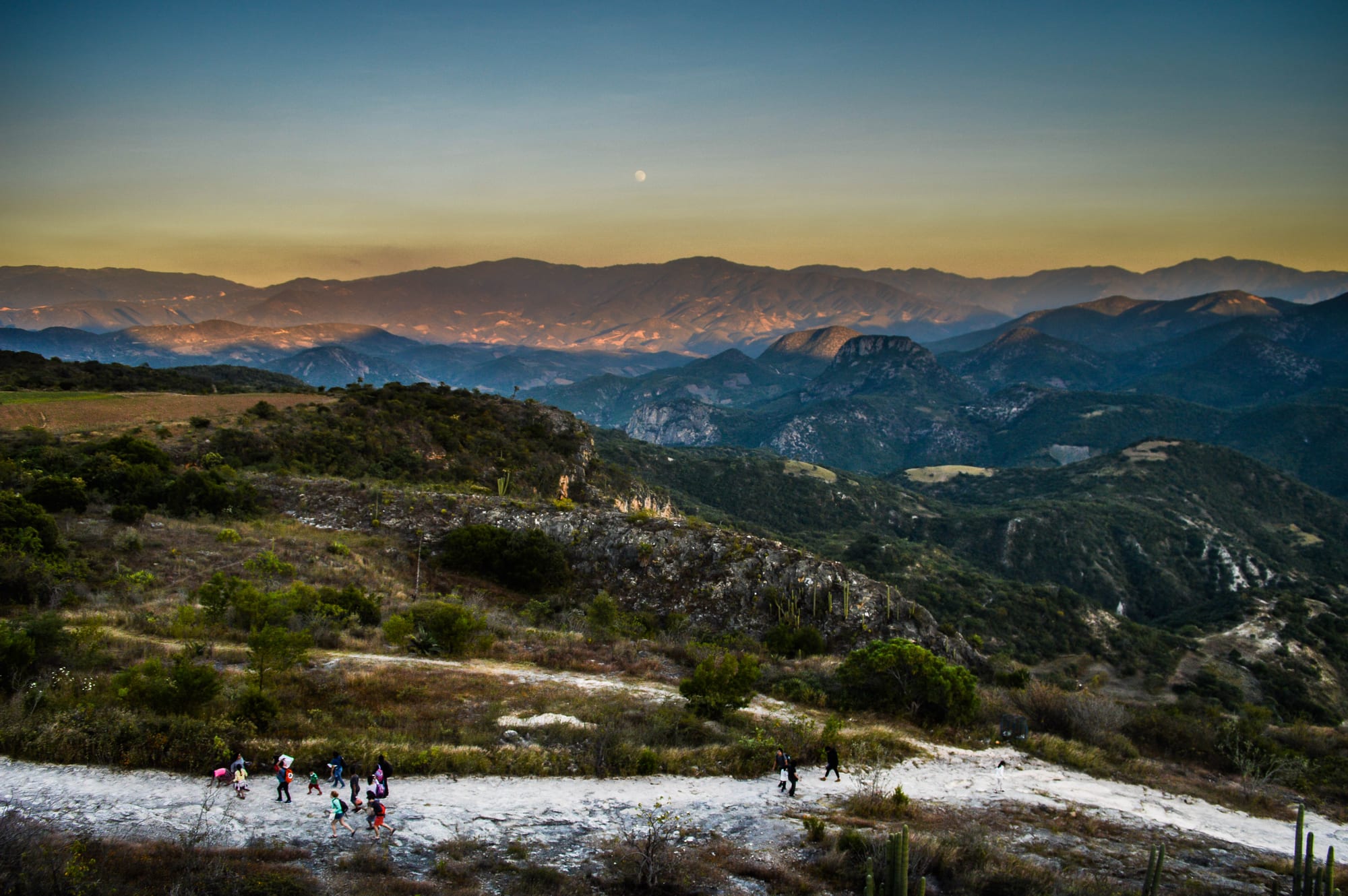
Layers of dry, scrub-covered mountains at dusk under a pale moon, with visitors walking a white rock path below

Mexico

Oaxaca & the Pacific South

The mountains east of the Valley of Oaxaca seen from Hierve el Agua at dusk. (Nataly Gómez Gómez / Wikimedia Commons · CC BY-SA 4.0)

Mexico's south-western states of Oaxaca and Guerrero, where the Sierra Madre del Sur drops to a long Pacific coast — the most Indigenous corner of the country, home of the Zapotec city of Monte Albán, colonial Oaxaca, mezcal and mole, and beach towns from Acapulco and Zihuatanejo to Puerto Escondido and Huatulco.

Explore Oaxaca & the Pacific South

History

The Valley of Oaxaca was home to one of Mesoamerica's earliest urban societies. Around 500 BC the Zapotecs levelled a mountaintop and built Monte Albán, which ruled the valley for over a thousand years before it declined around AD 700 to 800; power then passed to smaller centres such as Mitla and Yagul. In the mountains to the west, the Mixtecs built kingdoms remembered in their painted codices, and a Mixtec burial placed in Monte Albán's Tomb 7 yielded a celebrated hoard of gold. The Aztecs imposed tribute on much of the region in the 15th century.

The Spanish arrived in the 1520s, and Cortés took the title Marquis of the Valley of Oaxaca. Dominican friars built Oaxaca's great churches, and the region grew rich on cochineal, a red dye made from insects living on cactus. On the Pacific, Acapulco became the Spanish port for the Manila galleons, which carried Asian silk and porcelain across the Pacific for some 250 years.

Oaxaca produced two of Mexico's defining 19th-century figures: Benito Juárez, a Zapotec from the mountain village of Guelatao who became the country's reforming president, and Porfirio Díaz, who ruled for three decades. Guerrero was named after Vicente Guerrero, an independence leader from its hills. In the 20th century Acapulco became a jet-set resort, and in recent decades both states have been scenes of protest and conflict: the teachers' uprising in Oaxaca City in 2006, and the disappearance in Iguala in 2014 of 43 students from the Ayotzinapa teacher-training college, which remains unresolved.

Culture & Customs

Oaxaca is the most Indigenous state in Mexico, with more than a dozen peoples — among them Zapotecs, Mixtecs, Mazatecs, Mixes and Chatinos — and most of its municipalities govern themselves through community assemblies under customary law, known as usos y costumbres. Guerrero has its own Nahua, Mixtec, Tlapanec and Amuzgo communities, and the Costa Chica, running along the coast of both states, is home to many Afro-Mexican towns.

The Guelaguetza, held each July on Oaxaca City's Cerro del Fortín, brings dancers from the state's regions together; the pineapple dance of the Papaloapan women and the feathered dance of the plumes are the best known. Day of the Dead fills cemeteries with candles and marigolds, and on 23 December the Night of the Radishes displays scenes carved from outsized radishes in the main square. In the Isthmus of Tehuantepec, women wear the embroidered Tehuana dress made famous by Frida Kahlo, and Juchitán is known for its long-accepted muxe community, people assigned male at birth who live in a third gender role.

Crafts are tied to particular villages: the carved and painted wooden animals called alebrijes in San Martín Tilcajete and San Antonio Arrazola, black pottery in San Bartolo Coyotepec, wool rugs in Teotitlán del Valle, and lacquered boxes in Olinalá in Guerrero. Guerrero's calendar has its own Thursday ritual, when restaurants serve pozole.

Daily Life

Oaxaca and Guerrero together have about 7.5 million people. Oaxaca City and its suburbs hold around 700,000, Acapulco about 800,000, and the other towns — Chilpancingo, Guerrero's capital, Juchitán, Salina Cruz, Puerto Escondido, Zihuatanejo — are far smaller; much of the population lives in scattered mountain villages.

These are among Mexico's poorest states. Farming of maize, coffee and agave, fishing, tourism and crafts support most families, and migration to Mexico City and the United States is heavy, so remittances keep many villages going. Salina Cruz has an oil refinery, and a rebuilt railway across the Isthmus of Tehuantepec is meant to link it with the Gulf of Mexico as a trade corridor.

In the valley villages, life still follows market days — each town has its own, such as Sunday at Tlacolula — and the community's cargo system, in which families take turns to fund fiestas and hold unpaid posts. Oaxaca City's streets are often shut by protest camps or marches, particularly by the powerful teachers' union. On the coast, fishing starts at dawn and tourism shapes the rhythm, while Acapulco is still rebuilding after hurricanes Otis in 2023 and John in 2024.

Food

Oaxaca is called the land of seven moles: mole negro, dark with burnt chillies and chocolate; red mole; coloradito; yellow amarillo; green verde with herbs; chichilo, made with beef stock and blackened chillies; and the fruity manchamantel. Tlayudas are large, crisp tortillas spread with pork lard and beans, topped with quesillo, the region's stringy white cheese, and often cured meats; memelas are thick corn cakes with lard, beans and cheese. Chapulines, grasshoppers toasted with chilli, lime and salt, are sold by the bowl in the markets.

Chocolate is ground with sugar and cinnamon and drunk hot with water or milk, often with sweet egg bread, and tejate is a cold, frothy maize-and-cacao drink sold in the valley markets. Mezcal is distilled from roasted agave, above all the cultivated espadín but also wild varieties such as tobalá, in small palenques around Santiago Matatlán.

Guerrero's cooking centres on pozole, a hominy stew that here comes white, red or green, with pumpkin seeds in the green version. On the coast, pescado a la talla — a whole butterflied fish rubbed with chilli paste and grilled over wood — is associated with Barra Vieja near Acapulco, alongside ceviche. The Costa Chica drinks chilate, a cold drink of cacao and rice.

Attractions & Natural Wonders

Oaxaca City's historic centre and Monte Albán are together a UNESCO World Heritage Site. In the city, the church of Santo Domingo has a gilded interior and a former monastery holding the Tomb 7 gold and an ethnobotanical garden of Oaxacan plants; the Zócalo, the Benito Juárez and 20 de Noviembre markets and the galleries fill the streets around it. Monte Albán lies on its mountain above the city.

East along the valley, Santa María del Tule has an enormous old cypress tree, the Árbol del Tule; Teotitlán del Valle weaves rugs; Mitla's ruins are covered in stone fretwork; and the prehistoric caves of Yagul and Mitla are on the UNESCO list. This is also mezcal country: Santiago Matatlán and the villages around it are lined with palenques offering tastings. Beyond, Hierve el Agua's mineral springs have left petrified-looking cascades on a cliff edge. North of the city, the Sierra Norte's Pueblos Mancomunados run cabins and trails in pine forest.

On the Oaxacan coast, Puerto Escondido has the big surf of Zicatela and quieter beaches at Carrizalillo; Mazunte, with a turtle centre, and Zipolite lie to the east, and Huatulco's bays shelter coral and calm water within Huatulco National Park. The Lagunas de Chacahua, a lagoon park, lie to the west.

In Guerrero, Acapulco's bay, the La Quebrada divers and the Fort of San Diego recall its glamour years, while Zihuatanejo and the neighbouring resort of Ixtapa offer a quieter bay on the Pacific.

Cities in Oaxaca & the Pacific South

Planning basics

Budget

Oaxaca is one of the cheapest parts of Mexico to travel in: market meals, colectivo taxis and simple guesthouses cost little, and Oaxaca City has good-value boutique hotels. Prices rise at the Guelaguetza in July, at Day of the Dead and over Christmas and Easter, when rooms book out. On the coast, Mazunte and Puerto Escondido range from cheap cabañas to pricier design hotels, while Huatulco, Ixtapa and Acapulco's resort hotels charge more.

Daily Budget Midrange
USD 80–190 (boutique hotel or beach bungalow, restaurants, first-class buses, a mezcal or ruins tour)
Daily Budget Shoestring
USD 30–55 (hostel or cabaña, market food, colectivos and second-class buses)

Carry cash for villages, markets and small coastal towns, where cards and cash machines are scarce.

Safety

Safety differs sharply between the two states. Oaxaca City and the main coastal towns see mostly petty crime, though protests and road blockades are frequent. Guerrero has long been one of Mexico's most violent states, with rival organised-crime groups active across much of it, and several governments advise against travel there; Acapulco has high homicide rates and was badly damaged by Hurricane Otis in 2023. On the coast, strong currents at beaches such as Zicatela drown swimmers every year.

Travel by day on main roads, take local advice before swimming, and be cautious about Guerrero outside tightly organised trips. Check current official travel advice before travelling.

Climate

The Valley of Oaxaca sits at about 1,550 metres and is warm and dry most of the year, with rain from about June to September. The Pacific coast is hot and humid throughout, and the rainy season there brings the risk of hurricanes from roughly June to November. The Sierra Norte and the high Mixteca are much cooler, with cold nights in winter.

Summer
Oaxaca City 25–30°C with afternoon rain; the coast 30–34°C, humid, with storms
Winter
dry and sunny, 25–28°C by day in Oaxaca City with cool nights; the coast stays around 30°C

Transportation

Oaxaca City has an airport with flights from Mexico City and some other cities, and first-class buses take about six to seven hours from the capital. The coast is reached by flights to Puerto Escondido and Huatulco, or by winding mountain roads from Oaxaca City; a newer highway has cut the journey to Puerto Escondido. Acapulco is about five hours by the toll road from Mexico City, and Zihuatanejo has its own airport. Colectivo taxis link the villages of the Valley of Oaxaca.

Allow extra time on Oaxaca's roads, where protest blockades can halt traffic for hours.

Best Time to Visit

October to April is dry and the easiest time on both the coast and in the mountains, and late October to early November brings Oaxaca's Day of the Dead, one of the most elaborate in the country. The Guelaguetza fills Oaxaca City on the two Mondays after 16 July. Surfers come to Puerto Escondido in the summer swell season, when the big waves break at Zicatela.